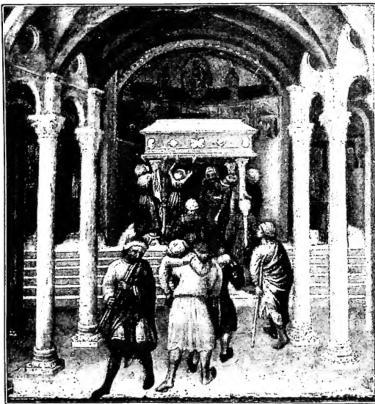
GENTILE da FABRIANO. - Gentile di Niccolò di Giovanni di Massio, painter, was born in Fabriano around 1370 and died in Rome in 1427. The following biographical details are known: in 1408, in Venice, he painted an anchor for Francesco Amadi, and was paid twice as much as the painter Niccolò di Pietro. In Venice he also executed a fresco, now lost, in the hall of the Maggior Consiglio in the Doge's Palace, depicting a naval battle between the Venetians and Otto III. On 17 April 1414, G. da F. was in Brescia, engaged in painting a chapel, destroyed, in the old Broletto. Documents (Municipal Archive of Fano) indicate the progress of the work until 18 September 1419. He was invited to Rome by Pope Martin V; he may, however, have returned to Fabriano (1420).
In any case, on 21 November 1422, G. was in Florence, enrolled in the matriculation rolls of the Guild of Physicians and Apothecaries. By May 1423, the Adoration of the Magi at the Uffizi was completed. Three works by G. date to 1425, also documenting a journey to Siena and one to Orvieto: the “Quaratesi polyptych” for the Church of S. Niccolò Oltrarno in Florence, the Madonna dei Notai in Siena (lost), and the fresco (Madonna and Child) in the cathedral of Orvieto. Having returned to Siena in October 1426, G. was certainly in Rome in January 1427. The cycle of frescoes he executed in S. Giovanni in Laterano, later continued (1431) by Pisanello, has been lost.
The tradition (later than Vasari) that traces the artistic origins of G. to the Marche trecento pictorial current of Nuzi and Ghissi now appears untenable. In reality, the panel by G. da F., once in the Museo Federico in Berlin (formerly in S. Niccolò in Fabriano), the first work known today by the artist (c. 1390–95), shows a precise reference to Lombard illumination and painting (memories, that is, of the Tacuinum sanitatis, by Giovannino de’ Grassi, and Michelino da Besozzo) and the influence of International Gothic (perhaps through the school of Cologne). In the “polyptych of Valle Romita” (Milan, Brera; 1400–1405), Sienese motifs (from Taddeo di Bartolo) are combined with the naive naturalism of Lombardy. Shortly afterward, the artist must have executed the Madonna col Bambino in the Pinacoteca of Perugia.
Of the Venetian period only the Madonna Kress survives, from Belluno (Washington, National Museum); damaged, but with an open rhythm, with the Child in a frontal pose relative to the movement of the Virgin; the center of the panel recalls those of Venetian origin. Instead, the Virgin in Adoration in the Museo Civico of Pisa, with its subtle Gothic, miniature-like quality, and the same literary suggestion (owing to the cultured environment of a court) of the Arabic characters on the edge of the cloth on which the Child lies, suggests a work from his Brescian sojourn. There he may have encountered Franco-Flemish illuminations, such as those of the Limbourg brothers, whose influence is evident in the Adoration of the Magi, executed in Florence for Palla Strozzi. Here, Gentile’s remarkable ability to revive, in a serene, narrative pictorial language, and to unify the most diverse and opposing impressions is evident. These are still Lombard, Sienese, and French impressions, and the first contacts with the Florentine environment. Affinities with Masolino and with Ghiberti, references to antiquity, and even a naive but effective chiaroscuro (scenes on the stole of St. Nicholas) are developed further in the “Quaratesi polyptych,” once in S. Niccolò Oltrarno, and in another polyptych for the same church (Uffizi, on deposit). The “Quaratesi polyptych,” now dismantled, consists of the “Madonna and Child with Angels” (London, National Gallery); the side panels with four saints (Florence, Uffizi); and the predella with scenes from the life of St. Nicholas (Vatican City, Pinacoteca; Washington, National Museum).
In the beautiful fresco in the cathedral of Orvieto, the influence of the delicate Sienese sense of color (echoes of Simone Martini) prevails, together with the monumentality derived from his experience of Florentine art. A broad, compact effect, achieved by reducing ornamental elements, is seen in the Madonna in the Chapter House of the cathedral of Velletri, the only work certainly from his Roman period (1426). The impression is of a painter who interprets Gothic art with classical measure: not unlike an Andrea Pisano or a Jacopo della Quercia. The attribution to G. of a frescoed Crucifixion in the refectory of the convent of S. Paolo fuori le Mura (Lavagnino) seems plausible; it stands midway between Masolino and the master from Fabriano. To him are justly attributed: the Coronation of the Virgin (Paris, Heugel Collection); the Madonna and Child with Angels, formerly Davis (New York, Metropolitan Museum); the Madonna formerly Goldman (Washington, National Museum); the fragmentary Madonna in the Berenson Collection (Settignano); the St. Francis formerly Fornari (Milan, Carminati collection); and other works.
The cosmopolitan character of Gentile da Fabriano’s painting reveals an individual foundation in his transposition of a love for naturalistic detail into the realm of poetry, in the enchantment of color and a fairy-tale narrative.
The same G. outlines the derivation of his thought in these terms: “Actualistic philosophy is historically connected with German philosophy from Kant to Hegel, directly and through the followers, expositors and critics whom the German thinkers of that period had in Italy during the last century. But it is also connected with Italian philosophy of the Renaissance (Telesio, Bruno, Campanella), with the great Neapolitan philosopher Giambattista Vico, and with the renewers of speculative thought in the age of the national Risorgimento: Galluppi, Rosmini and Gioberti” (Introd. alla filo. [Florence 1933], p. 20). Yet one must, more than appears from these lines, recognize the influence of Fichte and Spaventa and note that Italian philosophy, from the Renaissance to Gioberti, is connected with actualism only because G. gives an immanent (Kantian and idealistic) interpretation of thinkers who are indisputably Catholic, such as Campanella, Vico and Rosmini. Likewise, as more recent criticism has shown, the undeniable derivation from Spaventa must be understood as G.’s personal interpretation of some writings of the Neapolitan philosopher, and the rethinking of Hegel as the elimination of whatever realistic elements still remained in the German thinker’s system. This is clear precisely from G.’s first fundamental theoretical writings collected in the volume La riforma della dialettica hegeliana (Palermo 1913). Here G. calls his philosophy “actual idealism,” because “the Idea” is regarded as “act,” and because “the equation of Hegelian becoming with the act of thought is established as the sole concrete logical category” (ibid., preface). Hegel, instead, according to G., abstractly presupposes being and non-being to becoming, so that becoming can no longer be possessed or explained. Being is not to be presupposed to thought; being is a product of thought. Hegel lacked the exigency of “subjectivity,” and thus his logic, fixed in the position of Platonic Ideas, is an apparent movement of “thought Ideas” and not the real becoming of thinking thought” (ibid., p. 25). This is precisely the new standpoint gained by G.: the object of thought is the very act of thinking, thought that begins to think as other than itself” (ibid., p. 207). In short, the thought thought is the thinking thought that objectifies itself. The method of this philosophy is that of “immanence,” which “consists in the concept of the absolute concreteness of the real in the act of thought or in history; an act that transcends itself when it begins to posit something (God, nature, logical law, moral law, historical reality as a whole of facts, spiritual or psychic categories apart from the activity of consciousness) that is not itself as its own positing, or, as Kant said, the ‘I think’” (ibid., p. 208). Outside the act of thinking there is no concrete object: “the I has consciousness of the object insofar as it has consciousness of itself in the act of thinking it, that is, in positing it as self-consciousness.”
All of G.’s works develop, with a wealth of motifs, this concept of thought as act to which everything is immanent, applying it to all philosophical problems and every form of spiritual activity, from the Sommario

of pedagogy (2 vols., Bari 1912), to the Teoria generale dello spirito come atto puro (Pisa 1916), to the Discorsi di religione (Florence 1920), to the Sistema di logica come teoria del conoscere (2 vols., Bari 1920–23), which, together
2. - ENCYCLOPEDIA CATHOLICA. - VI.
with the Sistema di pedagogia, constitute the most complete exposition of his system.
The three absolute moments of the becoming of Spirit are: a) art, or the moment of pure and therefore abstract subjectivity: “... in its immediacy it eludes every effort the thought may make to reach it” (La filo. dell’arte, p. 119). To understand art, the moment of pure subjectivity in which it consists must be considered within the dialectical development of spirit, which is thought; it must enter “into spiritual actuality” (ibid., p. 125). b) Religion, or the moment of pure subjectivity as consciousness of the object, before which the subject annihilates itself. Truth is a product of thought in its formation, and to consent to God it reveals itself in the divine character of truth, immanent to thought: “the personality of God, of which it is impossible to doubt, is the personality of the Ego...” (Natura e dimostrazione dell’esistenza di Dio, in Introduzione alla filo., p. 220). Later, in the brief writing La religione (Florence 1943), G. professes himself “Christian” and “Catholic”: “Christian because the Christian religion is the religion of spirit, for which God is spirit; and ‘Catholic’ because ‘religion is Church’ with a Head, ‘let us call him even a pope.’” Yet the God of whom G. speaks here is still the absolute Ego or transcendental Spirit, and “Catholic” only in the sense that it is the generic gathering in a Church and because “everyone is Catholic in his own way.” c) Philosophy, or Thought in the full conquest and transparency of itself, in which the artistic and religious sentiments find their concreteness as dialectical moments of II. Philosophy is the concrete logos (which in itself resolves abstract logos) with which reality, which is history or the totality of the categories of the real in its logical or dialectical development, is identified. History and philosophy are identified and are the same dialectic in its “historicity” or the dialectical realization of humanity. Rather than verum et factum convertuntur, one must say verum et fieri convertuntur.
Yet it is precisely the “actuality of thinking thought” that remains, one might say, in the air in G.’s philosophy, and whose deepening is the keystone for criticizing the entire system from within. For thinking thought, always actual, is never actualized: neglecting the act and every act. In its pure transcendence, such actuality eludes itself, cannot be grasped, both because it is more than any of its acts and because, as pure subjectivity, it is abstract and is forced to mediate itself in the dialectical relation of subjectivity-objectivity. The act to which everything is immanent, as a perennial and unfigurable act, is self-transcendence. And since G. identifies the object or being with the very act of thinking, from which it is deduced, it follows that the pure actuality of the act is empty. From this transcendence, immanent to pure transcendentalism itself, it is impossible to pass to authentic transcendence, inasmuch as the transcendentalism of Gentile is Subjectivity: lacking in it is an objective element, that is, the idea as truth given to the mind. Therefore the absolute is the Subject itself, not truth. But in this way G. denies idealism itself, inasmuch as the idea is no longer the objective element, thought but not created by thought, but the very act, that is, the very subject. But in this way the thinking Subject is also denied, inasmuch as it is thought of its own subjectivity, that is, empty thinking. The denials of God as transcendent being, of the reality of subjects (actualism and solipsism), as well as of freedom and morality, are consequences of the non-idealistic (inasmuch as it denies the very idea) presupposition of reducing the idea to the subjectivity of the act of thought and the implicit (and unjustifiable) conception of philosophy as “development,” not as “discovery” of truth. This led G. to identify philosophy with history and with this the entire real in an immanentism that is positivism and no longer authentic idealism; and if it is not so to the very end, it is due to the fortunate contradiction that thinking thought transcends all thought thought and thus history. It is by deepening this point, to the point of overturning the premises and conclusions, that actualism can become fruitful for a rethinking of classical idealism (which is realism) and for the justification of those values (spirit, freedom, interiority, religion) for whose vindication G. spent his noble and vigorous intellect.
All G.’s works are on the Index (decree of 20 June 1934).