
ORVIETO, DIOCESI di. - Diocese and city in the province of Terni.
It has an area of 350 sq. km., with a population of 58,000 inhabitants, all Catholics, divided into 57 parishes with 55 diocesan priests and 15 regulars, 1 seminary, 6 male and 20 female religious communities
I. HISTORY
It was likely the center of the Etruscan federation, as attested by the large number of temples and tombs. The first preaching is attributed to s. Ansano (late 3rd cent.); however, tradition narrates that the episcopal see of Bolsena was transferred to O. due to the invasion of Alaric. In any case, the first known bishop dates from 590. Near O. an incomplete 6th or 7th-century inscription was found, beginning with: in nomine Dni nostri Iesu C(hristi), and according to G. B. De Rossi it recalls a bishop who lived 40 years "ante episcopatum" and 11 as bishop (Bull. di arch. crist., 6 [1881], p. 117; CIL, XI, 2899). In 538 Belisarius conquered the city, which Procopius describes and calls, in the Greek manner, "Ourbibentos". Paul the Deacon places the arrival of the Lombards in 605, though it is perhaps earlier (late 6th cent.). Mention is also made of a Lombard count Farolfo (8th cent.) whose nephews were devoted to s. Romualdo, their guest. But non-Lombard feudal lords also dominated the territory: Hugh of Tuscany (993) and Gerardo (1004). The first recognition of merchant libertates perhaps dates to the year 975, through the intervention of the bishop. With the donation of Tuscia to the Holy See (12th cent.) the popes necessarily held a certain predominance in O. What is certain is that in 1137 previous communal activities are mentioned. Dating from 1157 is a treaty that would set a precedent: O. swears ligium dominium to the Pope, and the latter purchases the beneficium of being hosted and defended personally, or in his successors, or in the persons of the Curia. O. demonstrated its fidelity to this treaty by successfully withstanding the siege of Henry VI (1189), who wished to punish the inhabitants of Orvieto for having subscribed, in the person of Pepo Farnese, to the peace of Venice (1177). From then on, throughout the 13th cent., the State of O. subdued the Guinicesco (1168) and Ildibrandesco (1203) territories and extended as far as the sea (Orbetello, Little O., I. del Giglio), bordering on Siena, Perugia, Todi, and the Patrimony of St. Peter. But it was precisely this latter proximity that created territorial disputes, which favored heretical movements; Patarenes made their appearance in the second half of the 12th cent. Innocent III, at the request of the Orvietans, sent Pietro Parenti as rector, but he was killed (1199). From then on, legal persecutions against heretics began. In 1249 the Inquisition was functioning, Dominican and later (1260) Franciscan, also in connection with anti-Ghibelline politics.The preaching of s. Francis is probable only for the outlying territory (1216); but Franciscanism immediately took root and in 1260, concurrently with Perugia, the Laudesi appeared, in whose mystical tradition the b. Angiolina of the counts Montemarte is to be placed. The Dominicans erected their first church to their founder there (1233),
held a chair of theology including with s. Thomas (ca. 1261-64), directed a school and a Third Order to which the humble b. Vanna was enrolled. They were joined later (1259-60) by the Servites and the Hermits, among the latter of whom the great theologian and prelate Ugolino d'O. (d. 1371) distinguished himself.
Meanwhile the city was expanding (perhaps a return) with large suburbs on the plain, and enclosed a population of ca. 30,000 people, among them famous families: the Medici, Monaldeschi, Filippeschi, Ranieri, dedicated to various activities and commerce even overseas (treaties with Genoa; Dominican missionaries in Samarkand, 13th-14th cent.). Special relations with European countries were also due to the stays of the Curia with the relative arrivals of ambassadors and sovereigns (England, France, Germany, etc.). On the other hand, the anti-French movement (1282) which anticipated the Vespers was important.
Constitutional development was rapid. In the second half of the 12th cent. the rector or podestà was added to the consuls; in 1250, concurrently with Florence, came the coup d'état of the captain of the people; from '56 began the conquest — favored by the popes — of power by the Arti, which was complete by '92. Dating from the same year 1292 is the land registry (catasto), the first or second in Europe. Boniface VIII favored O., where statues of him were erected, and he accepted the office of captain of the people (1297-98) and of podestà (1299).
With the early 14th cent., the ousting of O. from the dominion of the Tyrrhenian coastline and hinterland caused severe hardships and internal struggles. Economic demobilization worsened towards the middle of the century, nor was equilibrium regained through various attempts at lordships (signorie, 1334-53). The arrival of Albornoz, who had the Orvietan Count of Montemarte at the head of his troops, initiated (1354) the third political phase with the personal lordship of the pope, while O. remained excluded from the Patrimony of St. Peter (1368). In the general confusion of the Schism there was no shortage of nostalgic and ephemeral returns to an almost communal regime (peace of Benano, 1389), nor of sudden and brief attempts at local lordships backed by major foreign interests (Naples, Rome, Perugia, antipope, etc.); until in 1448 O. surrendered to Nicholas V almost in the form of 1368. Internal peace, blessed by the guest Pius II (1460), was followed by constitutional reorganization (1461) dividing power among nobles, middle classes (mediani), and people, with the Pope's help against feudal abuses in the countryside. In this state, pacified and impoverished, O. resisted Charles VIII twice (1494-95), instead hosting Alexander VI, whose government exercised through Cesare Borgia was excellent. But more famous is the hospitality given to Clement VII (1527-28), who had escaped the sack of Rome; and to this period likely belong certain honorary privileges of the bishop of O., which were followed by notable distinctions for the Cathedral Chapter.
In these centuries relations with the Curia were transformed, thanks to the very many Orvietan cardinals, prelates, jurists, and artists who made their mark in Rome. Of some importance is also the Orvietan colony in Paris (17th cent.) with a group of painters and musicians and with the famous "marchands d'Orvietan" certified by the kings of France themselves. At the court of Savoy, Ascanio Vitozzi established himself at that time as a military and civil architect.
The effects of the Catholic Reformation were not long in coming. In 1566 the Seminary was established; in 1588 the Doctrinaires and in 1621 the Jesuits opened schools and colleges. In 1794 the Carissimi arrived, who alone resisted the Napoleonic storm. In 1564 the government was more equitably divided between nobles and commoners, and was reconfirmed in this state in 1755, so that the Jacobin invasion could claim nothing to teach. Indeed, it caused the people to rise (1798). The final episode of the Church-State struggle in O. was Napoleon's persecution of Bishop Lambruschini (1809), repeated in a sense with the imprisonment of Bishop Vespignani during the Roman Republic (1849).
In '60 O., upon becoming part of Umbria, became the delicate point of the September Convention, won by the Orvietan F. A. Gualterio over Napoleon III.
II. MAIN MONUMENTS
Duomo. On the site of the ancient Cathedral, already in ruins by the end of the 12th century, and on the area of the capitular church of S. Costanzo, the new Duomo was erected with the previous dedication (S. Maria Assunta) upon the initiative of Bishop Francesco, with Nicholas IV blessing the first stone (1290). From 1321 the Opera del Duomo, established before 1285, assumed the legal character of a quasi-public body, which over the centuries grew rich and was then plundered (1876) by the subversive laws. The construction of the building took place in five phases. At first, S. Maria Maggiore in Rome was imitated by erecting an oratory for Eucharistic worship, making bas-reliefs and two portals (c. 1275-1280) which were later reused. Then came the construction (1290) of a grandiose Romanesque cathedral with three naves. In the third period (c. 1300-39) the building was transformed into a Gothic style with a cross-vaulted transept, a square apse, and a most original facade. Here the name of L. Maitani dominated, followed by A. and N. Pisano and the Orcagna, to omit the others. The pictorial decoration (apse, Chapel of the Corporale) was entrusted to Ugolino d'Ilario and his local school (mid-14th cent.). The fourth period - completion and decoration - began with the Chapel of the Corporale (mid-14th cent.), continued with the crypt (late 14th cent.), with the Cappella Nuova frescoed by Fra Angelico, Benozzo Gozzoli, and Signorelli, with the completion of the facade and with the interior decoration (demolished in the 19th cent.) (16th cent.). In this fifth phase, I. Scalza excelled as a sculptor and architect superior to his fame, among the Sammicelli, S. Mosca, B. da Montelupo, and other destroyers. Noteworthy in the Duomo are the celebrations: of the B. V. Assunta (Aug. 14 evening) connected with the "Maestà della Tavola" (Madonna and Child, late 12th cent.), and with a later processional float (16th cent.) bearing traces of the prior cult of the Lateran acheiropoietos; of Pentecost, with a liturgical drama transformed in the 14th-15th-19th centuries ("festa della Palombella"); of the Most Holy Corporale, in the special chapel and in the public procession of "Corpus Domini" ("festa del S.mo Corporale") in connection with the miracle of Bolsena. During the stay (1262-64) of Urban IV in O., from whence he issued the bull Transiturus (1264) to extend the Liège celebration of "Corpus Domini" (v.) to the entire Church, it happened that in the hands of a priest making a pilgrimage to Bolsena, the consecrated Host oozed blood with figures upon the Corporale. An inquiry was immediately launched by the Pope and Bishop Giacomo. The Eucharistic relics with the documents indicating the miracle remained in O. The cult, also mentioned in a document of 1298, took place in a first oratory (late 13th cent.) where from 1338 to c. 1360 stood the admirable Reliquary of Ugolino di Vieri (1338); then, in the current chapel. A sacred representation of the miracle began around 1325, and was later expanded (1338?) by the Dominicans. The Eucharistic procession, desired by the State since 1337, is the first of its kind.S. Andrea. On the site of an Etruscan metallurgical center (furnace, washing floor, etc.) and a temple restored in the Roman era, rose (6th cent.) the second collegiate church of Orvieto, restored various times (10th-11th, 12th cent.), enriched with a dodecagonal tower (11th-12th cent.; rebuilt 20th cent.); enlarged and restored (14th-16th cent.) as it now appears. Here Honorius III crowned Peter of Aragon, king of Jerusalem (1217), and Martin IV was crowned there (1281). Certainly the church had multiple state functions over the centuries, being connected with the cult of Christ the King (10th-18th cent.) venerated in an aedicule on the facade (demolished 1928) before which the oaths of allegiance of the subject lands were repeated (12th-17th cent.) for the "feriae Augusti" (Aug. 14 evening). The procession, now Marian, continues. S. Giovenale (1004?). It is
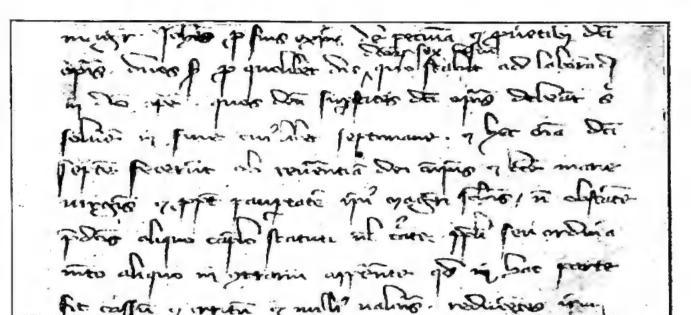
ORVIETO, DIOCESI di - The oldest act (April 24, 1298) concerning the veneration of the Orvietans for the Corporale: cf. Lazzarini, cited in bibl. - Orvieto, Municipal Historical Archive.
popularly called "the old duomo" although all documentation regarding this is lacking. It is a veritable repertory of late-medieval sacred painting (12th-15th cent.). S. Lorenzo "de Arari" (12th cent.?). So called because the altar is an Etruscan base. Well-done restorations (20th cent.) have removed 18th-century decorations. S. Domenico (1233). It is the first church dedicated to the Saint. Partially demolished (14th cent.) for structural reasons, in 1933 it was reduced to the transept alone. Notable things: the De Brave tomb by Arnolfo di Cambio (1282); the wooden Crucifix (13th cent.) that supposedly praised St. Thomas Aquinas for the Office of "Corpus Domini"; the chair, cap, and psalter of Aquinas. The doorway (14th cent.) was transported here (1933) from the ruined rural church of S. Spirito degli Armeni, as attested by the inscription in Armenian characters. S. Francesco (1240). Erected in grandiose Gothic forms with a drum-dome, for the Friars Minor previously residing in the destroyed hermitage of S. Pietro in Vetere, around 1260 a fraternity of laudesi arose there which later (1325) became a fraternity of disciplined actors, who competed with many similar sodalities. In 1272 Gregory X celebrated the funeral of Henry of England here; in 1297 Boniface VIII canonized St. Louis, king of France. Hospital of S. Maria della Stella (1179), the last remaining of the many that once existed; dismantled by the subversive laws (19th cent.). Palace of the Popes or "Soliano" (from the papal Solium). Enlarged by Urban IV (1262-64), under Boniface VIII (1297), as reparation, the State of O. began the great hall of the consistory and the external staircase there. It was meant to be the official residence of the popes who stayed in the bishop's palace, which was also a papal construction. Disused due to the Avignon exile, by 1330 it passed into the use of the Opera del Duomo, and only in 1493 under Alexander VI did it fulfill its function; but even during the stays of Paul III the city had not yet finished the work undertaken in the 13th century. Between the end of the 16th century and the beginning of the following one, it came to be considered, without reason, city property and thus belonging to the Opera del Duomo. Restored in the 19th century with arbitrary additions, the Museum of the Opera del Duomo was housed there. Episcopal palace: in its current form it retains traces of the 9th-10th centuries, although the construction dates from the 13th century and is due to the presence of almost all the popes of that time, who gave both money and the title of Apostolic to the Fabbrica, because it was to extend as far as the Soliano Palace proper. The governor took up quarters there in the name of Nicholas V. In 1503 the building was divided between the government and the bishop, though reunited on the occasion of papal stays (Alexander VI, Clement VII, Paul III up to Gregory XVI). Municipal Palace. It has the characteristic of being joined with the church of S. Andrea. It arose (13th cent.) on the site of a curtis. Restored and enlarged (13th cent.), it became the seat of the consuls, then the lodging of the podestà. It was completed by L. Maitani and decorated (14th cent.) with frescoes that have practically disappeared. With restorations designed by Sangallo (1532), the building acquired a totally new facade by I. Scalza (1573-81), who had conceived of doubling the length of the facade. On the ground floor, the first or second Monte di Pietà was opened (15th cent.). The Archive is extremely rich
(photo Raffaelli Armani and Moretti)