Machine translation of the 1948–1954 Italian original. The original text is authoritative.
MONTI DI PIETÀ. – Institutions whose purpose is to lend sums of money against pledges, with minimal payment for expenses, thus combating usury and coming to the aid of the less affluent classes of the population. In the economic ideals of the Middle Ages, the theory prevailed that money lent out was unproductive: every interest charge was consequently considered usury, and those who engaged in such activity were regarded as usurers: the Jews, and abroad the Italians, designated by the name Lombards.
The m. di p. originated in Italy as early as the fourteenth century. There had previously been some attempts to establish credit institutions, which differed in purpose from the m. di p. because charitable activity lay outside their scope. Thus, in 1196, an initial attempt was made at Freising in Bavaria, followed in 1350 by a kind of mutual-aid fund organized by the burghers of Salins (Franche-Comté); in 1361 Michele di Northburg, bishop of London, left a sum to the Cathedral Chapter so that it might be distributed in loans against pledges and without interest for a period of one year. The first to consider establishing genuine m. di p. were the Franciscans, with the one in Florence in 1358, founded through the efforts of Francesco da Empoli; owing, however, to a lack of organizational experience, it soon ended in failure. In 1454 a credit institution was established at Ancona through the efforts of Marco da Montegallo, to assist the city with loans, but in this case there was no true m. di p., although it has been regarded as such. Most m. di p. were founded in the second half of the fifteenth century. Fra' Domenico founded one at Ascoli in 1458; Michele da Carcano another at Perugia in 1462, approved by Pius II in 1463, and the necessary capital was collected through alms by fra' Barnaba da Terni. The initiative spread rapidly, and m. di p. were founded at Orvieto (1464), Aquila (1466), S. Giacomo della Marca and Fabriano (1470), and Fano (1471). In the same year Sixtus IV sanctioned the statutes of the one at Viterbo, and in 1479 those of the one at Savona. In 1484 Innocent VIII permitted its establishment at Mantua. New foundations received a Bernardino da Feltre (v.), who established them at Parma, Rimini, Cesena, Chieti, Narni, Rieti, Lucca,
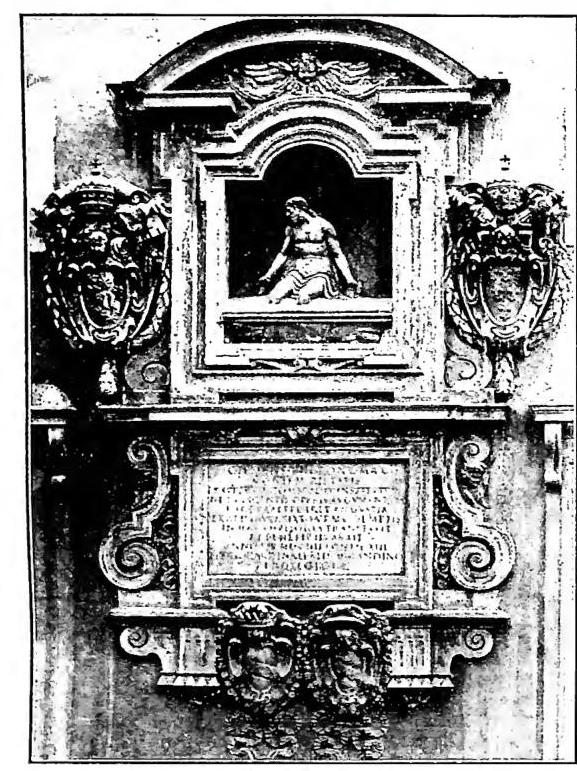
MONTI DI PIETÀ – Shrine commemorating the enlargement of the M. di p. by Clement VIII (1604) – Rome. Siena, Padua (in connection with b. Angelo Carletti da Chivasso), Pavia, Milan.An examination of the statutes shows that, in general, the m. di p. were organized according to a single model. The personnel employed had a technical character; the most important functions belonged to the conservator, the depositary, and the notary. The first (also called the massaro and montista) was responsible for accepting the pledges, safeguarding them, and returning them to their owners when the latter had fulfilled their obligations. The second (also called the treasurer or cashier) dealt exclusively with cash operations, while the third was entrusted with the administrative side, that is, the drafting and custody of the records. Other minor employees included the person responsible for appraising the pledged objects, the person who put them up for sale when they were not redeemed at maturity, the auctioneer, and the subordinate staff. Administration was entrusted to religious and laymen: the former by right, the latter chosen by lot from among members of certain categories. To cover operating expenses, a small contribution was charged, which some theologians condemned as interest, alleging the unlawfulness of the loan. In 1496 the Augustinian N. Boriani published a pamphlet De monte impietatis (Cremona 1496), in which he judged such activity scandalous and condemned II. The Dominicans joined him, while the Franciscans engaged in controversy against them. The question of the gratuitousness of loans was also debated in a general Chapter of the Observants, held in Florence at the end of the 15th century, and the thesis of gratuitousness was defended by Michele da Segni, who intended thereby to put an end to the attacks of his opponents. Bernardino da Feltre opposed him, asserting the necessity of charging a minimum amount as compensation for expenses, since it was necessary to remunerate those who provided their services in the m. di p., and it would not have been possible to do so except by means of the contribution of those who benefited from them. This latter thesis prevailed, and it was also supported by the Order’s vicar general, Evangelista da Perugia. The first official recognition of the lawfulness of this practice came only at the Fourth Lateran Council (1515). Thus the m. di p. were recognized, and it was established that a small charge was lawful, provided that it did not exceed what was strictly necessary to cover expenses. Only the popes Julius III and Pius IV included among management expenses a share of interest to be paid to those who had supplied the institution with the necessary capital.
In the 16th century the m. di p. of Rome and Naples were established. The former in 1539 by the Friar Minor Giovanni Calvo; the latter in 1540, to assist the needs of the population following the expulsion of Jewish lenders from the Kingdom, through the efforts of certain philanthropists (Aurelio Paparo and Leonardo di Palma) and, it seems, also on the advice of s. Gaetano da Thiene.
The foundation of the m. di p. was an extremely important innovation from the social point of view, since credit came to be granted on favorable terms precisely to the humblest classes of the population, who had the greatest need of II. It benefited those who, in the event of possible sudden necessities, had no reserves on which to draw and would have been forced to turn to Jewish and Christian usurers, facing the payment of high interest.
In the other countries of Europe, the m. di p. appeared later. In 1572 and 1607, they were established in Bruges and Lille. Later (1643), that of Paris was founded; it experienced considerable growth, so much so as to justify its expansion about a century later (1777). Still later was the establishment of the m. di p. of Madrid, which began its activity in the 18th century. None were established either in Germany or in England. In these two countries, institutions of credit for small merchants and industrialists were created above all, while lending on pledge remained in private hands. It is noteworthy that in many cases the m. di p. expanded their activities until they became genuine credit institutions.
BIBL.: G. B. Gifuni, Compendio istor. della orig. e fondaz. del S. M. della P. in Napoli, Naples 1801; L. Masetti, I primitivi capitoli del m. di p. di Fano, in Arch. stor. marchigiano, 1 (1879), pp. 663-702; V. Aleandri, Gli Ebrei e loro banche di usura ed i m. di p. in Sanseverino Marche, Sanseverino 1891; A. Bertolini, Nota sull'orig. dei m. di p., in Giorni, degli economisti, III, Suppl. 1891, pp. 527-30; N. Mengozzi, Il Monte dei Paschi di Siena e le aziende in esso riunite, I, Siena 1891; O. Scalvanti, Il «Mona Pietatis» di Perugia, con qualche notizia sul Monte di Gubbio, Perugia 1892; A. Balletti, Il S. M. della p. di Reggio Emilia, Reggio 1894; L. Zdekauer, L'interno di un banco di pegno nel 1417 con documenti inediti, in Arch. stor. ital., 2ª serie, 17 (1896), pp. 63-105; D. Tamilis, Il S. M. di p. di Roma, Rome 1900; L. Degani, I m. di p., Turin 1922; M. Tosi, Il S. Monte di p. di Roma e le sue amministrazioni, Rome 1937; A. Messini, Le origini dei m. di p. di Foligno (1462-88), Foligno 1940; M. Bolzonella, Pietro Barozzi, vescovo di Padova (1487-1507), Padua 1941; A. Parsons, The economic significance of the Montes Pietatis, in Franciscan Studies, 2ª serie, 1 (1941, II), pp. 3-28; D. Zampese, Il M. di p. di Verona, Udine 1941; G. Fabiani, Gli Ebrei e il M. di p. in Ascoli, Ascoli Piceno 1942; G. Barbieri, Saggi di storia economica italiana, Naples 1948; F. Nicolini, I banchi pubblici napoletani e i loro archivi, in Boll. dell'Arch. stor. del Banco di Napoli, 1 (1950), pp. 1-36. Giuseppe Coniglio
Cite this article
“MONTI DI PIETÀ.” Enciclopedia Cattolica, vol. VIII (1952), p. 825. Azione Romana digital edition, https://azioneromana.com/article/monti-di-pieta.