
BERNARDINO da FELTRE, blessed. — Friar Minor, in the world Martino Tomitani, preacher, born at Feltre in 1439, died at Pavia on 28 September 1494. His mother was a cousin of the celebrated Vittorino. He was a pupil of Guarino Veronese or of one of his disciples; he was attending courses in literature, logic, and law at the University of Padua when, in 1456, attracted by the eloquence of St. Giacomo della Marca, he entered the Order of Friars Minor. A priest from 1463 and a lector, he began his religious and social apostolate at Mantua in 1469.
Like his namesake and patron of Siena, he continually traversed, on foot, the regions of northern and central Italy as far as L’Aquila, everywhere ardently desired, and, like him, dared to address matters of current concern, even when thorny or dangerous. Indeed, the implacable struggle he began at Trent in 1476 against usurers, especially Jewish ones, and his firmness in denouncing injustices and abuses, even on the part of rulers, earned him the indignation of some of them, and even attempts on his life by private individuals who considered their interests or licentiousness threatened. A typical example is the banishment imposed on him by Florence one night during Lent in 1488.
He carried out delicate papal assignments and exerted great influence in promoting peace between factions in many cities, even at the cost of exposing himself unarmed among torch-
He promoted associations for worship and charity, especially on behalf of the ashamed poor; but the work most closely associated with his name is Monti di pietà (v.), the first being that of Mantua, founded by him in 1484, with the characteristic of charging interest on loans, advocated by a few of his confrères, while overcoming the tenacious opposition of other religious, who did not wish to admit the lawfulness of such a loan, although it was necessary for the prosperity of the Monti. The recent discovery of two collections of B.’s sermons has finally made it possible to know his original thinking on the matter, whereas previously it had to be sought in the Defensorium of Bernardino de’ Bustis, inspired by the man of Feltre. From the pulpit he also thundered against feminine vanity and luxury, considering them an offense against the wretched. Among the subjects he particularly favored, one should also note: devotion to the Eucharist, the defense of the Immaculate Conception of Mary, then publicly challenged, and advocacy of the Third Order of St. Francis.
It is not easy to form an exact literary judgment of his eloquence, because both the Quaresimale of Pavia of 1493 and the Avvento of Brescia of the same year bear too strongly the imprint of the compiler’s pen, Fra Bernardino Bulgarino, who partly preserved the Italian form and partly translated into poor Latin, interspersing it with Venetian expressions. Nevertheless, these sermons, together with the few previously known, convey the vivacity of the tone described by the early biographers, the anecdotal facility, and do not conceal the preacher’s sound culture, preparation, and seriousness.
Venerated as blessed by the Friars Minor, his cult was confirmed in 1654. Feast day: 28 September.
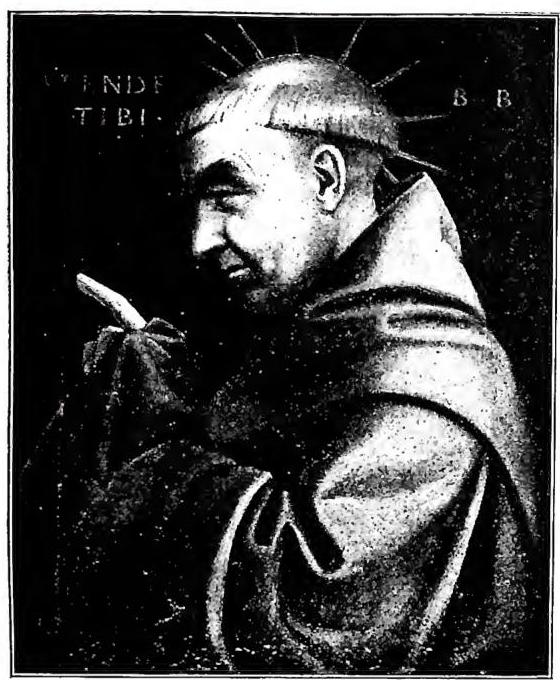
Iconography. — The canonization proceedings contain information about abundant iconographic material dating from before the 17th century, collected especially in Feltre and Pavia. Notable in the former city are: the portrait executed by Luzi (the “Dead Man of Feltre”) for the church of S. Maria degli Angeli, and the paintings in the churches of S. Lorenzo and the Spirito Santo; in the latter: the Sacred Conversations in S. Chiara (dated approximately to 1493), in S. Maria delle Virtù, in S. Francesco, in the church and the Chancellery of the Hospital; an ancient bust in the building of the Monte di Pietà at Porta Marica, as well as a Sacred Conversation in the monastery of S. Agata, by Rosso, a contemporary of B., and, by the same artist, a fresco based on the death mask, on the door of the blessed’s chapel in S. Giacomo. He is also depicted in Verona in the Sala del Morone near s. Bernardino and in an altarpiece by Cavazzola in the Castelvecchio museum.
Signs and attributes: short face with somewhat protruding eyes; emblem of the pietà or of the Monti; sometimes scrolls bearing one of the mottos: «Attende tibi - Habe illius curam - Nolite diligere mundum».