
Bernardino of Siena, St. — Franciscan friar, distinguished for learning and holiness, for his original and highly effective preaching, for the propagation of the cult of the name of Jesus, and for imparting a new spirit of reform to the Franciscan Order in the 15th century.
I. LIFE
Born into the noble Sienese family of the Albizzeschi, B. was born at Massa Marittima, in the territory of Siena, on 8 Sept. 1380. Having been orphaned at the age of six, he was brought up by his closest relatives in Siena, where he completed his studies in rhetoric, philosophy and jurisprudence. Initially captivated by the love of classical Latin authors, he later devoted himself with great fervor to the study of Sacred Scripture and theology, and to more intense practices of piety. At the age of 22 he entered the Friars Minor. After receiving Holy Orders, he was licensed to preach in 1405, a ministry he continued until his death. Little is known of the first fifteen years of his religious life; it is certain, however, that he spent them chiefly in perfecting his theological learning, preparing abundant material which is found in various miscellaneous codices recently discovered and transcribed or commissioned by him during those years (cf. D. Pacetti, I codici autografi di s. Bernardino, in Archivum Franciscanum Historicum, 29 [1936], pp. 231-241, 523-30). His preaching during this period was confined mainly to Tuscany and did not arouse great enthusiasm. From 1417 onwards B. was able to extend it to northern and central Italy with immense fruit, everywhere awakening dormant religious sentiment in consciences, recalling people to the practice of the sacraments, allaying hatreds, reconciling factions, suggesting social reforms, and inspiring works of charity and self-denial.Noteworthy are (some of which have come down to us) the Lenten sermons preached at Genoa (1418), Milan (1419), Padua (1423 and 1443), Florence (1424 and 1425), Viterbo (1426), Gubbio (1427), Arezzo (1428), Venice (1429), Siena (1434), Massa Marittima (1444); and likewise well known are the series of sermons delivered at Genoa (Advent 1417), Treviglio (11-25 Nov. 1419), Bergamo (June 1422), Verona (1 Nov. 1422-17 Jan. 1423), Vicenza (May-July 1423), Treviso (20 July-Aug. 1423), Belluno (25 Sept.-Oct. 1423), Modena (Nov. 1423), Bologna (Jan. 1424), Prato (May-June 1424), Lucca (Sept.-Oct. 1424), Siena (20 Apr.-10 June 1425), Assisi and Perugia (Aug.-Nov. 1425), Todi (Jan.-Feb. 1426), Rome (Apr.-May 1426), Montefalco and Spoleto (June-July 1426), Amelia (Dec. 1426), Orvieto (12 Jan.-16 Feb. 1427), Urbino (June 1427), Siena (15 Aug.-6 Oct. 1427), Forlì (29 May-2 July 1431), Matelica (Sept. 1433), L'Aquila (Aug. 1438), Milan (Dec.-Feb. 1442-43).
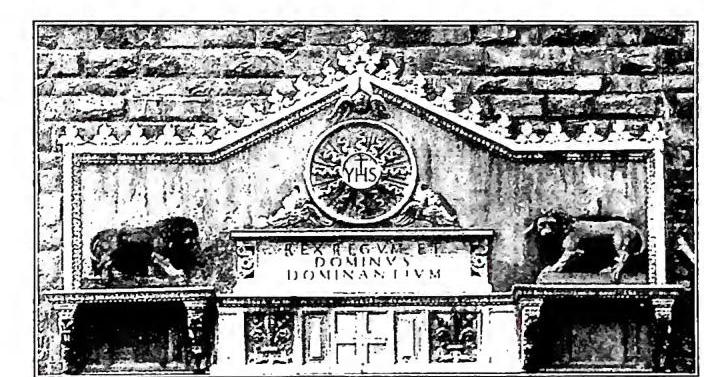
The marvellous success enjoyed by B. everywhere was due, besides his exceptional eloquence and the topicality of his preaching, to the holiness of his life. He was a great promoter of devotion to the Holy Name of Jesus, which he had painted or carved on tablets with the monogram YHS, and he urged the multitudes to venerate II. Because of this innovation he was accused by rivals of superstitious and heretical worship and twice brought before the Roman authorities (1426 and 1431), but was declared innocent; indeed, Eugenius IV, unaware that a second trial had already begun against him, issued on 8 Jan. 1432 a bull containing the amplest praise of B.’s doctrine and morals (cf. E. Longpré, S. Bernardin de Sienne et le Nom de Jésus, in Archivum Franciscanum Historicum, 28 [1935], pp. 443-76; 29 [1936], pp. 142-68; 30 [1937], pp. 443-77; 31 [1938], pp. 170-92). Within his Order he was the chief promoter of the Observant reform, for which he founded many convents and of which in 1438 he was elected vicar general (cf. Ilarino da Milano, S. B. da S. e l'Osservanza Minoritica, in S. Bernardino da Siena. Saggi e ricerche pubblicati nel V centenario della morte [Pubblicazioni dell'Università Cattolica del S. Cuore, nuova serie, 6], Milano 1945, pp. 379-406; D. Pacetti, S. B. da S. Vicario Generale dell'Osservanza con documenti inediti, in Studi Francescani, 17 [1945], pp. 7-69). He died at L’Aquila on 20 May 1444. He was canonized by Nicholas V on Pentecost 1450.
II. OPERE
Gli scritti più importanti lasciati da B. sono tutti di prediche e in lingua latina, ad eccezione del Quaresimale fiorentino del 1425 (cf. D. Pacetti e B. Bughetti, Intorno agli schemi in volgare di s. B. da S. per la Quaresima Fiorentina del 1425, estratto da Arch. Franc. Hist., Quaracchi 1941, pp. 1-108), di poche lettere e di alcuni trattati in volgare a lui aggiudicati (cf. s. B. da S., Le Operette volgari, integralmente edite da D. Pacetti, Firenze 1938). Oltre agli scritti suoi sono fino a noi pervenute anche molte prediche, raccolte da uditori dalla viva voce del Santo. Si ha così una doppia serie: Opere scritte da B. stesso e Prediche riportate da uditori. Questi, con più o meno fedeltà e quasi sempre in compendio, stenografavano su tavolette cerate o su carta le parole del predicatore, ora riportandole nell'idioma volgare nel quale sempre da B. erano pronunciate, e ora in lingua latina; cosicché ci sono giunte prediche riportate latine e riportate volgari. Di esse, alcune sono edite, altre inedite. Talvolta è accaduto, ad es., a Padova nel 1423 (cf. D. Pacetti, Una redazione inedita del «Seraphim» predicato da s. B. a Padova nella Quaresima 1423, in Bull. di Studi Bernardiniani, 4 [1938], p. 35 sgg.) che contemporaneamente più riportatori o tachigrafi hanno raccolto un medesimo corso di prediche del Santo, pervenendo così redazioni ben diverse delle stesse. Benché(fot. Alinari)
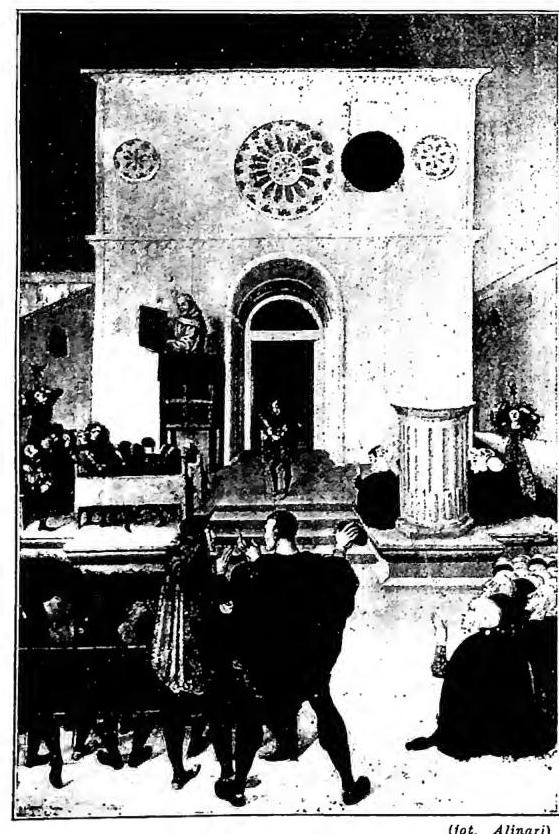
BERNARDINO da SIENA, santo - Predica di s. B. da Siena. Pittura attribuita a Sebastiano di Cola del Casentino (sec. XV). Aquila, museo aquilano.
1. - Opere latine certe: a) Edite: Quadragesimale De christiana Religione (finito e edito dal Santo tra il 1430 e il 1436), I, pp. 1-319. - Quadragesimale De Evangelio aeterno, sive de caritate (1430-37), II, pp. 1-430. - Tractatus De vita christiana (anteriore al 1430), III, pp. 1-18. - Tractatus De B. Virgine (1430-40), IV, pp. 71-116, 119-30. - Tractatus De beatitudinibus evangelicis (1441-43), III, pp. 18-61, 249-51. - Tractatus
De Spiritu Sancto et de inspirationibus (1442-44), III, pp. 119-43; IV, pp. 32-50. - Sermones De Tempore, Extraordinarii et De s. Joseph (1440-44), IV, pp. 1-19, 14-31, 139-230; III, pp. 61-68, 393-421, 448-56; IV, pp. 143-47, 181-86; IV, 231-35. - b) Inedite: Itinerarium anni seu sylva praedicabilis (1417-24), Siena, bibl. Comunale, codd. U. IV, ff. 7-8. - Postillae super Epistolas et Evangelia totius anni, ivi, cod. U. V (?), f. 4. - Due Sermoni incompleti senza titolo si trovano nel cod. autografo Chigiano C. VI, 163, ff. 212 r., 214 r., 215 v., 216 r.; 37 abbozzi di sermoni, nel cod. autogr. U. III, 1 della Comunale di Siena; questioni, compendi e appunti autografi diversi, nel cod. U. V. 6, ff. 99 v.-100 v., 294 v., 331 r., 344 r.-v., 394 v., e nel ff. 6 r.-60 V. del cod. autogr. U. V. 5 della stessa biblioteca. - c) Smarrite: Avventuale (1417) e Quaresimale (1418) di Genova; Postillae super Epistolas et Evangelica a Septuagesima ad Pascha; Opusculum et 23 articula contra Fr. Manfredum Vercellensem.
(fot. Alinari)
BERNARDINO DA SIENA, santo - Monogramma bernardiniano del Nome di Gesù, sulla facciata del Palazzo Vecchio (sec. XVI) - Firenze.
3. - Opere latine sparie: Quadragesimale De pugna spirituali, III, pp. 69-118. - Commentarii in Apocalypsim, V, pp. 1-117. - Disputatio (dialogus) inter mundum et religionem coram Papa, III, pp. 445-48. - Sermoni: De humilitate, seu de quatuor nonissimis; De miseria conditionis humanae; De vilitate hominis; III, pp. 369-73, 390 sgg.; De regno caelorum, IV, pp. 131-36; In Parasceve, vel Dom. 2e Quadragesimae: Assumpsit, ed. 1591, III, pp. 333-35; De Annuntiatione Virginis gloriosae, ed. Venezia 1591, III, pp. 540-43.
4. - Opere volgari: Trattato della confessione «Renovamini»; La divota confessione volgare; Trattato dell'amor di Dio; Lettere (ed. D. Pacetti, Operette volgari, Firenze 1938, 1-316). - Quaresimale fiorentino del 1425, cod. n. 28 dell'Osservanza di Siena (cf. D. Pacetti e B. Bughetti, Intorno agli schemi in volgare di s. B. da S. per la Quaresima fiorentina del 1425, op. cit.). - Due prediche sulla vanità delle donne e sulla viduità (ed. L. Marri Martini, in La Diana, 1-2 [1930] e in Bull. Senese di Storia Patria, 3 [1931]); un Prologo e otto prediche del medesimo codice (ed. D. Pacetti, in S. B. da S., Prediche volgari inedite, Siena 1935, pp. 205-300).
5. - Prediche riportate: a) Edite latine: Avventuale di Genova del 1417 (brevi abbozzi delle prime 9 prediche, riportate da un anonimo uditore servita, ed. F. Delorme, La predication de st. B. d' Gênes en 1417 et 1418, in Bull. di Studi Bernardiniani, 7 [1941], pp. 185-215). - Quaresimale «Seraphim» di Padova (1423) riportato da D. de Purziliis unitamente alle prediche dal Santo tenute prima e dopo la detta Quaresima, III, pp. 146-362; e ed. Venezia 1591, IV, pp. 77-95. - Le ultime due prediche di Padova (1443), ed. S. Bastanzio, in Bull. di St. Bernard., 8 [1942], 3-9. - b) Inedite latine: Quaresimale «Seraphim» di Padova (1423) riportato da anonimo, Roma, arch. FF. Minori conventuali, cod. D. 41 (cf. D. Pacetti, Una redazione inedita del «Seraphim», op. cit., pp. 35-63, 97-125, 162-88; Una predica sul SS. Nome di Gesù tenuta a Padova nel 1423 da s. B. da S. e raccolta da un suo anonimo ascoltatore, in Miscell.
Francescana, 42 [1942], pp. 257-76). - Corso di Siena (1425), riportato da G. N. de Griffulis, cod. Magliab. cl. XXXIX, 60 (cf. S. Tosti, Di alcuni codici delle prediche di s. B., in Arch. Franc. Hist., 12 [1919], pp. 198-210). - Corso di Assisi e di Perugia (1425) riportato da S. Giovanni da Capistrano, cod. di S. Cataldo, Modena (cf. D. Pacetti, La predicazione di s. B. a Perugia e ad Assisi nel 1425, in Collect. Franciscana, 9 [1939], pp. 494-520; 10 [1939], pp. 5-28, 161-88; G. Cantini, Due sermoni sul nome di Gesù secondo il cod. di S. Cataldo, in Bull. di St. Bernar., 2 [1936], pp. 288-300; 3 [1937], pp. 290-95). - Corso di Amelia (1426) riportazione anonima incompleta, cod. Vat. lat. 6966, f. 169 r-176 V. (cf. D. Pacetti, Le Prediche volgari inedite, op. cit., p. 22 sgg.). - Quaresimale di Padova (1443), riportato da D. de Purziliis, Bergamo, bibl. Civica, cod. A. A. 23 (cf. D. Pacetti, Nuovo codice di prediche inedite, in Bull. di St. Bernard., 1 [1935], pp. 191-204). - c) Edite volgari: Predica sul SS. Nome di Gesù, 1418-21 (ed. E. Bulletti, in Bull. di St. Bernard., 8 [1942], pp. 3-29). - Quaresimale fiorentino del 1424 (ed. C. Cannarozzi, S. B. da S., Le Prediche volgari, 2 voll., Pistoia 1934). - Quaresimale fiorentino del 1425 (ed. C. Cannarozzi, S. B. da S., Le Prediche volgari, 3 voll., Firenze 1940). - Corso di Siena del 1427 (ed. L. Bianchi, Le Prediche volgari di s. B. da S. dette nella piazza del Campo l'anno 1427, 3 voll., Siena 1880-88; P. Bargellini, S. B. da S., Le prediche volgari [I classici Rizzoli], Roma-Milano 1936). - Tre prediche « De benefacite » (ed. Z. Lazzeri, in Bull. di St. Bernard., 6 [1940], pp. 93-141). - d) Inedite volgari: Quaresimale di Firenze del 1425, Siena, convento dell'Osservanza, Cod. n. 27, f. 28r-218r.; riportazione anonima indipendente dalla edita sopra notata. La 1ª predica, Gli occulti giudizi di Dio (ed. D. Pacetti, in Le Prediche Volgari inedite, op. cit., pp. 155-77). - Corso di Siena del 1425, Firenze, bibl. Nac., cod. Magliab. cl. XXXV, 240; Pavia, Univ. cod. Ald. 162; riportazione anonima. Alcune prediche, ed. D. Pacetti, in Le Prediche Volgari inedite, op. cit., pp. 393-550; quella sulla Necessità dello studio, in Bull. di St. Bernard., 2 [1936], pp. 301-21; G. De Angelis, Quattro prediche inedite di s. B., ibid., 6 [1940], pp. 177-202; 7 [1940], pp. 50-57).
245; G. Melani, S. B. da S. ed il Nome di Gesù, op. cit., pp. 247-300; C. Mesini, La sociologia di s. B. da S., op. cit., pp. 341-77; M. Agosti, La pedagogia di s. B. da S., op. cit., pp. 407-44; A. Gemelli, S. B. da S. francescano perfetto, op. cit., pp. 465-79; L. Di Stolf, S. Bernardina Sen. cinque de Humanismo ac studiis sententia, estratto dal periodico Antonianum, 1945, pp. 1-50; A. Lazzeri, S. B. teologo del SS. Nome di Gesù, in Studi Franc., 17 [1945], pp. 70-76; F. Sarri, Lirismo bernardiniano, ibid., pp. 91-110; D. Pacetti, La glossa bernardiniana all'Epistola e al Vangelo dell'Atessiniana, ibid., pp. 111-32. Dionisio Pacetti
### ICONOGRAPHY
He is always depicted in the Franciscan habit, barefoot and clean-shaven; in one hand he holds a book and a crucifix, and in the other the tablet which the famous preacher was wont to present to his hearers, bearing the name of Jesus surrounded by golden rays. At the feet of the Saint are seen three mitres, in memory of the three bishoprics he refused. Among the oldest, and certainly the most faithful, representations that have come down to us of his characteristically ascetically emaciated appearance are probably those by Sano di Pietro (Siena, Palazzo Pubblico; ibid., Pinacoteca; Acquapendente, sacristy of S. Francesco, and many other replicas or copies, including many that have passed into private collections). Throughout the entire 15th-century Italian period and beyond, St. Bernardino is depicted alongside the most sacred figures: for example, in contemplation of the Madonna (L. Lotto, Bergamo), kneeling before the Holy Family (Garofalo, Rome, Galleria Doria Pamphili), at the foot of the Crucifix (Niccolò l'Alunno, Terni). The great popularity he enjoyed at the same time in northern art is attested by a copper engraving from 1460 and some incunabular woodcuts. St. Bernardino in glory was portrayed by the sculptors Agostino di Duccio (façade of the oratory of the same name in Perugia, 1457–61) and Urbano da Cortona (Siena, work of the Duomo). Eight posthumous miracles are attributed to Fiorenzo di Lorenzo. The most important cyclical representations of the legend are due to the frescoes by the young Pinturicchio in S. Maria in Aracoeli in Rome (1485). — See Tavv. LXXXVII–LXXXIX.