
VENETO. — It is the entire region enclosed between the Alpine arc, Lake Garda, the Mincio, the Po, and the Adriatic. It is divided into three distinct units: Trentino-Alto Adige; V. or Venezia Euganea; Friuli-Venezia Giulia.
I. GEOGRAPHY.
I. THE TRENTINO-ALTO ADIGE
It comprises the basin of the Adige upstream from the Salorno gorge, the Sarca valley with a strip of Lake Garda and the headwaters of some Lombard (Chiese) and Venetian (Astico, Cimone, Piave) rivers; besides the two provinces it is divided into the numerous small units that form some of its major valleys (Non, Sole, Fassa, Fiemme, Val Sugana, Val Pusteria, etc.).It is Italy’s northernmost and most mountainous region: half of its surface area (13,602 sq km, of which 6,202 in Trentino) is covered by woods, mostly coniferous, and a quarter by pastures, while crops occupy the valley floors, especially in the larger valleys (Val d’Adige), where the population is concentrated. Wheat and maize prevail in Trentino, rye in Alto Adige, and potatoes are grown almost everywhere. Fruit orchards are widespread, particularly in the Merano and Bolzano basins, as is the vine; the olive tree is found only in the Garda region. Livestock farming is of modest importance. Mineral resources are not lacking, though small in scale; nonetheless, industry has been spurred by the extensive development of hydroelectric plants.
The population (729,000) is entirely Italian in Trentino and mixed in Alto Adige, where there are 195,000 German speakers and 17,000 Ladin speakers. On 28 November 1948 the region officially called Trentino-Alto Adige received a special Statute that recognizes parity of rights for the Italian and German languages. Of the 48,000 Germans who in 1939 opted for Austria and emigrated there, although they are permitted to return to Alto Adige, only 5,000 have in fact resettled there (up to 1951). Besides the two provincial capitals, Merano (28,000 inhabitants), one of Europe’s best-known climatic resorts, and Rovereto (22,000 inhabitants), a notable industrial town, should be noted.
| Provinces | Area in sq km | 1950 census population (in thousands) | Density per sq km | Capital (population in thousands) |
|---|---|---|---|---|
| Bolzano | 7,400 | 334.0 | 45 | Bolzano (70) |
| Trento | 6,202 | 394.6 | 63 | Trento (62) |
| Trentino-Alto Adige | 13,602 | 728.6 | 54 |
V. OR VENEZIA EUGANEA
It extends from the north-eastern part of the Po Valley, watered by rivers independent of the Po, with most of the lagoons stretching to the east of it bordered by a belt of pre-Alpine and sub-Alpine reliefs running from Lake Garda to the Livenza; and by the southern slopes of the Dolomite Alps. Of its territory (18,385 sq. km.; the province of Udine, or Friuli, having been transferred to Venezia Giulia), half is flat, the other half made up of mountains and hills. Agriculture is flourishing, especially in the lowlands, i.e. below the resurgence zone, yielding mainly cereals (wheat and maize), forage, grapes, fruit, and, particularly in the Polesine (between the Po and Adige), sugar beets, hemp, and tobacco. Mulberry trees, which support an intensive silkworm industry, are widespread. The hills, where olive trees thrive here and there, are rich in orchards and vineyards, while in the mountainous areas, covered with forests and abundant in pastures, the main resources come from forestry and livestock farming (cattle), along with the associated dairy industry (butter and cheese).Industry has made notable progress in recent years (especially in textiles), thanks to the development of hydroelectric plants and the impetus given to the large centre of Porto Marghera (extractive, iron and steel, mechanical industries, shipyards), which lies near Venice, the city towards which most of the region’s traffic converges and which is in fact its only maritime emporium.
The population (nearly 4 million inhabitants), which has a density well above the Italian average, lives largely concentrated in urban centres, many of which, of ancient origin, such as Verona, at the outlet of the great Brenner route, and Padua, the most populous mainland city, at the heart of a thriving agricultural district. Founded in the early Middle Ages, Venice, after a period of great prosperity (trade with the Levant), followed by a slow decline, has revived thanks to its still favourable geographical position, though challenged by the growing competition from other Adriatic ports.
In addition to the provincial capitals, Venezia Euganea has about ten cities each with over 20,000 inhabitants, all inland—except Chioggia (49,000 inhabitants), an important fishing port—and sometimes developed as industrial centres (Schio, Valdagno).
| Provinces | Area in sq. km. | Pop. census 1950 (in 1,000 inhab.) | Density per sq. km. | Provincial capital (pop. in 1,000 inhab.) |
|---|---|---|---|---|
| Belluno | 3,685 | 236.8 | 64 | Belluno (29) |
| Padua | 2,142 | 714.0 | 333 | Padua (166) |
| Rovigo | 1,804 | 355.1 | 197 | Rovigo (46) |
| Treviso | 2,477 | 611.1 | 247 | Treviso (62) |
| Venice | 2,458 | 739.9 | 301 | Venice (316) |
| Verona | 3,097 | 644.8 | 208 | Verona (178) |
| Vicenza | 2,722 | 607.7 | 223 | Vicenza (80) |
| Venezia Euganea | 18,385 | 3,909.4 | 213 | — |
III. VENEZIA GIULIA
Within the physical boundaries of Italy, Venezia Giulia extends over approximately 9,000 sq. km. and includes the inner slopes of the Julian Alps, the Karst plateau, the Istrian peninsula, and the Quarnero Islands. After the Second World War, Italy retained only a small strip on the left bank of the Isonzo, with the city of Gorizia, which itself is bordered by the Yugoslav frontier. To these 469 sq. km. of territory from the old Gorizia and Gradisca dispute (which alone measures about 3,000 sq. km.), the Friuli or Province of Udine is added in the current regional toponym, reproducing, in essence, the characteristics of the neighboring V. The population (928,000 inhabitants) is almost entirely Italian (speaking a Ladin dialect), with small Slovenian minorities. Apart from the provincial capitals, only two inhabited centers exceed 20,000 inhabitants: Pordenone (27,000 inhabitants), the largest industrial center in Friuli (with a cotton mill), and Monfalcone (24,000 inhabitants), at the foot of the Karst plateau, also important for its industries (shipyards).| Province | Area in sq. km. | Population census 1950 (in 1,000 inhabitants) | Density per sq. km. | Provincial capital (population in 1,000 inhabitants) |
|---|---|---|---|---|
| Gorizia | 469 | 133.2 | 283 | Gorizia (41) |
| Udine | 7,166 | 795.2 | 111 | Udine (72) |
| Friuli - Venezia Giulia | 7,635 | 928.4 | 121 |
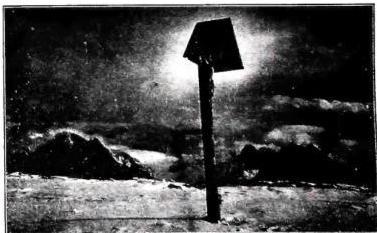
Dolomites. The Marmolada (3,344 m).
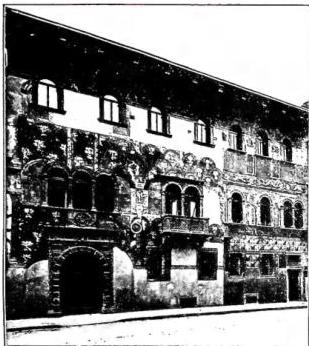
VENETO - Façade of the Palazzo Salvadori in Trento (16th century) with 17th-century reliefs.
The life and civilisation of the Veneti are sufficiently documented in the Bronze Age by hill-forts in Venezia Giulia and Trentino, by pile-dwellings on Lake Garda dating to the same period as the terramare of Emilia, by necropolises and various objects from the early Iron Age in eastern Venezia (S. Lucia near Tolmino in the Isonzo valley, Caporetto, S. Canziano in the vicinity of Trieste, in the Karst, at Cividale and S. Pietro al Natisone) and by related burial sites in the provinces of Padua, Treviso, Belluno, Verona, Trentino and Alto-Adige. These artefacts lend themselves to comparison with those of Este (Ateste), the most notable and important centre of Venetic civilisation, a city that takes its name from the Adige “Athesis”, the river flowing here without embankments, as two Roman inscriptions in the Este museum attest, and which, after the flood of 589, opened a new channel 19 km away, in the Polesine. The Este museum houses the antiquities and monuments of Euganean-Venetic civilisation, divided into three periods: Italic, Venetic and Gallic. The Venetic period lasts until the 3rd century BC, and its artistic manifestations take a different direction from that prevailing in Emilia: instead of the Villanovan ossuary (near Bologna, whence the Villanovan civilisation), there is a bronze situla (bucket) or an imitation thereof; famous is the Benvenuti situla in embossed bronze, divided into three zones with series of figurations of the Veneti: producers of situlae (bronze-workers), farmers, warriors. On stelae, tablets, sheets and vases is inscribed the alphabet of the Paleo-Venetic language, which, for lack of bilingual inscriptions, awaits its interpreter and decipherer.
After Etruscan domination in the 5th and 4th centuries BC
The Celts crossed into Venetia (v. the entry), halting at the Adige. The Veneti, remaining masters of Vicenza and Ateste, their advanced frontiers, were able to render the Romans valuable assistance by fighting their terrible neighbors, while other hordes of these were advancing toward central Italy as far as assaulting Rome. “Only at a later time do we find the region of the Carnic Alps also in the power of the Celts; from Germany, where numerous Gallic tribes were settled, they infiltrated into the valleys of present-day Carnia, Carniola, and Carinthia. They are precisely known under the names of Taurisci and Carni, and on the side of the Alps that were later called Julian, they came to be near the Istrians and the Iapydes, while they were able to press upon the Veneti living in the plain. However, when they might have attempted a conquest from this direction, they found themselves facing a far stronger adversary than the Veneti: the Romans, who in 222 B.C. defeated the Celts in Cisalpine Gaul and took Milan, and thus the Cenomani and the Veneti, whether by love or by force, had to accept their alliance” (P. Paschini, Storia del Friuli, I, Udine 1934, p. 10).
In 181 B.C. the Romans founded in the Carnic-Illiric territory the Latin colony of Aquileia, destined to become later a great emporium of the Roman world; from Aquileia they marched victoriously against the Istrians (178–177 B.C.) and with the consul Gaius Sempronius Tuditanus against the Carni, the Taurisci, and the Iapydes (129 B.C.); after the Social War (89 B.C.) Aquileia became a municipium with administrative autonomy, and the cities of Venetia, by the Lex Pompeia, were assimilated to colonies of Latin right, such as Padua, Este, and Vicenza.
After Augustus’ conquests and victories over the transalpine peoples and the Pannonians, the frontier of the Empire was brought to the Danube; in Augustus’ division of Italy into 11 regions, Aquileia became the capital of the 10th region, “Venetia and Histria,” comprising the territory from the Adda to the Carnic and Julian Alps, shifting Italy’s borders from the Formicone River (modern Risano) to the Arsa, thus including with Pola almost the entire Istrian peninsula. In the territory of the 10th region, already occupied by the Gallic Cenomani, arose the cities of Brescia, Cremona, Trent, Verona, and Mantua; in the territory of the Veneti, between the Po and the Livenza: Padua, Vicenza, Este, Altino, Adria, Oderzo, Belluno, and Feltre; between the Livenza and the Risano: Concordia (a Roman colony founded in 41 B.C.), Aquileia, Trieste (Tergeste), Cividale (Forum Iulii), Zuglio (Iulium Carnicum), Longatico, Nauportus, and Ljubljana; in the territory of Istria: Pola, Parenzo, and Nesactium; while the rest of Istria with Albona, Fianona, and the coast along the Quarnaro (Liburnia) continued to belong to Illyricum (v. the individual entries). Augustus showed particular interest in Aquileia, also in relation to his plans for expansion toward Pannonia and the Danube, and organically connected it with the road network.
After Augustus, the history of the Veneto is subordinate to the history of the Empire: one must recall the invasion of the Quadi and Marcomanni (AD 169), who destroyed Oderzo (q.v.), the various fortification works, episodes such as the “Bellum Aquileiense,” which ended with the victory of the Roman Senate and the killing of the emperor Maximinus and his son beneath the walls of Aquileia (AD 238), the victory of Constantine at Verona over Ruricius Pompeianus, general of Maxentius (AD 312), and also the victorious war of Theodosius against the rebels Magnus, Eugenius, and Arbogastes in the valley of the Frigidus (AD 395), the invasions of the Visigoths led by Alaric, who caused grave damage and destruction to the Veneto (AD 401–10), the various barbarian incursions, particularly that of Attila (AD 452) with its sackings and burnings, and that of Theodoric, who defeated (AD 489) Odoacer east of Verona, where he later built his capital: Aquileia, together with the Veneto and Istria, formed part of the Ostrogothic Kingdom, which had Ravenna as its capital. Theodoric entrusted the defense of Italy to Alamannic populations, which, however, failed to prevent the Baiuvarii or Bavarians, settled in Raetia (Bavaria), from penetrating into the Venosta, Isarco, and Pusteria valleys.
Christianity, at least for the part east of the Adige, is centered in Aquileia; however, no certain evidence of this exists before the mid-3rd century. Episcopal sees that must be considered alongside Aquileia before the Constantinian peace include those of Verona, Padua, and Parenzo in Istria (q.V. ITALY, History, no. 10). During the 4th century, the sees of Altino, Trent, Concordia (recent discoveries of paleochristian sepulchral areas and cemetery basilicas reveal its great importance in the 4th and 5th centuries), Iulium Carnicum, and probably Mantua, Oderzo, Feltre, Belluno, Asolo, Treviso, Vicenza, Trieste; and beyond the Alps, Scarabantia, Sabaria, and Emona in Pannonia Savensis, were gradually established. In the 5th century, Aquileia was the metropolitan see for the bishoprics of the “Venetia and Histria,” the territories of Raetia Secunda with Vindelicia, Noricum, and Upper Pannonia—Brescia being excluded. The list of sees is preserved in the subscriptions of the Synod of Grado (579), which was attended, in addition to Elias, resident at Grado but “episcopus sanctae Aquileiensis Ecclesiae,” who convoked and presided over it, by the aforementioned bishops as well as those of Pola, Cissa (a now-vanished Istrian diocese), Parenzo, and Pedena in Istria; of Celeia (Cilli), Aguntum (Innichen in Carinthia), and Tiburnia (Spittal) in Noricum; and of Sabiona (Seben, later Brixen, in Raetia Secunda).
In the 6th century new events and political and religious dissensions brought about radical changes in the internal relations of Venice and Istria, occasioned by the condemnation of the Three Chapters (q.v.) decreed by the Emperor Justinian and sanctioned by the Fifth Ecumenical Council, the Second Council of Constantinople (553). The metropolitan of Aquileia, together with his suffragans, refused to accept the condemnation, placing himself in opposition not only to the emperor but also to the Pope; and Pelagius II and Gregory I vainly sought to convince him that the definition of the Council of Chalcedon had not been compromised, as they maintained. Even the strong measures attempted by the Exarch of Ravenna at the end of the 6th century had to be abandoned in the face of the schismatics, who intended to take advantage of the upheavals created by the Lombard invasion.
The Lombards, having crossed the Julian Alps, entered Italy in 568 and established their first duchy at Cividale. Feeling secure in their rear, they advanced through Regio X, took Bolzano and Merano from the Bavarians, and established the duchy of Trent, in addition to those of Verona and Ceneda, intent on opposing Byzantine institutions with those more in harmony with their national customs. Arians in religion, though without particular fanaticism, they encountered distrust in the Catholic hierarchy, so that the Venetian bishops left their cities closer to the sea, with at least part of the urban population, to take refuge in the lagoons opposite, which remained within the boundaries of their dioceses, over which the Byzantine authorities retained jurisdiction: Concordia at Caorle, Oderzo at Cittanova, Altino at Torcello; as for Aquileia, Bishop Paul (557–69), according to Paul the Deacon, “fearing the barbarity of the Lombards, fled to the island of Grado and carried with him all the treasure of his church” (Hist. Longob., II, 10). Istria, on the other hand, over which the Lombards could not maintain stable dominion, remained subject to the exarchate until the arrival of the Franks. The unity of the metropolitan see of Aquileia was broken when, in 607, the Byzantine authority succeeded in imposing a Catholic bishop at Grado (Candidianus); at that point, the schismatics on the mainland, under the protection of King Agilulf, managed to have a bishop of their party at Aquileia (John), and there came to be two metropolitan sees: that of Aquileia for Lombard territory and that of Grado, which later proclaimed itself New Aquileia, including Istria and the lagoon sees as they were established: Caorle, Cittanova, Equilio, Torcello, Malamocco (later Chioggia); both metropolitans assumed the title of patriarch. The schism did not end on the mainland until, toward the end of the 7th century at Pavia, the bishop of Aquileia solemnly anathematized it and his suffragans with him. Little is known of the latter, and it is doubted whether the episcopal succession in some sees was not interrupted; in any case, Concordia had its bishop, as did Ceneda as successor to that of Opitergium.
Frankish occupation did not substantially alter the state of affairs. The Lombard dukes were succeeded by Frankish counts, and since the one in Friuli had direct
In the defence of the borders, it held particular prominence with the title of marquis, extending for a moment its government over the transalpine territories of the East recently annexed to the Frankish Kingdom. The disintegration of the Frankish Empire and the invasions of the Hungarians at the beginning of the 10th century subjected the Venetian populations to severe trials: the seat of the march was moved to Verona and the feudal regime was established in the country, particularly under Italian kings, among whom Berengar I was forced to be generous with his dependents in granting them political powers. But alongside that of the counts, the power of the bishops was affirmed thanks to the concessions of immunities, possessions and privileges by the Saxon and Frankish sovereigns, so that, for example, the Patriarch of Aquileia obtained the county of Carniola, the march of Istria, and direct feudal authority over the bishoprics of Concordia and those of Istria. Meanwhile, the prince-bishopric of Trent was established with Bolzano; the Venosta Valley passed to the Bishopric of Chur, and the valleys of the Rienza and Isarco to Bavaria. Since the power of the bishops had its centre in the city, in the Veneto, as indeed in the neighbouring Lombardy, this power favoured the urban populations, which, growing in number and wealth, were able to resist the pressure of the lords of the countryside and establish a communal constitution, even limiting the powers of the bishop, until they were able to form free associations among themselves, as happened in 1164 with the Veronese League. The most important communes were Verona first of all, Treviso, which was at the head of the Joyous March at the beginning of the 13th century, Padua, Mantua; while Vicenza, coveted prey of powerful neighbours, Feltre, Belluno had rather secondary importance; a special historical physiognomy, more long-lasting feudal, was maintained by Friuli, still lacking important urban centres.
To contain the power of the communes at the decline of imperial power, Ezzelino III da Romano, relying on a vicariate obtained from Frederick II, attempted to establish a state with Verona, Vicenza and Padua, while his brother Alberico settled in Treviso, but they were finally crushed in 1260, leaving the field open to the Signorie; that of the della Scala in Verona, which had its centre of action in
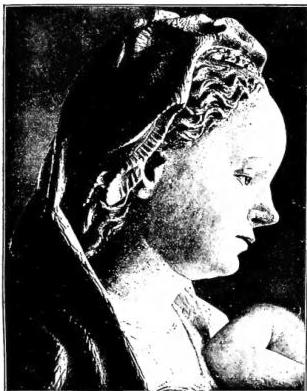
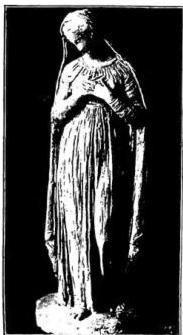
THE VENETO — The Madonna. Detail of the statue of the Madonna and Child, in carved and painted wood. Local art (c. 1470). S. Paolo d'Appiano, parish church.
No significant religious upheavals occurred in the Veneto after the schism of the Three Chapters. The Reformation movement of the 16th century attempted to create centers of heresy in the humanist milieu of the cities, particularly in Verona, Padua, Vicenza, and Venice; traces of Anabaptism are attested in the region. Stronger efforts appeared in Gorizia and Trieste, while in Istria the two Vergerio brothers, Battista in Pola and Pier Paolo (v.), sought to introduce a reform of a disciplinary nature in Capodistria. But after the death of the first and the forced departure from Italy of the second in 1549, every trace of Protestantism soon vanished.
Cessation of Venetian rule in 1797, with the Treaty of Campoformio, assigned the mainland territory east of the Adige to Austria. But after the victory of Austerlitz in December 1805 this territory as far as the Isonzo was united with the Kingdom of Italy; after Wagram (6 July 1809) it was enlarged by the addition of Trentino and the Illyrian provinces of Gorizia, Trieste, Istria, the Dalmatian Littoral and other non-Italian lands. With the fall of the Kingdom of Italy on 7 April 1815, V. together with Lombardy became part of the Kingdom of Lombardy–Venetia under an Austrian archduke resident in Milan. It comprised the ancient Venetian mainland territories, with modified eastern borders; Trentino, the Dalmatian Littoral and the so-called Littoral (Küstenland) comprising Gorizia, Gradisca with the Isonzo valley, Trieste and Istria remained under direct Austrian rule under a lieutenant resident in Trieste. Ecclesiastical relations were settled in 1818 through negotiations between Pius VII and Francis I (v. VENEZIA).
The war of 1915–18 reunited Trentino with Alto Adige and the Littoral to Italy, altering the boundaries of the dioceses of Gorizia and Trieste; but with the peace imposed on Italy in 1945 the borders were pushed back to the Isonzo and the Free Territory of Trieste was created, which cannot enjoy autonomous life, while almost all Istria was assigned to Yugoslavia. Ecclesiastical relations in this area have not yet reached a stable settlement.
It coincides with the ecclesiastical province and therefore is not bound by the obligation to celebrate the Plenary Regional Council, following the provisions of can. 283 ff. of the CIC on the Provincial Council. The following sees belong to the Venetian conciliar region: 1) immediately subject: a) metropolitan without suffragane sees: UDINE; b) archiepiscopal: TRENTO; c) episcopal: BRESSANONE; 2) metropolitan: VENEZIA (patriarchate) with the suffragane sees of ADRIA, BELLUNO and FELTRE, CHIOGGIA, CONCORDIA, PADOVA, TREVISO, VERONA, VICENZA, VITTORIO VENETO; GORIZIA E GRADISCA with the suffragane sees of TRIESTE E CAPODISTRIA (Free Territory of Trieste). By the motu proprio Qua cura of 8 Dec. 1938 (AAS, 30 [1938], pp. 410-13), the Regional Tribunal for matrimonial causes was established with its seat in Venice; it is a court of first instance for all the dioceses of the region and a court of appeal for the dioceses of the Flaminia or Romagna region. For the Venetian region, however, the Milanese Regional Tribunal is the court of appeal. The norms issued by the Sacred Congregation of the Sacraments on 10 July 1940 govern the functioning of these tribunals (ibid., 32 [1940], p. 304). Cosimo Petino
IV. ART IN THE VENETIAN REGION
I. VENEZIA TRIDENTINA
Due to its geographical position, Venezia Tridentina was subject to various and sometimes opposing artistic currents. Clearly Venetian zones of influence are found in the northeast of Lake Garda (Riva, Rovereto, Ala), while to the west of the lake Lombard influences prevail. Trento (q.v.) and its surroundings have a clear Italian Renaissance imprint; in Alto Adige, in Bolzano and Merano, the Gothic and German element prevails instead.The current that had the most unified diffusion there is undoubtedly the Romanesque one, of Italian character: the greatest example is the cathedral of Trento (12th-13th centuries), begun by Adamo d'Arogno and continued by workers from Como and Campione; interior with three naves and cross vaults; portal with prothyrum. In the left arm of the transept, interesting frescoes of the Emilian school of the 14th century with the Legend of St. Julian, by Monte da Bologna.
In the small church of S. Benedetto at Malles there are precious frescoes of the 9th century, already imbued with the plastic sense of Romanesque art. At Tubre (upper Venosta Valley) is the church of S. Giovanni, founded by the Knights of St. John of Jerusalem, and at S. Candido the collegiate church of SS. Candido and Corbinian (13th century), with a solemn interior and vigorous examples of wooden and stone sculpture. There are then many examples of Romanesque-Gothic architecture, such as S. Apollinare in Trento, S. Pietro in Cembra (Gothic interior), S. Maria Assunta in Malè in Val di Sole, the cathedral of Bolzano (first half of the 14th century). Gothic lasted a long time in this region, with Italian forms that exceptionally reached Alto Adige, where, however, models from beyond the Alps dominated. The Gothic-Italian current includes the oldest part of the Castello del Buon Consiglio in Trento (13th-14th centuries), with the large round Romanesque Torre Grande. At Fiera di Primiero, the church of S. Maria Assunta, with an imposing three-nave Gothic interior, and S. Francesco in Bolzano with a beautiful cloister.
The 15th century in Trentino is almost entirely still Gothic: characteristic of this region are the castles, buildings that often maintain the medieval character of their original structure, with superimposed Gothic and Renaissance elements; they often preserve frescoes of the profane and chivalric international current, of great quality and rare interest, such as Castel S. Pietro near Calliano, the Castello di Rovereto (enlarged by the Venetians in the 15th century), the Castello di Avio (with the first cycle of profane frescoes in Trentino) in Merano, the Castello di S. Zeno and Castel Tirolo (12th-13th centuries, ceded in 1363 to the Habsburgs) with fine Romanesque reliefs, Castel Churburg, in Val Venosta (13th and 16th centuries) and also that of Pergine in Valsugana (end of the 15th century) and that of Appiano (12th and 16th centuries, now in ruins). In Castel Roncolo, north of Bolzano, 15th-century frescoes with the cycle of Tristan.
In painting, in addition to the aforementioned examples of the international current, to which must be added the cycle of the months on the walls of the Buonconsiglio (Torre dell'Aquila), a work by an artist from beyond the Alps, a Giottesque-Romagnol current reaches as far as Bolzano, where it leaves an outstanding ensemble of frescoes in the chapel of St John in the Dominican church (1340). Of great importance is the Germanic influence, especially in popular art, which is evident in the frescoes of the Romanesque cloister of Bressanone Cathedral (14th–15th centuries), where Jacopo Sunter, the last High-Altitude Gothic painter, also worked.
Also worthy of mention are the singular frescoes of the Romanesque church of St James in Termeno (13th century) and the most elegant ones depicting the Stories of St Daniel (15th century) in the church of the same name in Ora. In St Proculus in Naturno there are frescoes from the 8th and 9th centuries derived from Irish miniatures.
The Renaissance current slowly penetrated towards the end of the 15th century, and its development, with the exception of the Trento area and a few other rare exceptions, was always hindered by the Gothic element. The Renaissance flowering in Trento was initially due to the bishop of Trento from 1514 to 1539; in 1520 the beautiful church of Santa Maria Maggiore by A. Medaglia, a Como native, was built; within a few decades the city was adorned with palaces of distinctly Venetian character, including the Town Hall (16th century), the Geremia, Salvadori and Rella houses (the latter with frescoes attributed to Fogolino) and Palazzo Tabarelli, of Lombard school. In Bressanone, where northern elements often blend with Renaissance ones, the Prince-Bishops' Palace has a fine courtyard with three tiers of loggias. But the most important Renaissance architecture is undoubtedly the Buonconsiglio complex. The first Romanesque construction was modified with Venetian variations by Bishop Hinderbach in 1475; then between 1528 and 1536 Bernardo Clesio had the Magno Palace added to the south, worthy of comparison with the finest Italian royal residences of the period.
(photo Alinari)
VENETO - Church of the B.V. of Succour, called the "Rotonda," architect F. Zamberlano (1594) - Rovigo.
The architect's name is unknown. The loggia was frescoed by Romanino; Lotto, the two Dosso painters, Fogolino, and Zuccari were also called upon to decorate the Castello. This was a moment of great artistic fervour; the city was open to the best that was being produced in the surrounding regions. The Lodron Palace at Ponte Caffaro is an example of Brescian architecture. At Rovereto, under Venetian rule, the Town Hall was rebuilt in 1476 (with a frieze by Fogolino). Michele Pacher of Brunico (second half of the 15th century), sculptor and painter, is the most notable and refined artist of the Alto Adige (old parish church of Gries).
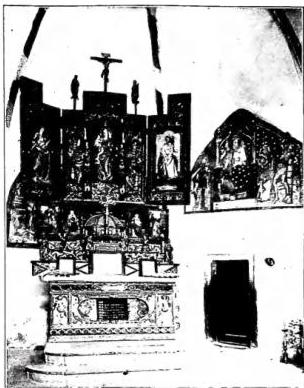
The Baschenis family, popular painters from Bergamo, also worked in some localities of Trentino (frescoes in the church of St Anthony at Pelugo in the Val Rendena and in the church of St Vigilius near Pinzolo, with the famous Danse Macabre painted on the façade by Simone Baschenis: V. t.V. XLVII). Many churches are frescoed by anonymous Trentine folk painters and adorned with statues, altars, and wooden choir lofts of local craftsmanship (with a tendency between Gothic and Baroque). The Baroque period is not of great importance; mention may be made of the church of the Seminary in Trento designed by Fr Pozzo, a native of that city, the chapel of the Crucifix in the cathedral of Trento, and, again in Trento, the churches of the Annunciation and St Martin (decorated by Knoller and Cignaroli). In the 18th century, painting assumed great importance due to its links with the nearby Viennese Rococo style. The Guardi family originated in the Val di Non (at Vigo, in the parish church, painter of Antonio and Francesco Guardi). This was the moment when a group of notable painters flourished who often found fame in other Italian cities: Alberti, Unterpergher, and Lampi.
In the 19th century, all artistic activity stagnated. Still noteworthy is the painting of Segantini and, towards the end of the century, that of Umberto Moggioli.
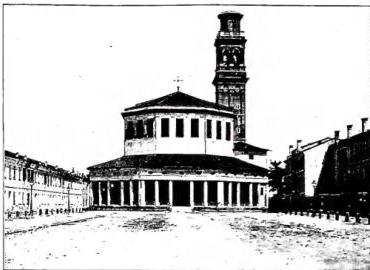
II. VENEZIA EUGANEA
With the establishment of Roman civilization in the region, monuments also begin to appear that provide marvellous testimony to this civilization, and they multiply throughout the period that ends, roughly speaking, with the Lombard invasion. These are sepulchral monuments, of which splendid examples are found especially in Aquileia; statues and reliefs, notable products of provincial art; amphitheatres still in goodVeneto – The Immaculate. Sketch by A. Canova – Possagno (Treviso), Gypsotheca Canoviana.
Venetian paleo-Christian art may be described as late Roman art with Byzantine influences absorbed through Ravenna. The artistic heritage of the classical world, filtered through barbarian influence, prepared the new Romanesque art, which later developed more freely on the mainland: S. Sofia in Padua, and, a masterpiece of Venetian Romanesque, S. Zeno in Verona, derived from the splendid Modena cathedral by Lanfranco (1120–38). Along the coast, more closely tied to ancient tradition, stand the splendid examples of the cathedral of Torcello, with three naves of exarchal type, and, on the same island, S. Fosca, probably rebuilt on a pre-existing martyrion (Bettini), with an interior in the form of a Greek cross and an exterior with arcades following a polygonal perimeter. The apse, entirely articulated with niches and bricks, recalls that of SS. Maria e Donato in Murano (rebuilt in 1140), for the same tendency toward color and the delicate relationships between surfaces and atmosphere. The prototype of these lagoon churches was the cathedral of Caorle (1038), with three naves, Romanesque-Byzantine capitals, and small slit windows. Similar must have been the first ducal basilica of the Partecipazi (828); this is the moment when Byzantine workmen arrived in Venice, summoned precisely to work there. The second S. Marco, built by Pietro Orseolo, was entirely decorated with marbles and Byzantine sculptures, which were later reused in the third Basilica, constructed by Domenico Contarini, which absorbed and erased the previous structures (1063). According to some scholars, the structure of S. Marco is therefore Romanesque and owes its oriental appearance to the decoration that gradually enriched itself with the rich spoils that Venetian merchants brought back from the East; according to Fiocco, it is the work of Byzantine workmen inspired by the example of the Apostoleion renewed under Basil, with domes projecting on a deliberately archaic plan. S. Marco influenced the architecture of the Santo in Padua, where, however, the domes do not harmonize with the body of the Romanesque-Gothic basilica. In Venice, in the oldest part, especially in the Rialto area, there still exist Byzantine civil buildings.
As for painting in the Veneto, the influence of the East was continuous, and Venetian painting was formed precisely from this relationship between ancient Eastern and Western civilization. In Venice and along the coast, the Byzantine element long predominated, producing the splendid mosaics of S. Marco in the time of Doge Domenico Selvo (11th century), while in
conservation as at Pola, Verona and, to a much lesser extent, at Padua; theatres like those at Trieste and Verona; temples and arches like those at Pola and Verona, while at Aquileia notable parts of the Forum have been discovered. Remains of less important buildings and villas are found throughout the region. There are also numerous mosaics, especially at Aquileia. The first Christian basilicas arose at Aquileia (q.v.) from the first decades of the 4th to the 6th century, but only their mosaic-covered plans survive, as at Giulio Carnico, while those of the Vergine and of St Euphemia at Grado (q.v.), of Eupraxius at Parenzo (q.v.), of SS Felix and Fortunatus at Vicenza (q.v.), and of the Assumption at Trieste, are preserved in their outlines.
In the Venetian hinterland, Romanesque-Northern forms spread, notably at Verona with significant Germanic contributions. By the mid-13th century, some mosaicists from St Mark’s displayed affinities with Romanesque art and achieved a dramatic intensity previously attained only by sculpture: it seemed almost as if Venice were breaking away from the East (mosaics of the atrium).
Early Christian sculpture in the Veneto took over late Roman forms inherited from Ravenna: St Mark’s was adorned with Early Christian reliefs, capitals and statues (the throne of St Mark, the Nativity, etc.). In the hinterland Lombard-Carolingian forms appear in decorative sculpture.
In the thirteenth century Byzantine art again exerted great influence on the maritime Veneto: many reliefs and more specifically decorative works (transennae) adorned the churches, and many Byzantine craftsmen worked there, forming their own school which, however, took account of the new Romanesque art.
The new Gothic current was not immediately accepted in the Venetian environment, which absorbed it slowly; it then developed greatly in the first three decades of the fifteenth century, increasingly accentuating decorative elements.
On the mainland there are S. Anastasia and the cathedral of Verona, S. Fermo and the Eremitani in Padua; in Venice the Gothic churches of the Mendicant Orders, whose construction extended into the fifteenth century: SS. Giovanni e Paolo and the Frari, almost contemporary, and then S. Stefano, simpler, the Madonna dell’Orto, the Carmine and S. Zaccaria (interior), all three-aisled, with cross-vaulting. Characteristic elements are the columns, the tie-rods which reduce the function of the buttresses, and the arches which widen out. Later, single-aisled, are S. Maria della Carità and S. Gregorio.
It was in this period that the definitive construction of the Doge’s Palace was completed; originally a castle, it began to assume its present form around 1340, after various rebuildings, and received the imprint of that florid Gothic characterized by the predominance of voids over solids, which was to dominate for a long time in Venice. Another splendid example of this light architecture, in harmony with the light and entirely resolved in surface, is the Ca’ d’Oro; among secular buildings there are also to be remembered Ca’ Foscari, Ca’ Pisani, the Palazzi Priuli, Soranzo, Van Axel and Contarini-Fasan.
In the fourteenth century Giotto worked in Padua (Scrovegni Chapel), and his art exercised a profound influence in the region. To understand, however, the subsequent developments of painting in the Veneto, one must stress the importance of the school of the Rimini and Romagna miniaturists. Hence Tommaso da Modena (with Gothic and Sienese influences) who worked especially in Treviso; Altichiero at the Santo in Padua, and then Stefano da Verona. In Verona worked Pisanello, the highest genius of the International Gothic in Italy (frescoes at S. Fermo and S. Anastasia). In Venice, Paolo Veneziano was still steeped in Byzantine modes and influenced the Paduan Guariento; but Lorenzo Veneziano was already drawn into the Gothic world, as was Jacobello del Fiore, who succumbed to the charm of Pisanello. With the major contributions that Gentile da Fabriano’s painting made to Jacopo Bellini and Alvise Vivarini, the threshold of the Renaissance was now being crossed.
In the field of sculpture there still persists some Byzantinism (sarcophagus of the SS. Sergio and Bacco), but otherwise the Gothic-Venetian current is entirely under the influence of Antelami and perhaps indirectly of French art: noteworthy, in Padua, the portal of S. Giustina; in Venice, the Dream of S. Marco (Basilica Marciana) and the decoration of the main portal of the same Basilica, in which Byzantine influences are still noted in the pictorial sensibility. In Padua Giovanni Pisano is present (Madonna and Angels at the Scrovegni), Nino Pisano works in Venice at the Corner monument in S. Giovanni e Paolo. Both in Venice and Padua, the two Tuscans left a deep mark on a school which, as always, elaborated their contribution and transformed it into a Venetian idiom. Many masters belonged to this school who left works throughout the region; the best known are the brothers Jacobello and Pier Paolo dalle Masegne, who were also active in Mantua, Bologna and Lombardy and are the authors of the statues of the iconostasis of S. Marco. Balduccio da Pisa brought the teaching of the Pisani to Verona and influenced those Campionesi masters to whom the Scaliger tombs are due.
In the early 1400s, several great Tuscan artists were called to Venice. After the fire that devastated San Marco in 1479, Paolo Uccello and Andrea del Castagno were summoned by the Republic to revive the now-declining mosaic school. Though the two masters did not restore the splendor of ancient decoration, they elevated it to a high level. Thus, in Padua, Filippo Lippi (working at the Santo) brought the new Renaissance message, influencing some local masters. From Squarcione’s school emerged Mantegna (Ovetari Chapel, Eremitani), and from 1443 onward, Donatello worked in Padua for a decade; the city became the most vital and fertile artistic center for spreading Renaissance ideas and art northward. From Andrea Mantegna (q.v.), one may say that all the Renaissance schools of Venice and Lombardy derived renewed vigor. The Venetians would increasingly resolve problems of form and space through color, their natural and essential medium. Thus, it can be said that in every city of Venice a school flourished: in Padua, in Verona—where Mantegna’s influence was especially strong—with F. B. Bonsignori, D. and F. Morone, G. dei Libri, Liberale, and F. and G. Caroto. The Venetian school was about to yield its highest fruits with the Bellini (q.v.). Alongside Donatello, other Tuscan sculptors worked in Padua, such as Dello Delli, Michele da Firenze, Pietro Lamberti, and Agostino di Duccio, whose example freed Venetian sculpture from Gothic influences. From them emerged Niccolò Pizzolo, author of the Eremitani altarpiece (terracotta), Bartolomeo Bellano (whose works remain at the Santo, San Giustina, Eremitani, San Francesco, etc.), and Andrea Briosco, called Il Riccio, a bronzeworker renowned for his witty realism. In Venice, the workshop of Bartolomeo Bon—author of the Porta della Carta—produced sculptors (“taiapiera”) of Tuscan, Venetian, and Lombard origin, such as Matteo Raverti, who worked in the Doge’s Palace, and Andrea da Milano. Great renown also came to the workshop of Pietro Lombardo, who worked with his sons Antonio and Tullio and was influenced by Agostino di Duccio; the Lombardi left works even in Padua (Santo) and Treviso (Duomo). In the second half of the 1400s, Venice saw the emergence of Antonio Rizzo, whose genius produced his masterpiece in the statues of Adam and Eve in the Doge’s Palace—a work in which all Gothicism ended and a new plastic sensibility was born, characterized by flowing, luminous masses.
Peter Lombard was also an architect, with a marked tendency toward decoration rather than the creation of definite structures (church of the Miracoli, Palazzo Dario), whereas Mauro Codussi was sustained by a true architectural genius and organized spaces and gave the ribs their functional purpose (façade of S. Zaccaria, S. Maria Formosa, S. Giovanni Grisostomo, S. Michele in Isola). In 1527, after the sack of Rome, Sansovino arrived in Venice, where he enjoyed great success; among his principal works should be recalled the Mint, the Library of S. Mark, the church of S. Francesco della Vigna, the Palazzo Cornaro, and the loggetta of the bell tower. He knew how to adapt his classical and Roman experiences to the particular atmosphere of Venice, giving his constructions rhythms marked by the predominance of voids over solids, with evident pictorial research. Toward the mid-16th century flourished the greatest Venetian architect, Andrea Palladio (q.v.). Among them also worked Falconetto, who derived from Bramante and Peruzzi; Serlio, particularly well known as a theorist; Fra Giocondo (loggia in Piazza dei Signori in Verona); and oth-
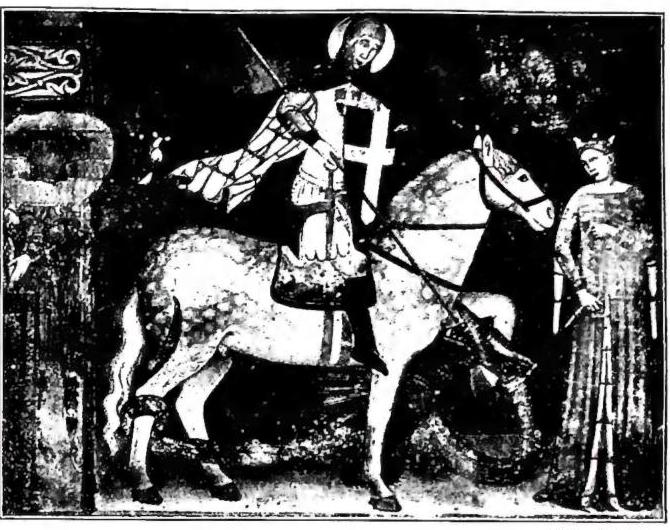
Veneto - St George Slaying the Dragon, fresco (late 14th–early 15th century). Verona, basilica of S. Zeno Maggiore.
Among all, the Veronese Sanmicheli, great military architect who reveals this quality even in the monumental lines of his palaces (Grimani).
Meanwhile the school of Giovanni Bellini yields its splendid fruits; in Venice colour is now free from every subjection to drawing, it is like a vital breath that animates, in the light of its relationships, landscapes and human figures. In this direction decisive was also the contribution of Antonello da Messina, active in Venice and Milan in 1475–1476 (Pietà of the Correr). From this master, who fused in high poetic synthesis the achievements of Piero della Francesca with Flemish contributions, was particularly influenced Alvise Vivarini, who then drew near to the Giambellino, with Basaiti, B. Montagna (Vicenza) and Cima da Conegliano. At the close of the 15th century were in Bellini’s workshop: V. Catena, Bissolo, Rocco Marconi, G. M. Pennacchi (Treviso), B. Boccaccini (Cremona), F. Mazzola (Parma), N. Rondinello (Ravenna). Giorgione of Castelfranco ([v.] altarpiece at Castelfranco) comes from the Giambellino and is the marvellous flower of his school; as Titian (v.) in turn comes from Giorgione, and the same can Elder (v.). In this period flourish the Pordenone, who prefers monumental forms, Lorenzo Lotto who, for his refined unease and the northern accents of his cold colours, holds a special place in the history of Venetian painting; A. Previtali, Cariani, who derives from Palma the Elder and from Lotto, Bernardino Licinio, Savoldo, Romanino, Moretto of Brescia and Bonifacio de’ Pitati and the Torbido of Verona, A. Schiavone, Paris Bordone.
Venetian sculpture of the 16th century, which in the Veneto develops in the wake of the school of the Lombardi, receives fresh impetus from Jacopo Sansovino, Tuscan, whom Vasari rightly recognises as possessing «facility, sweetness, grace and a certain leggiadry»; this master, besides the statues of the Loggetta, left the Venier monument and the Giants of the staircase of that name (work of his school). Among his followers: Danese Cattaneo, Tiziano Minio, Tiziano Aspetti, a very refined bronze-worker, G. Campagna of Verona and A. Vittoria of Trent, who dominated in Venice with a marked tendency to painterly effects of light and shadow.
At the end of the 16th century V. SCAMOZZI, VINCENZO, most learned theorist, spreads with his works an academicism that blocks the natural development of Renaissance architecture in the Veneto. The first to return to tradition was
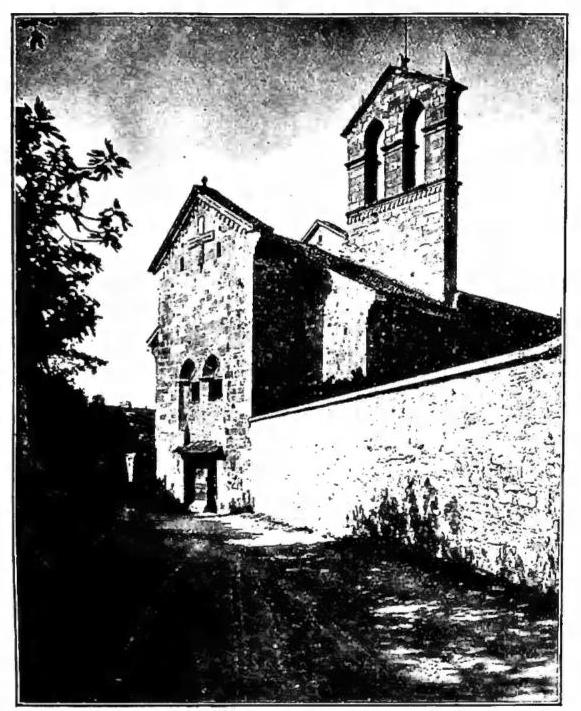
Veneto – Rear façade of the church of S. Francesco (14th century) – Pola.
Baldassare Longhena, pupil of Scamozzi, whose Baroque language carries to their extreme consequences those elements of pictorialism already present in Palladio, Sansovino, and Sanmicheli (Palazzo Belloni-Battaglia, church of the Salute, Ca’ Pesaro, Ca’ Rezzonico, cathedral of Chioggia, interior of the Scalzi, School of S. Giorgio dei Greci and dei Carmini, staircase of S. Giorgio Maggiore, Villa Rezzonico at Bassano and Widmann at Bagnoli, etc.). He had no true followers.
In the 17th century, painting in Venice suffered a setback: the epigones of the great Venetians either limited themselves to imitation of the masters or allowed themselves to be drawn to the most common mannerism, or continued to exploit Titian’s colour. Yet even at this moment “Europe speaks in painting a single tongue, the Venetian.” And in Venice and in the Veneto the authentic tradition regained value especially through the work of foreign artists: D. Fetti, who exercised great influence even on G. Liss, a German who worked in Venice in those same years (until 1630), bringing painting to a great freedom united with refined preciosities of style. In 1630 there arrived in Venice B. Strozzi (Genoa), who in Fetti’s legacy clarifies the qualities of his capricious temperament. The liveliest strand of the Venetian tradition continues with F. Maffei (Vicenza), S. Mazzoni, the Mola, the Ruschi, the Zanchi, and the Langetti.
In this period sculpture developed as decoration: at the Salute many craftsmen worked under the guidance of the Fleming Giusto Le Court. Sculptors from every city in Italy came to work in Venice: Parodi (Genoa), Maaza (Bologna), the Frenchman Perreau, and the Germans Weyering (S. Moisè) and Barthel (Pesaro monument in the Frari). All ended by adopting the local pictorial manners.
In the 18th century in Venice architecture returned to Palladian models; majestic exteriors of five orders correspond to the light and capricious Rococo interiors. G. Massari (first half of the 18th century) is the author of Palazzo Grassi, of the churches of the Fava and the Gesuati. Also to be remembered are T. Temanza (church of the Maddalena) and A. Tirali (church of S. Vitale and pronaos of the Tolentini).
In the 18th century, particularly important in Venice and the Veneto was the school of Venetian view-painters, founded by the Friulian L. Carlevaris; in his workshop, Canaletto began, whose painting was influenced by the Swede Richter. From him derives his nephew Bernardo Bellotto. While in Canaletto «the pictorial realization is mediated by perspectival framing», Guardi’s painting formed on completely different premises. In him, the relationship between figure and space is essentially pictorial: «he achieves an atmospheric, pulverulent light, within which form is as if dispersed, immersed in the very nature of light» (Pallucchini).
Among the sculptors of the 18th century, we may recall here Marchiori, Bonazza, and Morlaiter, who continued the sensitive pictorial tradition of the Venetians. In the same milieu, A. Canova was trained, who would later become the leading exponent of the Neoclassical movement.
In the 19th century, the coloristic tradition continued within the limits of provincial anecdote; yet some figures stand out with notable personalities and belong to the history of Italian painting of the time: G. Favretto, Hayez (of Lombard training), M. Grigoletti, G. Ciardi, whose ties with the Macchiaioli gave him greater vitality, L. Nono, A. Milesi, Zandomeneghi, who emigrated to Paris and was influenced by the Impressionists. Among sculptors, special mention must be made of Selva, Dal Zotto, and especially Borro.
Among contemporaries, the leading painter is G. Rossi, and the most important sculptor is A. Martini of Treviso, who, through manifold experiences, decisively influenced modern Italian sculpture.
III. VENEZIA GIULIA
Between the 7th and 8th centuries, the region came under Lombard rule. In Cividale, which was the Lombard capital of Friuli, the oratory of S. Maria in Valle remains a notable monument of this period, probably built under the patriarchate of St. Paulinus, combining Roman and Byzantine elements; it features wonderful stuccoes and frescoes contemporary with the stuccoes. The local Archaeological Museum and the cathedral house fragments with Roman, barbarian, and prehistoric monuments, as well as important works of art from later periods. In the plutei of Cittanova d'Istria, in addition to classical decorative motifs, one can observe representations of animals of vigorous imagination, a prelude to Romanesque art, which did not bring many changes to functional elements, but rather to decorative ones. Among the buildings to be noted are S. Anastasia of Zara with its three naves (13th century) with capitals of various styles, S. Lorenzo del Pasenatico, the basilica of Muggia Vecchia, the small church of S. Silvestro in Trieste, and finally S. Giusto, which arose in the 14th century from the union of two pre-existing churches: the Assunta, with three naves, and the first S. Giusto, smaller and also with three naves. The new basilica lacks unity, but the five poor and austere naves create a solemn atmosphere. It features classical and Byzantine capitals, and the mosaics are contemporary with those of St. Mark’s; the frescoes in the apse depicting the Stories of St. Giusto, the martyr, are by Altichieri da Zevio. In Friuli, worthy of mention are S. Maria di Castello in Udine (with a Lombard façade), S. Francesco in Cividale (13th century), that of Udine, and the cathedral of Gemona (by G. Griglio), a transitional work with an interior of Gothic arches.The Gothic age developed under Venetian rule, to which Istria too was subjected from the mid-13th century. During this period, everything reflects the presence of the Republic of Venice: its seal, the Lion of St. Mark, is still found everywhere today. Venetian painters, sculptors, and architects worked here, so that one can speak of Venetian art. Among the architectural works to be noted are the cathedral of Pola, of paleo-Christian origin but with Gothic-provincial transformations (15th century); the church of S. Francesco built by the Friars Minor, who were very active in Istria; the cathedral of Muggia with a façade featuring an ogee arch similar to that of the church of the Carità in Venice; the small church of S. Giacomo in Capodistria, the cathedral of Udine (with frescoes by Vitale da Bologna) Romanesque-Gothic in style, later altered, and that of Venzone.
Among the civil and private buildings, the small palaces of Pola, Pirano (the city most reminiscent of Venice), Parenzo, Capodistria; the Venetian houses with biforas and triforas in Pirano, Udine, Pordenone and other centers; the castles that flourished in many places, including that of Colloredo di Montalbano, with its three rings of walls. The Republic built fortifications, walls and towers everywhere, all of them very fine. The Castle of Gorizia, like the cathedral of Pisino, shows German influences due to the rule of the counts of Gorizia of German origin; Trieste, by contrast, did not suffer any northern influence. In the main apse of its cathedral there were frescoes—now lost—by the Friulian school. The school of the De Sanctis, Venetian sculptors trained under Nino Pisano, left works in Udine and Capodistria. The penetration of Venetian art continued in the 16th century with a more unified character throughout the region, including Friuli. At Capodistria the Dalle Masegne and Tullio Lombardo worked on the cathedral.
In the mid-16th century Jacopo Sansovino restored S. Maria del Canneto in Pola; Palladio worked in Udine; on Brioni Island excellent stone-cutting craftsmen flourished. Istrian stone gave a new and distinctive austerity to Venetian models. There were not many original constructions, but numerous transformations and rebuildings: the cathedral of Osséra is a Renaissance building with an arched façade and a Lombard portal, as is the cathedral of Cherso; the cathedral of Cividale, enlarged and rebuilt to a design by P. Lombardo; the fine Palazzo del Comune of Venzone (14th–15th c.) and the town hall of Gemona, the Castle of Udine (architecture by G. Gontana), now the civic museum, and that of Sanvincenti. Among the painters, G. Martini of Udine (works in Udine, Portogruaro, etc.), of Tolmezzan origin, was influenced by Alvise Vivarini and Cima da Conegliano; he in turn influenced Pellegrino da S. Daniele. Gianfrancesco da Tolmezzo decorated the church of S. Martino at Socchieve; a pupil of G. Martini was Giovanni da Udine, who worked in Friuli as an architect. For the cities of Istria and Dalmatia, Vittore Carpaccio and his son Benedetto, Titian, Paris Bordone and Palma the Elder, Paolo Veronese and Jacopo Bassano were active. In Friuli, G. A. da Pordenone worked, emulating Titian (choir of the parish church of Travesio),
VENETO - Coronation of the Virgin. Painting by Girolamo da Udine (early decades of the 16th century) - Udine, Museo comunale
duomo of Spilimbergo, S. Maria dei Battuti in Valeriano), then Pomponio Amalto and Sebastiano Florigerio. From Zara come Andrea Schiavone and Francesco Laurana, though they left no traces in the region. Military architecture flourished particularly, a direct emanation of the Serenissima, especially through the work of Michele Sanmicheli (porto di Terraferma in Zara), Falconetto, Palladio, Scamozzi, and Serlio. With the Baroque period, artistic fervor diminished throughout the region; decline coincided with the end of Venetian power. There are no architectures of great significance: instead, the interiors of churches were modified (duomi of Udine, Gorizia, and Capodistria), and in the numerous church reconstructions of the 18th century and early 19th century, Venetian models of that age were reproduced. In S. Ignazio in Gorizia, there are frescoes by Taucher, a pupil of P. Pozzo. The importation of works by Venetian painters continued, including those by Palma the Younger and the last followers of Titian.
With the fall of Venice, the Venetian tradition was interrupted, and art entered the Italian and European sphere without producing anything exceptionally noteworthy. From the Neoclassical period, S. Antonio Nuovo and the Verdi Theatre in Trieste are remembered, where a local academic school developed with Viennese influences. In the Museo Revoltella in Trieste, among the many 19th-century works, a notable portrait of a lady by G. Tominz is preserved. Friulian is M. Grigoletti, a notable painter trained in Venice and master of G. Favretto.
Michelangelo Muraro
Folkloristically, as well as linguistically, the Venetian people are among the most clearly defined and distinct in Italy. Not
The most common type of monostrophic lyrical song in the popular tradition of the Three Venetias is the so-called Venetian villanella, which is stylistically characterized by a refined dialectal language, by the simplicity and linearity of its expressive modes, often veiled by a satirical sense, and which metrically represents the survival of the strambotto, being formed as it is by two, four, six or even eight hendecasyllabic lines, rhymed or alternately assonanced, with the closing couplet in a rhyming couplet. Shaped according to this scheme are the serenades or morning songs, called mazzinae in the Val Lagarina, widespread among the Veneto-Julians and in Trentino from ancient times, as declared by an ecclesiastical edict of 1551 that prohibited the singing of morning songs at night in Trent during Lent. Not to be confused with the Venetian villanella is the Friulian villotta, which is a stanza proper and exclusive to Friuli (with some traces of infiltration in the Veneto and in Lombardy), composed of a simple quatrain of octosyllables, within whose brief melodic circle a desire, a praise, or a compliment is enclosed. Nor does the V. ignore sacred and profane narrative songs. Of the former, numerous are the versions of the Passion Italia Centrale I and III. Of the latter, the Istrian area reveals a particularly conservative character, where, in addition to the songs of the common Venetian repertoire (Donna lombarda, Pesca dell'anello, Bevando sonuifera, Palso pellegrino, etc.), rarer songs are found, such as La fuga, La morte occulta, Il marito ucciso, Il testamento dell'avvelenato.
Rich is the body of legends. The romance legends current in the Veneto–Julian lands include all the major cycles, with the exception of the Breton cycle of the Round Table; in the cycle of the Risorgimento the figure of Garibaldi stands out, especially at Buie and Visinada. Historical legends draw their subject matter from the battles between the ancient Istrians and Romans, from the War of Chioggia between Venice and Genoa, and from the struggles of the Istrians against the Slav invaders. Jesus and the Madonna, angels and saints (among whom, especially in Julian lands, are St Nicholas, St Martin, and St George) are the favourite characters of sacred legends. Finally, there are countless legends about natural and supernatural phenomena, through which the people have created their own mythology of fantastic beings, usually invoked to frighten restless and disobedient children; such are, in Trentino: besides the Devil and the Ogre, the Salvanèl, the Calcatrapole or Calcaròt, the Basadòne, the Barzola; in the Julian Veneto: the Balarin, the Massariol, the Sión; and everywhere various types and names of witches.
Among the various beliefs and customs that mark the calendar cycle, the most characteristic are recalled. In the days before Epiphany it is customary in many places in the Veneto to cantare la Stela: at dusk, a company of young men goes around the houses of the village, carrying a paper star hung from a long pole and singing lauds to Jesus and the Madonna or the story of the Magi. Among the Carnival rites, the folklore of Trentino recalls the ploughmen’s masquerade at Mésero and Predazzo, the masquerade of the months at Cembra, and the hunt for the Salvanèl at Panchià and Tésero: the characters in the latter are, besides the Salvanèl—a man covered with goatskin or sheepskin and with branches of fir or green pine—the Cavra barba (a bearded goat), a Harlequin, and various hunters. Well known throughout the Veneto are the masks of Harlequin, dressed in multicoloured rags, Brighella (the ancient Zanni) and Pantalone, the king of Carnival. On Mid-Lent Thursday it was once common practice to saw or burn the vècia, a puppet representing Lent. At Calendimarzo, the beginning of a seasonal cycle, in many valleys of the Veneto the public announcement of betrothals takes place, with customs that essentially link back to the de lis cidulis, which survives
In Carnia. In Val di Fiemme the feast was organized by youth associations: the chosen company would go beneath the windows of the girls to sing the maridazzo, with which they would assign the most beautiful to the bangeral, head of the association, and then another to the sotobangeral, and so on down through the other members of the company. At Chizzola the ceremony took place around a bonfire, amid the ruins of an old castle, and as the sung dialogue unfolded, amid shouts and gunshots the young people would brandish burning embers, hurling them down the crag as a sign of joy and good wishes.
Easter marks the beginning of spring in many localities. Indicative elements of its propitiatory meaning include at Verona the brassadele, a kind of golden doughnut symbolizing the Sun, which in country shops are seen threaded onto little trees called bastoni; and the very widespread game of eggs (played as scoceta, rompiovo, or righèla), sometimes dyed in multiple colors as a propitiatory sign.
Traces of the spring cult of St George (23 April) appear in Venetian–Julian folklore: in many Istrian villages the first propitiatory procession for the harvest is held, and at Cherso the water is blessed for later use in blessing fields and livestock. On the night of St John a vigil was once kept in the Bellunese area (vea de s. Zuane); in Cadore great bonfires are lit, the blessed ashes collected and kept as amulets against landslides. Many medicinal and protective virtues are attributed to herbs: in the Bellunese area the erba dela incontradora o de s. Zuane is a special herb burned to ward off storms. Various and widely diffused (for example in Venice) are the ways of drawing, on that day, prognostications about the future and especially about marriage.
Notable spectacle value attaches to certain local-tradition festivals, such as the Festa del Redentore in Venice (third Sunday in July), voted by the Venetian Senate for the city’s liberation from the terrible plague of 1575, and marked by the historic costumed regatta on the Grand Canal; the Rua (wheel) at Vicenza, consisting of a great wooden tower-like machine, topped by a statue of Justice and containing a wheel in the middle, which was borne in procession on the shoulders of eighty bearers on Corpus Christi Day; and the bacchanal of the guoco at Verona on Shrove Friday.
Of the picturesque Venetian ceremony of the “marriage to the sea” on Ascension Day or Sensa, the saying andár a la sensa (“to go to the Sensa”) survives in the sense of “to lose one’s head”: “… on that solemn day the Doge would mount the Bucintoro, resplendent in cloth of gold, and, followed by a magnificent escort of gondolas, barges and the most elegant boats adorned with silks and flowers, proceed to the Lido amid a ceaseless cannonade from every ship and vessel in the vicinity and the joyous pealing of all Venice’s bells. And, once at the Lido, he would cast a gold ring into the sea, pronouncing the famous words: ‘We wed thee, O sea, as a token of true and perpetual dominion’” (Olivieri).
The cycle of human life in the Veneto is likewise rich in ethnographically interesting elements. Among tree-cult rites, at Pinzolo in the Bellunesato lovers exchange a green sprig as a pledge; in Friulian districts it was customary to place a log on the beloved’s doorstep as a marriage proposal, and in several places—especially in the past—there were ceremonies of marriage to trees. A characteristic custom in the Polesine is the levata (“raising”) of the bride: in certain villages of the Sette Comuni a traditional dialogue took place between the groom’s kin and the bride’s family, the whole scene recalling the bride’s habit of hiding before proceeding to the wedding, still widespread in notable parts of Europe. During the bridal procession in many Veneto localities the sharra was performed, with flowers and ribbons, and the couple had to pay a toll to gain passage. At Belluno, to cross the Piave bridge the newlyweds had to pay a foot-toll to the raftsmen’s guild: the tradition thus marks a rite of material passage. A noteworthy trace of the chastity-night rite survives in several Veneto places where the bride spends the first night alone while the groom keeps vigil with friends, and the festivities may last three days. Among funeral usages, the name anzoleto is given to the merry peal that announces the death of a child, a name linked to the line in a Chioggia lullaby: “Fussistu nato per anare in cielo / I anzoli godaria el to viso belo!”
Traditional and distinctive elements of dress are found in Chioggia: for men, the red or blue berrettone with or without a tassel, a rough jacket, heavy wooden clogs (muloti), and a hooded hat; for women, the tonda, a wide percale kerchief, double-layered in winter, which on feast days is replaced by the pietà, of fine linen adorned with lace. In Venice, the scialeto (once called zendale or zendaleto), once colorful but now black and fringed.
The Venetian, Julian, and Istrian women’s costume is rich in lace (notably the ancient lace of Veglia and the Quarnaro) and various ornaments: earrings, pins, pendants, clusters of pearls, as in the attire of Dignano, and other types of Istrian goldwork from Pirano, Pisino, and Rovigno.
Closely related to the characteristics of the human environment is the distribution in the Veneto of the principal forms of rural houses, which, especially in border zones, reflects the meeting of diverse cultural influences—German, Italian, and Slavic. A marked bipartition is evident, for example, in Venezia Giulia, where a clear dividing line separates the “Central European” group, representative of the eastern, predominantly mountainous part, characterized by steeply pitched roofs covered with straw or wood, from the “Southern European” group, akin to the Italian type, with gently sloping two-sided roofs covered with tiles or stone.
Of particular interest, as survivals from the past, are the so-called residual types, rare but existing specimens of which demonstrate that their former diffusion was once much greater: the single-cell houses of Seiane and Villanova del Quieto, once presumably widespread throughout Istria and the Karst; the house of Divaccia, which shows Friulian, Istrian, and Central European traits; the casite of southern Istria, derived from ancient single-cell circular structures used for burial; and the casoni of the Grado lagoon, reminiscent of Paleo-Venetian dwellings and illustrative of the transition from circular to rectangular floor plans. - Vedi tavv. CXXII-CXXV.