Machine translation of the 1948–1954 Italian original. The original text is authoritative.
PALMA il VECCHIO (GIACOMO NEGRETTI, detto). – Painter, b. at Serina around 1480, d. at Venice in 1528.
The scarcity of biographical information (he is documented at Venice from 1510 onward) and of paintings that can be dated with certainty makes the chronological ordering of his pictorial production difficult and disputed. A native of Bergamo, he was undoubtedly influenced by the masters of his homeland associated with the Belliniani circle: Francesco da Santacroce and especially Previtali; he always retained from them a taste for a color with clear, transparent enamel-like qualities, at times akin to Lotto’s (the altarpiece of S. Pietro martire at Alzano is traditionally attributed to the latter, whereas Longhi assigns it to P.), and for a clearly defined plastic form. His youthful period includes, besides the Carpaccio-like Madonna in Berlin, the Holy Conversations in Chantilly (their date of 1500 is disputed), in the Galleria Borghese (no. 163), and in Leningrad. Giorgione’s influence then acted powerfully upon P., enriching the substance of his color and accentuating his taste for limpid, placid landscapes, consonant with his art, which constantly expresses an idyllic serenity and a contemplative calm tinged with sensuality: from the Pastoral Scene in Philadelphia to the Nymphs in Frankfurt (Städel Institute), and the late Meeting of Jacob and Rachel in Dresden. With the Holy Conversations, P. created an iconographic scheme that achieved very wide diffusion in the Venetian school, and which he himself repeated with innumerable variations, from the youthful ones in Bergamo, the Galleria Borghese, and Vienna, to the more animated and vibrant ones
(Alinari photograph)
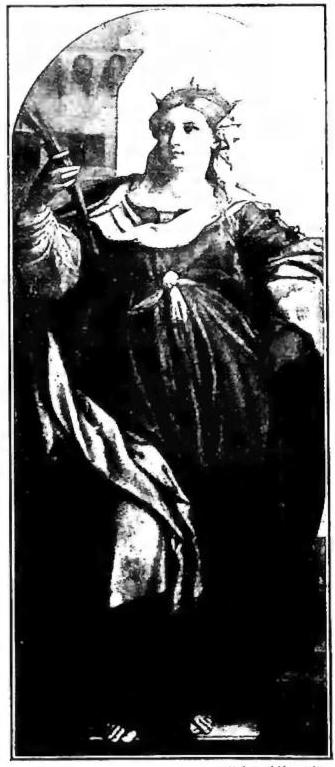
PALMA IL VECCHIO (GIACOMO NEGRETTI) — St Barbara. Painting in the church of S. Maria Formosa, Venice.
(courtesy of Prof. E. Joni) PALMAS - Interior of the Cathedral (20th century).in color in Munich, in the Accademia of Venice, the Louvre, and the Museum of Naples: in the latter, there is a Mannerist expansion of contours that calls Pordenone to mind, whereas examples of a tendency toward the precise definition of forms are found in the Adamo ed Eva of the Brunswick Museum (believed to date from 1512 but rather later) and in the Veneri of Dresden and Cambridge. A celebrated masterpiece is the Altare di S. Barbara in S. Maria Formosa in Venice, erroneously considered a youthful work, in which the serene solemnity of the figures is clothed in a warm, compact color, with chiaroscuro modeling that reflects Tiziano’s investigations. P. exalted feminine beauty in a series of portraits in which warm, sensual color is set against a vacuous coldness of expression: among the best known are the Bella (Rotschild collection in Paris), the so-called Violante in Vienna (attributed to Tiziano by Longhi), the Tre sorelle in Dresden, and others in Berlin, Milan (Poldi Pezzoli), etc. Among the other portraits, particularly beautiful is the Giorgionesque Poeta in the National Gallery, while those in the Querini Stampalia collection in Venice are noteworthy for their simplicity of composition (they formed part of a group of 68 works, most of them unfinished, listed in P.’s will of 1528). Also mentioned are the pala of the parish church of Zerman (Treviso), prior to 1511; the Assunta and the S. Pietro of the Accademia, and the S. Lorenzo e santi of S. Maria dell’Orto in Venice; and the Adorazione dei Magi in Brera, later than 1525.
BIBL.: G. Gombosi, s. V. in Thieme-Becker, XXVI, pp. 171–176 (with preceding bibliography); P. Locatelli, Notizie intorno alla vita e alle opere di P. V., Lipsia 1908; G. B. Cavalcaselle, A history of Painting in north Italy, ed. Borenius, III, Londra 1912, pp. 351–390; Venturi, IX, III, pp. 378–437; W. Suida, Studies in P., in Belvedere, 1934–35, p. 85; G. Gombosi, P. V., in Pantheon, 1935, p. 184; id., P. V., Stoccarda 1937; R. Pallucchini, La pittura veneziana del 500, I, Novara 1944, p. 35. Nolfo di Carpegna
Cite this article
“PALMA IL VECCHIO (GIACOMO NEGRETTI, DETTO).” Enciclopedia Cattolica, vol. IX (1952), p. 410. Azione Romana digital edition, https://azioneromana.com/article/palma-il-vecchio-giacomo-negretti-detto.
 Enciclopedia Cattolica