
GIORGIONE, GIORGIO da CASTELFRANCO called il. — Painter, born in Castelfranco Veneto probably in 1477 or 1478, died in Venice shortly before 25 October 1510; one of humanity’s greatest artists. He was the first free interpreter of nature; his creations are the fruit of a lyrical sentiment that lies at the foundation of modern art.
Nothing precise is known about his birth or beginnings, and only with difficulty can a few details of his life be reconstructed. That G. was born of a very humble lineage, as Vasari asserts, seems quite probable. Ridolfi (1648) says that he was called Barbarella; but this is the name of the family that perhaps adopted him. He was probably a foundling, and his predilection for the myth of Paris seems to confirm this. In contemporary documents he is called Zorzi or Zorzo da Castelfranco; Zorzon or G. is a designation that appears after his death, and is first written by Pino (1548).
Regarding G.’s artistic education, Vasari’s information is contradictory, because in the first edition of his Lives he states that G. was sent to the school of Gentile and Giovanni Bellini; whereas in the second edition (which is more reliable, since he had received information about G. directly from Titian) he makes no mention of such teaching, limiting himself to stating that G. far surpassed the Bellini. It is known from the inscription on the reverse of the painting of the Laura in the Vienna Museum that in 1506 he was the «colleague» of Vincenzo Catena and was called «master»; that in 1507 he received the coveted commission for a canvas to be placed in the Hall of the Council of Ten in the Doge’s Palace; and that he was certainly a master who had attained great fame in 1508, when he was entrusted with frescoing the Fondaco dei Tedeschi on the side facing the Grand Canal (while the less important walls, toward the Mercerie, were commissioned to Titian). Unfortunately, the canvas for the Doge’s Palace has been lost, and of the frescoes in the Fondaco there remains only a ghostly female figure, transferred to the Galleria dell’Accademia a few years ago (an iconographic record of those paintings survives in Zanetti’s engravings, 1760).
Vasari’s information about G.’s life and works is scant and not all reliable. He recalls him through tradition, especially that of Titian, as «gentle and of good manners, who continually delighted in matters of love and greatly enjoyed the sound of the lute, so much so that in his time he sang and played so divinely that he was often employed for various musical performances and entertainments and gatherings of noble persons»: remarks that also clarify G.’s «pictorial musicality». For the reconstruction of G.’s activity, in addition to Vasari, the Venetian nobleman Marcantonio Michiel is of assistance; from 1525 to 1543 he recorded various paintings and drawings by the master in the private houses of Venice and Padua, which constitute the principal sources for knowledge of his art. G.’s chronology can be defined only approximately.
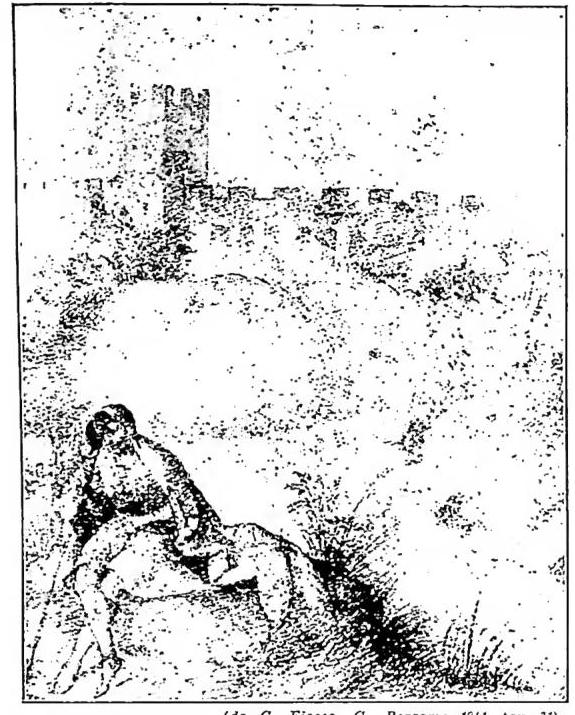
(from G. Fiocco, G., flergame 1911, pl. 31)
GIORGIONE, GIORGIO da CASTELFRANCO called il — Shepherd in a countryside. Drawing — Rotterdam, Boymans Museum (Koenigs Collection).
symbols of the warrior life; in it one should recognize almost a projection of G.’s ideological world, rather than his hand, since it is a work conceived with decorative aims.
The first important work, chronologically, on which critical judgment appears unanimous, is the Judith in the Hermitage in Leningrad: a work probably dating from around 1500–1502, of the utmost delicacy of execution and possessing that «united sweetness of colors» which Vasari considers a particular requisite of the «modern manner» inaugurated by G. The following paintings also belong to his youthful period and form a stylistically homogeneous group: the Adoration of the Magi in the National Gallery in London, in which echoes of Bellini and Carpaccio resound; the Holy Family, formerly in the Benson collection in London and now at the Duveen art gallery in New York, inspired, both in its composition and in the Gothicizing style of its drapery, by Schongauer’s prints; the Madonna of the Landscape in the Hermitage in Leningrad, an interpretation of exquisite humanity and naturalness; and the Sacred Conversation (formerly attributed to the school of Giambellino) in the Accademia of Venice, the latter work still disavowed.
This «first period» concludes with the celebrated Madonna of Castelfranco, executed around 1504–1505, a creation of marvelous beauty, especially in the upper part, where the dreaming Virgin with the Child reigns over a gentle sunset landscape, wholly suffused with a golden luminosity diffused through the atmosphere. And if, measured by the standard of Tuscan mathematical perspective, one notes in the composition as a whole some distortions caused by a viewpoint placed too close to the figures, the new poetic world revealed in it through a lyrical tonal interpretation of color transcends any restrictive judgment in the presence of so lofty a masterpiece.
G.’s maturity (a relative maturity, since it extends from approximately his twenty-seventh year to his thirty-third, when he died) certainly includes the aforementioned Ideal Portrait of Laura (1506), in the Vienna Museum; the Portrait of a Young Man in the Kaiser Friedrich Museum in Berlin, which likewise embodies an ideal of Renaissance beauty; and the portrait of the Old Woman «with Time» in the Accademia of Venice, by contrast, a work of astonishing realism inspired by the Northerners, formerly attributed to Torbido and, in truth, still unjustly disputed; as is, unfortunately, the suggestive panel with The Three Ages in the Pitti Gallery in Florence, whose attribution also remains debated. These are joined by the universally celebrated works, namely the aforementioned fragment of the fresco from the Fondaco dei Tedeschi (1508) and The Tempest, both in the Venetian Accademia, as well as the Three Philosophers in the Vienna Museum. The Tempest is the work that, more than any other by G., expresses for the first time in the history of art that panicked feeling of nature, that living and pulsating of man in unison with creation, that intimate «revelation» through which he is part of the cosmos and subject to its supreme laws. The descriptive, «optical» landscape of the Flemish and Northern painters is surpassed in a sublimely poetic transfiguration: so poetic that the figurative subject (probably referring to the myth of the infant Paris) recedes into the background, and Michiel already did not know it precisely, citing it only as «the little landscape with the storm, with the gypsy woman and soldier». The «theme» is even more mysterious when one considers that in the first version of the work G. had painted, in place of the «soldier», a nude female figure seated at the edge of the stream, bathing her feet in the water, as was recently revealed by radiographic examination of the painting.
The “subject” of the Three Philosophers is likewise somewhat enigmatic, having also been interpreted as Three Mathematicians, Three Astronomers, or Three Magi, or referred to Roman mythology, and even to the occultism of secret societies; but it most probably represents the three stages of philosophy, personified for antiquity by Aristotle, for the Middle Ages by Averroes, and for the Renaissance by the young observer and measurer, a follower of the new ideas of naturism then being taught at the University of Padua. The philosophical theme (or, in any case, the mythological one or whatever else it may be) has been transformed into pure lyricism, into musical contemplation; and the painting possesses a chromatic intensity so profound that it finds a counterpart only in a few works by G. himself. According to Michiel, the painting was completed by Sebastiano del Piombo; but it is certain that his intervention was limited to a few nonessential parts.
A painting that is moving toward universal critical recognition is the Adoration of the Shepherds, formerly in the Allendale collection in London and now in the National Gallery of Washington; it is among G.’s most important paintings, in which the master’s highest pictorial qualities are admirably summarized and synthesized. It must certainly be identified with the “Nocte” that Isabella d’Este wished, but unsuccessfully, to have acquired immediately after G.’s death. A masterpiece of the master’s final years, it is particularly enchanting in its atmospheric interpretation of light, which anticipates Vermeer’s achievements. Critical judgment is also moving toward agreement concerning other little-known works, such as the Eros with the Arrow in the Vienna Museum; the Self-Portrait in the Guise of David in the Braunschweig Gallery, which is unfortunately only a very deteriorated and restored fragment; and the Male Portrait, formerly in the Terris collection in London and now in the Museum of S. Diego, California, bearing on the reverse a contemporary inscription identifying it as “di man de m. Zorzi de Castel fr...” with the date (not entirely legible) 1508. Its strong resemblance to the aforementioned “self-portrait” in Braunschweig makes it probable that, in this marvelous head, with its diffuse luminosity and compact, thick chromatic substance, G. portrayed himself.
Also helping to clarify G.’s “pictorial world” are several copies of his paintings made by Teniers the Younger, such as the Finding of Paris, in the Loeser collection in Florence; the Attack, in the Gronau collection, also in Florence; and the half-length figure of Nero in the collection of Professor Suida in New York. Other interesting copies of lost originals by G. should be considered to include the Horoscope in the Dresden Gallery, the Shepherd with a Flute at Hampton Court, and David with the Head of Goliath in the Vienna Museum,
the Pageboy with the Golden Ball in the Ambrosiana of Milan; but in the case of these last two, they may also be originals damaged by old overpainting.
Among the uncertain works remains the much-discussed Judgment of Solomon, in the Bankes collection at Kingston Lacy in England, perhaps merely begun by G. and completed by Sebastiano del Piombo, while other celebrated creations, such as the Pastoral Concert in the Louvre, the Concert in the Pitti, the Adulteress in the Glasgow Museum, and the Madonna with ss. Roch and Anthony in the Prado, must now, without further doubt, be restored to the genius of the young Vecellio. As for the celebrated Sleeping Venus, formerly in the Dresden Gallery and now in the possession of the U.S.S.R., it is commonly held that the painting was begun by G. and finished by Titian, on the assumption that it is the same work noted by Michiel in 1525 in the house of Gerolamo Marcello in Venice; but its identification with that work is highly debatable, whereas the expansive pictorial style, the monumental composition, the chromatic impasto, and every formal element argue in favor of Titian alone; toward whom, moreover, criticism is decisively turning.
Of the many drawings attributed to G., only one is unanimously accepted as autograph: the Little Shepherd, with a view of the walls of Castelfranco in the background, in the Boymans Museum of Rotterdam; but the Violinist, in the École des Beaux-Arts in Paris, must certainly also be considered to be by his hand. These are drawings of extreme refinement, conceived in a properly “pictorial” sense.
G.’s artistic development began with the still-fifteenth-century concepts of the Bellini and Carpaccio, but soon departed from them in the search for a new pictorial world. According to Vasari, the revelation of this new world came to him through Leonardo’s “sfumato”: an hypothesis containing some truth when one considers the certain analogy of intention between the “spatial and atmospheric depth” achieved by Leonardo through chiaroscuro and G.’s “tonal harmony,” likewise understood as atmospheric fusion, but achieved exclusively through color. From his earliest works onward, G. rose above the distinction between form and color; for him, it is color that gives form to things. He therefore soon abandoned, as Vasari rightly says, though with exaggeration, “the dry, crude, and labored manner of the Bellini,” and began to work “without making a drawing, holding firmly that painting solely with the colors themselves, without any further study of drawing on paper, was the true and best way to proceed.” Thus G. passed from Leonardo’s “sfumato” to a touched brushwork, itself a consequence of tonal painting. It is therefore precisely to the final phase of G.’s development that Vasari’s passage must be referred—a passage that, in any case, so vividly captures the novelty of Giorgione’s painting.
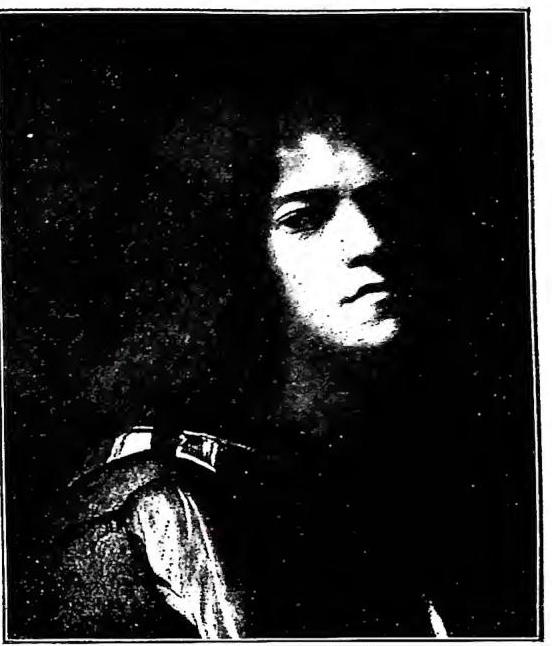
(from G. Fiocco, G., Bergamo 1915, vol. 10)
GIORGIONE, GIORGIO da CASTELFRANCO detto il - Surviving fragment of the self-portrait in the guise of David - Munich, Braunschweig collection.
To achieve the perfect fusion of his colors, G. employed a pictorial technique of glazing, which was already in use, moreover, in Venetian painting, but which he developed further, giving it capital importance. The exegesis of G.’s art is not, however, exhausted by the diagnosis of form; it requires a spiritual surrender to its pure poetic values, without which his pictorial personality, exquisitely mysterious and ineffable, would remain a dead letter.
G. is not a myth, as some have asserted. Besides the documents of the period cited above, G. is mentioned in the Diarii of Marin Sanudo, in which he recorded his death. But the most “living” documents concerning G.’s works are the letters Isabella d’Este exchanged, immediately after the artist’s death, with her agent in Venice, Taddeo Albano, in order to secure a Nocte by the great painter who had prematurely disappeared. Albano replied on 7 November that of the “Nights” (that is, Adoration of the Shepherds) painted by G., one was in the possession of Taddeo Contarini, another, of better workmanship, in that of Vittorio Beccaro; but neither one nor the other was willing to sell them “at any price; for they had had them made in order to enjoy them themselves”: an edifying example of the love that patrons felt for the works of the Master, whose greatness was already fully recognized by his contemporaries. - Vedi tav. XXXIV.