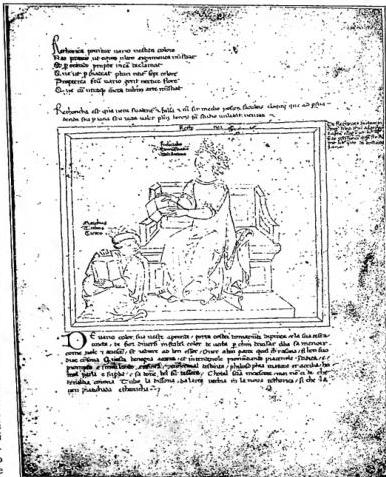
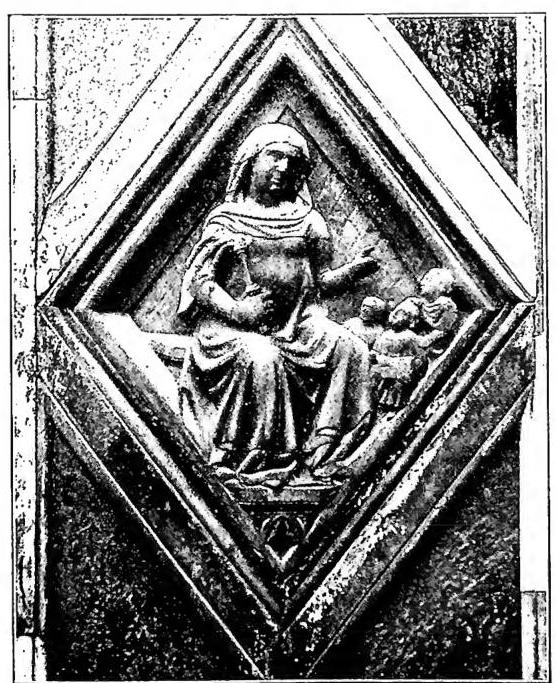
ARTI LIBERALI. — The literary and scientific disciplines that, during the Middle Ages, constituted the propaedeutic instruction to philosophy and theology were known as l. a. They were divided into two groups, called the trivium (grammar, rhetoric, dialectic) and the quadrivium (arithmetic, geometry, astronomy, music). The name, through the Latin tradition, derives from the Greek (ἐλεύθεροι τέχναι), and designates the arts worthy of a free man, in contrast to mercenary and mechanical ones (βάνσωσι). The distinction, which first appears in Plato (De republica, 405 a; 522a), is repeated by Aristotle, who, treating the education of young people in the Politica (VIII, 2), defines as mechanical every art or discipline that renders a free man unfit for the exercise of virtue. Cicero uses respectively for the two classes the terms «liberales» or «ingenuae» or «honestae», and «sordidae» or «inhonestae» (De officiis, I, 42).
As regards their number, Aristotle (loc. cit.) indicates as constitutive of the instruction commonly in use in his time: grammar, gymnastics, and music, «to which painting is sometimes added». Cicero in the De oratore (III, 32) includes: geometry, music, physics, ethics, politics, and the study of literature and poets. Very close to the medieval list is that given by Quintilian (Institutiones oratoriae, I, 10), who uses to designate the whole the Greek expression ἐγκύκλιος παιδεία («orbis doctrinae»), an expression that takes us back to the ideal and practice of the Hellenistic age. The complete complex appears definitively established in Pseudo-Cebes and in the Neoplatonist Porphyry. After Boethius, the cycle of the seven arts, which until then had undergone various fluctuations according to differing cultural ideals, was by now universally employed.
Grammar, from the final years of the Republic and then throughout the Empire, had as its principal task the teaching of the parts of speech, based on the testimony and authority of the ancients. Varro distinguishes four stages in the study of grammar: «lectio», or reading the classical text; «emendatio», or literal and literary commentary; «enarratio», or criticism of the text and style; «iudicium», or an overall view. During the Middle Ages grammar embraced the study of ancient and recent grammarians and writers. The two works on the eight parts of speech (Ars minor and Ars maior) by Aelius Donatus, who had been St. Jerome’s teacher in Rome and the most celebrated grammarian of his time, were extremely widespread and often commented upon. Alongside him, Priscian of Caesarea in Mauretania (ca. 500) was very well known, chiefly for his work, in 18 books, Institutio de arte grammatica. In addition, together with writers such as Orosius, Gregory of Tours, and Boethius, grammar included the reading of the Latin classics—Virgil, Horace, Seneca, etc.
Rhetoric had been held in great honor among the Romans. The traditional model of this discipline, intended to form the «vir eloquentissimus», was the Greek orations. Instruction comprised a theoretical part concerning the genres of eloquence—epideictic, judicial, deliberative—and its essential stages: invention, arrangement, and elocution; as well as a practical part consisting of frequent and varied exercises. In the Middle Ages rhetoric was not of primary importance. Theodoric of Chartres, in his Heptatouchon, recalls Cicero, Quintilian, and Marius Victorinus as models to be preferred.
Of the remaining liberal arts, geometry seems to have been taught during the Empire (Ulpian, Digesto 50, 13, 1), and especially astronomy. Varro mentions dialectic, arithmetic, and music, to which he also adds medicine and architecture. In the Middle Ages dialectic underwent great development and assumed the utmost importance in the 11th and 12th centuries. Whereas for St. Augustine it was still the science of the laws governing the activity of reason, or the art of convincing and confounding one’s adversary, in the Middle Ages, after the discovery of the complete Aristotelian Organon, it slowly grew richer and was transformed, until it assumed the characteristics of authentic philosophical speculation. The disciplines of the Quadrivium had less scope in the Middle Ages, since by their very nature they required more specialized technical preparation. The foundation of instruction in mathematics and astronomy consisted above all in the books of Boethius, Gerbert’s Astrolabio, and the theories of Euclid, in the version of Adelard of Bath.
Medieval scholars already found the entire ordering of the liberal arts clearly outlined in Cassiodorus’s De artibus ac disciplinis liberalium litterarum (part 1, praef.) and De institutione divinarum litterarum. These two works, a kind of general encyclopedia of knowledge, helped to disseminate that program of instruction which, subsequently taken up and renewed by Isidore of Seville and later by Alcuin, became, in the Trivio e Quadrivio, the characteristic canon of studies during the Middle Ages. This teaching, modest though it was, fulfilled, particularly during the centuries of the early Middle Ages, a function of unquestionable importance, preserving for the speculative revival of the 12th and 13th centuries the essential continuity of classical thought and culture.
It was precisely during this period that the expansion of knowledge, following the discovery of the Aristotelian synthesis, led to the gradual devaluation of the Trivio e Quadrivio. Yet Dante, according to a probable interpretation of the allegory, still regarded the liberal arts as indispensable propaedeutics to human knowledge when he speaks of the noble castle of Limbo, where, together with the other wise men, he must enter through seven gates (Inf., IV, 106–11). At the height of humanism, P. Paolo Vergerio entitled the pedagogical work written for Ubertino, son of the lord of Carrara, De ingenuis ac liberalibus studiis. But the liberal studies were already richer, and the aim was no longer the forma-