
LIMBO. – From the Latin limbus (= hem, edge, border), it is the place and state of the souls who, having not deserved hell, could not, before the Redemption, enter heaven (l. of the holy Fathers), or are eternally excluded from it because of unremoved original sin.
I. THE L. OF THE SS. FATHERS. – The state and place in which the just of the Old Testament found themselves: although they departed this life in grace and fully purified of their sins, they could not enter Paradise, because the Redemption of humanity had not yet been accomplished. Thus the souls of the just who died before Christ were in a tranquil state, serenely awaiting the Redemption. This state was called the l. of the Fathers, or
The word l. appears in theology only after Pietro Lombardo (d. 1160); the Jews called it fē'ōl; in the Greek version of the Bible made by the Septuagint, it was translated by the word Hades ('A8yc), and in the Latin version by the word Inferno (Infernus), which were the Latin and Greek terms denoting the dwelling place of the dead. The image evoked by these terms is that of a dark place, situated in the bowels of the earth, like an immense abyss. Sē'ōl was, in the Hebrew language, a common term designating both the dwelling of the just (“bosom of Abraham”) and the dwelling of the wicked, Gehenna, as it is called in the Gospel (Mt. 5, 22; 23, 15; 10, 28; Mc. 9, 42, 46; 18, 9; Lc. 12, 15). Subsequently, the expression “bosom of Abraham” became synonymous with Paradise. Thus, in the liturgy for the dead, God is entreated to place souls in the “bosom of Abraham” (cf. P. Heinisch, Teologia del Vecchio Testamento, Torino 1950, pp. 307–13). The l. of the ss. Fathers came to an end with the descent of Jesus.
II. DESCENT OF JESUS CHRIST TO LIMBO
I. Dogma
In the time between his death and the Resurrection, Christ’s soul descended into fē'ōl (ad inferos) to bring the fruits of redemption to the souls of the just, who were awaiting the fulfillment of God’s promises, in which they had believed. Thus Christ, as Redeemer, also shared the lot of the just who had believed in him, going with his soul into fē'ōl to await the hour of his triumph.The descent of Christ’s soul into limbo is an article of faith explicitly included in the Creeds from the fourth century onward, as is clear from the testimony of Rufinus (Denz-U, 3). In 447 Leo the Great spoke of Christ’s descent into hell as a dogmatic truth believed by the whole Church and beyond dispute (Epist. ad Turribium, 17: PL 54, 690). At the Fourth Lateran Council (1215), it was specified that the descent into limbo took place with the soul (in anima), in order to condemn Abelard’s opinion, according to which that descent was to be understood in a purely metaphorical sense, namely, as a simple saving operation performed by Christ in the souls of the just; a descent through potentiam, rather than a descent proper to the soul into the same abode as the just of the Old Testament.
This article of faith is contained in Sacred Scripture. Saint Peter, announcing the Resurrection of Christ to the Jews immediately after Pentecost, said, referring to David’s prophecy (Ps. 15, 19): “Since David was therefore a prophet and knew that God had promised him with an oath that one of his descendants would sit upon his throne, he spoke prophetically of the Resurrection of Christ, that he was not abandoned in fē'ōl, nor did his flesh see corruption” (Act. 2, 24-31). Other passages of the New Testament also allude to the dwelling of Christ’s soul in limbo (Mt. 22, 40; Rom. 10, 6-7; probably in I Pt. 3, 19-20).
As the holy Fathers point out, the doctrine of Christ’s descent into limbo accords with the divine plan of Redemption, according to which Christ freely and out of love takes upon himself all the states of troubled human existence, in order to redeem all. Descending into limbo and revealing himself to the just, Christ’s soul, subsisting in the person of the Word, brought the light of happiness: fē'ōl was transformed into Paradise, and the promise made by Jesus to the good thief was fulfilled: “Today you will be with me in Paradise” (Lc. 23, 43).
The effect of Christ’s descent into limbo was the liberation of the souls of the just who had departed this life in the grace of God; these just belonged not only to the Jewish people but also to the pagan peoples, among whom there could have been persons enlightened, believers in the future Redeemer, and living according to Grace, as Clement of Alexandria explicitly held (Stromata, 6, 6). It did not have the effect of redeeming those who had died without faith and without grace, condemned by God in hell for their obstinacy in evil. It did not grant redemption to children who had died with original sin, nor did it free the souls in Purgatory, except those that had already been purified and were ready for Paradise (Sum. Theol., 3a, q. 52).
Calvin interpreted the descent into limbo as meaning that Christ had suffered the pains of hell, so that we might be spared them. Calvin himself, like all Protestants after him, gave a metaphorical meaning to Christ’s descent into limbo. The rationalists maintain that this Christian belief was derived from the myths of paganism (Hercules, Orpheus); in reality, there is no more than an external resemblance between the Christian doctrine of Christ’s descent into hell and the pagan myths. The Christian dogma is already foreshadowed in the Old Testament, where mention is made of the just who descend into fē'ōl with the hope of Redemption, awaiting “Him who shall be sent” (Gen. 40, 10).
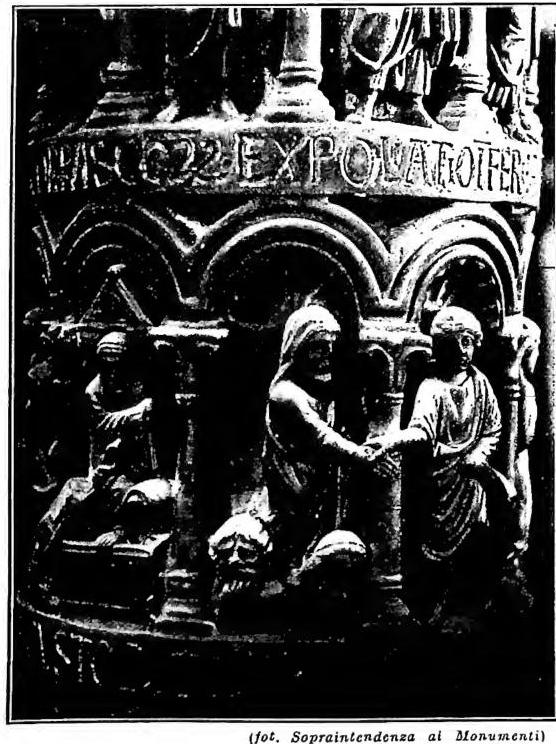
(photo: Superintendency for Monuments)
LIMBO – Christ in l. Detail of one of the columns of the ciborium of S. Marco (6th century) – Venice, basilica of S. Marco.
logical justification of the doctrine of the Descent in the older Christian tradition, in Zeitschrift für kath. Theol., 71 (1949), pp. 1–53 (important for the theology of the Fathers); I. De Ghellinck, Patristique et moyen-âge. Recherches sur les origines du Symbole des Apôtres, I, 2nd ed., Gembloux 1949, pp. 214–16, 238 n. (a reliable judgment on the works cited above). For the theological significance of the article: St Thomas, Sum. Theol., 3e, q. 52, with the classic commentaries and treatises of dogmatic theology. Cf. also: H. Quillet, Descente de Jésus aux enfers, in DThC, IV, cols. 565–619. Marcolino Daffara
2. Art
The representation of this subject in Christian art began relatively late. Literary testimonies date it to about the 6th century, when its first known representation appears on one of the carved columns of the ciborium of S. Marco in Venice. Later, in the 8th century, the representation of Christ descending into l. appears in a fresco of S. Maria Antiqua in Rome. This is already connected with Byzantine and Byzantine-influenced iconography, which continued through the 13th century and beyond, as demonstrated by the psalter of the Chlondof collection and others of the same type (9th–10th centuries; cf. Kondakof [V. BIBLICA.]) in Paris, as well as contemporary ones formerly in the Imperial Library of Petersburg and in the Vatican (Urb. lat. 2), or by scenes in frescoes and mosaics (often included in the cycle of the Passion), such as the mosaic of Dafni, particularly interestingfor its unusual freedom in interpreting the theme; the fresco in the lower church of S. Clemente in Rome (11th century); the mosaics of Monreale, Torcello, and Venice (12th century); and, down to the present day, those in Byzantine and Russian iconostases. The principal source for these artists is the apocryphal Gospel of Nicodemus, which establishes a compositional scheme consisting of a succession of episodes in which, generally, the moment is represented when Christ appears and extends his hand to Adam, who is accompanied by Eve: to these, who are the only figures in the earliest miniatures, are later added Satan bound, sometimes David and Solomon, and the liberated righteous. In northern Europe, where the earliest known works are no earlier than the 11th century, the scheme is instead abandoned, as shown by the Antependium of Klosterneuburg and the Psalter of Herman of Thuringia, and there is a tendency to make it an episode of the Last Judgment (e.g., S. Giacomo di Guérens).
Production, abundant especially in the 11th–13th centuries, then tended to decline in the following centuries until it was completely neglected after the 16th century. Among the finest representations of the 15th century, the fresco by Beato Angelico in the Convent of S. Marco should be mentioned; in the 16th century, Dürer and Bronzino still treated this subject.
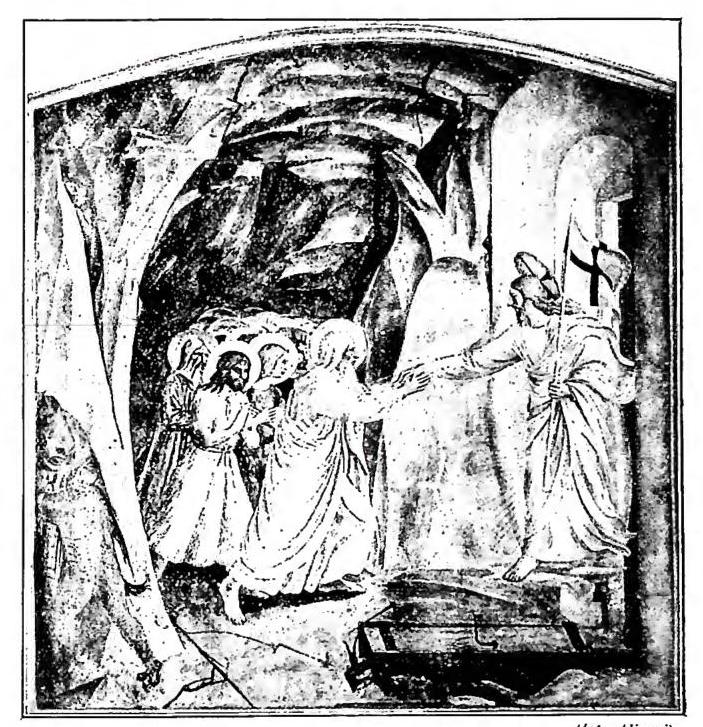
LIMBO – Descent of Jesus into Limbo, fresco by B. Angelico and collaborators. Florence, Convent of S. Marco.
III. LIMBO OF CHILDREN
According to theology, there still exists the limbo of children, that is, the state and place of unbaptized children who died before attaining the use of reason, without remission of original sin. Since, on account of their age, they are incapable of making acts of faith and contrition (Baptism of desire), they cannot be freed from original guilt except through Baptism, conferred in fide Ecclesiae; without receiving it, they do not « are reborn of water and the Holy Spirit » (Io. 3, 5) and therefore are not admitted into the Kingdom of God; they will not, however, undergo any other punishment, but rather, according to the common opinion of theologians, will enjoy a certain natural beatitude. As s. Tommaso puts it, « they will be happy in participating extensively in the divine goodness through natural perfections » (II Sent., d. 33, q. 11, a. 2; cf. d. 45, q. 1, a. 2; Sum. Theol., suppl., q. 79, a. 4). This theological conception, although not explicit in Sacred Scripture, is founded upon the justice of God, which cannot inflict personal punishments upon one who has no personal sins. Therefore, the lot of children who died without Baptism,as s. Gregorio di Nissa observes (PG 46, 177-80), must be distinguished from that of adults who, through their own fault, neglected Baptism; nevertheless, they will not be admitted to supernatural happiness, as the Pelagians thought, against whom the Council of Carthage in 418 (Denz-U, 102 note 4) and s. Agostino (De anima et eius origine, 12, 17: PL 44, 505) pronounced themselves. The limbo of children lasts eternally, since those who died with original sin alone are fixed in that state forever. This doctrine was clarified by the great theologians of the thirteenth century. - Vedi tavv. XC-XCI.