
INFERNO. — According to Catholic doctrine, it is the place in which the rebellious angels and human beings who die in mortal sin are eternally punished.
Etymologically, it derives from the Latin infernus, “lower, subterranean place,” and corresponds to the Greek ἀδός, “dark place” (from privative α and the root a) [“to see”]) and to the Germanic Hole (German Hölle, English hell), which means cave. The Hebrew ἐδ'ῶ seems to derive from ἐδ'ῶ, fodit, excavit, and indicates: pit, dark cavity, void. This interpretation is confirmed by Gen. 37:35; Num. 16:30; Deut. 32:22; Iob. 10:21–22; Ps. 85:13; Prov. 15:24;
Is. 14:9; Ez. 31:15. Others prefer to assign to the root ἐδ'ῶ the meaning popascit, which would indicate an insatiable abyss that devours human beings, or else a place of inquiry, as though the dwelling of spirits who were consulted (cf. Prov. 27:20; 30:16; Is. 5:14; Ps. 6:6; 89:49).
SUMMARY:
I. The existence of i
II. The nature of the punishments of i
III. The properties of the punishments of i
IV. Iconography.I. EXISTENCE OF HELL
The Jews, like all ancient peoples, admitted the survival of man after death. They held that all the dead (Ps. 89:49; Iob. 3:13–19) descended into ἐδ'ῶ, an immense cavern, as large as a region (Iob. 10:21–22; Ps. 88:13), divided into sectors of varying depth (Is. 14:15; Ez. 32:23), poetically conceived as a profound abyss, almost an insatiable monster (Ps. 144:7; Prov. 1:12; 27:20; 30:15), which never returns its prey (Iob. 7:9; 14:12; 16:22; 17:13–16). A dark place, where «nullus ordo sed sempiternus horror inhabitat» (Iob. 10:21), it is described as a prison-land, closed by gates and bars (Is. 38:10; Iob. 38:17; Ps. 9:14; 107:18). There the dead, commonly called réphá'im (weak, feeble), lead a halved, shadowy life, without knowledge or will, as though immersed in a profound lethargy (Iob. 14:12).This vague conception of the hereafter, which prescinds from a clear distinction between the fate of the good and that of the wicked, predominates in the historical books (Pentateuch, Judges, Kings); it is slightly modified in the moral books (Job, Psalms, Proverbs, Ecclesiastes), in which, from the anguished spectacle of injustices on this earth, one rises to the concept of a sanction in the world beyond (Prov. 11:4; Eccl. 12:13–14). The emphasis takes on precise contours in the Prophets, who describe in vivid colors the otherworldly punishment of the wicked: Is. 66:23–24: «All shall come to bow down before me and, going out from the walls, shall see the corpses of the men who have rebelled against me, for their worm shall not die and their fire shall not be extinguished, and they shall be an abhorrence to every man.» This is the great prophetic vision of eternal punishment, inspired by the macabre spectacle of the Valley of Hinnom near Jerusalem. The description is repeated in Iud. 16:20–21: «Woe to the nations that rise up against my people: the Lord, the Almighty, will punish them on the day of Judgment, when he sends fire and worms into their flesh, so that they may howl in pain forever.» Daniel (12:1–2), announcing for the first time the resurrection of the wicked for a judgment of condemnation, says clearly: «Many who sleep in the dust shall awake: some to eternal life, others to eternal disgrace and eternal infamy.» Similar themes are developed in Is. 14:9–20; 33:14; Ez. 32:23; Zach. 5:1–11; Mal. 4:1–3.
This faith in otherworldly retribution, which until the third century B.C. belonged to the chosen souls and the great seers of Israel, became widespread after the religious persecution of Antiochus IV, under whom many Jews suffered martyrdom. The sight of the heroes who, in order to remain faithful to God, had sacrificed their lives deepened in the souls of the persecuted the idea of the reward of the good and the punishment of the impious. This faith vibrates in the words of the mother of the Maccabees and her seven sons, in which the announcement of eternal punishment is fiercely hurled in the face of the persecutors (II Mach. 7:1–39), and it permeates the entire book of Wisdom, according to which the wicked will be oppressed by unspeakable sufferings and will lament in vain at the universal Judgment, when they witness the happiness of the just (5:3–13).
The precursor, link between the two Testaments, sums up the doctrine of the Old in the penitential cry: «Brood of vipers, who suggested to you that you flee from the coming wrath? Bear, therefore, fruits worthy of repentance» (Mt. 3:7), and opens the New by pointing out in the already come Messiah the one who «holds the winnowing fan to sift the grain: and he will cleanse his threshing floor and gather the wheat into the granary and burn the straw in a fire that shall never be extinguished» (Lc. 3:7, 17). The idea of unquenchable fire, joined to that of the worm that does not die, already powerfully staged by Is. 66:23–24, repeated by Iud. 16:20–21, and taken up again by St. John, constantly returns to the lips of Jesus, who connects it with the macabre image of Gehenna (many times in the Synoptic Gospels). This term is composed of gē' («valley») and Hinnōm (probably the name of the ancient Jebusite owner). By this toponymic designation was indicated a ravine southwest of Jerusalem, sadly famous because there Achaz (II Reg. 16:3) and Manasseh (ibid. 21:6) had immolated and burned human victims, especially children, in honor of Moloch. The horrible crime, later repeated by the Jews, was stigmatized by Jeremiah (7:31–32; 19:4–7; 31:38–40) and by Ezekiel (20:30–31). From that time onward, the sinister name was associated with the idea of the fire devouring the victims and the worms that slowly consumed the unburied corpses. By evoking this historical-prophetic image, Jesus impressed upon his hearers a powerful and apt idea of the eternal punishment of the wicked. In his preaching he identified as candidates for Gehenna those who insult their brothers (Mt. 5:21–26), hypocrites (Mt. 11:23; 23:15; 24:51; Lc. 10:15), apostates (Mt. 10:28; Lc. 12:5), and those who wish to serve two masters (Lc. 5:29–30; 18:9). Particularly forceful is the saying: «And if your hand causes you to stumble, cut it off; it is better to remain maimed than, having two hands, to be cast into Gehenna, into the unquenchable fire (πῦρ τὸ ἄσβετον), where their worm does not die and the fire is not extinguished» (Mc. 9:42–43). Moreover, beneath the gentle veil of the Gospel parables, Jesus clearly allowed the prospect of eternal damnation to be glimpsed: the weeds will be thrown into the fire: «sic erit in consummatione saeculi... mittent eos in caminum ignis (εἰς τὴν χάμινον τοῦ πυρός); ibi erit fletus et stridor dentium» (Mt. 13:40–42); in the dragnet of fish, the wicked will be cast away (Mt. 13:47–50); at the wedding feast, whoever does not wear the wedding garment will be thrown «in tenebras exteriores» (Mt. 22:1–14); the foolish virgins will remain outside the door (Mt. 25:1–13); the slothful servant will be driven from his master’s house (Mt. 25:14, 30; Lc. 19:1–28).
In the great eschatological discourse Jesus foretells that at the universal Judgment the Lord will separate the good from the wicked and will address the latter with the words: «Depart from me, accursed ones, go into the eternal fire (εἰς τὸ πῦρ τὸ αἰώνιον), which was prepared for the devil and his angels... And these shall go away to eternal punishment, and the just to eternal life» (Mt. 25:31–46).
The Apostles echo the teaching of the Master. St. Paul repeatedly enumerates the sins that exclude one from the kingdom of God (Rom. 2:7–9; I Cor. 6:9–10; Gal. 5:19–21; Eph. 5:5) and recalls to the Thessalonians the otherworldly justice by which the persecuted will find consolation and the persecutors «paenas dabunt in interitu aeterna» (II Thess. 1:9). St. Peter, in vivid expressions, foretells future suffering for the impious: «Hi sunt fontes sine aqua et nebulae turbinibus exagitatae quibus caligo tenebrarum reservantur» (II Pt. 2:12–17). St. Jude recalls the punishment of the Pentapolis to admonish the Sodomites, «exemplum ignis aeterni paenas sustinentes» (Iud. 7), and compares sinners to wandering stars «quibus pro-
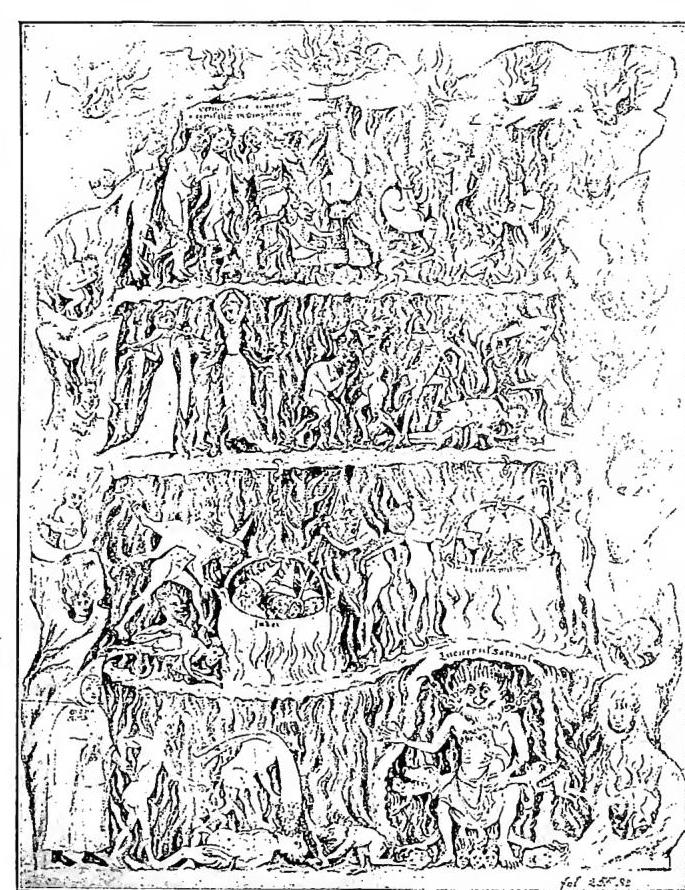
(from Herred of Landsberg, Hortus Deliciarum, Strasbourg 1901, plate 73)
INFERNO - Miniature from the Hortus Deliciarum (from a copy), fol. 255² - Paris, National Library.
cella tenebrarum servata est in aeternum » (Iud. 13). In the Apocalypse, S. Giovanni speaks of the abyss, of which Satan is king (9, 11), because he possesses its keys (9, 1); when he opens its gates to unleash his satellites upon the world, “from the pit there rises smoke, like that of a great furnace, by which the sun and the air are darkened” (9, 2). From the abyss emerge the Antichrist, the beast, and the multitude of demons, represented by the army of locusts (11, 7; 17, 8). An angel will cast Satan back into his depths and hermetically seal its opening, so that he may deceive the nations no longer (20, 1-3). The struggle between the infernal powers and the Church, between the city of God and that of Satan, foreshadowed in Mt. 16, 18, is here more fully delineated, and in the intervention of the avenging angel the fulfilment of the promise is indicated: Non praevalebunt.
Meanwhile, in the East, the true tradition continued through the clear testimonies of the Syro-Palestinians (s. Efrem, Sermo de fine, 8; s. Cirillo di Gerusalemme, Catech., 18, 18: PG 33, 1040), the Cappadocians (s. Basilio, Hom. in Ps. 28, 8: PG 29, 300), and the Antiochenes (s. Giovanni Crisostomo, De Remrretione, 8: PG 50, 430), to whom in the West were joined s. Ilario di Potiere (In Mt., 5, 12: PL 13, 1088-89) and above all s. Agostino, whose lucid doctrine, expressed in formulations of singular precision (De Civitate Dei, 21, 17-26: PL 41, 732-36; De haeresibus, 43: PL 42, 96), permeated all medieval eschatology and constituted the basis for the subsequent speculations of the scholastics.
Eschatological Origenism was condemned by the Fides Damasi (Denz-U, 16), by Pope Vigilio (Denz-U, 211), and by the ecumenical Councils: Constantinople II (a. 553), III (a. 680), and Nicaea II (a. 787). The error of Arnobio (d. ca. 327), who asserted the annihilation of the damned, found no following and provoked no condemnation. When, however, the idea of postponing retribution until the Last Judgment spread among the dissident Easterners, the Second Council of Lyons (a. 1274) defined that those who die in mortal sin «mox in infernum descendere» (Denz-U, 464). This doctrine was reaffirmed by Benedetto XII (Denz-U, 531) and by the Council of Florence (Denz-U, 693). There are many other definitions of the Church concerning hell (v. Denz-U, 40, 410, 429, 835, 1290, 1526).
II. NATURE OF THE PUNISHMENTS OF HELL
By sinning, man culpably turns away from God, his ultimate end (“aversio ab incommutabili bono”), and attaches himself to a created object, from which he derives an ephemeral enjoyment (“conversio ad commutabile bonum”). To these two aspects of sin correspond the twofold punishment of loss and of sense (cf. Sum. Theol., 1ª-2ªe, q. 87, a. 4).1. The punishment of loss (Lat. damnum = “loss,” “misfortune”) is deprivation of possession of God, solemnly expressed in the words “Discedite a me, maledicti” (Mt. 25, 41). Other biblical texts suggest the same idea (Mt. 25, 10-12; I Cor. 6, 9; Apoc. 22, 15), which the Fathers develop with breadth and profundity (cf. s. Giovanni Crisostomo, In Mt. hom., 23, 9: PG 57, 317; s. Agostino, Enchiridion, 112: PL 40, 285). This punishment, which is as great as God (“paena damnati est infinita, quia est amissio boni infiniti”: Sum. Theol., 1ª-2ªe, q. 87, a. 4), essentially constitutes hell. As long as the soul remains in the body, it is not conscious of the profound capacity of its nature, because the fascination of finite things dulls its unsatisfied longing for the Infinite. At the moment of death, the spell of transitory things vanishes, and through the intuition proper to spirits it clearly perceives its relationship as a creature, which immediately causes the irresistible gravitation of its being toward the universal center of spirits. This innate impulse toward God, which metaphysically conditions the soul’s creaturely existence, reveals to it the immeasurable depths of its nature, which only God could fill; at that same instant it perceives that its obstinate rebellion against God will forever deprive its demanding hunger of the satisfaction of divine bread. Thus the most tragic divorce between God and the soul takes place. The eternally rejected soul vainly tends toward God through instinctive motion, since by an immutably depraved will it hates him and feels itself rejected by him. This inner rending contradiction constitutes the essence of hell and provokes in the damned the frenzied movement of despair, which Dante has powerfully staged in the tercets where he describes the chaotic uproar of the “lost people” (Inf., III, 22-30).
The chaotic rage of the reprobate, nourished by unrepentant remorse, is the worm that does not die, the fabulous vulture that devours the ever-regenerating entrails of one who lives again in death. Tormented in the whirlpool of ever-new sufferings, the eternal exiles erupt in furious revolt against God, whom they blaspheme, and in jealous hatred against all human beings, even close relatives, whom they curse (cf. Sum. Theol., 2ª-2ªe, q. 34, a. 1; 3ª, Suppl., q. 98, a. 1-2, 5-6; Compendium Theologiae, 174; Dante, Inf., 3, 103-105). Thus, through a succession of acts inspired by desperately impotent hatred, the damned experience with growing bitterness the harsh goad of that immortal death which constitutes the “summum malorum” (Sum. Theol., 3ª, suppl., q. 98, a. 6, ad 3), before which the gentle soul of s. Bernardo shuddered: “Horreo vermem mordacem et mortem vivacem, horreo incidere in manus mortis vivventis et vitae morientis” (De consideratione, 5, 12: PL 182, 803).
2. The punishment of sense (so called because it is produced by sensible things, which have become instruments of divine vengeance) is added to the agonizing deprivation of God as its complement. It is indicated in the words of the Divine Judge: “Ite in ignem aeternum” (Mt. 25, 41), in many other passages of Scripture (Mt. 8, 12; Mc. 43, 47; 9, Lc. 16, 28; Iud. 6), and in the constant teaching of Tradition.
The punishment of sense is the hostility of creation, which rises up against the reprobate as an effective instrument of retributive justice. Man tends toward God as toward the supreme good, and he also tends with spontaneous impulse toward the created universe, a reflection of divine goodness. There is no incompatibility between these tendencies, but rather subordination. Man can turn toward
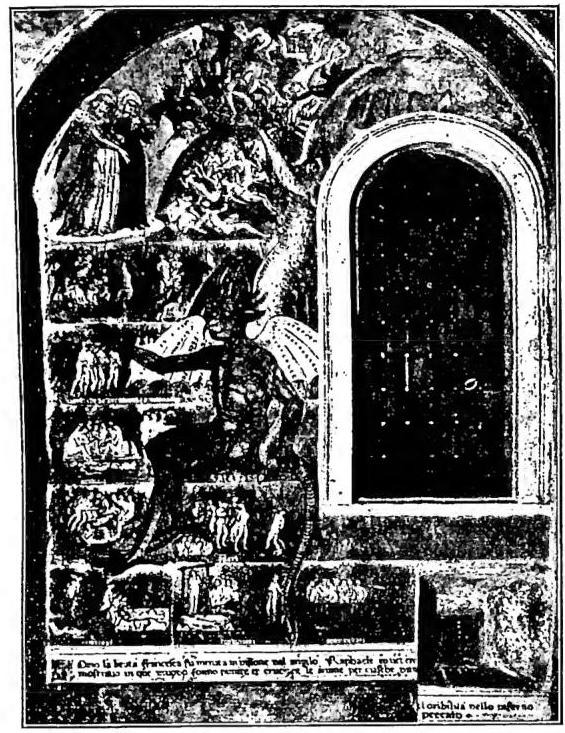
(fot. Brementamp)
INFERNO - S. Francesca Romana, led in a vision by an angel, witnesses the punishments of the damned. Fresco of the school of Antonazzo Romano (15th century) - Rome, convent of Tor de' Specchi.
creatures not as an end in themselves, but as a ladder to the Creator; placed before the alternative of respecting or violating this hierarchy of values, man, by sinning, chooses the creature, replacing the Creator with II. At the moment of death, the impenitent, who has overturned the divine plan, is struck by his own disorder (cf. C. Gent. 4, 146). The rejected God withdraws, the chosen created order advances, and in the crucifying finiteness of its elements constrains and grips the evil spirit.
Others, insisting on the specific effect of fire, which is to burn, maintained that the fire of hell emits supernaturally painful qualities (Suárez, De Angelis, disp. 18, n. 14), or held that this fire, as an instrument in the hands of God, is elevated to produce an effect surpassing its nature, in the same way that the Sacraments, sensible rites, sanctify the soul, which is spiritual (Lessio, De perfectionibus moribusque divinis, 13, 30, 216). Whatever judgment may be reserved for these explanations, the teaching of s. Agostino always remains true: « Quamvis miris tamen veris modis etiam spiritus incorporeos potest paena corporalis ignis affligere » (De Civitate Dei, 21, 10: PL 41, 724).
III. PROPERTIES OF THE PUNISHMENTS OF HELL
Although the punishments of hell are immutable and eternal for all, they nevertheless have a greater or lesser degree of severity, proportionate to the number and malice of the sins.The inequality of punishments is affirmed by Scripture (Wis. 6:6-7; Mt. 10:15; 11:22; Apoc. 18:7) and by the Fathers, whose thought s. Gregorio Magno summarizes: « Quantum exigit culpa, tantum illic sentitur paena » (Dial. 4, 43: PL 77, 401). The Church has sanctioned this truth, which is a requirement of justice (cf. s. Tommaso, Sum. Theol., 3°, Suppl., q. 69, a. 5), with her infallible magisterium (at the Second Council of Lyons: « paenis tamen disparibus puniendas »; Denz-U, 464, cf. 429, 693).
The immutability of the torments of hell was denied by Prudenzio (Hymans de lumine paschali: PL 59, 828) and by certain medieval theologians (Gilberto Porretano, Pietro Lombardo, Prepositino di Cremona), who admitted a certain mitigation through the prayers and suffrages of the faithful. S. Tommaso rejected this opinion as « praesumptuosa, utpote sanctorum dictis contraria et vana » (Sum. Theol., 3°, Suppl., q. 71, a. C). The same judgment must be passed on the recent attempts of Giusto Mivart (19th century) and Alonso Getino (d. 1946) to prove that the punishments of hell are tolerable or capable of mitigation.
The eternity of hell is formally asserted by Scripture (Mt. 25:46; Mk. 9:42; Apoc. 14:11; 20:10) and by Tradition (v. above), whose every element s. Agostino gathers together when he declares that it is « multum absurdum est » (De Civitate Dei, 21, 32: PL 41, 736) to wish to exclude the eternity of hell from the Lord’s saying: « Iunt in supplicium aeternum » (Mt. 25:46). The Church solemnly defined this truth in the Quicunque Creed (Denz-U, 40) and at the Fourth Lateran Council (op. cit., 429). This dogma was the rock against which Origene foundered and is the stumbling-block of unbelievers in every age (Celso, Unitarians, liberal Protestants, rationalists).
Reason comes to a halt before this mystery of justice and limits itself to demonstrating the non-absurdity of the divine plan. Sin and punishment stand to one another as the concave and the convex; since sin has toward God « quamdam infinitatem », it demands an infinite punishment, if not in intensity, at least in duration (cf. Sum. Theol., 1°-2°, q. 87, a. 4; 3°, Suppl., q. 99, a. 1). Fear of temporal punishment would not be an effective means against the passions, which offer immediate enjoyment: the fear of a punishment distant and limited in time would always be overcome. If the punishment were not eternal, the creature would be master of its own fate, and the fulfillment of the divine designs would depend on human caprice, because the creature could boast, after the rebellion of sin, of having compelled God one day to give it its happiness. Thus the epilogue of history would depend on the creature and not on God.
Despite these reasons, which demonstrate the non-repugnance of the divine plan, even today, as in the past, people cry out against the unthinkable cruelty of a God breathing vengeance. In reality, it is not God who takes revenge, but sin, the mystery of iniquity, that draws upon itself a mystery of justice. It is not God who casts the sinner into hell, but the sinner who, sciens et volens, enters it: « in id quod elegerunt eos expellens » (s. Agostino, Enarrat. in Pt. 5, 10: PL 36, 87). If someone were to tear out his own eyes and live forever, he would be eternally blind through his own fault, and God would not be cruel in failing to restore his sight (cf. Sum. Theol., 1°-2°, q. 87, a. 3; 3°, Suppl., q. 99, a. 1).
M. Daffara, De Sacramentis et de novissimis, Torino 1944, pp. 763-85; L. Lercher-F. Dander, Institutiones theologiae dogmaticae, IV, II, pars altera, Innsbruck 1949, pp. 33-59; A. Piolanti, De novissimis, 3ª ed., Roma 1950, pp. 33-59. — Monographs: A. Casarino, De bonorum praenio et supplicio malorum aeterno et vero igne inferni, Lione 1542 (he maintains that the fire of hell is metaphorical); A. Rusca, De inferno et statu duemonum ante mundi exitum, Milano 1621; V. Patsi, De futuro impiorum statu, Venezia 1764; C. Passaglia, De igne inferno non metaphorico, Roma 1855; A. Vincenzi, S. Gregori Nyseni et Grignoli de aeterniate paenarum in vita futura cum dogmata catholico concordia, ivi 1864 (he attempts to reconcile the two writers); F. S. Schouppe, Il dogma dell'i., Torino 1890; I. Stuller, Die Helligkeit Gottes und der ewige Tod, Innsbruck 1903; I. Mew, Traditional aspects of Hell, Londra 1903; F. X. Kieff, Die Ewigkeit der Hölle, Paderborn 1905; I. Bautz, Die Hölle, Magonza 1905; A. Lehaut, L'éternité des peines de l'enfer dans et Augustin, Parigi 1912; A. Michel, L'enfer et la règle de la foi, ivi 1921; A. Cabassat, La mitigation des peines de l'enfer d'après les livres liturgiques, in Revue d'histoire ecclésiastique, 23 (1927), pp. 65-70; E. Méric, L'altra vita, trad. II. di E. Lari, II, Torino 1927, pp. 262-84; I. Tiveront, Histoire des dogmes, 3 voll., Parigi 1928-31, passim: G. M. Monsabré, Esposizione del dogma cattolica (Quaresima 1888) conferenze 68-99, trad. II. di G. Bonomelli, Torino 1929, pp. 41-120; T. V. Gerster a Zeil, Infernus, Traciatus dogmaticus inxtus senum s. Bonaventurae, ivi 1937; A. D. Sertillanges, Il catechismo degli increduli, trad. it., ivi 1937, pp. 287-306; H. Rondet, Les peines de l'enfer, in Nouvelle revue théologique, 67 (1940), pp. 397-427; id., L'enfer et la conscience moderne, Peut-on être donné pour un seul péché mortel? in Problèmes pour la réflexion chrétienne, Parigi 1944, pp. 99-158; R. Garrigou-Lagrange, L'altra vita e la profondità dell'anima, Brescia 1947, pp. 71-106; I. B. Manya, Theologumenae: II, De ratione peccati parnum aeternum inducenti, Battellona 1947; P. Parente, Dio e l'uomo, 2ª ed., Roma 1949, pp. 451-55; F. Cumont, Lux perpetua, Parigi 1949, pp. 189-235; P. Heinisch, La teologia del Vecchio Testamento, trad. II. di D. Pintonello, ivi 1950, pp. 307-18; D. Spica, La révélation de l'enfer dans la Six Écriture, in Enfer (Foi virante), Parigi 1950, pp. 89-144; G. Bardy, Les Pères de l'Église en face des problèmes posés par l'enfer, ibid., pp. 145-240; Ch.-V. Héris, Le dogme de l'enfer et la théologie, ibid., pp. 241-306. Antonio Piolanti
IV. ICONOGRAPHY
The earliest representations of Hell are purely symbolic and, despite possible relations with the Oriental, Greek, and Latin traditions that also described the realms of the hereafter in literary terms, appear only very rarely in early Christian iconography, but always in connection with two scenes from the New Testament: the Liberation of Adam from Hell, as on the ciborium of the basilica of S. Marco, from the 5th-6th century, and the Parable of the Rich Man, as in a Greek Psalter in the Library of Moscow, from the 9th century. Hell is indicated by an opening between rocky crags; at times, instead, it is identified with the figure of a prince bearing demonic features and attributes.This identification appears with particular frequency in Western art: Hell is represented as the maw of a wild animal, frighteningly deformed, with fangs and sharp teeth, seen from above or in a lateral foreshortening (a miniature in a manuscript of the Library of Oxford, datable to around 1000). Exceptionally, dragon’s feet and fangs are added to the infernal mouth, placed immediately below the throat (a miniature in a medieval German Psalter, ca. 1233). This terrible animal representation, also recalled by the Venetian artists who depicted Satan devouring the damned in the vault of the baptistery of Florence, enjoyed particular success in the Nordic countries. A miniature in a Psalter from Winchester, now in the British Museum in London, from the 12th century, clearly shows the identification of Satan’s throat with the infernal gate, affixing to the jaws an actual door with bolts and bars. An engraving from the Lower Rhine, from the middle of the 15th century, still recalls this theme and specifies this mouth as the entrance to the subterranean kingdom and to the houses of the damned.
Those representations of Hell in which the elements of punishment appear, especially fire, are considered “real” representations. Hell is generally conceived as a subterranean pit or cavern, partly because of the recollection of the classical descriptions of Avernus. From the bottom flames rise, or else a torrent of fire pours forth from the foot of the Cross and flows from the wounds of Christ, filling the abyss and enveloping the damned in coils. But the variations
are manifold. In a miniature illustration of the parable of the Rich Man, in the Evangelistary of Emperor Otto at Aachen (10th century), Hell is represented as a fiery precipice, from which emerges a demonic female head bearing the word obyssus written upon its hair. At other times Hell is regarded as the princely dwelling of Lucifer. Not infrequently it is transformed into a noble palace or royal residence, as is already found in a 9th-century ivory with the scene of the Judgment (in the Museum of London). Inside a tower the gigantic head of Satan presides, swallowing the damned. The infernal character of the building is clearly indicated by the armed troops of devils guarding it, and by the fortified entrance, with doors, bolts, turrets, etc. In a prayer book from the beginning of the 15th century, in the Library of London, the theme is further developed, while reminiscences of infernal buildings and of the diabolical citadel can still be observed in Stefano Lochner. Varied representations of Hell also appear in depictions of the Last Judgment, not infrequently colored by a strong taste for the macabre and the grotesque.
The most extensive representations of Hell, however, are found in Italy, where they cover entire walls. In Byzantine-influenced art, as at Torcello and S. Angelo in Formis, Hell is already divided into several levels and different sections, devoted to individual kinds of the damned. They form part of representations of the Last Judgment; such, later, is Giotto’s, on the counterfacade wall of the Scrovegni Chapel at Padua, ca. 1305. But Giotto devotes an extraordinarily large space to Hell, perhaps providing the most complete description of infernal punishments, with a wealth of imaginative elaboration and so many coincidences as to call Dante’s pages to mind. He draws directly upon popular tradition, perhaps making use of the choreography of sacred plays, one of which, performed in Florence in 1304, is recalled by Villani; it is probable that the coincidences with the first cantica of the Divina Commedia depend upon the use of identical sources. At the center, below, stands Lucifer, iconographically derived from Nicola Pisano’s pulpit in Pisa. He devours sinners and grips two of them in his hands. He sits upon dragons with open jaws that bite the damned. On the right, in the foreground, are four bolge, in which naked men suffer, some headfirst: in the background stretches a rugged landscape of terraces and rocks, where particular episodes of punishment unfold according to the law of talion or contrapasso. At times the sin is repeated in an inverted and ironical situation (simony, lust, gluttony, avarice, etc.). Beside figures tortured by various torments, from the fiery pot to the gallows, appear lizard- and frog-devils, who impale, mangle, and roast their victims on spits or take part in the macabre representations of their offenses. The humble and the powerful, mingled indiscriminately in punishment, struggle in the marsh devastated by the torrent of fire or among the rocks.
Similar representations are found in S. Maria Maggiore at Tuscania and in the cemetery of Pisa. With the fresco by Nardo di Cione, devoted to the Judgment but in which Hell occupies an entire wall, in the Strozzi Chapel of S. Maria Novella in Florence (shortly after 1350), the representation of the infernal kingdom becomes, at least in Italy, the figurative commentary on the first cantica of Dante. The subterranean world is seen as if in a sectional drawing, and the individual zones, arranged in rings, are separately isolated, following the Dantean narrative. The first five circles are in turn separated from the central core of Hell by the walls and towers forming the enclosure of the city of Dis. The indifferent are thus separated from the violent, while the fraudulent are received into the malebolge, where the well narrows into rocky circuits. Lucifer presides below in a frozen lake, devouring the traitors. Despite the necessarily fragmentary vision, it retains the fascination of a distinctive rendering of the landscape.
The Italian Renaissance, although adopting new stylistic interpretations, does not abandon the Dantean conception; indeed, it makes skillful use of II. It is enough to recall, alongside Botticelli’s drawings for the Divina Commedia, partly in the Vatican Library, Luca Signorelli’s frescoes
in the cathedral of Orvieto, or Charon’s boat in Michelangelo’s Giudicio.
Outside Italy, amid the many variations, representations of Hell remain almost medievally chaotic, with the evocative power of fiery landscapes or ghostly skies. Of these, the Flemish works (by the Bruogels or by I. Bosch) are particularly important, where the macabre, the deformed, or the formless are joined to a Romantic sensitivity for apocalyptic landscapes, sinisterly illuminated by fires (