
RESURRECTION OF THE DEAD. — The Catholic Church believes that, at the end of the world, all the dead, good and evil, will rise again to be judged by Jesus Christ and receive the eternal reward or punishment. This dogma is commonly expressed by the phrase « carnis resurrectio », to indicate that the lower part of the human composite, through divine power, will be reunited with the immortal soul.
I. TRUTH OF THE RESURRECTION OF THE DEAD
I. Scripture. – In the Old Testament, the revelation of this truth was progressive, in harmony with slow divine preparations (Jahweh, God of life: Gen. 5, 24; Deut. 32, 39; I Reg. 17; II Reg. 2, 3, 11-12; 4, 33-36; 13, 21; Ps. 9, 2; Sap. 2, 24; 16, 13) and with the profound aspirations of the human heart (permanent familiarity with God: Gen. 3, 8; Is. 38, 18; Ps. 6, 5-6; 73, 25; the justice of the world beyond as the work of Jahweh: Ier. 31, 29; Ez. 18). The first allusion appears in the eighth century, under the veil of symbolism, in Os. 6, 1-2: «Come, let us return to God, for it is he who has wounded us and will heal us: he has struck us and will restore our health; after two days he will revive us, and on the third day he will raise us up, and we shall live in his presence» (cf. Os. 13, 14). The spiritual resurrection of the chosen people is promised to Ezekiel (37, 1-10) under the imposing image of an ossuary (ossa orida), which, at the breath of the spirit of God, becomes a living army, «grandis nimis valde». Isaiah announces the definitive disappearance of death (25, 8) and the triumphant restoration of the chosen people, as though returning from exile as from the grave, in terms that spontaneously evoke the concept of the resurrection of bodies (26, 19; cf. F. Notscher, Altorientalischer und alttestamentlicher Auferstehungsglauben, Würzburg 1926, p. 159). The celebrated text of Job (19, 23-27) is today the subject of considerable dispute; the version of the Vulgate, which the Church makes extensive use of in the liturgy for the dead, clearly expresses faith in the resurrection: «Scio enim quod Redemptor meus vivit et in novissimo die de terra surrecturus sum et rursus circumdabor pelle mea et in carne mea videbo Deum. Queni visurus sum ego ipse et oculi mei conspecturi sunt et non alius»; the Masoretic text is less explicit and probably corrupt in some places. The author, who was writing during a period of persecutions, announces the individual resurrection of the good and the wicked with a view to judgment, as a warning to the impious, who are subject to a justice beyond this world. The seven Maccabean brothers, martyred one after another, made a solemn profession of faith in the future resurrection: «You, O wicked man, kill us in the present life, but the Lord of the universe will raise us up, who have died for observing his laws, restoring us to eternal life» (II Moch. 7, 9; cf. 7, 14, 17; 12, 43-45 [offering for the dead: V. PURGATORIO]; 14, 46 [the episode of Razia]).This doctrine, accepted only by the most elevated souls of Israel and rejected by the entire Sadducean sect (cf. Mt. 22, 23; Lc. 22, 27; Act. 4, 1-2; 23, 8), became universal teaching in Christianity. Jesus, having refuted the error of the Sadducees (Mt. 22, 23-33), fully confirmed the teaching of the Pharisees (cf. IV Esd. 7, 32) and of the best Israelites (Mt. 10, 28; 14, 2; Lc. 9, 8; 14, 14), especially in his conversation with Martha: «Your brother will rise again. Martha replied: I know that he will rise again on the last day. Jesus said to her: I am the resurrection and the life; whoever believes in me, even if he has died, will live» (Io. 11, 23-25). Previously Christ had affirmed his own divinity by appealing to his power, shared with the Father, to raise the dead: «... In truth, in truth I say to you, the hour is coming, and it is now, when the dead will hear the voice of the Son of God, and those who have heard it will live...» (Io. 5, 21, 25, 28-29). In the discourse delivered in the Synagogue of Capernaum, Jesus established an intimate relationship between his eucharistic flesh and the bodily resurrection (ibid. 6, 39-40), and once again attributed to himself the divine power to raise the dead (ibid. 6, 55). Jesus’ categorical affirmations received a dazzling confirmation in facts, above all in his Resurrection (v. GESÙ CRISTO).
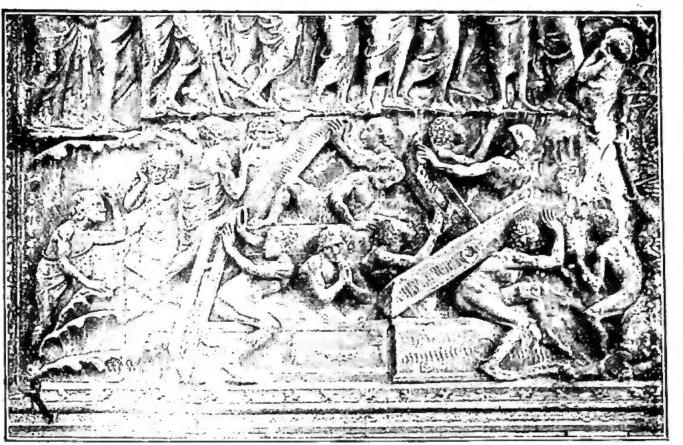
(phot. Raffaelli Armani and Moretti)
RISURREZIONE DEI MORTI - The resurrection of the bodies, sculpture by Lorenzo Maitani. Façade of the Cathedral (beginning of the fourteenth century) - Orvieto.
from the solidarity of the members with the head (ibid. 15, 20-22), from Baptism « pro mortuis » (ibid. 15, 29), from the heroism of the apostolate (ibid. 15, 30-32), from Christ’s perfect victory over death (ibid. 15, 53-57), from the desire placed by God in the human heart for the perfect reintegration of the human composite (Rom. 8, 22-23), from the character and gift of the Holy Spirit as a divine pledge (Eph. 1, 13-14; 4, 30; II Cor. 5, 4-5), from the indwelling of the Holy Spirit (Rom. 8, 11); he illustrated its possibility by the analogy of the seed (I Cor. 15, 36). In the Letter to the Hebrews (6, 1-2) he placed among the fundamental doctrines (βενέλων) of Christianity that of the resurrection of the dead (cf. L. Simeoni, Doctrina resurr. iustoum in ep. s. Pauli, Rome 1938, pp. 86-123; L. Cerfaux, La résurr. des morts dans la vie et la pensée de St Paul, in Lumière et vie, 1 [1952], pp. 61-82).
2. Tradition
From the beginning of the Church, the resurrection of the dead was vigorously attacked by the pagans (cf. s. Agostino, Enarr. in Ps., 88, 2: PL 37, 1134); consequently, the first apologists were particularly zealous in defending II. After the testimonies of the Didaché (16, 6), of Ps. Barnaba (5, 6; 21, 1), of I Clem. 24, 1-5 (the Pauline idea of the seed) and 25-26 (the legend of the phoenix), of s. Giustino (I Apol., 18-19: PG 6, 356-57: comparison with the seed), and of Taziano (Adv. Graecos, 6: PG 6, 817-20: God can reassemble the body despite the most diverse transformations), the first treatise De resurr. carnis by Atenagora appeared (PG 6, 973-1024), in which the possibility (he who created the body can raise it again, even in the event of cannibalism) and the necessity of this eschatological event (the destiny, nature, and end of man, and the justice of God) are demonstrated. After s. Ireneo’s counterattack against the Gnostics’ denial (Adv. Haeres., IV, 18, 5; V, 2, 2; V, 3, 2: PG 7, 1027-29; 1123-30), Tertulliano gathered all the elements of Scripture and Tradition in De resurrectione carnis (PL 2, 791-886), whose celebrated arguments of fittingness are drawn from the transformations of creation (chap. 12: ibid., 810; cf. Minucio Felice, Octavius, 34: PL 3, 347), from the dignity of human flesh (chap. 9, ibid. 2, 807), from divine justice (chap. 8: ibid. 806), and from the perfection of salvation (chap. 34: ibid. 842; cf. H. I. Marrou, La résurr. des morts et les Apologistes des prem. siècles, in Lumière et vie, 1 [1952], pp. 83-91). Origene, in De principiis, II, 3, 7 and III, 54, seems to cast doubt on whether the elect will have a body in the next life; but this is not his precise or definitive thought, since elsewhere he openly condemns the Gnostics, who admitted salvation only of the soul; cf. F. Prat, Origène, Paris 1907, pp. 88-89. He denied only the material identity of the resurrected body (cf. s. Girolamo, Ep. ad Pammachium: PG 11, 95-96), while attempting to preserve its essential identity through the use of Aristotelian concepts (cf. A. Michel, art. cit. in bibl., cols. 2530-31).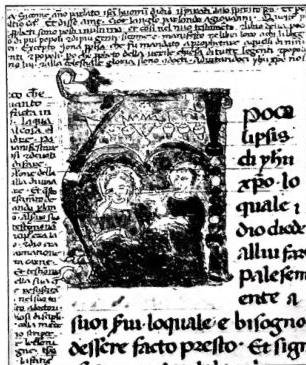
3. Doctrine of the Church
From the beginning, the Magisterium expressed the revealed doctrine in an article subsequently inserted into the various professions of faith: « Credo... carnis resurrectionem » (Apostles’ Creed, Denz-U, 2, 6, 8); « Exspectamus resurrectionem mortuorum » (Nicene-Constantinopolitan Creed, ibid., 86); cf. Creed of s. Epifanio (ibid., 14); Fides Damasi (ibid., 16), Athanasian Creed (ibid., 40), Council of Braga (of 561; ibid., 242), Creed of Leo IX of 1053 (ibid., 347), Profession of Michael Paleologus of 1247 (ibid., 464), bull Benedictus Deus, of Bene-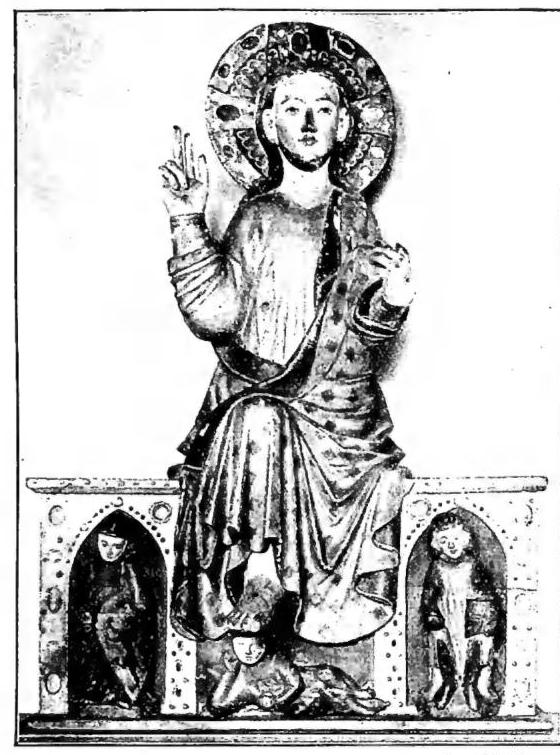
RISURREZIONE DEI MORTI — The angel sounds the trumpet, and a dead man rises. Illuminated initial of cod. Urb. lat. 564, fol. 1 (15th century), containing the Italian version of the Apocalypse, with glosses by Nicola di Lira — Vatican Library.
(photograph from the Museum)
RESURREZIONE DI GESÙ CRISTO - Risen Christ. Polychrome wooden sculpture from the monastery of Wienhausen (ca. 1300). Hannover, Landesmuseum.
Decree XII of 1336 (ibid., 532). Profession of faith of Pius IV (ibid., 994).
II. THE IDENTITY OF THE RISEN BODIES
It is explicitly revealed in I Cor. 15:53, “Oportet enim corruptibile hoc (τοῦτο) induere immortalitatem,” and expressed by Tertullian: “Resurget caro et quidem omnis, et quidem ipsa, et quidem integra” (De resurrectione carnis, 63: PL 2, 933); by s. Girolamo (Contra Johannem Hieros., 30: PL 23, 398), by s. Agostino (Sermo, 264, 6: PL 38, 1217; “ista caro resurget, ista ipsa quae sepeltitur, quae moritur”), and by Teodoreto (In I Cor., 15, 53: PG 82, 367), and solemnly defined in the Symbol of Leone IX: “Credo etiam veram resurrectionem eiusdem carnis quam nunc gesto” (Denz-U, 347), and in the ecumenical Councils of Lateranense IV (ibid., 429) and Lugdunense II (ibid., 464).When one asks how a human body that has become dust, mingled with the most disparate cosmic elements, can be recomposed in its numerical identity, one must confess that one is confronted with the mystery common to all aspects of the economy of salvation (cf. L. Billot, De novissimis, Roma 1938, p. 154). The divergences among theologians in their manner of conceiving the identity of the risen bodies are therefore understandable. Passing over the disputed opinion of Carlo Bonnet (d. in 1799: he held that a spiritual body, as a germ, would remain attached to the soul, from which the body would then naturally develop; he was thoroughly refuted by A. Muzzarelli, Il buon uso della logica, Foligno 1788, chaps. 1 and 4), it is necessary to recall Durando’s attempt, according to which, in order to have the identity of the risen body, the identity of the form (the soul) is sufficient, whatever the matter may be to which it is united by divine power (IV Sent., d. 44, q. 1). Although this explanation appealed to Billot (De novissimis, Roma 1838, pp. 154–62, followed by Hugueny, Michel, Feuling), it nevertheless does not seem acceptable, above all because it does not appear to preserve perfectly what the documents of the faith require for the numerical identity of the risen body. Therefore s. Tommaso’s doctrine is to be preferred on this point as well: namely, that “ex coniunctione eiusdem animae numero ad eamdem materiam numero homo unus numero reparabitur” (Contra Gent., IV, 81; cf. Compendium theologiae, chap. 153; Sum. Theol., suppl., q. 79, a. 1, ad 3); a principle applied with great moderation, so that it is not required that all the matter successively informed by the soul over the course of human life be taken up again, but “praecipue illud resumendum videtur, quod perfectius fuit sub forma et specie humanitatis consistens” (Contra Gent., IV, 81). Thus he dispels the difficulty of cannibalism (ibid.), which had arisen from the earliest times of Christianity.
III. PROPERTIES AND GIFTS OF THE RISEN BODIES
The bodies of those who will rise will enjoy natural and preternatural prerogatives, called proprietates: a) immortality (a preternatural prerogative), explicitly asserted in I Cor. 15:53; Lc. 20:35; Apoc. 21:4; also in the bodies of the damned; b) integrity (a natural prerogative), which implies the restoration of the limbs (cf. Denz-U, 207), the distinction of the sexes (cf. s. Girolamo, Epitaphium Paulae, 22: PL 22, 900; s. Agostino, De Civitate Dei, XXII, 17: PL 41, 778), and the perfection of the sexes (cf. L. Lessio, De summo bono, I, III, cap. 8); c) beauty and physical vigor (a natural property), which s. Agostino discusses at length: « Nihil tunc vitii in corporibus existet » (De Civitate Dei, XXII, 19: PL 41, 781).The glorified bodies will moreover have four entirely supernatural gifts, called dotes, of which s. Paolo speaks in I Cor. 15:42-44; a) impassibility or incorruptibility (ἀφταρεία), derived from the body’s perfect subjection to the soul (cf. s. Tommaso, Sum. Theol., suppl., q. 82, a. 1), whereby they will be preserved from every pain (cf. Is. 25:8; 49:10; Apoc. 7:16-17; 21:4); b) brightness (δῶς), which will reflect upon the bodies of the Saints the soul’s inner splendor (Sum. Theol., suppl., q. 85, a. 1), making them conform, also in body, to the Incarnate Word (Phil. 3:21), so that « tunc fulgebunt iusti sicut sol in regno Patris mei » (Mt. 13:45; cf. Sap. 3:7; Dan. 12:3); c) agility (δῶσις), whereby the bodies, freed from natural heaviness, will be able to move rapidly from one point to another (cf. Is. 40:31; s. Agostino, Serm., 242, 3: PL 38, 1140): this will occur through the body’s complete subjection to the soul, not as form but as motor (Sum. Theol., suppl., q. 84, a. 3); d) subtlety (σῶμα πνευματικῶν), which, understood differently, s. Tommaso (ibid., q. 83, aa. 1 and 6; Contra Gent., IV, 86) considers to be that gift by which the body serves perfectly as an instrument for any action; today it is commonly interpreted as the power of glorified bodies to penetrate, without difficulty and without mutual injury, the other bodies of the universe. S. Tommaso, moreover, grants this prerogative also to the bodies of the elect (IV Sent., d. 49, q. 4, a. 2, qc. 6, sol. 2; Sum. Theol., suppl., q. 83, a. 2); cf. A. Lépicier, De novissimis, Roma 1921, pp. 463-65).