
IRENAEUS, Saint. - Bishop of Lyon, b. ca. 135-40, d. ca. 200; feast on 28 June.
I. LIFE
The historically certain data of the life of St. I. are few. In all probability he was a native of Smyrna or its surroundings. In fact, in his infancy, as he himself attests (Adv. haer., III, 3-4; Ep. ad Flor., in Eusebius, Hist. eccl., V, 20, 4-8), he saw and heard St. Polycarp, the famous bishop of that city and a disciple of St. John. It is commonly held that, in his youth, still in Asia Minor, he formed personal relations with other eyewitnesses of the Apostles. In 177 or 178, during the persecution of Marcus Aurelius, he was at Lyons as a priest of that Church; and as such he received from the martyrs the charge of carrying to Pope Eleutherius a letter concerning Montanism (Eusebius, ibid., V, 4, 1). After the martyrdom of the bishop Pothinus, who was almost ninety years old, which occurred in 178, he succeeded him in the see of Lyons. In the Quartodeciman controversy, which gave rise to a heated clash between Pope Victor (189-99) and the episcopate of Asia Minor, I. distinguished himself as a peacemaker (Eusebius, ibid., V, 24, 9).II. WORKS
Although he had learned to speak the "barbarian" language - Latin or Celtic - of his adopted country (Adv. Haer., I, praef. 3), I. remains a writer of Greek language and Hellenistic culture. His literary activity, quite varied, presents an exclusively polemical and apologetic character. A part of his works is lost (De cognitione adversus graecos, De schismate ad Blastum, and others). There remain nevertheless: 1) Detectio et eversio falso cognominatae gnoseos, better known under the name of Adversus haereses. The work comprises 5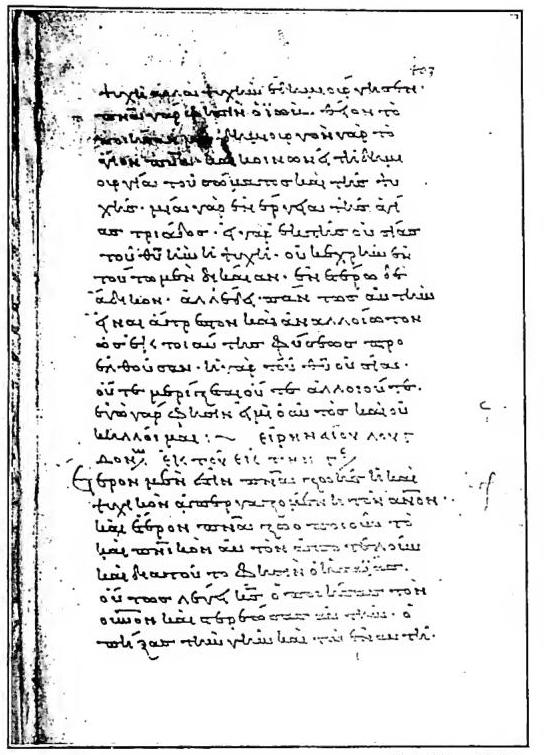
III. THOUGHT
I. gave the best and most original refutation of Gnosticism; in this consists his greatest importance for the age in which he wrote. But his work goes far beyond the circumstances that provoked it and retains a permanent value, both for the richness of information and for the importance of the doctrine.Regarding the material gathered in the Adversus haereses, I. described the systems of the principal Gnostic leaders or related heresiarchs, such as Valentinus, Marcus, Simon, Menander, Saturninus, Basilides, Carpocrates, Cerinthus, Cerdo, Marcion, Tatian, and the doctrines of several sects, such as the Ebionites, the Nicolaitans, the Ophites, the Cainites and others. These pieces of information do not all have the same value: those concerning the origins and the first stages of the evolution of the various sects must be taken with caution, while it appears ever more clearly, in the light of the discoveries of authentically Gnostic documents, that I. was well informed about Gnostic doctrines as they presented themselves in the second half of the 2nd century.
The doctrinal expositions of the Adversus haereses, although they have a rather weak form and contain digressions and repetitions that are often tiresome, nevertheless reveal a firm and coherent, not to say systematic, thought. Indeed, three fundamental themes are discovered in I.; that of the Church, that of the corporeal world and of human flesh, and that of recapitulation. To the first are connected I.'s well-known views on the doctrinal authority of the Church, on the rules of faith, the succession of bishops, the apostolicity of particular Churches, especially of the Roman Church; the famous text of the Adv. haer. (III, 3, 1) on the «potentior principalitas» of the Church of Peter and Paul still tests the sagacity of exegetes. The theme of the corporeal world inspires almost all the other doctrinal developments of I.; in fact it is precisely with regard to matter and especially the flesh of man that Book V of the Adv. haer. examines in turn the doctrines of the uniqueness of the Creator, of creation, of the Incarnation and of the salvation of the whole man. But the master idea that really guides and dominates all of I.'s speculations is that of the recapitulation of human flesh and of the totality of the material world in Christ, the prototype of humanity and the initial exemplar of creation; this grandiose conception embraces both the hidden designs of God and their historical realization through the redeeming Incarnation of Christ; into it are inserted the theses dear to I., of Christ the new Adam, of Mary the new Eve, of the divinization of the whole man through Grace, of his final salvation in a completely restored material world. Only one passage somewhat spoils this beautiful synthesis, and that is the one on millenarianism proposed in the Adv. haer. (V, 32-35); it is significant, however, that the most recent studies on this point cast doubt on the authenticity of these chapters, which in any case do not accord perfectly either with the doctrine of recapitulation or with I.'s usual style.
BIBL.: sources