Machine translation of the 1948–1954 Italian original. The original text is authoritative.
OFITI. - Name of a group of Gnostics, which derives from the prominence they gave to the serpent in the paradise narrative.
These Gnostics were originally either Jews or Jewish-Christians, because they were called Naassenes from the
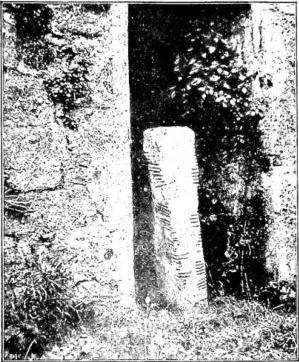
(from Th. J. Westropp, Irish Ethnographical collection, Dublin 1911, (betw. p. 10 and 11) OGAMICA, SCRITTURA - Stone with o. w. - Ardmore (Ireland), Cathedral.Hebrew name nāḥāš of the serpent. The hypothesis of H. Leisegang (in Eranos-Jahrbuch, 1939 [Zurich 1940], p. 206), who wishes to derive the Gnostic sect of the O. from a Hellenistic environment, is therefore mistaken. The kinship of the O. with Gnostics who spoke of the patriarch Seth (the so-called Sethians) and with the Peratae, who were likewise adherents of a Jewish gnosis, points us towards a Jewish or Judeo-Christian gnosis. These Gnostics were known to Irenaeus (v. Haer., I, 30 St=I 28 Harv) who identifies them precisely with the Sethians; Celsus also knows them (v. Origen, Contra Cels., VI, 21 ff) and Epiphanius, Haer., 36 (cf. Ps. Tertullian, Adv. omnes haer., 2; Philaster, Haer., 1, p. 2, 9 Marx) speaks of them at length. It is always a question of the transmission of gnosis, that is, of knowledge, thanks to the serpent, of the good and evil that the Jewish creator God had not wished to reveal to men in paradise. Opposition to the Jewish concept of a creator God is therefore an integral part of this gnosis. This Jewish sect probably came from Mesopotamia, where a branch of it always remained, but later it also spread to the West (to Rome? already in the 2nd century), especially in Egypt. This gnosis predated Valentinus and it appears that not Hellenism, but Jewish (or Judeo-Iranian) speculation was at its base.
It should be noted that not the symbol of the serpent, as was initially stated (v. Comptes rendus de l'Acad. des Inscript. et Belles Lett., 1948, p. 89), but the ansata cross was the decoration of the leather cover on one of the new Gnostic manuscripts from Nag-Hammadi; V. PECIA, op. cit. in bibl., p. 95.
BIBL.: R. A. Lipsius, Über die ophitischen Systeme, in Zeitschr. für wissenschaftl. Theol., 1863, p. 410 ff.; Honig, Die Ophiten, Berlin 1899; E. Amann, Ophite, in DThC, XI, 1063 ff.; G. Bornkamm, Ophites, in Pauly-Wissowa, XVIII, 1, 654-58; T. Hopfner, in Charisteria A. Rzach, Reichenberg 1930, p. 86 ff.; G. Scholem, in Zeitschr. für neutest. Wissensch., 1931, p. 170 ff.; H. Ch. Puech, Les nouveaux écrits gnostiques, in Coptic Studies in honour of W. E. Crum, Boston 1950, p. 51 ff.; especially p. 146 ff. Erik Peterson
Cite this article
“OFITI.” Enciclopedia Cattolica, vol. IX (1952), p. 78. Azione Romana digital edition, https://azioneromana.com/article/ofiti.