
TAZIANO. – A Christian “apologist” of the second century. Very little is known about his life. He himself tells us that he was born “in the land of the Assyrians,” that he had been a pagan and had received a Greek education (Or., chap. 42). He travelled extensively, probably as a wandering philosopher, in the manner of the rhetors and Cynics of his time; he sought in the mysteries a fulfillment of the spiritual needs that beset him (Or., chap. 49), and finally came to know the Scriptures, which, as he asserts, convinced him
His growing disgust with the immorality of paganism, a sojourn in Rome where he met and became a disciple of s. Giustino martire, and the accusations and persecutions of a Cynic philosopher, Crescente, whom Giustino had victoriously refuted and exposed as ignorant (Giustino, Apol., II, 3), and who repaid master and disciple with deadly hatred, drove him to hate violently the entire world and the ideas in which he had grown up. The term barbarian, which had a history of its own not only in earlier apologetics but already in paganism and Judaism, was then adopted by him as a banner of revolt and violent opposition. The martyrdom of Giustino must have confirmed him still further in this attitude. His Discourse to the Greeks, the only work of his that has been preserved, bears witness both to this state of mind and to the author’s violent and aggressive personality. It is a diatribe which, in the violence of its language and the startling radicalism of its negations, has nothing to envy in the writings of certain Cynics. Undoubtedly, the literary genre he chose must also have influenced the tone of the polemic; nevertheless, T. remains the first virulent and at times truculent apologist of Christianity. He is, however, a man who knows how to write: harsh, mocking, often vulgar, but always impassioned.
He has a style of his own, although it is often, through an excess of subtlety, convoluted and obscure. Convinced that he had been a famous man when he was a pagan, he cannot resign himself to failing to prove that he had become one as a Christian: this explains both certain of his stylistic procedures and his tendency to summarily condemn whatever displeases or eludes him; and he almost felt the need to exculpate himself in advance from this, anticipating the reaction of his opponents (Or., cap. 35). Christian doctrine, anti-pagan polemic, and an apology for Christianity are violently and tumultuously mingled in his Discourse, which is certainly no model of order and clarity. T. begins by accusing the Greeks of having stolen everything from the barbarians: no art, no discipline, he maintains, was invented by them. Philosophy alone is their boast, but it is a very miserable thing, as the absurdities of the philosophers demonstrate (capp. 1-3). The practical and theoretical attitude of Christians is quite different; they believe in one God and therefore reject idolatry (cap. 4). The unity and solitude of God do not conflict with the existence of another principle, the Logos, who was ab aeterno with the Father, since God was alone in the beginning with respect to creation, which had not yet taken place; but, since everything existed in him through rational power, God and the Logos existed in him. The Logos therefore proceeded from the Father and initiated creation (cap. 5: one of the most difficult and controversial chapters of the Discourse). What follows, according to a logical concatenation that is partly personal, is an exposition of the other central points of Christian doctrine: the resurrection of the bodies (cap. 6), angelology and demonology (cap. 7), the fall of man and the activity of the demons (capp. 8-11), psychology and pneumatology (capp. 12-13), and the regeneration of man, without any concrete allusion to the fact of the Incarnation, but following the speculative and moral lines of the problem and presenting it as a struggle against the activity of the demons, whose influence extends extraordinarily far and reaches even to the physical evils that afflict man (capp. 13-19). This entire doctrinal section, however, is continually and extensively interspersed with detailed polemic against the various opposing aspects of paganism, especially against mythology, with digressions, developments, returns, and repetitions. Later, after a reference (cap. 21) to the belief in “a God who appeared in the form of a man,” in whom Christians (whose name, moreover, is never pronounced) believe, the polemic against the moral and practical aspects of paganism begins: assemblies, festivals, and spectacles (cap. 22); gladiatorial games (cap. 23); tragic performances (cap. 24); the life of the philosophers (cap. 25); the variety of languages and the preciosities of grammarians (capp. 26-27); and the different systems of legislation (cap. 28). The complete lack of unity observed within paganism, personal experience, and its insufficiency in the face of immoral customs: these are what T. recalls at this point (cap. 29), explaining his conversion and advancing (cap. 30) the demonstration he considers decisive for proving the validity of the doctrine he has now embraced. It is the chronological argument that occupies the whole of the final section of the Discourse (capp. 31-41), the section most frequently cited and exploited by later writers (Clemente Alessandrino, Eusebio, etc.). Included in it, besides the usual personal and polemical digressions, is the so-called “catalogue of statues” (capp. 33-34), a list of more or less famous sculptural works and of more or less well-known sculptors’ names, which T. presents in order simultaneously to demonstrate the immorality and emptiness of pagan ideals and to show his personal knowledge of what he condemns. The basis of the chronological argument is the relationship between the two chronologies, Greek and “barbarian”: the former beginning with Homer, the latter with Moses. Drawing on Chaldean, Phoenician, Egyptian, and Greek testimonies, T. intends to demonstrate the priority of Moses and his legislation over Greek legislation, history, literature, and wisdom. He therefore concludes (cap. 42) with an affirmation of certainty regarding the goodness of the cause he now supports, declaring himself ready, with God’s help, to submit it to the scrutiny of his opponents.
The date of composition of the Discourse is uncertain and disputed. It was certainly written outside Rome. According to Harnack, whose chronology is, in truth, based on extremely weak foundations (a disputed passage in cap. 35), it would have been composed shortly after the conversion, which would also partly explain its tone, and in any event before the death of Giustino (163-67). For others (Kukula, Puech, Geffcken), it already reflects T.’s subsequent development and should be dated around 170 or after 172 (the date of T.’s return to the East). But this chronology too is far from certain. From the doctrinal point of view, it should be noted that, because of his tendency to present Christian thought in a personal manner, T.’s relationship to the ideas most current among his contemporaries is not always clearly revealed. Although he attacks Stoicism, Stoic influences are undeniable, all the more pronounced because the rational presentation of the data of faith naturally leads him to express himself according to the philosophical formulas current in his time. More markedly than the other apo-
More accentuated than the other apologists, he tended to present Christian beliefs according to their intrinsic rational and moral demands, which led a character such as his to adopt positions sometimes differing from those of his contemporaries and even of the official Church. After Justin’s death, according to the testimony of Irenaeus (Adv. haer., I, 28; Eusebius, Hist. eccl., IV, 29, 2), T. is said to have increasingly distanced himself from the prevailing teaching. It is quite possible that he approached the Gnostics, particularly the school of Valentinus (Clement of Alexandria, Strom., III, 13, 92, 1). In any case, the heresy of which he was found guilty (A.D. 172) was above all a moral heresy, encratism: a rigorous moralism that condemned marriage, the consumption of meat, and, it is said, even wine. The heresiologists make him the founder of a genuine sect bearing that name. It is nevertheless probable that the rigorous moralistic attitude, traces of which can also be detected in the Address to the Greeks (e.g. in his hostile attitude toward matter), concealed more particular and precise doctrinal reasons of a Gnostic character. One indication of this may be his conception of Adam’s damnation, insofar as Adam was the progenitor of the human race, and probably also the belief—which was not exclusively Tatian’s—that his fall was connected with the sin of sensuality. After breaking with the Church, T. went to the East, where he is found at the head of a Didaskaleion. It has even been supposed that the Address was an inaugural oration for one of the courses held there (Kukula). If credence is given to the rather late testimony of Epiphanius (Panar., haer., 46), the Didaskaleion was initially located in Mesopotamia, while T.’s subsequent activity, by then wholly heretical, took place in Syrian Antioch, Cilicia, Pisidia, and elsewhere. The date of his death is unknown.
Before the Address to the Greeks, T. had already written a work on animals, to which he himself refers in the Address (chap. 15); he also alludes (chap. 16) to another work on demons. When he wrote the Address, he had in mind another work against those who had written about the Divinity (chap. 40), although it is not known whether he completed II. He certainly wrote another work, this one heretical, on perfection according to the Savior, to which Clement of Alexandria, who refuted it, refers and from which he preserved a passage representing a rigorist and encratite exegesis of I Cor. 7:5, from which it deduced the demonic origin of marriage. It may be that the corrections to Pauline expressions attributed to him according to Eusebius (Hist. eccl., IV, 39, 6) concerned rather some of his somewhat forced and arbitrary exegeses, such as the one mentioned above, or certain acts of violence done to the text in order to support his theses more effectively. Eusebius (ibid., V, 13, 8) also recalls a work of Questions concerning obscure and convoluted passages of the Old Testament, whose explanation one of T.’s disciples, Rhodon, had declared that he wished to provide.
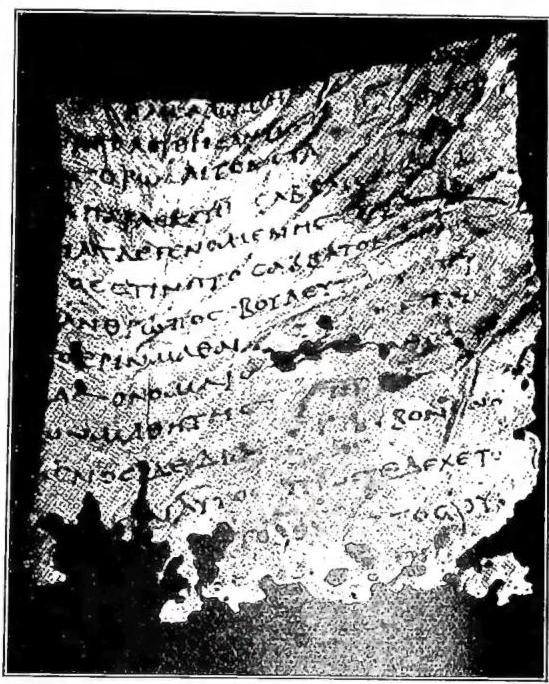
Much more information is available, however, about another work by T., the Diatessaron. This was a fusion of the four Gospels into a single harmony, an undertaking that, for practical reasons, met with great success. The original text has been lost, not only because the Church upheld and defended the four Gospels separately, but also because, having been composed when the author was already a heretic, it contained elements betraying his heterodoxy. We know, in fact, that it omitted, for example, the genealogies of Jesus (Mt. 1:1–7; Lc. 3:23–38) and anything that might reveal a human origin for the Savior. This is what we learn from Theodore of Cyrus (v.), who had more than two hundred copies destroyed in his diocese; they were in the hands of ordinary faithful, who used them as a useful Gospel compendium (Haer. fab. comp., I, 80). Yet despite this opposition, the Diatessaron became extremely widespread; this too explains the extraordinary complexity of the problem of reconstructing the Diatessaron. At present, the material available for studying the question consists of: a) a Persian Diatessaron translated from Syriac, which seems so far to be the text closest to the original; b) an Arabic translation, likewise from Syriac, known in at least three related copies; c) a harmonized Gospel text in Latin, in two recensions, one of which, contained in the Codex Fuldensis, represents the harmonized text that in 546 Victor of Capua (v.) adopted in place of the four separate Gospels and which he no longer entitled Diatessaron but Diapente; d) a harmony in Old Dutch translated from a Latin original; e) a group of complete or fragmentary texts of Gospel harmonies in the Old German of northern and southern Germany; f) a harmonized text in Old English known as the Pepysian Harmony; g) an Italian vernacular Diatessaron in two recensions, one Tuscan and one Venetian; h) a fragment of the Greek Diatessaron discovered in 1933 at Doura-Europos, and therefore earlier than 256 (the existence of another Greek fragment is disputed). These texts are of very unequal value; all of them, however, seem, more or less directly, to go back to a Syriac original, including the Greek fragment, which is no longer regarded today as T.’s original, but itself as a translation of a Syriac original. This series of Diatessaron texts presents highly complicated problems of mutual interference: at times, as, for example, in the Arabic Diatessaron, the original text has been partly recast with the text of the Pèliità, though certain peculiarities of the original nevertheless reappear. For the reconstruction of the original Diatessaron and for the history of the reception of the Diatessaron, the commentaries written on it must also be taken into account. The most important is the Syriac commentary by s. Ephraem, of which only fragments of the original and an Armenian translation survive; another, much later commentary (12th century) in Latin is due to Zacharias Chrysopolitanus. To complete the foregoing, one must also add the traces of lost Diatessaron texts and the direct and indirect influences exerted by each upon the others.
Thus, an Armenian translation of the Diatessaron is thought to have existed, which would have influenced the subsequent Armenian and consequently Georgian translation of the Gospels. Influences are detectable in the ancient Syriac versions of the Gospels, in readings used in the Syriac Church, in Gospel citations in the Manichaean Kephalata, in various Eastern and Western liturgical and spiritual texts, ranging from Turkish texts to the life of Christ by Ludolph of Saxony and, finally and above all, in the text of the ancient Latin translations of the Gospels and in the Greek text of the New Testament represented by the famous Codex Bezae (D). It has rightly been said that the problem of the Diatessaron represents one of the most difficult problems in ancient Christian literature. Among others, two fundamental questions still remain unresolved. First of all, whether the Syriac original to which this whole complex of texts and testimonies seems to point should indeed authorize the conclusion that the original language of the Diatessaron was Syriac and not Greek, as Orientalists tend to conclude, but a conclusion which many still do not consider certain. Secondly, whether the presence in the Diatessaron of readings that differ from one another or that seem to derive from extra-canonical or heretical texts can authorize the conclusion that T. did not use only the four Gospels, introducing, when necessary, some heretical or extra-canonical readings that fitted well with his ideas, but deliberately basing his harmony on a fifth source, which some identify without hesitation with the Gospel according to the Hebrews, also on the basis of the vague testimony of Epiphanius (Pan., 46: but Epiphanius did not know the Diatessaron directly, and those who, according to Epiphanius’s citation, identified the Diatessaron with the Gospel according to the Hebrews probably did so because they knew that this Gospel was regarded as encratite, the heresy of which T. himself was considered the founder). In his Diatessaron, T. is known to have adapted the narrative of the Synoptics to the historical framework of the Fourth Gospel. The date and place of composition are not known with precision.
T. Disc. ai Greci, Turin 1921. The only comprehensive monograph, although in certain parts entirely superseded, is that of H. A. Daniel, T. der Apologet, Halle 1837. On the Discorso ai Greci, see: R. C. Kukula, T.'s sogenannte Apologie, Leipzig 1900; A. Puech, Rechercher sur le Discours aux Greci de T., Paris 1903 (by the same author also Les apologistes grecques du IIe siècle de notre ère, ibid. 1912, pp. 148–71); C. H. Heiler, De T. apologetæ dicendi genere (diss.), Marburg 1909 (on style); A. Casamassa, Gli apologisti greci, Rome 1943–44, pp. 135–62; M. Pellegrino, Gli apologeti greci del II sec., ibid. 1947, pp. 69–145. On the heresy of T.: M. Zappalà, T. e lo guasticismo, in Rm. di studi fil. e religiosi, 3 (1922), pp. 307–38 (inadequate and at times erroneous). For the Diatessaron, all editions of the texts and critical studies up to 1939 are cited and examined in C. Peters, Das Diatessaron T., Rome 1939. After it, suffice it to cite: S. Lyonnet, Les origines de la version arménienne et le Diatessaron (Biblica et Orientalia, 13), Rome 1950; G. Messina, Diatessaron persiano (ibid., 14), ibid. 1951. Franco Bolgiani