
TAYLORISMO. - Scientific management of labor, originating in America at the end of the 19th century through the work of F. W. Taylor.
In the author's original conception, the primary purpose of the new system should be to ensure
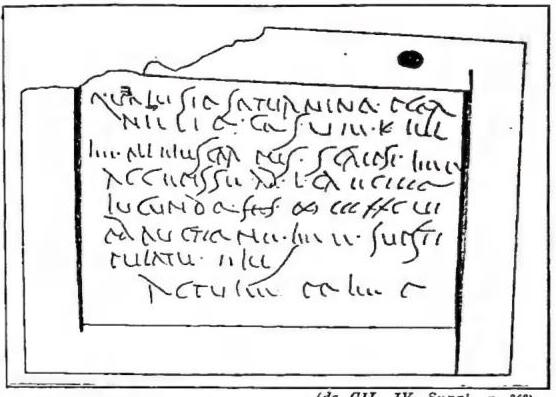
TAVOLETTE CERATE - Drawing of the façade reproduced in the adjacent figure. The triptych in question contains a loan receipt for an «auctio», issued by M. Alleius Carpus to the banker L. Caecilius Jucundus.
ensure, through the transformation of the company's working and management methods, the maximum prosperity for both employers and workers; in this way, the antagonism between the former and the latter would automatically cease, because both would find the fulfillment of their fundamental interests, which consist, for the employers, in low production costs, and for the workers, in high wages. Taylor starts from the principle that maximum prosperity can only be achieved by bringing production to its maximum. Indeed, someone who manages to produce four compared to another who under the same conditions manages to produce two can pay their employees better, sell the goods at a lower price, and have an overall higher profit margin. From this stems the necessity to combat all forms of underworking, which may be due to causes of a technical nature, and to psychophysical or psychological factors (poorly chosen work tools, lack or deficiency of the proper work aptitudes, natural laziness, inadequate or superfluous movements, etc.).
The measures to be implemented are: rational choice of work tools, selection and instruction of personnel with new systems, assistance to the worker during the execution of their work, supervision of the worker with a stopwatch, and an increase in wages in proportion to the work accomplished.
This presupposes, among other things, a radical change in the guiding concepts of a company's managerial function. Two types of managers are needed: those who study how to improve production quantitatively and qualitatively, and those who oversee the execution of the work within the established time.
With the new science, destined to replace old empiricism in human labor, new relations would be established between company management and workers; the worker, scientifically trained in their task, would feel bound to those who drew up the work plan and to the others who trained them; the management would find itself actively cooperating with the employees and sharing work and responsibilities with them. Regarding wages, Taylor establishes that when workers carry out their work within the established time, they are entitled to a supplement that can vary, depending on the case, from thirty to one hundred percent of the base wage; a bonus is also due to foremen, in proportion to the number of workers supervised by them who complete their task within the assigned time; this would serve as an incentive to train the less skilled workers so that they could be gradually brought up to the level of the more skillful ones.
Many criticisms have been leveled against t. It has been observed first of all that the new system imparts an exhausting stamp of aridity to work; by abolishing all sorts of private initiative and prescribing identical gestures for everyone,
it makes workers resemble machines. To this, the supporters of the system have countered that scientific management favors initiative more than the old system; indeed, initiatives are encouraged and welcomed if recognized as useful for improving the company. Furthermore, a worker trained with a rational technical education to make the best use of their aptitudes, and who works with well-studied machines in rationally organized workshops, can refine their skills to the point of reaching management positions. Finally, a worker's efficiency is not determined solely by the repetition of immutably identical movements, but also by promptness and the ability to maintain self-awareness and presence of mind at all times. It has also been lamented that, as a result of the selection favoring the best elements, too many average elements, yet suitable for profitable work, would be wrongly discarded by the new labor organization. But, it is answered, this should not happen, because the increase in production entails an increase in business and the demand for a larger workforce: therefore, hiring would necessarily have to fall also on elements of average value. Another objection is that increased production, more easily than with the old systems, paves the way for unemployment. But even if it became necessary to contain production, the worker would still retain the advantage of earning more or receiving the same wage while working for a shorter time. T. has also been reproached for the torture of time-motion study, an instrument of worker exploitation. But while this represents a means used by scientific management, it does not characterize the system. On the other hand, science is based on the study of the nature of phenomena, and when one intends to study human labor, one cannot help but record the time it takes to perform II. It has also been objected that double work should correspond to double pay, which does not occur with t. However, the need to take into account the mass of consumers, who ultimately pay both the worker's wages and the entrepreneur's profits, has been highlighted.
Still other objections are raised against t., but Taylor has insisted that it is neither this nor that aspect, nor the system as a whole that characterizes scientific management, but the spiritual revolution of the workforce acquiring new rights and assuming new obligations, and the change in mentality of the managerial bodies.
Shortly after its immediate elaboration by Gilbreth, Barth, and Thompson, t. began to be opposed by the labor organizations themselves, which saw in it a threat to, rather than the protection of, their interests. Only after the war, which ended in 1918, was the movement able to spread in Europe, especially in the nations most advanced in industrial organization, undergoing modifications there in relation to the needs and psychology of the individual countries.