
NATIVITY OF MARY MOST HOLY. — One of the major feasts of the Madonna, celebrated on 8 September; double of the second class, with a simple octave.
I. LITURGY
The reason why the feast of the n. of M. was assigned to 8 September is entirely unknown. Its origin, like that of all the major Marian feasts, is found in the East, probably in Palestine and perhaps in Jerusalem.The birth and life of the Madonna, passed over by the Gospels, greatly captured the interest of the people; to fill this gap, various apocryphal writings soon arose, among which the so-called Protoevangelium of St. James stands foremost,
NATIVITÀ DI MARIA S.MA
both in antiquity and importance, certainly dating from the end of the 2nd century. But in the time of St. Augustine there certainly did not yet exist a particular liturgical feast (Sermo 292 de Sanctis: PL 38, 1320). Shortly thereafter, however, that is, once, following the Councils of Ephesus (431) and Chalcedon (451), the figure of the «Deipara» had appeared before the Church in all its greatness, her Nativity was introduced along with the other major Marian feasts. The wording of the Hieronymian Martyrology, «Nativitas s. Mariae, Matris Dei», clearly reveals the profound theological reason for this celebration. Many patristic sermons, especially Eastern ones, exalt the n. of M. (though not all are authentic); such are those of St. Proclus of Jerusalem (d. 447: PG 65, 680 ff.); and Romanos the Melodist, one of the foremost Byzantine liturgical poets (ca. 560), described it in verse according to the Protoevangelium of James (J. B. Pitra, Analecta sacra, I, Venice 1876). For St. Andrew of Crete (740), the feast of the Madonna’s birth was already an ancient tradition (v. the 4 sermons for the said feast: PG 97, 805-82).
In Rome the feast was introduced around the middle of the 7th century, together with the feasts of the Purification, Annunciation, and Assumption of Mary, through the agency of the Eastern monks who at that time emigrated en masse from the eastern regions that had fallen under the Mohammedan yoke. Sergius
I (687-701) established that the said Marian feasts should be marked by a solemn procession setting out from the ancient Curia Senatus, which had become S. Adriano, and ending at S. Maria Maggiore (Lib. Pont., I, p. 376). From as early as the 7th century, the feast of the n. of M. also appears in many liturgical books (thus in the Gelasian and Gregorian Sacramentaries, in the Capitularia Evangeliorum, in various lectionaries, etc.). The Gospel pericope generally used was the story of the Visitation (Lk. 1:39-47), later replaced by the genealogy of Mt. 1:1-16. The reading varied considerably until Pius V. The spread of the feast was slow and uneven. It entered the martyrologies early: it is mentioned by Bede in the Martyr. poeticum and in the historical Martyrology (PL 94, 605; 1037), by Ado in the Libellus de festivitatibus ss. Apostolorum (PL 123, 201-202), and by Usuard in his Martyrology, the basis of the Roman one (Acta SS. Junii, VI, Antwerp 1715, p. 486). In canon 20 of the Council of Reims, under Sonnatius (630), the n. of M. was prescribed as a feast day (Mansi, X, p. 599), as likewise in the Synod of Riesbach-Freising (791, can. 10; Hefele-Leclercq, III, p. 1107); whereas it is absent from the list of feast days of St. Boniface and from the great reform Council of Mainz of 813. Amalarius, too, makes no mention of it in his numerous writings. A synod was held in London on this feast in 948. Be that as it may, from the 10th–11th centuries onward the feast of the n. of M. was universal. It is enough to recall the principal liturgists: G. Durando, Rationale Div. Officiorum, VII, 28; G. Belet, Div. Officiorum eorundem rationum brevis explicatio, 149; Sicardus, Mitrale, IX, 43. During the difficult Conclave following the death of Gregory IX (1241), the cardinals pledged that, if the conclave ended successfully, they would press the new Pope to institute the octave of the feast of the n. of M. The elected pope, Celestine IV, having died after only 18 days, his successor, Innocent IV, with the approval of the General Council of Lyons (1245), decreed the said octave, celebrated, according to the testimony of Radulfus of Rivo (De can. observantia, propos. 19, ed. C. Mohlberg, Münster 1915, p. 117), as a major, that is, full octave. Gregory XI (1378) also instituted a vigil, with fasting, and composed the Mass; but upon his death it immediately fell into disuse.
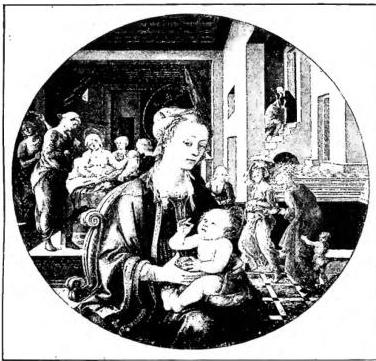
(phot. Andersen)
NATIVITÀ DI MARIA S.MA - The Virgin with the Child Jesus; in the background, the N. of the Virgin. Painting by Filippo Lippi - Florence, Pitti Gallery.
On this day, fresh water from the well is distributed in the church of S. Maria in Via; according to tradition, the image of the Madonna venerated there was found floating in II. It should be noted that the lessons of the second nocturn, attributed in the Breviary to St. Augustine (Sermo 18 de Sanctis), are instead by the abbot Autporto Ambrogio (a. 787; cf. Enc. Catt., II, cols. 499–500). Pius X reduced the octave to a simple octave; with the transfer of the feast of the Sorrows of Mary to 15 September, the eighth day too was in practice eliminated.
II. ICONOGRAPHY
The earliest depictions of the Nativity of Mary known to date go back to the 11th century; the oldest seems to be a miniature, datable to 1025, painted in a Greek codex of the Vatican Library (Vat. grec. 1613). The iconography of the Nativity of Mary appears in synoptic representations of the entire life of the Madonna, presented in a series of consecutive scenes from the history of Mary the Virgin, from her birth to her Assumption into Heaven, the entrance into which is depicted by the Coronation. Such synoptic Marian representations appear in the art of Western Europe and multiply in the late Middle Ages. In depictions of the sceneTwo actions are usually seen brought together: the first is devoted to the account of the childbirth of s. Anna, lying in a broad bed in a room; the second generally shows in the foreground the midwives gathered beside the bed, occupied in washing the newborn girl in a basin. The same iconographic type was adopted for representations of the birth of s. Giovanni Battista, which are often confused with those of the Madonna. From the fourteenth to the sixteenth century, Italian art produced several beautiful representations of the n. of M. V. Among these, for medieval art, mention should be made of that composed in mosaic by P. Cavallini in S. Maria in Trastevere in Rome; Giotto’s fresco in the Scrovegni chapel in Padua; Taddeo Gaddi’s fresco in the Baroncelli chapel and the other by Giovanni da Milano in the sacristy of S. Croce in Florence; the panel carved by Orcagna in the tabernacle of Orsanmichele in Florence; the Birth of Maria frescoed in 1424 by Ottaviano Nelli in the Trinci chapel of the palace of the same name in Foligno follows the fourteenth-century model. For Renaissance art, the well-known fifteenth-century representation by Domenico Ghirlandaio, frescoed in 1488 in the main chapel of S. Maria Novella in Florence, should be recalled. Fra' Filippo Lippi adorned the background of his Madonna with the Child Jesus, painted in a tondo in the Palazzo Pitti in Florence, with the birth of Maria. Among the sixteenth-century representations of the n. of M. V., mention should be made of Andrea del Sarto’s fresco in the cloister of the S.ma Annunziata in Florence. - Vedi tav. CXI.
III. THE GOSPEL OF THE NATIVITY OF MARY
A title by which the apocryphal work that its first editor (Postel, who died in 1581) James (v.) is designated in many manuscripts. In its most ancient form it dates back to the second century. A Latin reworking, usually cited as Pseudo-Matthew, also bears the title Book of the Nativity of the Blessed Virgin Mary and of the Infancy of the Savior. In its first 17 chapters it depends on the Proto-Gospel of James; in the remainder it recounts the flight into Egypt and life at Nazareth.Later, in the Carolingian period, a new Latin reworking arose, more refined and discreet than the preceding one: it attenuates its inconsistencies, accepting only what Pseudo-Matthew has in common with the Proto-Gospel of James. These writings exerted great influence on Eastern and Western art and liturgy. The feast of the Presentation of Mary in the Temple is owed to this apocryphal work.