
PRESENTAZIONE DI MARIA S.MA, FESTA of.—The feast of the P. is one of the minor Marian feasts of the universal Church and is celebrated with the rite of a double major feast on 21 November. The only proper liturgical text of the Office and the Mass is the Oremus.
The direct subject of the feast is an event in the life of the Madonna, when, at the age of only three, she is said to have been taken by her parents to Jerusalem, to be offered to the Lord in the Temple, where she is said to have remained until the age of twelve, devoted exclusively to piety and the service of the sanctuary. This event, however, is not contained in the Gospels, but is one of the many pious inventions of the apocrypha. It first appears, still with few details, in the so-called Protoevangelium of James (2nd–3rd century), subsequently developed and dramatized in various other apocryphal infancy gospels of the Lord (v. BONACCORSI, PIERINO, Vangeli apocrifi, I, Firenze 1948, pp. 72-73 and passim). This narrative found a cordial reception among the people, and the imagination of artists was inspired by it; in the representation of the scene they found, from antiquity onward, a broad field for artistic depictions (v. below).
The liturgical celebration appears, however, relatively—
late. Its beginnings seem to be sought in Jerusalem. The church of St Mary the New, built in the center of the city by Justinian I in 543, seems to have been intended to localize the event; from the anniversary of the dedication of this church, 21 November, the actual feast of the P. is said to have subsequently arisen. In the time of the Crusaders, remembrance of this event passed to the Templum Domini, that is, the mosque of ʿOmar, on the Temple esplanade, which served as a Catholic church from 1099 to 1187. In any case, the feast of the P. is found in all Eastern calendars, always on the indicated date (v. NIELLO, Kalendarium manuale utriusque Ecclesiae, I, II, Innsbruck 1898, see indexes). In 1143 Manuel Comnenus made the P. a public holiday.
The West came to know the feast through various Eastern influences and by many routes. It appears in isolation as early as the 10th and 12th centuries in two Greek Gospel books, manuscripts from Cesena (Plut. XXVII, cod. IV, 10th century; Plut. XXIX, cod. II, 12th century; H. Leclercq, Cétène, in DACL, II, 3313), in a 12th-century English calendar at Winchester, where it is called «oblatio s. Mariae in templo cum esset trium annorum» (R. T. Hampson, Calendaria medii aevi, London 1841, 432, 445), and in the calendar of a Hungarian sacramentary from 1200, preserved in Budapest (National Museum, Vyelvemlekek; 1), where it appears as «rappresentatio s. Mariae», and in another Hungarian calendar (Budapest, National Museum, F. 94), as «contestatio Mariae Virginis». It began to become universal in 1372. In that year the ambassador to Cyprus, Filippo de Mazières, persuaded Charles V of France to celebrate the feast, with the approval of Gregory XI, in the church of the Friars Minor at Avignon, where the papal Curia was then residing. The King invited the realm to follow the example, the Pope inserted it into the calendar of the Curia, and shortly thereafter it spread throughout the Western Church. The Carmelites adopted it in 1391, the Carthusians in 1474; Pius II and Sixtus IV greatly promoted its diffusion: in 1472 it was granted to Duke William of Saxony, from where it passed to Mainz and Trier. Pius IV introduced it into the Roman Breviary; but St Pius V suppressed it because it was apocryphal. Philip II of Spain, however, obtained from Gregory XIII permission to continue celebrating it in his kingdoms, and shortly afterward Sixtus V, also urged on by Fr Francesco Turriani S. I., prescribed it once more for the universal Church (brief: Intemeratae Matris Dei Mariae, 1 September 1585), with the rite of a double feast and with the formulary of the feast of the Nativity of Mary, replacing the word «nativitas» with «praesentatio». The various medieval formularies thus disappeared, with texts that were sometimes bold but often poetic. Finally, Clement VIII, on the occasion of the revision of the Missal (1602), raised the rite to that of a double major feast and reduced the formulary to its present form. When, under Benedict XIV, a reform of the Breviary and the
Missal was discussed, the feast of the P. ran the risk of being eliminated once again; but the Pope died before he could bring his plans to completion. Even in recent times, voices have occasionally been raised calling for its suppression because it is apocryphal; others, however, would like to preserve it, not as a celebration of the «presentation of three-year-old Mary», but in deference to the broader and theologically secure concept of the «oblatio» or «consecratio» of the Most Holy Virgin to God, by which she, as no other human creature, was wholly dedicated to the Lord.
Fourteenth-century Florentine painting contributed greatly to establishing the illustrative concept of the P. of the V. in compositions in which, among many figures, the Virgin Mary is seen as a young girl, accompanied by s. Joachim and s. Anne, ascending a flight of steps in front of a temple, where she is received by a priest. Mary alone stands on the staircase, while her parents remain farther down, at a certain respectful distance. To illustrate the gradual development of the increasing splendour of this representation, three notable frescoes belonging to three successive generations of fourteenth-century Florentine art may be noted: Giotto’s, painted in 1305 in the Scrovegni chapel at Padua; Taddeo Gaddi’s, painted in 1335 in the Baroncelli chapel at S. Croce in Florence; and that of Giovanni da Milano, executed around 1345 in the Rinuccini chapel, which forms part of the sacristy of the same church in Florence. According to the same illustrative concept, though in a much abbreviated and reduced form, the Presentation was painted by Bernardo Daddi among the Stories of the Virgin adorning the predella of the Uffizi polyptych. Orcagna likewise depicted the P. of the V. at the same time in a far more condensed manner, as shown by a carved marble panel in the tabernacle of Orsanmichele, executed between 1349 and 1350, where the figures of the young Mary and the priests are seen on a staircase in the centre, while at the sides, arranged symmetrically, are her parents and two angels.
PRESENTAZIONE DI MARIA S.MA - PRESEPE
The figurative concept of the P. della V., thus established in the late Middle Ages, changed little in the fifteenth century, as can be seen in the fresco painted by Domenico Ghirlandaio in the Cappella Maggiore of S. Maria Novella in Florence.
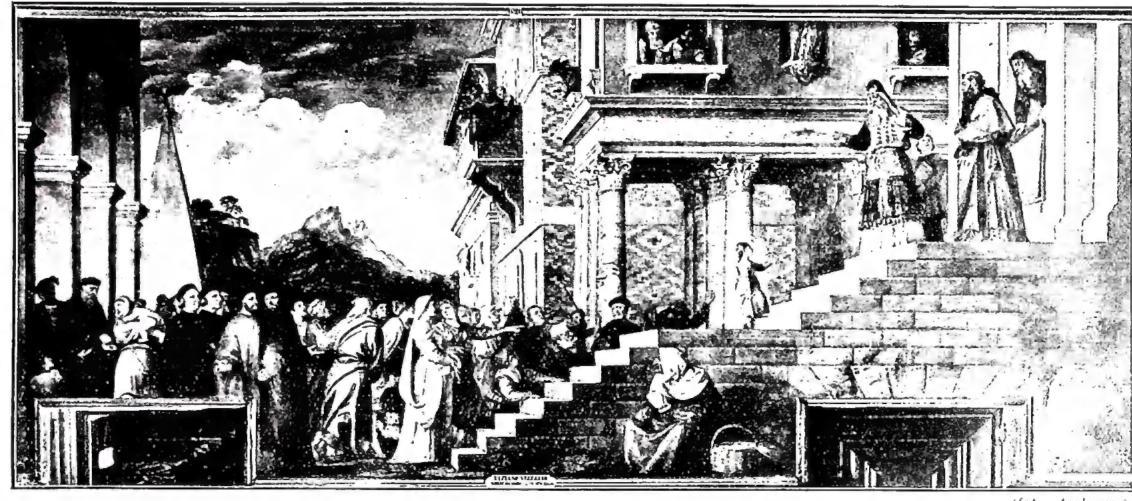
Notable depictions of the P. della V. were produced by Venetian painting in the sixteenth century; among them, in chronological order, are those by Carpaccio (Milan, Brera) and Cima da Conegliano (Dresden, Gallery), the other famous one by Titian, painted between 1534 and 1538 (Venice, Accademia), and the slightly later one by Tintoretto (Venice, church of S. Maria dell’Orto).
A grandiose depiction of the P. della V., conceived in accordance with the Baroque taste, was painted in 1642 by Giovanni Francesco Romanelli for the Vatican Basilica. The original of this altarpiece, later reproduced in mosaic, was transferred in the mid-eighteenth century to the church of S. Maria degli Angeli in Rome, where it is still preserved. - Vedi tav. CXXXIII.