
PURIFICAZIONE (CANDELORA), FEAST of the. - A Marian solemnity, celebrated on 2 Feb. as a double feast of the second class, to which is added the blessing of candles followed by the solemn procession. However, if it coincides with one of the Sundays of Pre-Lent, the feast of the P. is transferred to 3 Feb., while the blessing of the candles and the procession remain on the second day.
1. Origin of the feast
Like the other great Marian feasts, this too is of Eastern, specifically Jerusalemite, origin. Its basis is found in thebiblical account (Luke 2:22 ff.) that the Blessed Virgin brought Jesus to the Temple of Jerusalem 40 days after his birth, in order to redeem him according to the Law (Lev. 12:2 ff., and Num. 18:15 ff.), meeting on this occasion the aged Simeon, who foretold the glory of the Son and the sorrows of the Mother. This narrative gave rise, like other biblical episodes, to a liturgical commemoration first in the holy city. It is described by Egeria (end of the fourth century), and took place on 14 Feb.; it was therefore called « quadragesimae de Epiphania », since Christmas was solemnized on the feast of the Epiphany, 6 Jan.; after the customary solemn processions there followed the sermon
on Luke’s Gospel episode and the great Mass. The feast was celebrated « cum summa laetitia ac si per Pascha » (ed. Gamurrini, cap. 28, p. 84). The sermon « De occursu Domini » by St Gregory of Nyssa (d. 394) attests that the feast was also celebrated outside Palestine (PG 46, 1151-82). Shortly afterwards St Cyril of Alexandria likewise delivered a festive sermon for the P. (Hom., 12: PG 77, 1039-50); he was followed by the Eastern sacred orators of subsequent centuries.
At Constantinople the feast became official or obligatory
2. The feast of the P. in the West. - Among the various mosaic scenes on the triumphal arch of the basilica of S. Maria Maggiore in Rome is also that of the presentation of Jesus in the Temple. But in the West no liturgical celebration yet existed. In the liturgical and extra-liturgical sources from the time of St Gregory the Great there is no trace whatever of the Marian feasts of the P., Annunciazione (v.), Assunzione (v.), Natività di Maria (v.). A hundred years later, however, Pope Sergio I (681-701) decreed that the celebration of these four Marian feasts should be made more solemn by a special procession. These feasts, therefore, were imported from the East during the seventh century and, as everything leads one to believe, through the work of Eastern monks, who flocked in great numbers to the Urbs, bringing with them not a few other liturgical celebrations as well (v. LIBIA. Pont., I, 376). Indeed, the Roman liturgical books which first contain the feast of the P., such as the Gregorian-type Sacramentaries, the Capitularies of Epistles and Gospels of the Roman type, bear the Greek name of the feast: « Ypapante »; in the additions to the Hieronymian Martyrology (since the feast is absent from the archetype) it often appears as « S. Symeonis »; in the later Sacramentaries of the Gelasian type, and in various corrections and additions to the earlier liturgical books, there instead appears the Latin name that subsequently prevailed: « Purificatio s. Mariae », of rather Gallican origin.
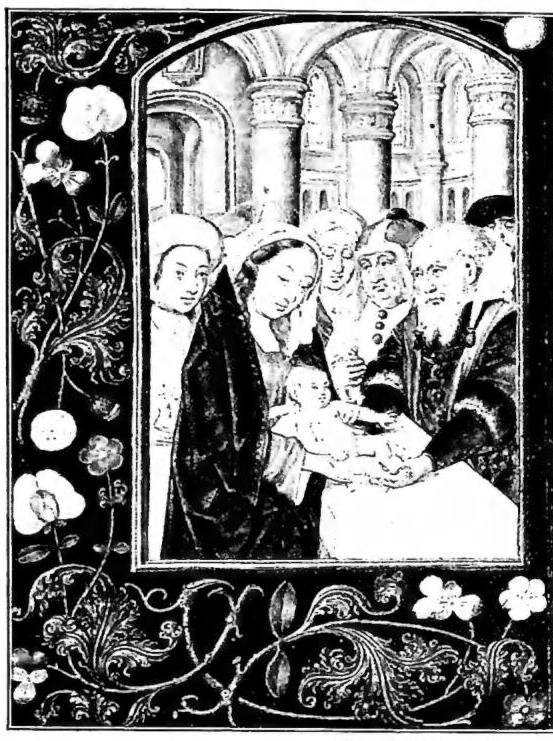
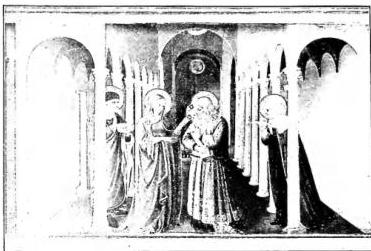
(photo Alinari) PURIFICATION — Presentation of Jesus in the Temple. Detail of a predella painted by Beato Angelico (15th century) — Corrona, Church of the Gesù.
Sergius I, as was said, added a procession to the celebration of the four Marian feasts; the one for the Assumption continued in Rome until the Avignon period, whereas that of the P. entered into use throughout the universal Church. According to the present rite, a series of five prayers prepares the blessing of the candles, which is performed with sprinkling and incensation; these are then distributed to the clergy and the people by the celebrant, while the antiphon “Lumen ad revelationem gentium” is sung, intercalated with the verses of the “Nunc dimittis”. Once the distribution is finished, the oremus “Exaudi” follows, preceded, after Septuagesima, by the “Flectamus genua”. During the procession, opened with the customary “Procedamus in pace”, three antiphons of Greek origin are sung. It concludes with the solemn Mass. The color of the vestments is violet until Mass, at which white is used instead. The primitive nucleus of the entire rite is the “litany”, that is, the penitential procession which in Rome moved from S. Adriano, at the Roman Forum, the ancient Curia. The oldest description is found in the so-called Ordo of St-Amand (ed. Duchesne, Origines, 499-500, according to Andrieu’s new arrangement, Ordo XX: Les Ordines Romani du haut moyen âge, III, Leuven 1951, pp. 231-36), which dates from the end of the eighth century. The vestments were black; the Pope distributed candles that were neither lit nor blessed, then recited the Collect (the present “Exaudi”), and carried out the procession to S. Maria Maggiore, singing antiphons and, near the Basilica, the “litany”, repeating it three times; at Mass the Gloria in excelsis was omitted. It corresponds perfectly, in time and form, to the text of the Sacramentary of Hadrian (the Gregorian sacramentary of the time of Hadrian I, end of the eighth century), in which the text of the collecta “Exaudi” is also found, often with the variant “Erude” at the beginning. Amalarius (d. ca. 850) speaks at length of the procession, adopting a passage from St. Bede in which this litany is attributed to Pope Gelasius (v. sotto), a citation that subsequently became customary among all medieval liturgists. But Amalarius too knows nothing of any blessing of the candles (cf. Liber officialis, III, chap. 43, ed. Hanssens, II, Vatican City 1949, p. 380).
A complete rite for the blessing is found instead in the so-called Pontifical of the twelfth century (M. Andrieu, Le Pontifical Romain au moyen âge, I, Vatican City 1938 [*Studi e testi, 86], pp. 206-209), with prayers partly identical to the present ones, or greater in number. The singing of the antiphon “Lumen” already exists, as do the final antiphons during the procession. The blessing of the candles, like that of the ashes and palms, is a Franco-German invention of the ninth and tenth centuries. E. Martène (De antiquis Ecclesiae ritibus, III, chap. 15) reports seven different Ordines, with a quantity of oremus and features that were regulated only by the Missal of St. Pius V in 1570. The full magnificence of the Roman “litany” of the P. is revealed by the Ordines Romani XI, XII, XIV and XV (ed. Mabillon), which range from ca. 1140 to ca. 1400. In Rome the “litany” had remained the essential element; the blessing of the candles, already mentioned in the Ordo XI, was imparted beforehand, without solemnity, by a cardinal deacon, and later (Ordo XII and following) by the two youngest cardinal deacons. The Pope, seated before the church of S. Adriano, distributed the candles to the clergy and the people; during the procession he went ahead, barefoot with all the others, in black vestments. In the Ordo XIV it is stated for the first time that, when it coincided with Septuagesima or Sexagesima, the “litany” was to remain on the date of the second, a prescription that remained definitive in the rubrics of St. Pius V. In the Ordo XV, after the Avignon period, the litany and penitential procession disappeared; the distribution of the candles was carried out directly in S. Maria Maggiore. It should be noted that outside Rome the procession of the candles did not have an explicit penitential character, and even less so with the development of the solemn blessing. According to St. Bede the Venerable (De temporum ratione [PL 90, 351-52]), the “litany” was introduced by Gelasius I (492-96) as a substitute for the February lustral processions, the lupercalia, or other amburbalia, as all medieval liturgists, Baronio (Annales, ad ann. 544), and certain modern scholars would later affirm (G. Wissowa in the reworking of vol. III of J. Marquardt, Röm. Stnotsrecht, Leipzig 1878, p. 446). But according to the most authoritative scholars, such a derivation is untenable. In Gelasius’s time the pagan processions mentioned were no longer held, and their date did not correspond to 2 February; above all, however, the information in the Liber Pontificalis concerning the institution of the four Marian processions under Sergius I is clear: this was something ex novo. That the procession of the P. remained alive and underwent such developments and transformations is grounded in the biblical texts of “Lumen ad revelationem gentium” (cf. H. Grisar, Roma alla fine del mondo antico, Italian trans., II, Rome 1930, p. 911, or D. De Bruyne, L'origine des processions de la Chandeleur et les Rogations, in Revue bénédictine*, 30 [1922], pp. 15 ff.). In Rome, after the Avignon period, the “litany” of the P. was never resumed; indeed, the blessing of the candles and the procession by the Supreme Pontiff took place in one of the inner chapels of the Palace, and from 1839 to 1870 in the Vatican Basilica; afterward it was entirely discontinued. The custom had been introduced whereby the pope himself, after the procession, would throw the blessed candles from the Palace window into the crowd; but, because of the various inconveniences that resulted, Gregory XIII abolished it in 1573. Instead, at an imprecise date, but already in the eighteenth century (v. the “Chracas”), the custom was introduced that, after the liturgical ceremonies, when the pope had returned to his rooms, artistic candles should be presented to him by members of the Papal Court, representatives of Chapters and of the Roman clergy, the government, and the city. Deputations from religious Orders residing in Rome subsequently took part in this ceremony, and it still continues in this form.
Today the presentation of the candles takes place in the Hall of the Consistory. The pope sends some artistic candles to distinguished persons, sovereigns, nobles, etc., distributing the others to poor churches.
4. Theoretical information concerning the feast of the P. – On the morning of 2 February 1703, a very violent earthquake devastated a large part of the Papal States, but in Rome the damage was relatively slight. Pope Clement XI therefore intoned the Te Deum after the solemn Mass of the P., a practice that continued until 1870. He also promised, on behalf of the City, as a vow, to observe 1 February for one hundred years as a vigil with fasting and abstinence; this vow was renewed in 1802 by Pius VII for another hundred years and made perpetual in an inscription on the Capitoline Hill.
Beginning with Second Vespers of 2 February, whether the P. was celebrated there or not, the final antiphon of the Office, “Ave, regina caelorum”, is recited; it then continues until Holy Week. The Office of the feast of the P., in its psalmody and hymns, is Marian; the antiphons of First Vespers belong to the Circumcision (1 January); the remainder, as does the whole Mass, clearly reveals that the feast was originally a feast of Christ.
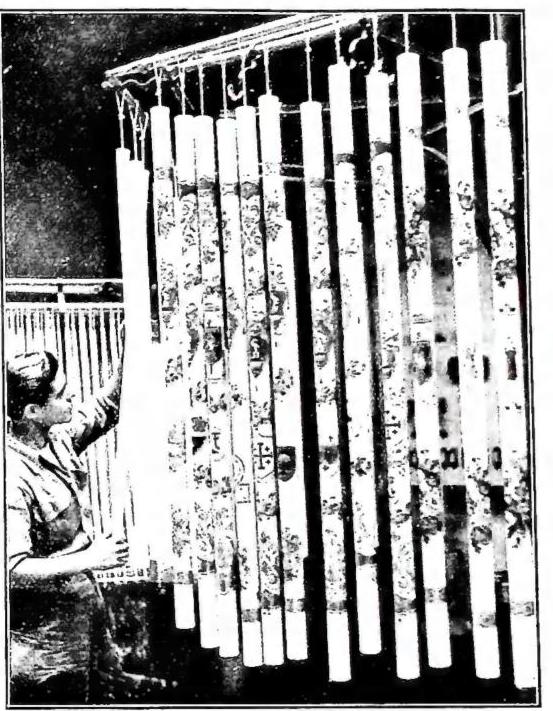
At present, the most vivid expression of popular devotion consists in the fact that the blessed candles, especially in the countryside, but also among the urban populace, are jealously kept, often prominently displayed in bedrooms, because particular powers are attributed to them
(courtesy of Mons. A. P. Frutasi)
PURIFICAZIONE - Preparation of the candles that will be offered to the Holy Father on the day of the feast
against the maleficent forces of nature and evil spirits. For this reason people light them at the bedside of a dying person, convinced that the light of the candle will drive death away; likewise on the occasion of storms and against lightning and hail, in order to placate raging nature and ward destruction from the fields. In many places it is customary to display the lit candle outside the window while the storm is raging. In the Abruzzi, on Candlemas Day, everyone refrains from working, but especially millers, because it is said that once a miller refused to sanctify this feast and saw flour emerge from the mill in the shape of a candle.
In the traditional calendar Candlemas marks the end of winter; hence a great number of weather proverbs, beliefs, and predictions take their cue from the weather on that day. In most cases Candlemas is held to indicate the end of the winter season (“by Candlemas—from winter we are out”), but if the weather is fine on that day, winter will continue for another month or more. Interesting in this regard is the belief, widespread throughout Europe, that on that day the bear would come out to see what the weather was like: if it was cloudy, with three leaps it announced that winter was over; if the sky was clear, it withdrew, showing that forty more days of cold were to be expected. Perhaps related to this belief is the custom, still widespread in some Piedmontese valleys, according to which, on the eve, young people, by means of some trickery, try to get some distinguished or foreign person to come out of the house and, as soon as the person is outside, surround him or her, making a great din and shouting that they have succeeded in bringing out the bear. Something similar also occurs in Valtellina. The custom, certainly very ancient and to be connected with ancient agrarian rites marking the end of the year, is regarded by some ethnographers as a probable survival of a prehistoric cult of the bear (or she-bear) as a divinity. In many regions, for example in France and Italy, the bear is replaced by the wolf, or even by the lion. In Calabria, the periphrastic term “u lanutu” (the woolly one) designates an old man who, dressed in a wolfskin, goes about pretending that he wants to seize children with his long arms and swallow them. Everywhere he is greeted with the cry: “Fora, fora, lu viernu fora”; to which he replies: “O fora o non fora, quaranta journi ci hadi ancora”. As an indication of the end of one season and the beginning of a new year, Candlemas also presents certain old rural customs that correspond to similar ceremonies and New Year celebrations. In Schleswig-Holstein a great bonfire is made, lights are placed in the windows, and children are carried in procession to drive away harmful insects, mice, and snakes. Elsewhere in Germany lights are placed on the trees, and children carry them in procession or dance outdoors around a fire. In Flanders and in certain regions of France, peasants customarily wave straw torches (brandones) around fruit trees; this practice, with a much wider diffusion, belongs to the cycle of Carnival agrarian ceremonies, intended to purify and bring good fortune at the beginning of the new season. In France, too, families once prepared special sweet pastries called mariottes or marionettes, which were thought to represent the fairies who, according to legend, had once appeared to the washerwomen at the Douix spring. With these human-shaped sweets (five beans, broad beans, or peas inserted into the head served to represent the diadem, nose, and eyes), young and old went to the spring, beheaded the mariottes, and threw them into the water, which they then stirred with ladles and sticks; if the fairies were favorably disposed, young men and girls would find spouses within the year. The motifs of Perrault’s Novella della Candelora are traced back to this substratum of ancient rites intended to bring good fortune. And, as at New Year, in many regions girls draw predictions concerning marriage on the eve of Candlemas.
Connected with the feast of the P. is the custom whereby new mothers go to church on the fortieth day after the birth of a child. The custom has an extremely wide area of diffusion and considerable local variation, with greater or lesser richness of detail in the performance of the ceremony. One example will suffice. In Venezia Giulia the woman who has given birth must remain shut up at home for forty days, and the first time she goes out she must be accompanied by the midwife. She goes first of all to church to purify herself and to give thanks to God, St. Anna, and the patron saint of the village for the safely completed delivery. During the journey from the house to the church she speaks to no one and does not even reply to people’s greetings: the midwife attends to this. The mother carries bread with her, symbolizing “providence,” so that evil influences may not take away her milk, the nourishment of her child. Upon reaching the church, she kneels at the door, holding a lit candle. The priest then comes toward her and raises her from that position, sprinkling her with holy water and placing his white stole over her arm. The woman remains absorbed in prayer for some time and sometimes attends Holy Mass. After this ceremony, the mother may resume her relations with the world; indeed, before returning home, she must visit relatives and friends. - Vedi tav. X.