
EGERIA. - A Latin nun (E. is the most established form of the name, Eteria is the alternative), known previously only from a letter by Valerius, abbot of S. Pietro in Montes (Galicia) in the 7th century (PL 87, 421; better L. Garcia, La lettre de Valérius aux moines du Vierze sur la bienheureuse Aetheria, in Anal. Boll., 29
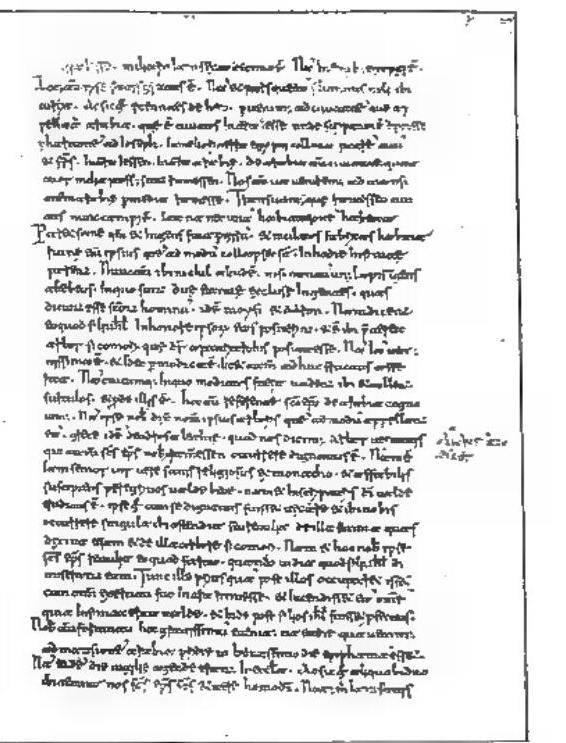
[1910], pp. 377 ff.). Since 1903 (D. Férotin, Le véritable auteur de la « Peregrinatio Silviae », la vierge espagnole Ethéria, in Rev. des quest. hist., 74 [1903], pp. 367-97), she has been recognized as the author of a Peregrinatio ad loca sancta, which Fr. G. Gamurrini published in 1887 from an Arezzo codex, written at Montecassino in the 11th century, mutilated at the beginning and the end, the only copy that has come down to us (aside from a few meager extracts) of this precious little book.
In the part that remains to us, E. recounts in the form of a letter to her fellow nuns the pious excursions that she undertook, using Jerusalem as her base, to visit Mount Sinai, Egypt, Arabia, or Transjordan, and finally, on her return journey via Constantinople, Mesopotamia, drawn by biblical memories, the recollections of martyrs, and the spectacle of fervent male and female monasteries. Lastly, as a separate appendix, she gives a detailed description of the sacred ceremonies with which the feasts of the Christian year, particularly Holy Week and Easter, were celebrated in Jerusalem.
One can easily understand how precious this writing is for scholars of biblical geography and the history of liturgy. For the knowledge of the Jerusalem liturgy in particular, it has an incomparable, almost unique value. But it is no less important for philology, because it is written with gentle abandon in a language bordering on everyday conversational speech, in which the features of the new Romance vernaculars are already apparent. Expressions such as sub vesperam (III, 2), transire habebamus (II, 1), mansi loco ("ri-
Where was « the noble female writer born when she was in Palestine? These are questions that fascinate and divide scholars. Having discarded, along with Férotin, the hypothesis of the first editor, Gamurrini, that the author was an Aquitanian Silvia, today it is generally believed that she was a Spaniard. In fact, the oldest testimonies come from Spain. But the language of E., which, even with some Spanish coloring, more frequently borders on the vernaculars of France and Italy, and the comparison of the Euphrates with the Rhône (XVII, 2), would make the scale tip towards southern Gaul (K. Meister and others). As for the date, Gamurrini places the Peregrinatio between 385 and 388, « which found many followers. Others pushed it about ten, twenty, thirty years later. K. Meister placed it much lower down, between 533 and 539, followed predominantly by philologists. But the end of the 4th century is better suited to the cheerful and calm tone of the writing, where there is no hint of the disturbances brought by the barbarian invasions to the West. - See plate IX.