
LITURGY. - From λῆσον ἔργον = publicum opus (public work). Among the Greeks, it implied the concept of a public work undertaken for the good and in the interest of all citizens by those possessing a wealth exceeding three talents; in this way, public festivals, national games, and the like were provided for. Later, the meaning was restricted to a public work, yes, but one of worship to the gods, and from then on it was no longer the duty of the wealthy citizen but of the public treasury (cf. Aristotle: Politics, VII, 9).
CONTENTS:
I. Liturgy in non-Christian religions
II. In the Catholic religion
III. Origin and division
IV. Liturgical movement
V. Writers on liturgy
VI. Liturgy as a theological science
VII. Liturgy as a dogmatic source
VIII. Liturgy and piety.I. LITURGY IN NON-CHRISTIAN RELIGIONS
All religions possess a liturgy, that is, a norm by which sacred action is modeled. Two elements are indispensable to every liturgy: action and word. Action, which in primitive groupings occupies the principal place, expresses through gesture and various movements of the person (dance, mime, etc.) what it intends to achieve; the word is reduced to the minimum necessary either to explain and provoke the effect on the part of the one directing the action or to approve with a cry or formula the adherence of the group attending the rite. The word tends to assume in the liturgy of more evolved civilizations an ever greater development and moral elevation (v. PREGHIERA) and, from a simple imperative formula or a request for benefits according to the do ut des formula, ends by becoming the aspiration of the heart, especially in private prayer. In liturgy, given its public character,the word is never separated from action because every liturgy is a drama that refers to a historical moment or a collective aspiration of the group and that is either drawn from the deposit of the group’s oral tradition or codified in its sacred books. In all organized liturgies, the association of word with action through formulas of assent (amen, so be it, alleluia; canticles, hymns, psalms, dance) is constant, and indeed essential at the culminating moment of the sacred action.
Silence, too, is part of liturgy and is imposed with specific formulas (e.g., among the Romans Iavete linguis, parcito linguam) not only to prevent the sacred action from being disturbed by profane noises but also because silence fosters the recollection of the spirit and allows the active presence of the divinity to be experienced, just as the darkness of the sanctuary aids the concentration of the soul in God. To this the Catholic priest’s exhortation at the beginning of the Preface invites: «Sursum corda!».
Liturgy in all human groups that have fixed and organized places of worship is twofold: daily for the daily service of the temple and the particular piety of the devotees; and periodic according to the various times of the year, coinciding with the rhythm of the seasons, with the recurrence of historical events that have affected the life of the group, or with the commemoration of the mythical and historical events of the patron deity of the group itself. Thus, in Egypt, the death of Osiris and the finding of his body (Inventio Osiridis) are commemorated; the Metroac ritual recalls the death (Sanguen) and resurrection of Attis (Hilaria); the Christian religious calendar is essentially dedicated to recalling the life of the Redeemer from Advent, Christmas, Epiphany, Death, and Resurrection to Pentecost. The periodicity of liturgical celebrations serves to renew the sense of social unity by recalling the ideas and events that presided over the constitution of the group itself and thus to consolidate its structure. Without this periodic reminder enacted by liturgy, the cohesion of the group would dissipate into often unregulated individual manifestations.
II. IN THE CATHOLIC RELIGION
In the sense of worship offered to the divinity, the term liturgy was also introduced into the Bible by the Septuagint, to indicate, therefore, the sacred office of priests and Levites in the Temple; thus it was also used by the writers of the New Testament (Lk. 1:23 regarding Zechariah), even to designate the acts of Jesus as eternal priest (Hebr. 8:2); analogous expressions are found in the Didaché (15:1) and in Clement of Rome (To the Corinthians, 44:2). Later, it came to signify only the act of worship par excellence, the Mass (perhaps in correspondence with Act. 13:2), as attested by the Councils of Ancyra (314), Antioch (314), Laodicea (375), in the Apostolic Constitutions, by the Fathers, and by Greek sacred texts.The Greek noun and verb were translated in the Latin Bible with ministare, ministerium, officium (Lk. 1:23; Act. 13:2; Hebr. 8:2 and 6), which, with the addition of the adjectives divinum, ecclesiasticum, were also used by medieval writers. The classical erudition of the 17th century rendered the Greek term into the Latin liturgy, assigning it the role of indicating the historical forms of a rite (thus Mabillon with the work De liturgia gallicana; Muratori with Liturgia romana vetus, etc.), as well as the living complex of rites. However, when its meaning was sought to be more precisely defined, discussions began. Aesthetes and rubricists described it as "the complex of rites and prescriptions forming the ceremonial of Christian worship," exposing liturgy to becoming mere external ritualism; attempts were therefore made to affirm its essential spiritual element through definitions such as: "cultus publicus ab Ecclesia quo ad exercitium ordinatus" (Callewaert), or "the complex of public prayers and acts of worship ordained by Jesus Christ and the Church" (Eisenhofer), and others similar (cf. J. Hanssens: La définition de la liturgie, in Gregorianum, 10 [1929], pp. 204-28), all, perhaps,
inspired by can. 1257 of the CIC. The best definition is that of M. Righetti: "it is the worship of the Church" (Storia liturgica, I, Milan 1945, p. 6 ff.). Today, the discussions appear to be closed by the encyclical Mediator Dei, of 20 November 1947: "Liturgy is the integral worship of the Mystical Body of Jesus Christ, that is, of the Head and His members"; in other words, "it is the public worship which our Redeemer offers to the Father as Head of the Church and the worship which the society of the faithful offers to the Head and, through Him, to the Eternal Father." This definition contemplates the "fact," which, in itself, does not exclude the "manner" in which liturgy is realized: this, however, is better indicated by the term rite. For this reason, there is only one Christian liturgy, while the rites may be many. It further follows that liturgy is synonymous with Christian worship, a single and immutable trunk, from which rites arise, varying according to times, places, and persons; they represent a particular way of feeling and cultivating the virtue of religion. Each rite has its own testimony in the liturgical books that collect the prayers, biblical passages,
and chants for the Mass (lectionary, epistolary, evangeliary, antiphonary, sacramentary, Missal), for the Divine Office (Bible, homiliary, passionary, martyrology, hymnal, collectary, psalter, antiphonary, responsorial), for the Sacraments and sacramentals (ritual), and also the rules (rubrics) for the ordering of ceremonies ("ordo," ceremonial).
The study of these direct testimonies, together with those obtainable from the most varied monuments of Christian tradition, and the comparison of different rites, can reveal the origin of each and their grouping, thus constituting a genealogical tree, always living and luxuriant, even if, after the Council of Trent, the growth of new branches no longer appears possible. In the present state of studies, rites can first be distinguished into the two fundamental groups of the East and the West, each with numerous derivations, stemming from Churches particularly important in the early Christian centuries.
III. ORIGIN AND DIVISION
East and West share the history of the origins of the liturgy and its development up to the year 313. This is the history of Christian worship (v. CRISTIANO), with the emergence and early growth of those local elements which, from the 4th century onward, reveal the existence of distinct rites.1. East
Three periods may be distinguished: a) 4th-5th centuries. — The organization of the Church favors certain centers which, due to their acquired importance, produce two opposing effects: that of causing the disappearance of liturgical particularities in small Churches, which had lived under forced liturgical autonomy due to persecutions, and that of better ordering their own liturgy, which, either on its own or by force of conciliar and synodal canons, imposes itself on neighboring small Churches. Proof of this is the fact that, having established the four patriarchates of Alexandria, Antioch, Jerusalem, and Constantinople at the Council of Chalcedon in 451, these became four liturgical centers, the latter two being the most important and of greatest influence even in subsequent centuries, both in the East and in the West—the one as the destination of continuous pilgrimages, the other as the capital of the Empire, where political affairs easily convened. b) 6th-7th centuries. — By this time, the Byzantine, Armenian, Syriac, and Coptic rites are fully constituted, each having the history of every rite under the influence of evolving civilization, yet remaining always alive. c) The first printed editions (16th century) of Eastern liturgical books fix the ordo of each rite, offering an advantage over manuscripts with their many variants.2. West
The origin and history of Western rites hinge on that of the Roman rite, even if there is still debate over how many liturgical centers existed in the 3rd-4th centuries—whether two, Rome and Milan, or Rome alone. Today, even if some Churches or religious Orders preserve minor liturgical particularities, all countries of Western civilization, as well as others converted to Christianity from the 16th century onward, follow the Roman rite, with the exception of Milan.
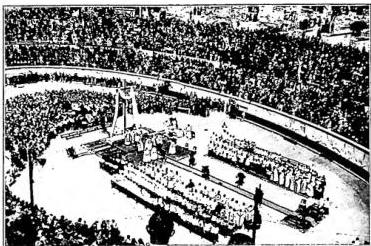
Regarding historical development, whatever the course of liturgy in individual Western countries may have been, general lines of a common evolution can be established: 1) Until 313. — For the West as well, the history of Christian worship in this period applies. While in the past it was thought that New Testament writings and the apostolic age influenced the formation of liturgical texts, today there is a tendency to see in those writings the first documents of a liturgy that was certainly lived. 2) 4th-5th centuries. — A consequential event, marking a separation from the East, was the introduction liturgical language (v.); the 5th century is considered the common era for the official redaction of liturgical books, which, in their essential lines, have come down to us. By this time, year (v.) had been composed in its principal parts, sacramental discipline had been established, and public prayer had been ordered. Great resonance was achieved by the work of Pope Leo I and especially of Gelasius I. 3) 6th century-first half of the 8th century. — Information varies in number, extent, and importance according to the countries. The grand work of Gregory I must be considered, as well as, for Italy, the events provoked by Byzantine and Lombard domination. Perhaps for the entire West, the influence of Greco-Syrian currents, refugees from their lands, is significant, as indicated by the Greek popes of this period. 4) Second half of the 8th century-12th century. — Frankish influence and the Carolingian renaissance dominate. Liturgy tends increasingly to add to the markedly theological edifice of previous centuries a humanistic note, with the establishment of feasts commemorating episodes from the life of Jesus Christ and the Madonna, the addition of symbolic meanings to rites, and a greater attention to the needs of man on his journey toward heaven. The restoration of ecclesiastical discipline carried out by Gregory VII also aimed at liturgical unity.
5) 13th-14th centuries. — Decline becomes more pronounced due to the growing prevalence of devotions that increasingly occupy a place in the liturgy, the multiplication of feasts and texts, and the desire to assign a spiritual meaning to every gesture, indicated by an accompanying formula. 6) From the Council of Trent. — The need to defend dogma and a disciplinary concern led to a rigidification of the positions reached, though freed from superstructures and better adapted to the new conditions of Christendom. Official editions of liturgical books were carefully prepared (the Breviary in 1568, the Missal in 1570, the Martyrology in 1584, the Roman Pontifical in 1596, the Ceremonial of Bishops in 1600, the Ritual in 1614, the Roman Octavarium in 1623), which, apart from minor particularities and the addition of feasts, are the same as those used today. The establishment by Sixtus V in 1588 of the Congregation of Rites removed from bishops any possibility of innovation. Canon 1257 of the CIC confirmed this discipline. 7) 19th-20th centuries. — As a result of studies conducted according to the most modern textual and historical criticism, there is a tendency toward the purification of texts from secular corruptions and the reconstruction of liturgy along severe, dogmatic lines, in which the Christological cycle dominates over the Sanctoral. This work is overseen by the supreme authority of the Church, which seeks to harmonize it with the demands—sometimes strongly innovative—of the "liturgical movement."
IV. LITURGICAL MOVEMENT
Its origins in France stem from the reaction to the revolutionary Terror: Chateaubriand (v.) in Génie du christianisme celebrates the beauties of worship and the liturgy; Guéranger (v.) draws from the Benedictine soul, always exquisitely liturgical in homage to the "Rule," teachings and energies to restore worship to the splendors that, as effect from cause, flow from unifying discipline, spiritual penetration of every part, and the return of every rite to the purity in which it was established. On 1 September 1837, Gregory XVI, erecting the community of Solesmes into a Benedictine Congregation, blessed and approved Guéranger’s intentions, assigning to the monks, among other aims, that of "reviving the sound traditions of canon law and those now in decline of the sacred liturgy." Guéranger’s writings and work gave immediate solidity to the liturgical movement, which found kindred spirits: in Germany through the Benedictine abbey of Beuron, Bäumer (v.) SCHOLASTIK (v.) belonged, the latter having popularized the Missal and Vesperale among the people, where a movement for the restoration of sacred art also began; Newman (v.), to whom belongs the proposition: "he who ignores the liturgy understands only half the greatness of the Catholic religion"; in Belgium (centered at the abbey of Maredsous) with popularizing works by Dom Van Caloen and scholarly studies by Dom G. Morin (v.) in the Revue bénédictine (founded 1887); in Italy mainly through Don G. Amelli, founder of the Associazione di S. Cecilia for sacred music, while at Solesmes the restoration of Gregorian chant was being prepared; the journal Rassegna gregoriana (1902-14) exerted great influence.The liturgical movement had traversed its first phase, blessed but not yet directly organized by the supreme authority. The first step of the second phase was marked by the motu proprio "Tra le sollecitudini" (22 November 1903) of Pius X, in which, though the central topic was Gregorian chant and sacred music, it was repeatedly stated that their restoration depended on a renewed liturgical spirit. From then on, the liturgical movement pursued three aims, not equally pursued everywhere: 1) active participation of the faithful; 2) return to the sacred art of the Church (music, ornament, furnishings, etc.); 3) scientific study of the entire liturgy.
The best organization and principal development occurred again in Belgium (1909) with highly active centers at Maredsous, Mont-César, Malines, St-André-lez-Bruges, etc., where congresses and several liturgical weeks were held, the proceedings of which were published: an excellent contribution was made by the journal Questions liturgiques (founded 1910). In Antwerp in 1930, the first international liturgical congress was held; in Germany (1914), centered at the abbey of Maria Laach, the movement aimed especially at revealing the depths of the theological content of the liturgy, alongside a most rigorous scientific effort grounded in every ecclesiastical and secular discipline, with marked sympathy for the Eastern Church; in Austria (ca. 1919), centered at Klosterneuburg, with the fervent animator Professor Pius Parsch, author of several valuable publications, always of a popular character, some of which were translated into Italian; in Portugal from 1921; in the United States of America, from 1940, centered in Chicago, annual liturgical weeks were held with publication of the proceedings; in other American countries, too, the liturgical movement is active, as shown by ecclesiastical journals containing studies and commentaries on the liturgy; also from 1940 in France, centered in Paris, the "Centre de pastorale liturgique" began (publishing the journal La Maison Dieu from 1945), with influence in all Latin countries. In Italy, after 1903, the liturgical movement initially took on a scholarly character, in which Cardinal G. Mercati, F. Magani, A. M. Ceriani, A. Ratti (Pius XI), M. Magistretti, the "Greek" scholars of Grottaferrata, and, with a popularizing aim, Father G. Semeria distinguished themselves. Soon, however, the second phase began, when historical research became the foundation for the science of spiritual life, combating abuses introduced in previous centuries and establishing balance between liturgy and devotions. In 1914, under the care of the Benedictines of Praglia and Finalpia, the Rivista liturgica was founded, proposing a program of sound liturgical popularization. In 1913 in Milan, Arte cristiana was born, later becoming the organ of the Scuola superiore d’arte sacra B. Angelico, in which the liturgy served as inspiration. Particular impetus and formation, also for the clergy, came from the Liber Sacramentorum (1919-28) of Cardinal I. Schuster. Meanwhile (1921), in Vicenza, the Bollettino liturgico was founded, aimed at the faithful; in Rome, the new series (from 1927) of the international journal Ephemerides liturgicae, today the best and most complete of its kind, whose direction is a center of activity and propaganda; in Turin, the journal Liturgia existed for a few years, interrupted by the Second World War; in Milan, from 1931, the Opera della regalità di Cristo at the Università Cattolica distributed pamphlets for the people; Ambrosius (1925) extensively treats the Ambrosian rite (the scholarly aspect, in broader form, from 1949, is developed in the volumes of the Archivio ambrosiano); it also promotes the movement for altar servers and young choristers (the counterpart organizer, with the journal Il chierichetto, for the Roman rite is in Parma) and, since 1946, has been the organ of the Associazione dei SS. Ambrogio e Cecilia. In Genoa, the Apostolato liturgico, founded by Monsignor Moglia, organized in 1934 the first national congress, which advocated a "Centro di azione liturgica" for Italy, the foundations of which, however, could only be laid in 1949 at a national meeting held in Parma.
During and immediately after the Second World War, the liturgical movement concerned the Holy See because some appeared too eager for novelty and strayed from the path of tradition and prudence. Pius XII addressed this with the encyclical Mediator Dei.
BIBL.:
Per la storia del movimento liturgico: P. Guéranger, Institutions liturgiques, I-III, Parigi 1878-85; Id., L'année liturgique, I-XV, Parigi 1841-66; A. Bäumer, Geschichte des Breviers, Friburgo 1895; P. Batiffol, L'histoire du bréviaire romain, Parigi 1893; F. Cabrol, Les origines liturgiques, Parigi 1906; Id., Introduction aux études liturgiques, Parigi 1930; L. Beauduin, La piété de l'Église, Lovanio 1914; Id., Liturgie et piété populaire, Parigi 1930; P. Parsch, Das Jahr des Heiles, Klosterneuburg 1923; Id., Volksliturgie, Klosterneuburg 1940; G. Morin, Études, textes, découvertes, Maredsous 1913; A. Baumstark, Liturgie comparée, Chevetogne 1939; J. A. Jungmann, Missarum sollemnia, Vienna 1948; O. Casel, Das christliche Kultmysterium, Ratisbona 1932; Id., Mysteriengedanke, Düsseldorf 1951; R. Guardini, Vom Geist der Liturgie, Friburgo 1918; A. G. Martimort, L'Église en prière, Parigi 1961; per l'Italia: G. Amelli, La musica sacra in Italia, Milano 1904; I. Schuster, Liber Sacramentorum, Torino 1919-28; G. Mercati, Opere minori, I-III, Città del Vaticano 1937; A. Ratti, Scritti liturgici, Roma 1960; M. Righetti, Manuale di storia liturgica, I-IV, Milano 1945-55; per la musica sacra: P. Wagner, Einführung in die gregorianischen Melodien, Lipsia 1901-13; L. Lambillotte, Antiphonaire de Saint Grégoire, Parigi 1851; A. Gastoué, Les origines du chant romain, Parigi 1907; A. Mocquereau, Le nombre musical grégorien, Roma 1908-27; per l'arte sacra: P. Clemen, Die romanische Monumentalmalerei in den Rheinlanden, Düsseldorf 1916; J. Braun, Der christliche Altar, Monaco 1924; Id., Die liturgische Gewandung, Friburgo 1907; per il movimento liturgico contemporaneo: Atti dei congressi liturgici nazionali e internazionali, Roma 1931 ss.; Atti delle settimane liturgiche, Roma 1947 ss.; La Maison Dieu, Parigi 1945 ss.; Questions liturgiques, Lovanio 1910 ss.; Ephemerides liturgicae, Roma 1887 ss.; Rivista liturgica, Finalpia 1914 ss.; Ambrosius, Milano 1925 ss.; Arte cristiana, Milano 1913 ss.
P. SALVATORI.
V. WRITERS ON LITURGY — In the broadest sense of the term, certain Church Fathers and other writers may be considered as such. However, due to the absence of the liturgical texts they comment upon, their works are classified among the sources. These sources consist of the smallest and largest liturgical testimonies scattered in the writings of pagan and Christian authors of the first centuries, in councils, synods; excellent material is provided by archaeology, epigraphy, the history of music, and finally by liturgical books from the oldest to the modern redactions. The writers properly so called belong to three periods:
1. 8th–15th centuries. — The Carolingians initiate this period with Alcuin, Amalarius, Agobard, Florus of Lyon, Walafrid Strabo, and Rabanus Maurus: in their works, there is an attempt at criticism, and symbolism emerges as a means of supporting ceremonies no longer understood or diminished in their original efficacy due to the changing Christian life. They are followed by the allegorists, so called for their meticulous and often exaggerated search for the mystical-symbolic meaning of liturgical elements: Odilbert of Milan (d. 814), Berno of Reichenau, St. Peter Damian (d. 1057), Bonizo of Piacenza (d. 1089), John of Avranches (d. 1079), Bernold of Constance (d. 1100), Odo of Cambrai (d. 1131), Ivo of Chartres (d. ca. 1117), Bruno of Segni (d. 1123), Rupert of Deutz (d. 1135), Hugh of St. Victor (d. 1141), Honorius of Autun (d. ca. 1145), Berold of Milan (12th c.), Jean Beleth of Paris (d. after 1165), Sicard of Cremona (d. 1215), Innocent III (d. 1261), William Durandus (d. 1296), Radulph de Rivo (d. 1403). All these are sometimes considered rather as secondary sources because, with their descriptions and commentaries, they complete the picture provided by liturgical books.
2. 16th–18th centuries. — In reaction to the pseudo-Reformation, studies in positive theology, history, archaeology, and biblical scholarship gain great importance. For this reason, the 16th century may be seen as the birth of liturgical science, whose proponents are concerned with scrutinizing sources, publishing the oldest texts, comparing them, and providing commentaries according to a criticism that, over four centuries, continually perfects itself. The most important figures include: Johannes Dobeneck, known as Cochlaeus (d. 1552), Jacob Pamelius (d. 1587), Melchior Hittorp (d. 1584), Onofrio Panvinio (d. 1568), Angelo Rocca (d. 1620). Of great importance for Greek and Eastern liturgies are the publications of Jacques Goar (d. 1653), Leone Allacci (d. 1669), Eusèbe Renaudot (d. 1720), Angelo Quirini (d. 1755), Giuseppe Luigi Assemani (d. 1728), Giuseppe Simone Assemani (d. 1768). Meanwhile, for Western liturgies, significant texts were published by Hugues Ménard (d. 1644), Jean Mabillon (d. 1707), Edmond Martène (d. 1739), Giuseppe Bianchini (d. 1764), Giuseppe Maria Tommasi (d. 1713), Ludovico Antonio Muratori (d. 1750), Alexander Leslie (d. 1758), Domenico Giorgi (d. 1764), and Martin Gerbert (d. 1793). Serious commentators among others were: G. Visconti (d. 1633), G. Gavanti (d. 1638), G. Morin (d. 1659), G. Bona (d. 1674), L. Thomassin (d. 1695), P. Lebrun (d. 1720), G. Grancolas (d. 1732), Benedict XIV (d. 1753), G. Catalani (d. 1755), C. Chardon (d. 1757), C. Trombelli (d. 1778), and A. Zaccaria (d. 1795).
3. 19th–20th centuries. — It is impossible to provide a complete list: only those who, with their works, address the most varied themes, laying the foundations upon which many others continued the construction and were effectively stimulated to study liturgy, are mentioned. In France and Belgium: Dom P. Guéranger (d. 1875), L. Duchesne (d. 1922), U. Chevalier (d. 1923), P. De Puniet (d. 1938), F. Cabrol (d. 1932), H. Leclercq (d. 1947), P. Batiffol (d. 1928), G. Morin (d. 1946), P. Cagin (d. 1923), G. Corblet (d. 1886), C. Callewaert (d. 1943), A. Wilmart (d. 1946), R. Aigrain, A. Gastoué, H. Netzer, V. JALABERT, LOUIS, M. Andrieu, J. Hesbert, B. Capelle, J. Froger, B. Botte, L. Brou. In England: H. A. Wilson (d. 1927), C. Felton (d. 1926), E. Bishop (d. 1917), A. Fortescue (d. 1923), I. Mearns, I. Thurston, H. Connolly, F. E. Warren. In Germany: A. Ebner (d. 1898), G. Dreves (d. 1909), F. Probst (d. 1899), S. Bäumler (d. 1894), A. Kellner, A. Baumstark (d. 1948), A. Schönfelder, J. Brinktrine, K. Mohlberg, A. Dold, F. X. Funk (d. 1907), L. Fischer, B. Albers, P. Wagner, A. Franz, N. Nilles, L. Eisenhofer (d. 1941), J. Dölger (d. 1940), T. Klauser, P. Browe, M. Hanssens, F. Oppenheim (d. 1949), O. Heiming, O. Casel (d. 1948). In Spain-Portugal: A. Coelho (d. 1938), G. Suñol (d. 1946), Gr. Madinez de Antonana, Juan B. Fereres. In Italy: L. Barbieri, P. Silva-Tarouca, Pio Alfonzo (d. 1946), A. Paredi, P. Borella, A. Roberti, G. Destefani, L. Barin, M. Righetti.
For individual topics cf. DACL, exercising caution with articles signed by H. Leclercq, a scholar of undoubted value but who, from about the middle of the work onward, became almost the sole author of the dictionary. Excellent articles are also found in DThC.
A. Paredi
È sempre necessaria la consultazione di opere bibliografiche: a) per il passato cf. principalmente: F. Cabrol, Introduction aux études liturgiques, Parigi 1907; K. Mohlberg, Ziele und Aufgaben der liturgiesgeschichtlichen Forschung, Münster 1919. b) Dal 1921 in avanti guide ottime sono: i) Jahrbuch für Liturgiewissenschaft edito dal centro liturgico di Maria Laach (Germania). ii) La bibliografia in appendice alla rivista Ephemerides liturgicae curata in modo particolarissimo dal 1946. Per il rito ambrosiano, in aggiunta a quella riportata alla V. AMBROSIA, LITURGIA, cf. il II vol. di Archivio Ambrosiano, Milano 1950, con bibli. dal sec. XIX al 1949. Per il «movimento liturgico»: G. Zunini, Le conquiste del p. Pio Parich, in Ambrosius, 5 (1920), pp. 26-32; A. Hammerstein, Principi e scopi del movimento liturgico promosso dall'abbazia di Maria Laach, ibid., pp. 104-12; O. Rousseau, Il movimento liturgico in Belgio, ibid., pp. 173-80; C. J. Grimbeau, Il valore della rinascita liturgica in Inghilterra, ibid., pp. 258-69; A. Ferreira, Il movimento liturgico nel Portogallo, ibid., p. 1930, pp. 192-95; A. Bernareggi, Il movimento liturgico in Italia, ibid., pp. 162-74; M. G. Tissot, Movimento liturgico in Francia, ibid., 7 (1931), pp. 241-46; L. Andrianopoli, La rinascita liturgica contemporanea, Milano 1934; O. Rousseau, Histoire du mouvement liturgique... depuis le début de XIXᵉ siècle jusqu'au pontificat de Pie X, Parigi 1945; R. Pierre, Le mouvement liturgique fondé à Paris, in Ephemerides liturgicae, 59 (1946), pp. 151-168; E. Fei, Il movimento liturgico negli Stati Uniti, ibid., 60 (1947), pp. 100-106. Riviste pubblicate oggi: Ambrosius (Milano dal 1925); Ephemerides liturgicae (Roma dal 1887); Les questions liturgiques et paroissiales (Lovanio dal 1911); L. (Silos dal 1946); L. (Singeverga dal 1947); Liturgy (Birmingham dal 1920); Maison-Dieu (Parigi dal 1945); Paroisse et Liturgie (Bruges dal 1946); Rivista liturgica argentina (Buenos Aires dal 1936); Rivista Liturgica (Finalpia dal 1914); Sacris erudiri (Bruges dal 1948). Opere ascetico-liturgiche: Cours et conférences des semaines liturgiques, 1913-35, pubblicate dai Benedettini di Lovanio; G. Morin, L'ideale monastico e la vita della società cristiana nei primi secoli, trad. it., Sorrento 1927; R. Guardini, Lo spirito della I., trad. it., Brescia 1935; M. Zundel, Il poema della sacra I., trad. it., Roma 1939. Enrico Cattaneo
VI. LITURGY AS A THEOLOGICAL SCIENCE
Canon 1365, §2 also lists "Liturgy" among the subjects to be taught in major seminaries, referring to that part which scientifically considers and treats everything pertaining to divine worship (object), in its various aspects: essence, history, parts, execution (the latter part is more specifically called rubricistics). A satisfactory division of Liturgy as a theological science has not yet been established; generally, in general or fundamental Liturgy, the essence of worship, its general history, its constitutive elements, sacred times and places are treated; and in the special part, the various modes under which Liturgy is understood: sacrifice (Mass), prayer (Divine Office), Sacraments, sacramentals (blessings). Each individual part can be studied and presented from a purely historical-evolutionary perspective, from that of content or meaning, and finally from that of concrete and practical execution (rubricistics). It should be noted, however, that in the teaching of Liturgy in seminaries, given the complete and organic formation of the young aspirant, a clear division of these various perspectives is neithernecessary nor desirable, because the purpose of this teaching must consist in forming the young cleric for liturgical life, in and with the Church, with regard to his own person and to the entire Christian people. This presupposes a good knowledge of liturgical history, but even more so of its inner greatness and its pastoral-educational value, given that priestly activity unfolds, in its essential part, precisely through the Liturgy, which unites clergy and people in the common duty of worship due to God (v. below: Liturgy as a source of piety). Therefore, the encyclical Mediator Dei, 20 November 1947 (AAS, 39 [1947], p. 591 ff.), also recalls the necessity of a solid and complete liturgical formation of the clergy. Ultimately, even liturgical studies of pure historical investigation achieve their most fruitful purpose insofar as they serve the service and knowledge of the living, actual Liturgy.
As for its origin and development, Liturgy as a distinct theological discipline separated from theology only during the last century, although liturgical studies and treatises were not lacking beforehand. The credit for this evolution belongs France (v.), to Schmidt and Lüft in Germany (Fr. X. Schmidt, Liturgik der christl. Religion, Passau 1832; J. B. Lüft, Liturgik, 2 vols., Mainz 1844-47). With the Katholische Liturgik by J. Fluck (2 vols., Regensburg 1853-55), Liturgy can be considered a distinct theological discipline. However, some of the most accredited authors of pastoral theology in Germany still prefer to make Liturgy an integral part of pastoral theology (see the major works of Amberger, Benger, Schüch), with a treatment that is certainly less historically accentuated but endowed with solid pastoral doctrine, still very useful today. Since then, general introductions and particular works, especially of a historical-liturgical nature, have multiplied immensely (cf., for example, Ph. Oppenheim, Introductio historico in litteras liturgicas, 2nd ed., Turin 1945).
VII. LITURGY AS A DOGMATIC SOURCE
The probative value of liturgy as a dogmatic source is summarized in the well-known axiom Lex orandi, lex credendi. This derives from a passage by St. Prospero of Aquitaine in his De gratia Dei indicus, written between 435 and 442, later attributed to Pope Celestine I (Capitula Caelestini): « Obsecrationum quoque sacerdotalium Sacramenta respiciamus, quae ab Apostolis tradita, in toto mundo atque in omni Ecclesia catholica uniformiter celebrantur, ut legem credendi lex statuat supplicandi » (PL 50, 535; Enchiridion symbolorum, 26th ed., Freiburg im Br. 1947, n. 139; cf. E. Portalié, in DThC, II, 2052). An identical deduction, though in a more general form, was made contemporaneously by St. Vincent of Lérins in his Commonitorium (ca. 434), in another celebrated passage: « In ipsa item catholica Ecclesia magnopere curandum est, ut id teneamus, quod ubique, quod semper, quod ab omnibus creditum est. Hoc est etenim vere proprieque catholicum, quod ipsa vis nominis ratioque declarat, quae omnia fere universaliter comprehendit. Sed hoc ita demum fiet, si sequamur universitatem, antiquitatem, consensionem » (PL 50, 640; Enchiridion patristicum, 14th ed., Freiburg im Br. 1947, n. 2168). Both ancient authors, following ideas already expressed by St. Augustine and St. Cyprian, establish as the criterion for the truth and authenticity of Catholic dogmas the unanimous consensus of the Church, based on apostolic tradition. St. Prospero, in the cited passage, recognizes precisely in liturgy this universal and traditional attestation of the Church, which in itself carries the guarantee of the authenticity of faith. In other words, liturgy could not have formulated its prayers or celebrated its mysteries unless the same universal Church had previously held faith in those same truths and mysteries. Thus, it is not liturgy that creates faith or dogma; rather, from a particular faith or dogma arises the liturgical celebration of that mystery with its determined formulas. This is the true meaning of the axiom « Lex orandi, lex credendi », derived from St. Prospero’s passage (cf. L. Federer, Liturgie und Glaube [= Parodosis, n. 4], Freiburg in Sv. 1950).This same interpretation was given in an official form by Pius XII in the encyclical Mediator Dei of November 20, 1947 (AAS, 39 [1947], pp. 521-600), where he describes the developments of liturgy following the rise of new devotions in the Church, exemplifying his exposition with the fact that even Pius IX, when defining the Immaculate Conception of Mary, included the liturgical argument in his documentation (ibid., pp. 540-541). Moreover, the same Pius XII, in the dogmatic bull Munificentissimus Deus, employed, among other things, the same liturgical argument regarding the Assumption of Mary into heaven, delimiting its real scope in these precise terms: « Ecclesiae liturgia catholicam non gignit fidem, sed eam potius consequitur, ex eaque, ut ex arbore fructus, sacri cultus ritus proferuntur » (AAS, 42 [1950], p. 760).
Liturgy, therefore, is the adequate expression of the Church’s faith, for it summarizes in its terms and mysteries what, through the immanent action of the Holy Spirit and under the guidance of the supreme magisterium, is drawn from the treasures of the deposit of faith.
VIII. LITURGY AND PIETY
3. Liturgy and the Church
Worship constitutes an essential element for the active life of the Church. Therefore, liturgical piety, as the conscious and effective celebration and participation in the various liturgical acts (Sacrifice, Sacraments, preaching, public prayer), is obligatory for all Christians, clergy and laity alike. In worship, the Church acts and prays not only on behalf of the society of the baptized but also in the name of all humanity. Liturgy is not limited to liturgical acts alone but tends to place the Christian, in all his life and even profane activity, in his rightful position as a creature before his Creator. By thus effectively informing Christian life with the spirit of Christ, the Eternal High Priest, the Church anticipates, in a certain way, the perpetual heavenly liturgy on earth and prepares man to participate in it, thereby attaining the supreme end of the rational creature. Worship, and consequently true liturgical piety, being by its nature collective and social, leads to perfect charity, which encompasses, in a single act, God and neighbor. Liturgy has an apostolic character, as it obliges all participants to take an active interest, through prayer and sacrifice, in the salvation of all the redeemed. Indeed, liturgical formularies, with few exceptions, always speak in the plural and express collective intentions. In a word, liturgy continues the priestly work of Christ in its universality, through the centuries and among peoples; thus, Christian solidarity finds its highest expression in liturgy, which unites, in its acts, all without distinction in their unique condition as members of Christ, regardless of their social status.4. Liturgy and Priestly Piety
The Catholic priest is the "liturgist" par excellence, thanks to his sacramental participation in the priesthood of Christ, which prolongs His redemptive priestly action through the centuries. Indeed, the life and activity of the Catholic priest are sanctified by liturgy. He is therefore bound by a grave obligation of state not only to celebrate liturgy worthily according to external rites but above all to perform it with a profound understanding of its true significance. He must make his liturgical piety a true salvific instrument for himself and for the entire Christian family in the Mass, Divine Office, administration of the Sacraments, preaching, and instruction of the people. Only thus does the canonical prescription acquire its full value, which imposes in seminaries the study not only of rubrics but above all of liturgy in its substantial meaning as a science and means of sanctification. From this vision also derives the highest justification for the sound liturgical movement, directed especially to the benefit of the priest himself. A sincere and conscientious liturgical piety indeed safeguards the priest from the easy danger of routine and confers upon his priestly activity the necessary supernatural unction.5. Liturgy and Private Piety
Liturgical piety represents, so to speak, the official piety of the Church; yet it does not at all dispense individuals, including priests themselves, from private and personal piety. Mere participation in liturgy could not achieve its purpose and efficacy if it were not preceded by personal asceticism, without which vices are not uprooted nor Christian virtues developed. Meditation and individual prayer are indeed indispensable presuppositions for a penetrating and reformative liturgical piety; in turn, the latter perfects, elevates, and broadens private piety, which is all too often exposed to the danger of becoming sterile within its narrow self. For the priest, therefore, as for the faithful, the starting point for a fruitful participation or celebration of liturgy remains always personal piety, practiced through the common means of Christian perfection. Thus, private piety and liturgy stand in a relationship of continuous mutual aid, complementing and perfecting each other, uniting personal action with the universal action of the Church in liturgy, while, on the other hand, liturgical action also acquires greater merit and effect in proportion to the personal sanctity of the celebrant or participant. A fruitful liturgical education, both of the clergy and the people, must begin and proceed on the foundation of a sound and effective ascetical education; liturgy will be able to penetrate deeply and pervade all of Christian life, in its manifold activities, only when and insofar as the subject is prepared to fulfill his duties as a convinced and good Christian. Persuasive testimony of this is found in popular piety, paraliturgical, so flourishing especially in the Middle Ages, which invaded all areas of life with its devout customs and traditions. To ensure, therefore, the efficacy of liturgy, it is necessary to prepare priests and laity with the daily practice of Christian life.2. Literature: A. Grea, La Sainte liturgie, Paris 1909; M. Festugière, Qu'est-ce que la liturgie, sa définition, ses fins, sa mission, ibid. 1914; L. Beauduin, La piété de l'Église, Louvain 1914; E. Caronti, La pietà liturgica, Turin 1920; G. Lefebvre, Liturgia. Ses principes fondamentaux, 4ª ed., Abbaye de St. André 1929; Ph. Oppenheim, Introductio in scientiae liturgicae, Turin 1940; id., Principia theologiae liturgicae, ibid. 1947; Th. Filthaut, Die Kontroverse über die Mysterienlehre, Warendorf 1947 (with rich bibliography); Th. Bogler, Liturgische Erneuerung in aller Welt, Maria Laach 1950. The Jahrbuch für Liturgiewissenschaft, Regensburg 1921-41, formerly directed by O. Casel, is the richest and most varied liturgical bibliographical and scientific review of our time; since 1950 the title of the periodical is: Archiv für Liturgiewissenschaft. Giuseppe Löw