
ANGELICO, “BLESSED.” — Guido or Guidolino di Pietro, born at Vicchio di Mugello in 1387 or 1388, died in Rome on 17 February 1455, entered the Dominican convent at Fiesole in 1407 together with his elder brother (who became Fra Benedetto), with whom, the following year, he professed his vows at S. Domenico in Cortona, taking the name Fra Giovanni. The Dominicans of Fiesole, caught up in the events of the Church’s schism, had to take refuge (1409) in Foligno; they were then probably in Cortona and finally regained possession of their house (1418). Fra Giovanni, who is presumed to have followed the community, after its return to Fiesole remained constantly in his own convent, except for absences occasioned by commissions. His presence in Rome, however, is certain in 1447, when he was summoned there to paint the Chapel of the Sacrament in the Vatican, apparently remaining until 1449, by which time he had already begun, the previous year, the pictorial decoration of the Pope’s “study,” that is
A legendary light envelops the figure of Fra Giovanni da Fiesole, popularly known as the «Beato A.», although the Church does not number him among its blesseds; this legend is echoed by Vasari, who presents the artist
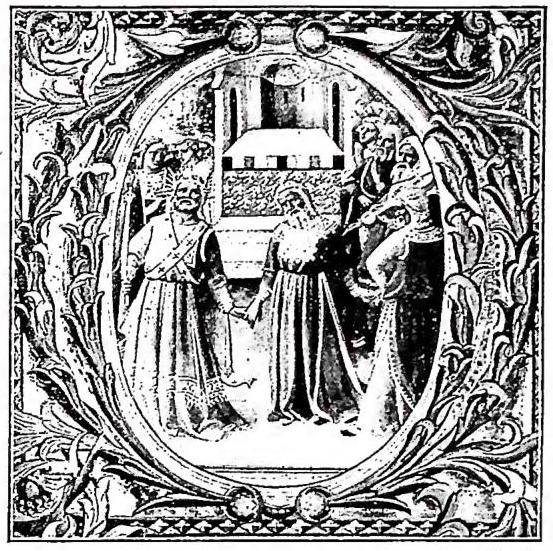
A. follows a distinct and closely coherent development, beginning with miniature-like modes reflected in his own smooth, clear, colorfully vibrant, luminous, and refined pictorial manner, which he did not abandon even when painting on walls, preferring the dry technique to fresco, or a mixed technique. It is plausible that the young Dominican frequented Lorenzo Monaco among the Camaldolese at the monastery of the Angels—that is, the greatest painter Florence possessed at the beginning of the fifteenth century on the path of the Gothic—which is confirmed by the latter’s echoes in our artist. A certain contact is offered by the Sunday day office no. 3 in the Laurentian Library, written in 1409. Alongside the flamboyant initials due to the school of the Angels and certain impassioned, thorny prophets that reveal Lorenzo Monaco and one of his disciples, several compositions with the Resurrection and other subjects, including the Dance of David, possess an idealized and serene sense of beauty close to that of Ghiberti’s second door, within the flowing linear harmonies derived from the Camaldolese monk, combined with fascinating archaisms and a clear, luminous, precious range characteristic of A. If the latter left the convent of Fiesole precisely in 1409, he might have undertaken this work even in his cell at Foligno. But during the years spent far from Florence—years entirely obscure for our knowledge of his art—he could not turn toward the Renaissance, which was making its first figurative experiments with Donatello. Thus a panel admired in the Museum of S. Marco—the Museum of A.—datable to around 1418, with its Madonna’s somewhat wooden profile, still reflects, despite the static three-dimensional pose, the Gothic manner of Lorenzo Monaco in the sinuous, calligraphic contours of the mantle, as confirmed by the bending of the Child’s body, although the Camaldolese’s fervent asceticism has disappeared into the calm candor of the melancholy Virgin and the virile type of the little Jesus, in an idealization that remains thoroughly Ghibertian. Gentile da Fabriano’s passage through Florence briefly turned A. toward the sumptuous decorative forms of the northern world (Madonna of the Stroganoff Collection in Leningrad), followed by delicate forms of extreme refinement (Madonna Van Beuningen in Rotterdam), which prepare us to appreciate the abstract idealism of works such as the Virgin among Saints in the Vatican Pinacoteca, the Madonna della Stella, and the small tabernacle with the Annunciation and the Adoration of the Magi in the Museum of S. Marco. These works possess an outward splendor and clear forms placed with assured order in space, suggesting the teaching of Masaccio. A. thus enters the Renaissance, and his subsequent, abundant activity displays compositional structures subordinated to a perspective vision that enhances the static quality of the images, from the triptych of S. Domenico in Fiesole (transformed into an altarpiece by Lorenzo di Credi and partly repainted) and the small altarpiece with the Madonna, the Child and Angels in the Staedel Museum in Frankfurt, to the Coronation and the Last Judgment in the Museum of S. Marco. In the latter, even two memorable predella panels, the Marriage of the Virgin and the Death of the Virgin, reveal structural echoes of the new order, which A. bends to the aspirations of a religious painter. Following the various stages of his development, in the gigantic Madonna dei Linaioli (1433) he monumentally exalts the solemn austerity of the Mother of God and the dominion of the Son, standing like a small archaic idol in a revival of the Tuscan «maestà» paintings of the thirteenth and fourteenth centuries. And while the saints on the shutters reveal too plainly, in the enlargement of their forms, the effort to achieve monumentality, the three predella scenes realize figures of broader scope within the defined space of the Renaissance. In them the collaboration of assistants emerges; in the master’s copious output they rarely disclose their personal accents, remaining almost always absorbed into the pictorial language of Fra Giovanni. A pure product of this period is the Giving of the Name to John the Baptist (before 1435) in the Museum of San Marco, which arranges solid and noble figures within the enclosure of a suburban villa, marked by a beautiful Renaissance doorway. This powerful geometric structure can be observed in the Deposition, formerly in S. Trinita, free of every pathos and with
(Ist. Alinari)
ANGELICO, BEATO - Jesus Taken Down from the Cross. Florence, Museum of S. Marco.
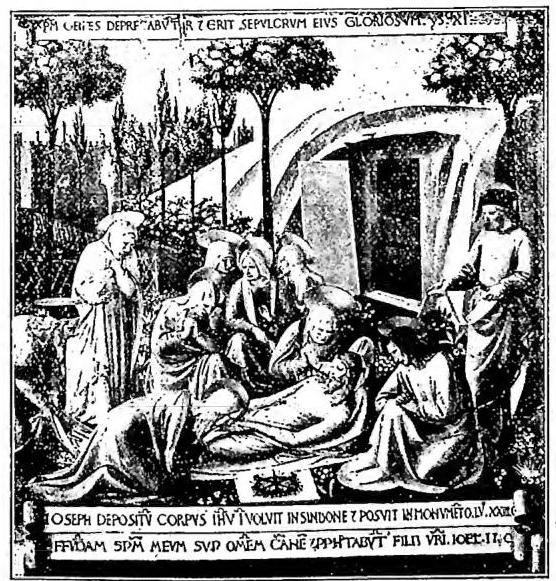
A panel from the chapel of the Compagnia del Tempio, slightly later than this pictorial decoration, must now be mentioned: the Lamentation over Christ, whose rhythm is far more tightly knit and complete than that of the well-known panel by Giottino in the Uffizi, from which it derives. By turning the composition from vertical to horizontal, it finds a place in a landscape broadly rendered in large strokes, livid and leaden, perhaps recalling Rome, whose depth and silence are heightened by the boundless walls of that deserted Jerusalem. Here, too, movement does not stir, nor does drama erupt: the whole has a sense of stasis and concentrated contemplation. The later cupboard doors (1448 and beyond) of the Santissima Annunziata, with thirty-five scenes, now in the Museum of S. Marco, with their more articulated and freer figures owing to the presence of various collaborators, among whom Baldovinetti, Strozzi, and Gozzoli can be recognized, appear somewhat discontinuous, but their narration is clear and fluent and their tone lively, even if at times discordant in their luminous colors. For the A. is now the head of a school that turns his art, always nourished by poetry, toward the prosaic, even in drawings such as the David in the British Museum of Lon-
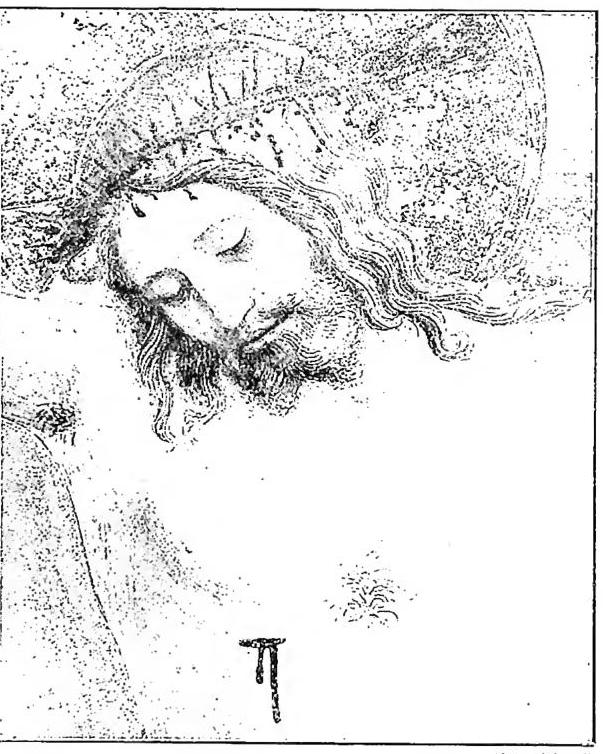
ANGELICO, BEATO - Christ and St. Dominic (detail). Florence, Museum of S. Marco.
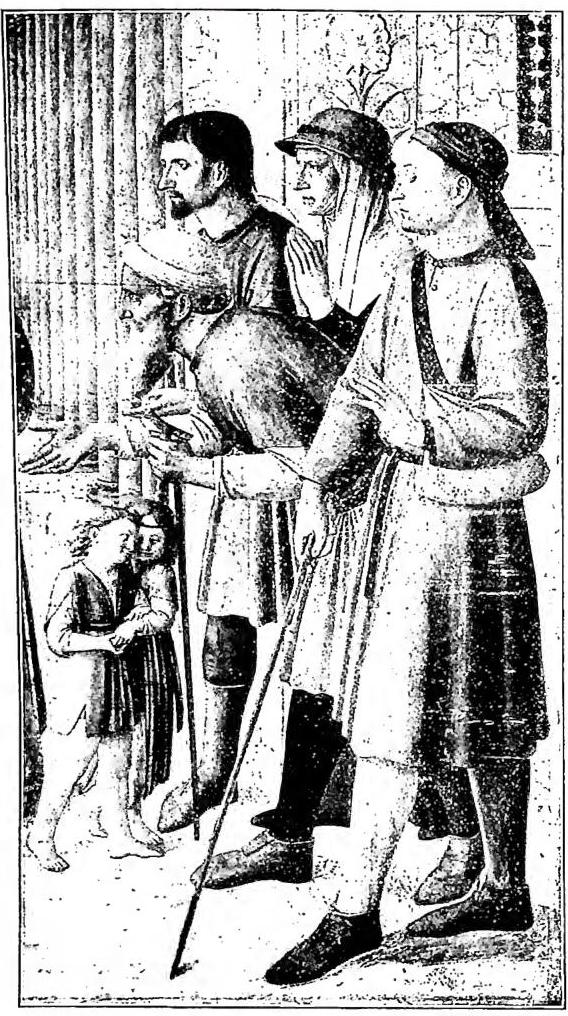
London, with such subtle and delicate linearism. Despite the collaboration, the two vaults of the cathedral of Orvieto, with Christ the Judge among angels and the choir of prophets, preserve as a whole his elevated tone. It is the master’s merit to have led his creatures from the glory of the altarpieces and the seclusion of the monastic cells and cloisters into the Nicoline Chapel in the Vatican, gathering them, in the narration of the deeds of St. Lorenzo and St. Stefano, into visions of full monumental power, which assume the solemn value of «history», at least in certain compositions, such as that where Lorenzo is consecrated deacon, despite certain qualitatively inferior details, and a nobility surely noted by Melozzo da Forlì in his fresco with Sisto IV and Platina; and the other with the Almsgiving of the Saint, in which every illustrative and realistic aspect is surpassed in those beggars seemingly touched by divine grace, which purifies them and illumines them with an inner light. One of the Beato’s points of arrival thus coincides with the aim of transfusing into men, cleansed of sin, the serenity of the Madonnas and Saints, caressed by a brush guided by a spirit that dreams of a beautiful and pure otherworldly world. And it is a sterile pursuit that seeks to explain the art of A. through literary sources (Rio, Kraus, Broussolle), or more particularly through fra Giovanni Dominici (Maione). Pious readings, and even the writings of the fervent Dominican orator, may have deepened our artist’s great faith and religious culture, and may also have inspired, as we have seen, some of his compositions. Yet A. possessed the gift of an artistic personality too elevated for what is the intimate essence of his spiritual poetic language to have depended on others; in particular, his serene and contemplative temperament would not permit comparisons with the exuberant and militant temperament of Dominici. The Christian humility that makes A. a friend of the poor, and the purity that keeps him from thinking about and seeing evil, are the moral premise of his pictorial work. This work was not indifferent, as has been observed (Rothes), to the earthly world which, as we have seen, A. investigated by directing his keen gaze beyond the cloister; while, on the other hand, one should not insist too strongly, as a careful monographer (Langton Douglas) does, on the influence of antiquity and nature, since his art reveals, as has rightly been said, the immanence of God. By recreating the sensible world within an abstract world created for people of faith, A. embodies in painting better than anyone else the religious aspect of that spiritual unity which is the Renaissance. Yet his historical importance is also great. Besides the collaborators, disciples, and followers whom we encounter along his long path (Battista Sanguigni, Zanobi Strozzi, Domenico di Michelino, Andrea di Giusto, Giovanni di Consalvo, Pesellino, Benozzo Gozzoli, the Umbrians, etc.), we may say that the Florentine painters, especially those active between 1440 and 1450, and those who came to Florence at that time, felt the fascination of his art, just as Jean Fouquet felt it in Rome; an art that rises to the greatest heights, like the moral stature of the man. - Vedi Tavy. CVII-CX.