
VALLA, LORENZO (Latinized as De Valle or Vallensis). — A humanist originally from Piacenza, born in Rome in 1405 (according to others, in 1407).
He taught rhetoric at Pavia (1431–33), from which he had to depart because of a writing against Bartolo. In 1435 he moved to Naples, where he became secretary to King Alfonso d’Aragona, whom he followed on his various journeys and campaigns. In 1443, after peace had been made between Eugenio IV and the King of Naples, he tried unsuccessfully to return to Rome, prevented above all by his Declamatio on the Donation of Constantine. Only in 1447, with the election of the humanist Niccolò V, was V. able to settle in his native city and become, in accordance with an old desire, an apostolic writer. He died in 1457 and was buried in the Archbasilica of Saint John Lateran, of which he had been a canon since 1455. His tomb, removed from its original site, is indicated in the Chapel of the Crucifix.
Ambitious and widely learned, V. himself affirmed that he engaged « in omni fere doctrinarum genere ». In addition to translations from Greek and numerous minor works, not all of which have survived, the following should be noted: Elegantiorum latinae linguae libri sex (before 1444). His most important literary work, which brought the author widespread renown; Dialecticarum disputationum libri tres (c. 1440), anti-Aristotelian; De libero arbitrio; De voluptate ac de vero bono (1432), a dialogue on Stoic, Epicurean, and Christian moral doctrine; De professione religiosorum; In Novum Testamentum ex diversorum utriusque linguae codicum collatione adnotationes (1449?), with which he opened the way for the criticism of Erasmus (v.) concerning the text of the New Testament; De mysterio Eucharistiae; Historiarum Perdinandi regis Aragoniae libri
(photo Enc. Catt.)
VALLA, LORENZO - Preface by L. V. to his Latin translation of Demosthenes’ Oration for Ctesiphon. In the initial portrait of V. Federico da Montefeltro, miniature of the Ferrarese school - Vatican Library, cod. Urb. lat. 337, f. 1r. (1475–82).
tres (1445); De falso credita et ementita Constantini donatione declamatio (1440), which provoked the liveliest controversies, continuing until the eighteenth century; Ad Eugenium IV Apologia; Recriminaciones in B. Faciens; Antidotus in Poggium, of a personal nature.
The markedly polemical character of the figure and work of Lorenzo V. still affects scholars’ judgments. The lack of restraint shown in certain self-satisfied attitudes toward «magnis et longo iam aevo probatis auctoribus», such as Aristotle, Cicero, whom he placed below Quintilian, Boethius, Bartolus, and s. Thomas Aquinas, together with his biting tone, earned him among many the reputation of a vulgar pamphleteer and the charge of heresy. For others, his bold and disconcerting positions constitute V.’s merit: he is regarded as the father of criticism and philology, a precursor of free thought and modern anticlericalism. To judge properly the controversies concerning V. and those raised by V., it is necessary to investigate further the complex aspects of humanism. In particular, caution is required regarding the religiosity of the humanists, both because current research on the religious sentiment of Italians in the fifteenth century is insufficient and because the sincerity of that sentiment should not be measured by the contribution, sometimes negative, made by their works. It therefore seems hazardous to dwell on certain extremely audacious attitudes of V., since he addresses the most difficult problems of philosophy, theology, and Sacred Scripture often with no preparation beyond that of a grammarian and scholar. His clear professions of faith have every appearance of sincerity, whereas Poggio’s insinuations, collected by Pontano, should be relegated among the obligatory themes of humanist polemic, too often rich in invective and implausible accusations. As for De voluptate, despite certain vivid descriptions, the author’s sympathy for Epicureanism is far from certain, even if one does not wish to regard the Christian conclusion of the third book as sincere or prefers to speak of an ambiguous work. Theologically dangerous is perhaps the attempt to insert Epicureanism—viewed as a lofty moral teaching and a noble ideal of a serene and healthy life—into Christianity. The two doctrines would thus be evaluated on the same level, and the doctrine of Grace relegated to a subordinate position, while recognizing that only Christianity brings about the supreme good.
The famous Declamatio, it is worth stating decisively, was neither the first, nor the most original, nor the decisive refutation of the celebrated Constantinian forgery, which, despite and in opposition to V., had supporters down to Baronius. V., nevertheless, went too far. Falsely asserting that the donation was the foundation, indeed the sole juridical foundation, of temporal power, he declares that power illegitimate and the source of all Italy’s evils. Hence the praise bestowed by the Reformation and the renewed sympathies of the nineteenth century for the humanist. Yet, although the Declamatio was included in the Index of 1559, he unequivocally exalts the spiritual po-
(phot. Garcia Garrebello)
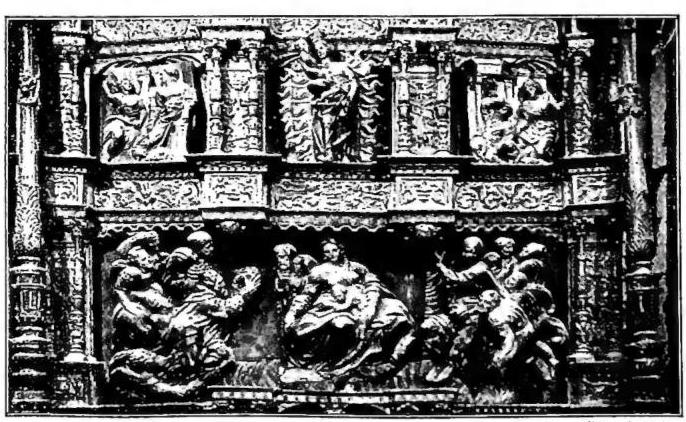
VALLADOLID, ARCIDIOCESI di - Detail of the retable of the church of S. James, with the Adoration of the Magi. Sculpture by A. Berruguete (sixteenth century) - Valladolid.
(phot. Garcia Garrebello)