Machine translation of the 1948–1954 Italian original. The original text is authoritative.
VALIGNANO, ALESSANDRO. — Organizer and superior of the missions of the Middle and Far East, b. at Chieti in the first half of February 1539, d. at Macao on 20 January 1606.
He is said to have received a law degree at Padua around 1558. After spending some time in Rome in the hope of obtaining a promotion, he returned to Padua to continue his studies; he was there in November 1562 when he was accused of having wounded a young woman. Imprisoned and tried, he was sentenced to a heavy fine and banishment from Venetian territory for four years. On 29 May 1566 he entered the Society of Jesus in Rome, and then, on 18 May of the following year, transferred to the Collegio Romano, where he studied philosophy (1567–69) and theology (1570–72). Ordained a priest at the Lateran on 25 March 1570, on 1 September 1572 he became rector of the College of Macerata. In August of the following year, General Mercuriano appointed him visitor, that is, superior of all the Jesuit missions in Asia. Having made his profession on 8 and 11 September 1573, around the 20th of that month he set out for Genoa and Labona, from which he sailed on 21 March of the following year at the head of 41 Jesuits, arriving at Goa on 6 September 1574. After making a double visitation of the missions of southern and northern India, on 20 September 1577 he undertook a long journey that brought him for the first time to Macao on 6 September 1578. There he conceived the plan of opening China to the Gospel and for this purpose immediately summoned Michele Ruggieri from India. Continuing his journey, he arrived in Japan for the first time on 25 July 1579. After visiting the mission and establishing the vice-province of Japan, on 20 February 1582 he departed from there in the company of four young Japanese nobles whom certain «daimio», or Japanese rulers, already Christians, had sent as ambassadors to the Roman Pontiff at the invitation of V. While he was in Macao (9 March–31 December 1582), he summoned M. Ricci (v.) there from India for the mission of China. Arriving at Goa on 10 November 1583, he relinquished the office of visitor and became provincial of India until 1587
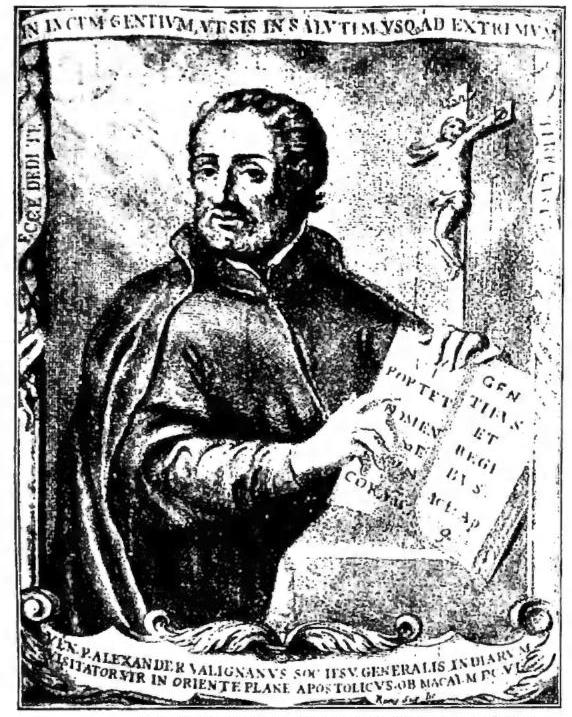
(from J. F. Schütte, Valignanos Missionsgrundsätze für Japan, Rome 1851, Latin, vol. 2, p. 18)
VALIGNANO, ALESSANDRO – Portrait. Engraving by N. Oddi.
when, after the appointment of the new visitor, he undertook from Goa a second journey to Japan on 22 Apr. 1588, in the company of the Japanese ambassadors, now returned from Rome. After a stay of almost two years in Macao (28 July 1588–23 June 1590) to encourage the incipient mission of China, he arrived in Japan once again on 21 July 1590 and remained there for more than two years, until 9 Oct. 1592. During the further two years that he spent in Macao (24 Oct. 1592–15 or 16 Nov. 1594), he approved Ricci’s reforms in the method of apostolate and urged him to reach Beijing. Having returned to Goa on 4 March 1595, on 24 Sept. of the same year he relinquished the office of visitor of India, retaining only that of visitor of China and Japan; in this new capacity, on 23 Apr. 1597 he left India definitively and arrived in Macao on 20 July of the same year. During this stay, he appointed Ricci superior of the Mission of China and once again urged him to go to Beijing. Having left Macao on 16 July 1598, he arrived in Japan for the third time on 5 Aug. of the same year and gave that mission ever greater impetus. Departing from there on 15 Jan. 1603, he reached Macao on 10 Feb.; while preparing to visit the mission of China, he died there. Approximately 400 of his letters are preserved, almost all unpublished.
In the face of difficulties, his watchword was: « Never retreat ». In India he consolidated and organized the work of Saverio. At his death he saw China opened to the Gospel through the work of Ricci and other confrères, five of them Chinese; and in Japan he left approximately 130 missionaries, nearly half of them Japanese, assisted by the country’s first priests, for he was a courageous and tireless advocate of the indigenous clergy. In addition to the College of Macao, shared by the two missions, he also left two large Colleges established at Nagasaki and Arima, one in its beginnings at Omura, and a « Rector’s House » in the Capital; a novitiate and two seminaries for Japanese; about twenty residences; and approximately 300 churches or chapels. The person who best characterized him was his contemporary, Fr. Celso Confalonieri, when he wrote that V. was « vir. plane. insignis et ad omnis summa natus ».
BIBL.: D. Bartoli, Opere, X-XVIII, Turin 1825, passim; P. M. D'Elia, II p. A. V. (I grandi missionari, 2ª serie), Rome 1940, pp. 119-79; id., Ponti Riccione, I, ibid. 1942, pp. LXXXVI-XCVII, 143, n. 2 (and corrections in vol. II, p. 638); II, ibid. 1949, p. 364, nn. 3 and 4; J. F. Schütte, Valignanos Missionsgrundsätze für Japan, I, i, ibid. 1951, pp. XXXI-LVI, 36-50. Pasquale M. D'Elia
Cite this article
“VALIGNANO, ALESSANDRO.” Enciclopedia Cattolica, vol. XII (1954), p. 613. Azione Romana digital edition, https://azioneromana.com/article/valignano-alessandro.