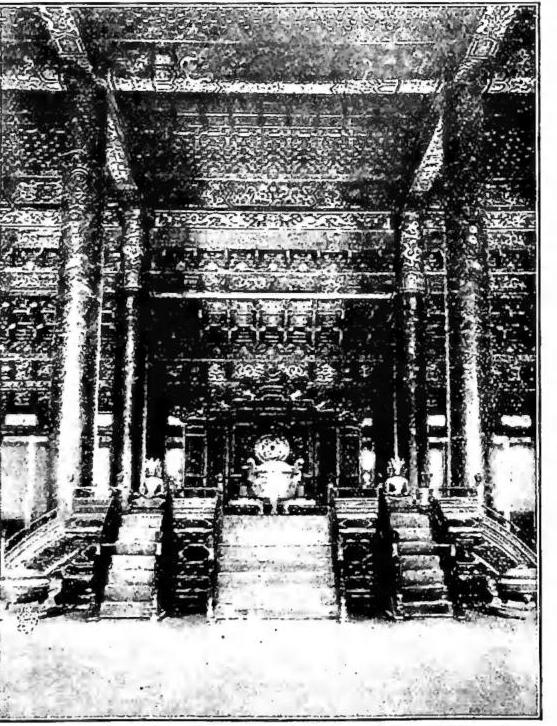
PECHINO, ARCIDIOCESI DI

PECHINO, ARCIDIOCESI di - Tempio del cielo. Cupola del padiglione del Nuovo Anno.

eternal. In psychology he gives particular emphasis to illumination: “Acquiritur animae scientia occasione per sensus praestita, sed causa scientiae est lux aeterna” (Tract. de anima, cap. 3); he posits a double agent intellect: one uncreated (God) and the other created (the active faculties of the soul); he defends the possibility of demonstrating with “irrefutable arguments” the immortality of the soul; he upholds the self-determination of the will and its primacy over the intellect. In these and other parts of his system, one notes a constant effort to remain faithful to traditional Augustinianism and to incorporate the best elements of Aristotelianism and Avicenna.

BIBL.: Among the numerous studies by H. Spettmann, who was among the first to reassess the work and thought of P., the following are noteworthy: Quellenkritisches zur Biographie des J. P., in Franz. Studien, 2 (1915), pp. 170-207, 266-85; id., Die Psychologie des J. P. (Beiträge zur Geschichte der Philosophie und Theologie des Mittelalters, 20, VI), Münster 1919; id., Der Sentenzkommentar des Franziskanerbischofs J. P., in Divus Thomas (Freiburg), 3 (1929), pp. 327-45; furthermore F. Ehrle, J. P. über den Kampf des Augustinismus. Aristotelismus in der zweiten Hälfte des XIII. Jahrhunderts, in Zeitschrift f. kath. Theol., 13 (1880), pp. 172-93; the same author adds further discussions and documents in L'Agostinismo e l'aristotelismo nella scolastica del sec. XIII, Rome 1925; C. L. Kingsford - A. G. Little, Bibliography of J. P.'s writings, in British Society of Franciscan studies, II, Aberdeen 1910, pp. 1-12; A. Callebaut, J. P. et l'Augustinisme, in Archivum Franciscanum historicum, 18 (1925), pp. 441-72; I. Rohmer, La théorie de l'abstraction dans l'école franciscaine d'Alexandre d'Hales à J. P., in Archives d'hist. doctr. et litt. du moyen âge, III, Paris 1928, pp. 178-84; A. Teeter, s. V. in DTHC, XIII, cols. 100-44, with bibliography; V. Doucet, Notulae bibliographicae de quibusdam operibus Fr. I. P., in Antoniinum, 7 (1933), pp. 307-28, 425-59; P. Glorieux, Répertoire des maîtres en théologie de Paris au XIIIe siècle, II, Paris 1934, pp. 93-98, with indication of manuscripts and editions, to be supplemented by the addendum of V. ARCHIVUM FRANCISCANUM HISTORICUM, 27 (1934), p. 458 ff.; G. Melani, La predicazione di G.P., in Studi francescani, 3rd series, 13 (1941), pp. 198-220; id., Tractatus de anima J. P., Florence 1948, with bibliography; D.L. Douie, Archbishop P. sermons and collections, in Studies in medieval history presented to F. M. Powicke, Oxford 1948, pp. 269-82; I. Smith, The attitude of I. P. toward monastic houses under his jurisdiction, Washington 1949. Gaudenzio Melani

PEKING, ARCHDIOCESE OF. - Peking, a city in the province of Hopeh, formerly the capital of China, is rich in monuments of ancient Chinese civilization. The history of the spread of Christianity up to the mid-nineteenth century is narrated under the heading China (Enc. Catt., vol. III, cols. 1656-71, where under the rubric Arte cristiana, cols. 1669-71, some Christian monuments of the place are also mentioned). On 30 May 1856, the diocese of Peking, whose jurisdiction had been reduced to the single civil province of Chihli (or Hopeh, today Hopeh), was suppressed, and its territory was divided into three apostolic vicariates: Northern Peking, Eastern Peking, and Western Peking, which were later designated respectively as Northern Chihli with its see in Peking, Central-Eastern Chihli with the ordinary’s see in Sienhsien (q.v.), and Southwestern Chihli with the ordinary’s see in Chengting (q.v.). The first and third were entrusted to the Congregation of the Mission, the second to the Society of Jesus.

Article illustration

The first vicariate was repeatedly subdivided to create the following circumscriptions: Eastern Chihli, now Yungping, on 23 Dec. 1899; Central Chihli, now Paoting (q.v.), on 14 Feb. 1910; Maritime Chihli, now Tientsin (q.v.), on 27 Apr. 1912; Suanhwafu on 10 May 1926. On 25 May 1929 it ceded the district of San Pio, which, together with three civil subprefectures taken from Paoting, formed the mission of Yihsien (q.v.). On 3 Dec. 1924 it changed its name from Northern Chihli to Peking, and on 11 Apr. 1946 it was raised to the status of a metropolitan archdiocese of the ecclesiastical province of Hopeh, with the suffragan dioceses of Ankwo, Chaohsien, Chengting, Paoting, Shunteh, Sienhsien, Suanhwa, Tientsin, Yungchien, and Yungping, to which Kinghsien and Tamig were added in 1947. On 25 May 1946, with the appointment of Cardinal Tien Kenhsin as archbishop, Peking passed to the Chinese secular clergy.

It has an area of approximately 30,000 sq. km. As of 30 June 1947, out of a total population of approximately 5,000,000 inhabitants, there were 215,918 Catholics and 1,756 catechumens; Chinese secular priests numbered 75, Lazarists 63 (of whom 30 were indigenous), major seminarians 15, minor seminarians 50. Auxiliary personnel: 8 lay brothers of the Lazarists (7 of them Chinese), 71 Marist brothers, 246 sisters, and 105 catechists. Within the territory, divided into 6 districts, there are 90 primary stations, 1,918 secondary stations, with 57 churches and 389 chapels. The Catholic University Furen, founded in 1924 in Peking and entrusted first to American Benedictines and later to the Society of the Divine Word, had four faculties. At Chala, near Peking, is the regional seminary entrusted to the Lazarists.

When at the end of the 16th and the beginning of the 17th centuries the missions were resumed, all of China, ecclesiastically, was under the jurisdiction of the diocese of Macao (q.v.). The progress achieved by the Jesuits and later by the Dominicans (1631), the Franciscans (1633), the Augustinians (1680), and the priests of the Paris Foreign Missions (1683) induced Pope Alexander VIII, urged also by the King of Portugal, to erect two further dioceses: Nanking and Peking (10 Apr. 1690), both suffragan to the archdiocese of Goa (q.v.), as was Macao. To the diocese of Peking were assigned the civil provinces of Peking (= Hopeh), Shantung, Liaotung (= Mongolia, Manchuria, Korea, and Tartary), Shansi, Shensi, Honan, and Szechwan. But already on 15 Oct. 1696 Innocent XII reduced the diocese of Peking to the provinces of Peking, Shantung, and Liaotung; on 9 Sept. 1831 Korea was detached, on 14 Aug. 1838 Mongolia, Manchuria, and Tartary, and on 3 Sept. 1839 Shantung, leaving Peking restricted to the single province of Chihli.

The Church in Peking did not escape persecutions, during which the missionaries had to flee to Canton and Macao, where Bishop Joaquim de Souza Saraiva, C.M., elected in 1808 and who was the last bishop of the diocese, also took refuge. After his death (1818) he was succeeded by four apostolic administrators, who governed it until 1856, when it was suppressed. The mission was able to revive after 1860. — See pl. LXXV.

Bibl.: GM, pp. 205-206; Lazzaristes du Pé-tang (Pékin), Les missions de Chine, Quinzième année, 1938-39, Sienhsien 1940; MC, 1950, pp. 317-313.