TIENTSIN, DIOCESI DI

TIENTSIN, DIOCESI di. - Nella parte nord-orientale della provincia del Hopeh, sulla costa del Mar Giallo.

TIENTSIN, DIOCESE OF

In the northeastern part of the province of Hopeh, on the coast of the Yellow Sea.

It was erected as an apostolic vicariate on April 27, 1912, under the name of "Celi Marittimo," by division of the apostolic vicariate of "Celi Settentrionale" (q.V. PECHINO) and was entrusted to the Congregation of the Mission, which, for apostolic work, sends its religious from the province of Paris. On December 3, 1924, it took the name of Tientsin, and on April 11, 1946, with the establishment of the episcopal hierarchy in China, it was elevated to a diocese, suffragan of Peking. It covers an area of approximately 12,500 sq. km. As of June 30, 1947, out of a total population of approximately 3,500,000 inhabitants, there were 50,000 Catholics; 85 priests, of whom 46 were Chinese; 5 major seminarians, 25 minor seminarians; 32 lay brothers, of whom 14 were Chinese; 132 sisters, of whom 70 were native. Among its works were 4 hospitals, 3 dispensaries, 2 orphanages, 1 hospice for the elderly, and 20 schools with 6,743 pupils. At Tientsin was also located the Catholic University of Tsinkou, run by the Jesuits, which in the academic year 1946-47 had 721 students.

In the mid-19th century, in the territory now comprising Tientsin, there was no priest with a permanent residence: the approximately 200 Christians scattered throughout it were visited only periodically by missionaries from Peking. Around 1858, the Chinese priest Siu was sent there; renowned as a skilled physician, he was able to remain in the city of Tientsin as a pharmacist and secretly instructed and baptized, but, discovered, he was imprisoned and forced into complete inaction. In 1869, a church was built in Tientsin, but the following year it was burned down during a new persecution in which the Chinese priest Ou, Fr. Chevrier, and 10 Daughters of Charity were massacred. Other serious massacres occurred in 1900 at the hands of the Boxers, but by 1903 the number of Christians had risen to 3,345, reaching 31,898 in 1911, the year before the erection of Tientsin.

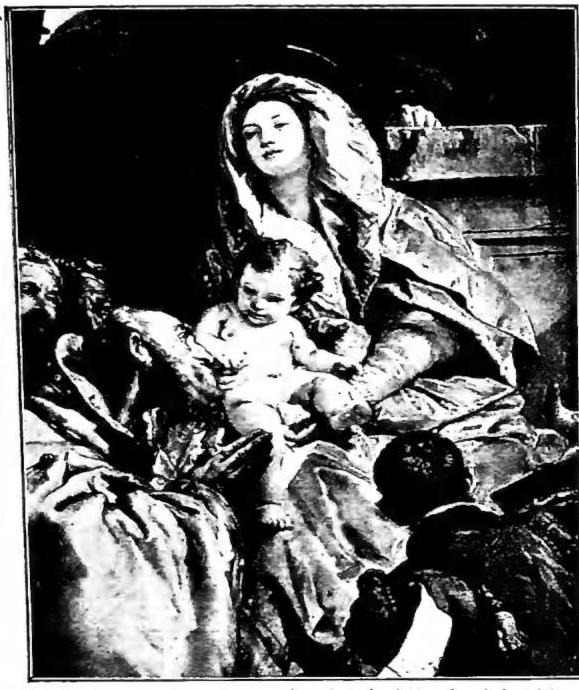
TIENTSIN — TIEPPOLO, GIOVANNI BATTISTA

"Cogitatio tepida, conversatio tepida; quorum obedientia sine devotione, sermo sine circumspectione, oratio sine cordis intentione, lectio sine aedificatione, quosque denique vix gehennae metus inhibet, vix frenat ratio, vix disciplina coercet" (Sermo 6 in Ascensione Domini). The tepid man provokes "vomit," the reprobation of God, as the Lord says to the "angel" of Laodicea: "Because you are lukewarm, and neither hot nor cold, I will vomit you out of my mouth" (Rev 3:16).

Sometimes lukewarmness follows a period of fervor, due to a lack of constancy in the spiritual life. The soul allows itself to be dominated by a progressive negligence. Pleased with its own mediocrity, the soul does not strive for perfection (q.v.). Dissipated and entirely exteriorized, it imprudently exposes itself to dangers and resists only half-heartedly the fire of temptation.

The remedies are those prescribed for the "angel" of Laodicea (Rev 3:18-19): a vigorous, radical return to former fervor, beginning a life decisively directed, through effort and renunciation, toward spiritual progress and perfection.

BIBL.: P. Lancisius, *Causae et remedia ariditatis*, Antwerp 1643; G. B. Scaramelli, *Direttorio ascetico*, vol. 3°, art. 5°; C. Grimbert, *L'aridité et certains processus psychopathologiques*, in *Études carmélitaines*, 22 (1937, II), pp. 121-31; P. Pourrat, *Tiedeur*, in *Dictionnaire de Théologie Catholique*, XV, cols. 1026-29; R. Daeschler, *Aridité*, in *Dictionnaire de Spiritualité*, I, cols. 845-55; R. Biot and B. Galimard, *Guida medica delle vocazioni sacerdotali e religiose*, 2nd ed., Milan 1940, pp. 164-70. Antonio Blasucci