TSINGTAO, DIOCESE OF. - On the coast of the Yellow Sea, in the south-eastern part of the province of Shantung, in northern China.
It was erected as an apostolic prefecture on 11 February 1925, comprising 12 civil sub-prefectures of the Yenchow mission (q.v.) and was entrusted, like the mother mission, to the Society of the Divine Word. On 14 June 1928 it was raised to an apostolic vicariate; on 19 July 1937 it ceded 5 civil sub-prefectures to form the apostolic vicariate of Ichow (q.v.), and on 11 April 1946, with the establishment of the episcopal hierarchy in China, it was elevated to a diocese, suffragan of Tsinan. It covers an area of 17,000 sq. km. As of 30 June 1950, out of a total population of approximately 3,500,000 inhabitants, there were 23,588 Catholics; 28 priests, of whom 10 were Chinese; 87 sisters, mostly Chinese. Among its works were 2 hospitals, 7 dispensaries, 6 orphanages, and 29 schools. The beginnings of Christian preaching in the territory of Tsingtao are due to the Divine Word missionaries, who arrived in the southern region of Shantung in 1882 (q.V. YENCHOW). At the time of its erection (1925), Tsingtao counted 20,000 Cath-
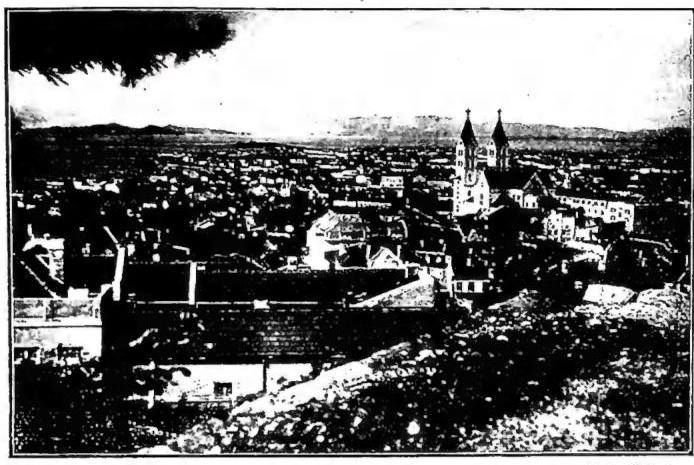
TSINGTAO, DIOCESE OF - View of the city. To the right, the Cathedral, begun on 10 April 1932, under the direction of the apostolic vicar, Monsignor Giorgio Weiig-Tsing-tao.
TSINGTAO, DIOCESE OF - Situated on the borders of the two provinces of Suiyuan and Chahar in Mongolia, it covers an area of 40,000 sq. km. and has a population of 600,000 inhabitants.
On 8 February 1929 the apostolic vicariate of Tsingtao was erected, detached from that of Siwantze. The same vicariate was elevated to a diocese on 11 April 1946. It has 38,500 Catholics with 326 catechumens; 64 native priests; 11 major seminarians; and 100 native sisters. The territory, of which Tsingtao now occupies the centre, belongs to the semi-mountainous region that rises—a powerful outlier—to defend the Mongolian plateau.
At first the area was inhabited only by Mongols, engaged solely in pastoralism, and apart from a few groups of tents and wretched houses, the region had only the rare and tiny centres of commercial exchange. After 1750 some Christian families settled in Tsingtao. Later, other Christians founded three more small villages, to which were added some families from the East. In 1892 the first missionaries of Scheut, attracted by the possibilities of settlement and cultivation in the region, made a first attempt to purchase land sufficient for the establishment of colonists. The attempt failed. The experiment was resumed in 1895 by Fr. Rubbens and met with success, thanks to the support of the mandarins. The mission, with full observance of legal formalities, sold parcels of land to Chinese colonists, drawn from various Christian communities, the land having been purchased from the Mongols, to whom, however, the right of pasture for their flocks was reserved. Thus, in four stages from 1895 to 1925, numerous Christian communities were established, settled in villages with an agricultural character. During the period between 1906 and 1910, the settlers themselves invited the missionaries to establish themselves in the new centres they had founded, for such a presence conferred an element of order, moral discipline, and unity essential to the prosperity of the enterprise. This was also noted by journalists and travellers who came to observe the work of the missionaries.
The Christian social and charitable activity carried out by the Scheut missionaries reached its culmination when, in 1933, the Pope elevated a native, Bishop Joseph Heng-An Fan, to the episcopal dignity and entrusted him with the apostolic vicariate of Tsingtao (now a diocese).