
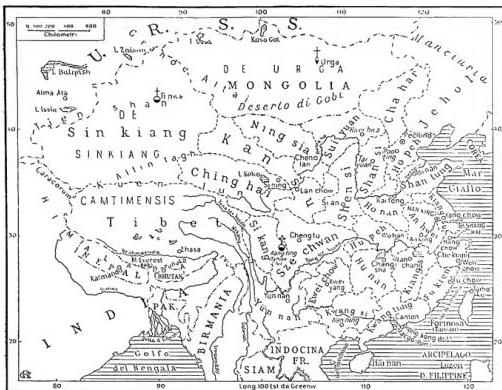
CHINA. - The Chinese state (Ta Chung Hwa Min Kuo, meaning "Great Republic of the Middle Flower," referring to the traditional designation "Middle Empire," originally applied to the province of Ho-nan, which occupies a central position in China in a narrower sense), comprises, in addition to the 18 provinces that constitute China proper (3.7 million km²), Manchuria (1.1 million km²), declared independent in 1932 and returned to China after Japan's defeat, Inner Mongolia (1.1 million km²), eastern Tibet (the western part, centered on Lhasa, once also Chinese, is now autonomous), Sinkiang, or Chinese Turkestan (1.6 million km²), as well as the island of Formosa, also lost by Japan in the recent conflict. The po-
SUMMARY:
I. Geography
II. Religions of China
III. Evangelization of China
IV. Art
V. Christian Art.I. GEOGRAPHY
Proper China, whose coasts face the Pacific, is separated from the rest of Asia by elevated plateaus and mountain ranges (which accounts for its long and enduring isolation) and is itself divided into two geographically distinct zones by a series of modest elevations that, under various names (Tsin-ling, Fu-niu-shan), extend from the K'un-lun almost to the delta of the Yang-tse-kiang. Northern China, still traversed by considerable reliefs in its western sector, opens to the east into a vast alluvial plain, formed by the yellowish clays (lōs) with which the rivers that cross it are laden and of which a part ends up in the sea (hence called Hoang-hai, or "Yellow Sea," just as Hoang-ho, or "Yellow River," is the name of the largest of those rivers, which winds its course for 4,100 km. and has shifted its mouth multiple times). The climate is continental, with long and harsh winters (in the Gulf of Pei-chih-li, at the latitude of Sicily, the sea freezes over) and early, scorching summers, with rainfall that is not abundant but concentrated in the warm season.Southern China, by contrast, is a far more varied land, with mountains and hills interspersed with basins and traversed by long, deep valleys. The hydrographic network is also organized here into a vast basin, that of the Yang-tse-kiang ("river of the kingdom of Yang"; not, as is still often repeated, "blue river"), one of the largest in the world (nearly 2 million km²) and among the most navigable (it is ascended from the mouth to Ichang for approximately 280 km). The climate, influenced by the beneficial monsoon, is warmer and more humid.
The economy of China is essentially based on agriculture (80-90% of the population), which is intensive and relies on small-scale ownership. The products of this activity are highly varied; but rice (though China alone harvests more than one-third of the world total, it does not meet domestic demand), wheat (China ranks third in the world, after the U.S.S.R. and the U.S.A.), tea (first place in global production, though exports are relatively modest due to high domestic consumption), and mulberry (100 million kg of cocoons annually) dominate. Far from negligible are the productions of maize, barley, millet, peanuts, sugarcane (China must import more than half of its needs), tobacco, cotton, oilseeds, citrus fruits (which originated here), opium, etc.
All other economic activities are incommensurate with the immense potential, including livestock farming (excepting, besides sericulture already mentioned, pigs in southern China and poultry), while meat consumption, essentially fish-based, is ensured by fishing and the widespread practice of aquaculture. Mineral resources are considerable: fossil fuels, iron, tin, and alloy metals abound, whose extraction and processing were recently initiated or promoted by foreign capital. Modern large-scale industry is still in its infancy (cotton, silk, wool, steel, etc.); craftsmanship is highly developed (works in bronze, tin, ivory, porcelain, hard stones, fabrics, etc.).
One of the most delicate problems of China's economy is that of communication routes; most roads are unsuitable for modern traffic. The network of canals, which are navigable (the Imperial Canal, built in the 6th century, crosses the lowland for 1,300 km), is excellent, connected with the Yang-tse and its tributaries as well as with the Si-kiang and the Kan-kiang, but the railways (which together do not equal the Italian network) are still far from meeting the needs of such an extensive and populous territory; aviation is slowly gaining ground (90,000 km of commercial routes). As for maritime trade, it is primarily in foreign hands (the United States and Great Britain foremost); the main ports are Tientsin in the north, Shanghai in the center, and Canton in the south.
In the absence of proper censuses, data on the Chinese population, all derived from estimates, must be treated with caution. Rounded figures suggest that no fewer than 500 million people live in the Chinese domain and no fewer than 400 million in proper China. The average density of the domain is about half that of proper China; but even the latter figure results from rather distant extremes. In the lower basin of the Yang-tse, over an area equal to that of Italy, the density approaches 350 inhabitants per km²; in northern China, the lowland counts at least 250, and the so-called Red Basin of Sze-chwan as many. Conversely, in the southern plateaus, density drops to 60 inhabitants per km², and even lower in the peripheral mountainous regions. The rural population likely represents four-fifths of the total; the urban population is distributed among more than a hundred large cities (each with over 100,000 inhabitants, though seven—Shanghai, Peking, Tientsin, Chunking, Mukden, Canton, and Hong Kong—exceed one million), and at least 500 other centers with populations between 100,000 and 25,000.
The Chinese state, which retained a monarchical form until 1912, has maintained a condition of permanent instability since the proclamation of the Republic, both due to external pressures and the prevalence of particularistic and separatist tendencies within. Recent events open a new chapter, but the transformation they herald presupposes, as always in China, a necessarily prolonged struggle.
Giuseppe Caraci
II. RELIGIONS OF CHINA
Had St. Paul, instead of taking the westward route, chosen the eastward one, one could be certain that of the Chinese, rather than the Greeks, he would have said they were in every respect pious, God-fearing, religious, devout, even to excess κατά πάντα ὡς δεισιδαιμονοτέρους (Acts 17:22). From the most remote origins of this people, around the mid-third millennium B.C., the religious sentiment toward the Supreme Being and filial, devout piety toward deceased ancestors have indeed been its most striking characteristic. This mark of pronounced religiosity is found, to a greater or lesser degree, in the Chinese of all centuries, up to our own, when, under the influence of Western atheism, young intellectuals—especially those educated abroad—sought, like some of their Western teachers, to rid themselves of every religious idea. Thus, it may be said that among all ancient and modern peoples not illuminated by the light of primitive or Christian Revelation, it would be difficult, if not impossible, to find one more religious than the Chinese people.In the history of this people, four religious currents independent of Christianity can be distinguished. Over a millennium—and perhaps even longer—of documented history, that is, from the 14th–13th centuries down to around the 3rd century B.C., the Chinese people, and not merely the scholarly class, certainly knew the true God, first under the name of Dominator, then also of Heaven, with or without adjectives such as supreme, august, immense, etc., and rendered Him the worship due. If we adhere to the most ancient and authentic texts, it is impossible, from a sinological standpoint, to deny that this people possessed a sufficiently complete and pure concept of God, at least during the first millennium of its history.
Thus far, the ground is firm, whereas the subsequent period is less certain. It is probable, however, that even over more than two further millennia, that is, until the 19th century, China, despite errors and accretions, retained, at least among some scholars, a sufficiently recognizable concept of the true God.
With the advent of Confucius in the 6th century B.C., this ancient tradition was preserved in his school, not in its primitive purity but still, as mentioned, in a sufficiently recognizable measure, at least until the arrival of the philosopher Chu Hsi (1130–1200), leader of the Chinese rationalists and of his school, the School of the Sung [Song], named after the then-reigning dynasty (960–1279). The Confucian school is known as Confucianism (v. CONFUCIANISMO).
Taoism and Buddhism must also be mentioned.
Taoism, or tao chiao (where the European reader should note that the a in the diphthong ao is nearly mute), a name that became current during the 2nd century B.C., is etymologically the religion of the tao. The tao, however, is among the vaguest of concepts and may signify, depending on context, way, perfect manner of governing or obeying, principle, absolute, mode of conception, method, manner of being or doing, etc. Western authors in their translations speak of Logos, God, reason, nature, way, providence, etc. For the Chinese, the founder of Taoism (v. TAOISMO) is Lao Tzu, a figure of the 6th–5th century B.C. about whom the most improbable legends have accumulated. The reason for this attribution lies in the fact that he is said to have been the redactor of the first Taoist text, the Tao-te-ching or Book of the Principle and Its Activity, which some recent authors have dated to the beginning or middle of the 4th century B.C., but which, being cited by authors of the 5th–4th centuries, must be of a somewhat earlier period. This book served as the basis for the subsequent development of the entire system. It seems, however, that Lao Tzu found the doctrine, already sufficiently formulated, in the archives of the Chou dynasty, begun in 1050 B.C., according to this phrase from the Literary Index of the Han: "The Taoists originated from the archivists," that is, from the annalists and astrologers of the Chou. The texts speak of it as a non-Chinese doctrine, then current in India, suddenly spread in China. It could therefore only have been a Chinese adaptation of the Indian system of the Upanishads, that is, "texts of doctrine
| Administrative Subdivisions | Area in km² | Population (thousands) | Density per km² | Capitals and their population (in thousands) |
|---|---|---|---|---|
| 1. Anhwei | 147,600 | 22,705 | 154 | Anking 641 |
| 2. Chekiang | 93,230 | 21,776 | 234 | Hangchow 425 |
| 3. Fukien | 121,730 | 11,990 | 99 | Fuchow 408 |
| 4. Honan | 165,740 | 31,806 | 192 | Kaifeng 450 |
| 5. Hopei | 145,000 | 28,644 | 198 | Paoting 408 |
| 6. Hunan | 217,530 | 27,187 | 125 | Changsha 312 |
| 7. Hupeh | 183,870 | 24,659 | 134 | Wuchang 660 |
| 8. Kansu | 414,350 | 6,255 | 15 | Lanchow 205 |
| 9. Kiangsi | 193,150 | 13,794 | 84 | Nanchang 270 |
| 10. Kiangsu | 101,000 | 36,469 | 361 | Chinkiang 200 |
| 11. Kwangsi | 109,760 | 14,255 | 68 | Nanning 75 |
| 12. Kwangtung | 233,070 | 32,339 | 139 | Canton 1,146 |
| 13. Kweichow | 186,460 | 10,487 | 56 | Kweiyang 107 |
| 14. Shansi | 170,920 | 11,601 | 68 | Taiyuan 104 |
| 15. Shantung | 150,200 | 38,100 | 254 | Tsinan 475 |
| 16. Shensi | 196,820 | 9,800 | 50 | Sian 437 |
| 17. Szechwan | 406,580 | 46,403 | 114 | Chengtu 441 |
| 18. Yunnan | 383,280 | 10,853 | 28 | Kunming 185 |
| China proper | 3,690,290 | 399,123 | 108 | Nanking 1,755 |
| 19. Taiwan (Formosa) | 35,961 | 6,084 | 169 | Taipeh 340 |
| 20. Antung | 59,285 | 3,214 | 56 | Antung 220 |
| 21. Heilungkiang | 183,802 | 2,469 | 13 | Peien 30 |
| 22. Hokiang | 131,608 | 1,298 | 10 | Kiamusze 94 |
| 23. Hsingan | 269,147 | 1,293 | 5 | Hulun 41 |
| 24. Kirin | 89,651 | 5,122 | 57 | Changchun 554 |
| 25. Liaoning | 75,625 | 12,460 | 165 | Shenyang 1,136 |
| 26. Liaopeh | 104,885 | 4,030 | 39 | Szepnghai 65 |
| 27. Nunkiang | 61,830 | 2,094 | 34 | Mergen 30 |
| 28. Sungkiang | 79,518 | 4,923 | 62 | Harbin 662 |
| Manchuria | 1,055,351 | 36,903 | 35 | Hsinking 788 |
| 29. Chahar | 261,560 | 2,306 | 9 | Wanchuan 89 |
| 30. Jehol | 192,422 | 2,185 | 11 | Chengtch 510 |
| 31. Ningsia | 292,640 | 736 | 3 | Ningsia 80 |
| 32. Suiyuan | 295,230 | 2,084 | 7 | Kweisni 185 |
| Inner Mongolia | 1,104,852 | 7,311 | 7 | |
| 33. Chinhai | 411,760 | 1,513 | 4 | Sining 165 |
| 34. Sikang | 347,020 | 1,756 | 5 | Tatsienlu 40 |
| Eastern Tibet | 758,780 | 3,269 | 4 | |
| 35. Sinkiang | 1,160,000 | 4,360 | 3 | Tihwa 47 |
| Greater China | 9,240,000 | 485,050 | 50 |
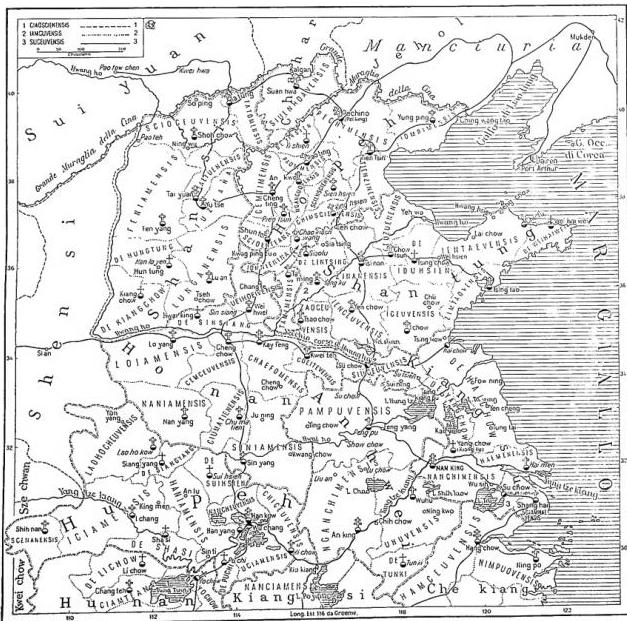
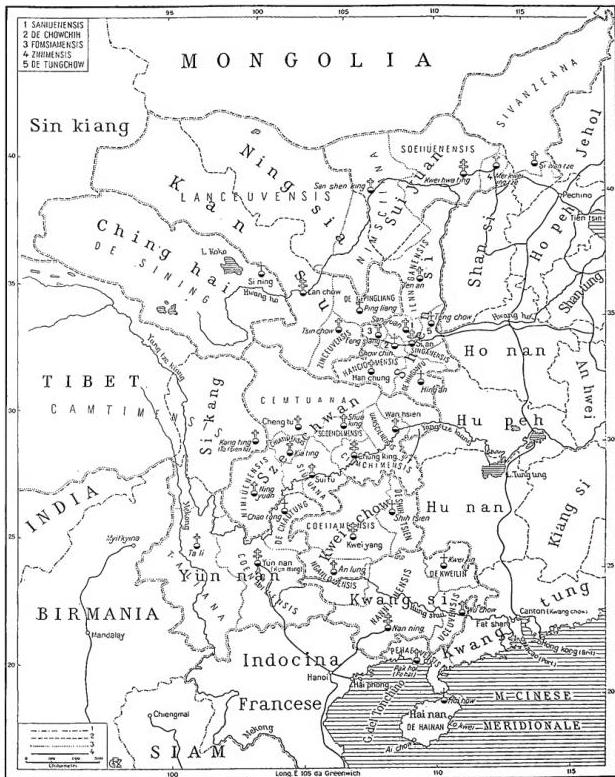
CHINA - Western Ecclesiastical C.:
1) State border;
2) Provincial border;
3) Ecclesiastical circumscription border;
4) Railways.
"arcana," containing reflections on the Supreme Being, the self, and the world, the oldest of which date back to the period 800-500 B.C. Before Laozi, there were pre-Taoists who taught Taoism but left no writings; some names of these pre-Taoists are known.
Laozi seems to have accepted, like Confucius, the ancient religion with its sacrifices, ancestor worship, and divination systems. What is certain is that he neither condemned nor recommended these practices. He was content to draw attention to the tao, hoping that man would conform to it and thus achieve moral perfection.
Temples and monasteries began to be built, where taoshi could even marry until the 10th century. Heaven and Earth were then spoken of. A pantheon almost as complete as that of Buddhism was introduced into worship. From then on, one religion or the other was favored at court, or both were persecuted. This seesaw continued until the 12th century, when Zhu Xi discredited both religions, and succeeded. Since then, Taoism and Buddhism have sought to coexist, borrowing and lending ideas and methods of action at the expense of the people.
Popular Taoism today is a mixture of coarse superstitions, inseparable from the worship of countless idols, the study of alchemy, and the practice of astrology. In its popular form, it has deities for all natural forces and for everything that can in any way be an object of human knowledge. There are deities for all diseases, from demonic possession to toothache, for all organs of the human body, for birth and death, for wealth and happiness, for old age, for commerce, for war, for mountains, rivers, lakes, for heaven, for hell, for the sun, moon, stars, for roads, for thunder—in short, for everything. Many of these gods can be seen in Taoist temples. In addition to guarding these temples, taoshi have the task of performing incantations and exorcising demons, driving them from houses or streets believed to be infested. They are also often invited to funerals or processions to obtain rain or fair weather. These functions cannot take place without frenzied shouting and great dissonance of instrumental music. All taoshi and even local deities depend on the "Celestial Master," a title conferred in 748 on Chang Tao-ling and his
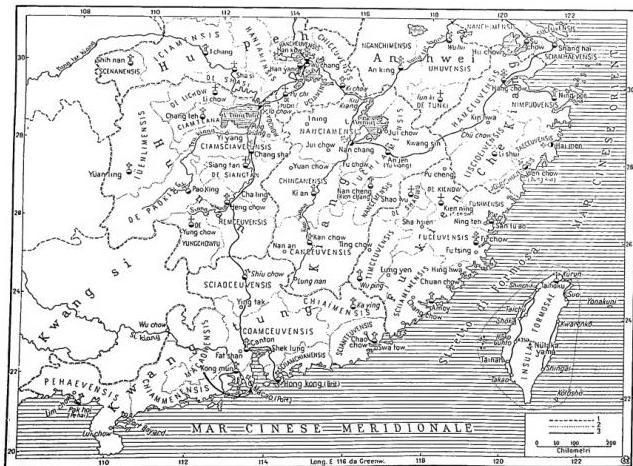
CINA - Ecclesiastical China, South-Eastern: 1) provincial boundary; 2) ecclesiastical circumscription boundary; 3) railways.
descendants, in whom some Westerners, utterly ignorant of religious knowledge, have blasphemously sought to see the "pope" of the Taoists. It is admitted that spells directed to the "Celestial Master" possess extraordinary efficacy. Taoist doctrines are contained in a most voluminous collection, called the "Taoist canon," comprising 1,504 works in 1,120 small volumes. The influence of Taoism on the Chinese nation today appears rather weak, with only the common people being more or less imbued with these doctrines.
Buddhism or fu chiao is the religion of Fu, a word formerly pronounced Bud, hence Buddha. According to a constant Chinese tradition, Emperor Mim [Ming] of the Later Han (58–75 A.D.) would have seen in a dream "a golden man," a statue sixteen feet tall and surrounded by a halo. The scholar Fui [Fu Yi] would have explained to him upon waking that this figure was the Buddha. Following this dream, the emperor would have sent to seek Buddhist preachers, two of whom, Kāśyapa Mātanga and Dharmakṣa or Gobharana, would have brought and translated the Sutra of the 42 Sections and other Buddhist books, arriving in Luoyang in Henan in the years 65, 67, or 68 A.D. This legend was accepted by all, including Catholic missionaries around 1600, who further supposed that the emperor had sent ambassadors to India to bring back the religion then preached there by the apostle St. Thomas, whereas they would have brought back only Buddhism. However, in 1910, Professor Henri Maspero demonstrated that the dream and the traditions connected to it are a pious fraud imagined at the end of the 2nd century A.D. (H. Maspero, Le songe et l'ambassade de l'empereur Ming. Étude critique des sources, in Bulletin de l'École française d'Extrême-Orient, Hanoi 1910, pp. 95–130). There is good evidence that already in the 1st century B.C., or even earlier, there were Buddhist infiltrations in the lower basin of the Yangtze River. Perhaps the legend arose with the fact of the official recognition of Buddhism around 65–68 A.D.
The new religion, though patronized by the emperor, did not make rapid progress at first. Almost all the preachers of this doctrine were, in the early centuries, foreigners to China. They courageously set about translating and adapting books into Chinese, a task in which they were greatly aided by a prince of Parthia, a certain Parthamasiris, who arrived in China in 148 A.D. and was known to the Chinese as An Shih-kao. In the 4th and 5th centuries, Buddhism entered an era of great prosperity. Around 335, in the capital alone, there were 42 monasteries, and in 381 it is said that nine-tenths of the inhabitants of northwestern China were Buddhists. At the end of the 4th century, the series of emperors who themselves embraced this religion also began. Then began the pilgrimages to India undertaken by the most pious Chinese Buddhists, who brought back legends, manuscripts, and various information. The most famous of these pilgrims is Faxian [Fa Hsieh], who departed in 399 and returned in 414. Buddhism in China experienced periods of rise and decline over the centuries, often facing rather severe persecutions, or, on the other hand, more than once seeing among its monks even an emperor who had abdicated to lead a more secluded life in some monastery. Its apogee was reached in the 10th and 12th centuries, when this religion not only became popular but also exerted a great literary influence.
Of the ten schools of Buddhism, that of dhyāna or contemplation, little known in India and brought to China in the 6th century by Bodhidharma, seems to have almost absorbed all the others. It aims to intensify the inner life through calm, meditation, and prayer. In the past, several Chinese thinkers who disliked the worship of images as practiced by the common people belonged to this school.
One branch of this school is Amidism, where good souls are not rare, who with pagan lips pray fervently and with almost Christian formulas: it is within this sect that one may hope the true God has prepared souls of good will to be guided by His Grace. Here one finds a Savior, who is not, however, a Redeemer, and the idea of salvation in a "pure land"; here one finds an intense life of prayer, long, humble, ardent, sincere, and, especially, beautiful acts of contrition and love. Every good Amidist must, every morning early, upon rising, turn toward the West,
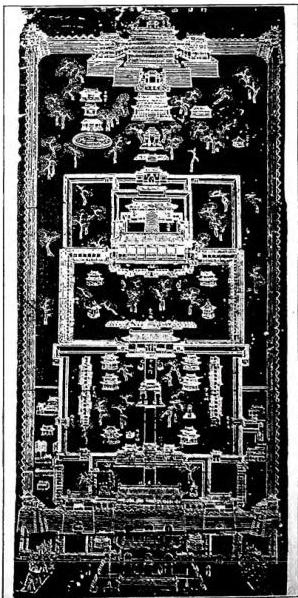
(photo: Istituto di archeologia e storia dell'arte)
A prospective Chinese plan of the Hua-Shan temple.
to worship with joined hands, collect himself, and invoke Amida. Furthermore, he must make an act of contrition, turn from evil to good, and express the desire to be reborn in the Pure Land. He must do all this with reverence, thinking that Amida is present. Though assured of his salvation through the invocation of Amida, the amidist must remain humble and pure, for salvation is truly assured only by invocations made at the hour of death. Then, ten invocations must be made from the depths of the heart. Only thus will Amida manifest himself, appear, console the soul, and receive it into his Pure Land. If Jesus is placed in Amida’s stead, the amidist’s prayer is often perfectly orthodox; here and there, some errors may still need correction, but the whole is a sincere prayer that cannot leave the heart of the true God unmoved.
Consider this prayer of a believer: «Behold, invoking Amida and commending myself to him, I place my trust in his name. Knowing that he, by virtue of his vow, has compassion for all who suffer, I express before him my repentance and my desire. I now confess with contrition all my ignorances and rebellions, all the sins committed in deeds, words, and thoughts. And I desire that at the last hour of my life, all obstacles that might oppose my rebirth in the happy land and my vision of Amida face to face be destroyed.» And here is a moving hymn in its brevity: «Hail, Amida, savior of the world, great father of mercies! With all my heart and all sincerity, I beg you to make me reborn in the Pure Land. By virtue of your vow and because of your great mercy, deign to free me from all bonds. Deign to mirror yourself in the heart I open to you, as the moon mirrors itself in clear water.»
Rarely does a non-Christian Chinese with religious sentiments content himself with only one of these three religions; not infrequently, he is a Confucianist and Taoist, a Confucianist and Buddhist, and perhaps even a Confucianist, Buddhist, and Taoist, according to the formula dear to every good Chinese: «The three religions are but one.»
The first certain mention of Manichaeism in China, arriving from Persia, dates to 694. For a long time, the Manichaeans practically tied their fate to that of the Uighurs, whose princes favored Manichaeism. With the decline of their protectors’ power, they too neared their end. Until the 12th century, small numbers of them are found in Chekiang and Fukien under the name Mim chiao, a name that was prohibited by the first emperor of the Mim or Ming dynasty and later passed to the Jews of Kaifeng.
No Chinese document attests to the arrival of Jews in China before 1000 A.D. Since they did not eat the sinews of animals in memory of Jacob (Gen. 32:24-32), the Chinese called their religion «the religion of those who remove the sinews.» According to a Chinese stele erected by Jews in 1489, the city of Kaifeng in Honan had a synagogue as early as 1163. Another synagogue would have been built in Hangchow in Chekiang. Several Jewish families lived in Kaifeng at the beginning of the 17th century. Matteo Ricci (v.) learned of them in the last days of June 1605 when one of these Jews, believing Ricci to be a coreligionist, visited him in Beijing. In 1607, Ricci sent a Chinese temporal coadjutor, Antonio Leitão, to Kaifeng for more information. These Jews, however, would not be rediscovered until October 1704 by the Jesuit Giovan Paolo Gozani, who informs us that they had preserved the Pentateuch in 13 scrolls, without Masoretic points, and a large number of other books of the Old Testament.
The upper part bears a magnificent cross with the following inscription beneath: “Stele of the Propagation in China of the Luminous Religion, come from the Great Qin,” that is, from the Eastern Mediterranean, perhaps Persia. The stele, carved in Chinese and in ancient Syriac (Estrangela), contains an expository section on religious doctrine, a historical section recounting the vicissitudes of Nestorianism in China from 635 to 781, and some seventy titles and names of Western missionaries in Estrangela.
The doctrinal section treats the following topics: God, one and triune, immutable, eternal, creator, pure spirit; the creation of the world and of man in a state of innocence; original sin; the Incarnation of the Lord from a Virgin, manifested by means of a star; Jesus, called Messiah, who fulfills the prophecies, founds the Church, preaches the eight Beatitudes, dies upon a cross (?), ascends to Heaven with the just, and leaves the New Testament; Baptism, the sign of the Cross, prayer with the face turned toward the east; finally, priests who wear beards and tonsures, profess poverty, recite the office for the living and the dead, and celebrate Mass once a week.
Received with great demonstrations of respect at court, the missionaries soon spread the “good news” even to the most remote regions, erecting churches and monasteries. They appear to have been almost exclusively foreigners and monks or nuns; very few testimonies allude to Chinese Nestorians or suggest their existence. By the mid-9th century, these Nestorians seem to have numbered nearly a thousand.
Upon their arrival, with the evident help of indigenous people—even if pagan, Buddhist, and especially Taoist—they set about translating or adapting into Chinese some of the 530 Christian books they had brought. Several of these works, translated between 635 and 700, were only rediscovered in 1908. Among them are a Life of Jesus Messiah, a Treatise on Monotheism, the Gloria in excelsis Deo according to the form used in Eastern Syria, and a kind of Litany of the Saints (P. M. D'Elia, Nel XIII centenario dell'arrivo dei nestoriani in C., in Civ. Catt., 1936, I, pp. 203 ff.; 304 ff.).
The decree of 845, which destroyed Buddhism, also destroyed Nestorianism. In 980, it was reported that the Christians of China had perished in one way or another and that the churches had been destroyed. Thus, by around 1000, this branch of Nestorianism from Persia had died out. However, in the 11th–13th centuries, a resurgence of the same occurred, this time originating from the Churches of High Asia.
Strong Nestorian communities are found in the northern provinces of China, among non-Chinese tribes such as the Uighurs, a Turkic tribe of Inner Mongolia; the Öngüt or White Tatars, another Turkic tribe; the Naiman of the Altai Mountains; and especially the Kereit, of whom as many as 200,000 are said to have converted along with their chief in 1007. Several Christian princesses from this branch later married Mongol Khans. From the north, these Nestorians later descended toward the south. Marco Polo encountered them in the north, center, and south between 1275 and 1292. In recent years, several relics of these Christian communities have been discovered, such as medals, crosses, and particularly Christian tombs and sarcophagi, often bearing a brief inscription in Syriac and one or more carved crosses. In the 7th–13th centuries, several foreign phoneticizations are also found, which are nothing but Christian names, such as Luca, Paolo, Giovanni, Giacomo, Sergio, Carlo, Zosimo, Giorgio, etc. In 1933, the last descendants of these ancient Christians were even found among the Erküt tribe, who inhabit the southeastern corner of the Ordos; even today, their rites allow one to trace Baptism, Confession, Marriage, and Extreme Unction.
2. First Contacts and the First Mission (13th–14th Centuries)
In 1206, the vast Mongol Empire began to rise, extending at one point from Mongolia and China to Dalmatia and the Adriatic. Innocent IV conceived the idea of establishing contact with the Mongols to convert them or at least to secure them as allies of the Crusaders against the Muslims, whom they would attack from the rear. To this end, in 1245, he sent as papal legate to the Mongol court one of the first companions of St. Francis of Assisi, Giovanni da Pian del Carpine, from near Perugia, who was the first traveler to reach the Far East by land; his mission having failed, he returned to Europe two years later and wrote his Historia Mongolorum. No better outcome attended the mission of the French Dominican Andrea da Longjumeau, sent in 1249 by St. Louis, King of France, to the Mongol emperor, who was said to have converted to Christianity; he too returned to Europe two years later. The mission of the Flemish Franciscan Guglielmo da Rubruk, who left in 1253 and returned in 1255, also yielded very modest results. None of these three remained in China.The honor of initiating the first Catholic mission in the Middle Kingdom belongs to the Italian Franciscan Giovanni da Montecorvino, who was the first to reach China by sea. Having probably disembarked at Zaiton (today Quanzhou in Fujian), where Arab merchants converged, he must have arrived in Khanbaliq, “the city of the Khan,” our Beijing, in the first months of 1294, shortly after the death of Kublai. In the very year of his arrival, he brought back to the Catholic Church from Nestorianism Prince George of Tenduk and, with him, a good number of his subjects, and the following year, he baptized one of the prince’s sons. A large and beautiful church was erected by the prince in honor of the Most Holy Trinity, probably in the province of Suiyuan. However, upon the prince’s death in 1298, his fanatically Nestorian brothers led the people back to their former errors.
In the first eleven or twelve years, Giovanni administered more than six thousand baptisms, and between 1298 and 1318, he built three churches in Khanbaliq. Some forty boys, aged seven to eleven, were being trained in the study of Latin, chant, and liturgy. For them, Giovanni translated the New Testament into Uighur and copied the Psalter, the Breviary, and the liturgical hymns.
When Clement V, then in Poitiers, learned of this good news in 1307, he consecrated six Franciscans as bishops, so that they might in turn consecrate Giovanni as the first archbishop of Khanbaliq and patriarch.
The Mongol dynasty’s fall in 1368 and its replacement by the native Chinese Ming dynasty marked the end of the Franciscans’ heroic missionary efforts. Several clues have led a number of modern sinologists to conclude that the indigenous element was extremely scarce, if not entirely absent, among both the Nestorians and the first Catholics in China. During the 7th–9th centuries, there had been around a thousand Nestorian monks and nuns, but very few of them were Chinese. In the 14th century, there were scarcely 30,000 Catholics, the vast majority of whom were non-Chinese. The history of Christianity in early and medieval China is not the history of a Chinese Church but the history of foreign Christians living in China—and these foreign Christians vanished with the storm of 1368. For two long centuries, from 1368 to 1551, the history of the Catholic Church has virtually nothing to record in China. The Middle Kingdom increasingly closed in on itself, isolating itself almost entirely from the rest of the world. In the language of Confucius, China and the world became “All that lies beneath the vault of heaven,” the borders of one sufficiently coinciding with the borders of the other.
3. Foundation of the Modern Missions (1583–1635)
The young Society of Jesus soon provided China with an outstanding pioneer in Francis Xavier, an exceptional strategist and leader in Alessandro Valignano, a patient forerunner in Michele Ruggieri, and an intelligent and devoted executor in Matteo Ricci, who would firmly establish the Church in that vast country.Francis Xavier, in contact with the Japanese between 1549 and 1551, saw the necessity of converting Japan through China. In August 1552, he arrived on the island of Sancian, about ten kilometers from the mainland and a little over a hundred from the city of Canton, awaiting a favorable opportunity to land on the opposite shore. However, death overtook him during the night of December 3, 1552, and he prophesied that his confreres would reach where he could not. This final wish of the Saint Valignano (v.), who on September 6, 1578, first landed in Macao, where the Jesuits had had a residence with an attached church since 1565. He decided to summon from India some young Italian fathers to devote themselves exclusively to the study of the Chinese language and customs.
The chosen ROUGIER, FÉLIX (v.). It has been said of him that he was the forerunner of Matteo Ricci, and this is true provided one does not believe he was the only or the first forerunner. Rather, he was the last in a long line, but the most fortunate. Indeed, in the space
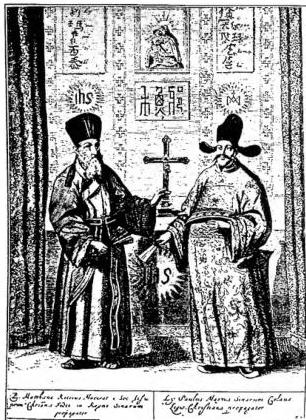
CINA - P. Matteo and P. Paolo Ly. - Engraving preserved by the Apostolic Delegation of C.
Over the span of 30 years, from Xavier (1552) to Ricci (1583), no fewer than 25 Jesuits, 22 Franciscans, 2 Augustinians, and 1 Dominican—some of them more than once—persistently and courageously knocked, though in vain, at the impenetrable gates of C. Ruggieri arrived in Macao around 20 July 1579 and immediately began studying Chinese, without books and with teachers he could not understand. While he continued this arduous study, the Portuguese of Macao, initially once and later twice a year, traveled to Canton for a fair that lasted several weeks. Seizing the opportunity, Ruggieri went there four times between March 1580 and April 1582. Meanwhile, he desired a study companion and insistently requested Valignano to send him a young fellow student from Macerata who was then in India.
As a result, on 7 August 1582 Matteo Ricci (v.) landed in Macao and began studying Chinese. After eleven months of intense study, both, on 10 September 1583—the true birthdate of modern missions—traveled to the city of Shaoqing or Zhaoqing, seat of the viceroy of Guangdong province, and settled there. In November 1588, Ruggieri was sent by Valignano to Rome to prepare a pontifical embassy to the emperor of C. When this too failed, he retired to Salerno, where he ended his days on 11 May 1607. Matteo Ricci, on the other hand, between 1583 and 1601 founded five residences from south to north, reaching Nanjing and Beijing, where he entered triumphantly in 1601 and remained until his death (11 May 1610). In the interior of C. in 1583, he found no Catholics, not even distant descendants of those baptized by the Franciscans of the 14th century; upon his death, he left approximately 2,500 under the care of 16 missionaries, half of whom were Chinese. Already on 12 November 1603, Valignano wrote: "This mission of C. has reached such a point that it seems more miraculous than human. Even in a hundred years, we could not have hoped that ours would come to enjoy such esteem in C." (P. D'Elia, Fonti Ricciane, II, Rome 1949, p. 264, note 4).
Very early on, the Jesuits concerned themselves with the indigenous element. The first two Chinese to become religious began their novitiate with the Jesuits on 1 January 1519, when there were only about 80 Christians in the interior of C. To these, who were Macanese, six others, also Macanese, and one Sino-Japanese were added during Ricci's lifetime. Two of them had studied philosophy, all but one Latin, and one had received the tonsure, which proves they were being prepared for the priesthood, though they never attained it, as the Order's general, for reasons of prudence, prohibited their access to the altar.
In their almost impatient desire to soon have a numerous indigenous clergy, the Jesuits, not supported, as we are, by nearly four centuries of experience, foreseeing and even exaggerating the difficulties Chinese would have in learning Latin, and wishing on the other hand that many literati already intellectually formed could be ordained priests without too many complementary studies, requested and in 1615 obtained from the Holy See the permission to substitute literary Chinese for Latin in the celebration of Mass, the recitation of the Breviary, and the administration of the Sacraments. In reality, this privilege was never put into execution, because Rome grew concerned before a project of such magnitude and practically withdrew, despite the repeated insistence of the Jesuits that continued throughout the 17th century.
One of the reasons Ricci was able to go to Beijing was precisely the hope that he could make this much-desired correction. Aware, however, of his scientific unpreparedness, as early as 1595, and again in 1605 and 1608, he asked his superiors in Rome for a genuine astronomer. Meanwhile, in 1609, Galileo constructed the telescope with which he began his series of sensational discoveries, published in March 1610. Among the closest friends of the Pisan astronomer was a German scientist, Johann Schreck, Latinized as Terrenz, who, having become a Jesuit and gone to C., remained an admirer of the great Tuscan astronomer. A young Piedmontese scientist, who had become a missionary in India, P. Antonio Rubino, informed in turn of the discoveries, alerted the missionaries in C. Already in 1615, which at that time represented remarkable speed, P. Emanuele Dias the Younger, in a pamphlet on Questions of Astronomy, made known to the Chinese on the last page of the work the telescope and the discoveries made with II.
Following new and increasingly insistent requests for genuine astronomers made from Beijing to Rome, on 16 April 1618, among others, the Milanese Giacomo Rho, the Bohemian Wenceslaus Pantaleon Kirwitzer—a convinced Copernican—the Austrian Johann Alberich, and two Germans, Johann Schreck, already mentioned, Schall von Bell (v.), embarked from Lisbon for C. On this occasion, the first telescope seems to have arrived in C. Schreck, concerned with the planned calendar reform, with ever more pressing insistence, made warm appeals to Galileo, from whom he solicited scientific aid he deemed decisive for the longed-for reform. From 1616 to 1623, these requests multiplied. After a clearly negative response from Galileo, Schreck turned to Kepler, who in December 1627 answered all the questions in detail and sent his works.
The missionaries were not officially entrusted with the correction of the calendar until 1629, a task to which Rho and Schall especially devoted themselves, assisted by about a dozen good literati. In the space of nearly five years, they published a collection of about 150 booklets of Mathematical Books. On 28 February 1634, the first calendar according to Western methods was presented to the emperor. Schall's work Verbiest (v.) and other distinguished scientists. From then on, the president of the astronomical office was always a Jesuit, and, after 1773, a missionary, even in times of persecution until around the mid-19th century.
4. Progress outside and inside the court (1635-1700). — Thanks to the imperial favor enjoyed by the Jesuit astronomers, the Church made marvelous progress. The 2,500 Catholics of 1610 had already become 5,000 by 1615, then 13,000 in 1627 and 38,200 in 1636. P. Prospero Intorcetta estimates that from 1583 to 1650, 150,000 baptisms were administered. Shortly after the mid-17th century, the annual increase of Christians was 10,000. Between 1651 and 1664, 105,000 baptisms were administered by all the missionaries then working in C. In 1664, about thirty Jesuit missionaries had succeeded in opening 42 mission stations, 159 churches, and a large number of private chapels. Around 1670, the total number of Catholics had reached 274,000, and by 1700 it would reach 300,000.
BIBL.:
P. D'Elia, Fonti Ricciane, Roma 1942-1949; H. Bernard, Matteo Ricci's Scientific Contribution to China, Pechino 1935; L. Pfister, Notices biographiques et bibliographiques sur les Jésuites de l'ancienne mission de Chine, Shanghai 1932-1934; G. H. Dunne, Generation of Giants, Notre Dame 1962; J. Dehergne, Répertoire des Jésuites de Chine de 1552 à 1800, Roma 1973; V. anche RICCI, Matteo; RUGGIERI, Michele; SCHALL VON BELL, Giovanni Adamo; VERBIEST, Ferdinando.
P. Pasquale M. D'Elia, S.I.
But more important than their number was the quality of these Catholics. Many of them belonged to the high society of 17th-century China. Already in the time of Ricci, who had grasped the correct method, truly eminent men were encountered: Paolo Siücoamcchi [Hsü Kuang-ch'i] (1562-1633), the most illustrious man the Church of China has ever had, baptized around 15 January 1603, who introduced Christianity into his native Shanghai in 1608; rising to the highest positions in social and political life, even becoming Chancellor of the Empire, he was, in Ricci’s words, the "greatest pillar" of the Church of China; Ignazio Cchiütaesu [Ch'ü T'aisu] (1549-1611), son of the greatest literary figure of that time, baptized on 25 March 1605, who, becoming an enthusiastic admirer of Ricci’s science and virtue, proclaimed them everywhere and thus smoothed his path wherever he went; Leone Licezeo [Li Chih-tsao] (1565-1630) of Hangchow in Chekiang, who made rapid progress in the study of Western sciences, which he disseminated in China, baptized by Ricci in March 1610, a few weeks before his own death; Michele Iamttimiüm [Yang T'ing-yü] (1557-1627), likewise of Hangchow, baptized in 1611. By 1636, among the Catholics there were 14 high-ranking officials, 10 doctors, and over 300 licentiates. Many others, among the greatest literati and the most influential members of the government, though not reaching Baptism, sympathized with the missionaries and admired the purity and elevation of Christian doctrine. It is certain that Ricci and some of his collaborators and successors had an enormous and truly exceptional influence on the highest society of 17th-century China—literati, magistrates, prefects, provincial governors, viceroys, ministers of the two capitals, princes, and personages who approached the emperor.
The Jesuits also indirectly penetrated the court. In 1626, they baptized Achille Ppamttienescu [P'ang T'ien-shou], who would later become Chancellor of the Empire and generalissimo of all naval and military forces of the last pretender to the Ming throne. Through him, Christianity reached the court. In 1636, 140 princes of the imperial house, 40 members of the court, and 70 to 80 palace ladies had received Baptism. Later, in 1647, both the natural mother and the legal mother of the pretender to the throne, Iomli [Yung Li], received Baptism under the respective names of Maria and Elena, and with them also the empress Anna, and the crown prince, who was given the symbolic name of Constantine. In 1650, Achilleo and Elena sent the Polish Jesuit Michele Boym to Rome, the author of letters to the Pope and the Superior General of the Order, in which requests were made for other missionaries of the Society. Alexander VII did not respond until the end of 1655, when Elena had already been dead for four years, and the responses of the Superior General Alessandro Gottifredi never reached their destination, as Boym, who was carrying them, died in 1659 before completing half of his journey.
Meanwhile, the work of European astronomy continued under the care of Adam Schall and Ferdinand Verbiest. Even amid their scientific labors, both did not lose sight of the apostolate. Schall undoubtedly would have brought the emperors Ciomcem [Chung Cheng] and Seicence [Shun Chih], respectively the last sovereign of the Ming and the first of the Qing, to the light of the Gospel, had their premature deaths not prevented him. Verbiest succeeded Schall in 1666 and enjoyed a relationship of intimate friendship with the emperor Camsci [K'ang Hsi], perhaps the greatest of China’s emperors. For five months, he taught the monarch Western sciences and, with them, Christian doctrine, which the emperor was inclined to embrace.
Indeed, Camsci, satisfied with the Treaty of Nerchinsk, negotiated by the Jesuits Francesco Gerbillon and Tommaso Pereira, by which peace was restored on 6 September 1689 between the tsar and the "Son of Heaven," issued the first decree of religious freedom on 22 March 1692: from then on, all his subjects could follow the Christian religion, and all missionaries could preach it throughout his vast domains. This decree crowned a century of Christian penetration.
5. Internal and External Difficulties (1632-1840). — Gregory XIII, at the request of the Portuguese government, in 1585 granted the Jesuits the exclusive privilege of evangelizing China and Japan. This explains why, during the years 1583-1631, there were no missionaries in China other than the Jesuits. In 1600, Clement VIII revoked this privilege, though he still required missionaries bound for Portuguese Asia to sail from Lisbon. In 1608, Paul V removed this restriction for the mendicant Orders, and in 1633, Urban VIII removed it for all religious without distinction. Finally, in 1673, Clement X extended this concession to the secular clergy as well.
Thus it came about that on 2 January 1632, two Italian Dominicans, Angelo Cocchi of Fiesole and Tommaso Serra of Santa Maddalena, arrived in Fukien. After the latter was killed by pirates, Cocchi requested and obtained another companion, Giovanni Battista Morales, who arrived in Fukien on 2 July 1633, accompanied by the Franciscan Antonio Caballero of Santa Maria. After Cocchi’s death in November 1633, another Dominican, Father Francesco Diez, and another Franciscan, Father Francesco Alameden de la Madre de Dios, arrived the following year.
With the arrival of the new missionaries, the notorious Chinese Rites Controversy (v. CIANRESI) broke out publicly in 1634, a dispute that would drag on until 1742 and only find its final resolution in 1939. The missionaries divided into two opposing camps: the Jesuits on one side and the Franciscans and Dominicans on the other. Camsci felt offended when he saw a foreign authority, distinct from his own and his nation, interfering in China’s affairs against his will.
The difficulty did not diminish with the arrival in the Far East of the first apostolic vicars. François Pallu, Pierre-Marie de la Motte-Lambert, and later Ignace Cotolendi, founders of the Société des Missions Étrangères de Paris, were appointed on 9 September 1659 as apostolic vicars of Tonkin, Cochinchina, and Nanjing, respectively, and at the same time administrators of five southwestern provinces, four southeastern provinces, and five central, northern, and northeastern provinces of China. The first two arrived in the East in 1664 and 1662, respectively, while the third died in India in 1662.
After the arrival of the first Augustinians in 1680, Pallu, appointed apostolic vicar of Fukien, and his successor in that office, Charles Maigrot, also arrived in China in 1684. With Maigrot began a more acute phase of the Rites Controversy, which led to a new examination in Rome and the dispatch to China of two legates, Carlo de Tournon and Ambrogio Mezzabarba, who further irritated Camsci, who could not understand how foreigners, ignorant of the language and history of China, presumed to judge the meaning of certain texts and millennia-old customs of the country.
BIBL.:
P. M. D’Elia, Fonti Ricciane, Roma 1942-1949; H. Bernard, Le Père Matthieu Ricci et la société chinoise de son temps, Tientsin 1937; L. Pfister, Notices biographiques et bibliographiques sur les Jésuites de l'ancienne mission de Chine, Shanghai 1932-1934; A. Väth, Johann Adam Schall von Bell, Köln 1933; J. Brucker, Les Jésuites en Chine au XVIIe et XVIIIe siècles, in Études, 1924; G. H. Dunne, Generation of Giants, Notre Dame 1962; G. M. J. Bry, La Compagnie de Jésus en Chine, Paris 1924; J. Sebes, The Jesuits and the Sino-Russian Treaty of Nerchinsk, Roma 1961; A. Chan, Chinese Rites Controversy, in New Catholic Encyclopedia, Washington 1967; vedi MISSIONOLOGIA.
A. ROSSI
The transition to persecution was short. And persecution, strongly influenced by that of neighboring Japan, manifested itself to varying degrees—open or covert, violent or veiled—practically extending from the first decade of the 18th century to around the mid-19th century, killing missionaries and Christians and destroying not a few churches. To these evils was added, in 1773, the suppression of the Society of Jesus worldwide and thus also in China, where, over nearly two centuries (1583-1773), 472 Jesuits had worked, some of whom were truly eminent figures in various fields. To partially replace the Jesuits of Beijing, the Lazarists were called upon and arrived in 1784. Yet persecution persisted. The total number of Catholics between 1800 and 1850 seems to have remained between 200,000 and 250,000. During this time, there were probably fewer than 40 European missionaries and about 80 Chinese priests in the country. Without a new turning point, the Church in China would likely have perished.
6. The International Turning Point (1840-1900)
But the turning point came. On June 5, 1840, the imperial commissioner of Canton, rightly wishing to suppress the opium trade controlled by the English, threw over 20,000 chests of the drug into the sea. This was the pretext for immediate war, which, naturally, was won by the English. On August 29, 1842, China was forced to sign the first international treaty of modern times, soon followed by others with America and France. On the occasion of the treaty with France, which was waiting for the opportune moment to replace Portugal as the protective power of the Missions, a double decree was issued: one in 1844 permitting Chinese to follow the Catholic religion, and another in 1846 abolishing the old penalties against Catholics. The Church, taking advantage of this situation, began to live openly.As seen, only a few Franciscans, not many Lazarists, a few Dominicans, and a certain number of members of the Paris Foreign Missions remained in China. Restored by Pius VII in 1814, the Society of Jesus resumed its place in China as early as 1842, specifically in the areas around Shanghai and later in Xianxian. With the opening of hospitals, asylums, and orphanages under the treaties, it became possible for the first time for religious women to work. The first were the Daughters of Charity, who arrived in Macao in 1847 and shortly after in Ningbo. The following year, the Sisters of St. Paul of Chartres arrived in Hong Kong, ceded to England.
The murder of a French missionary, Auguste Chapdelaine, in 1856, and the somewhat harsh treatment of some English sailors by the Chinese provided France and England, with the tacit consent of the United States and Russia, the pretext to oppose China and force it in 1858 to sign the Treaties of Tianjin with the aforementioned four Powers. The entry of Anglo-French troops into the capital in 1860 compelled China to sign the Convention of Beijing, by which it was forced to open its doors to foreigners. Between 1861 and 1869, China had to sign other treaties with Prussia, Denmark, the Netherlands, Spain, Belgium, Italy, and Austria. These treaties sanctioned the principle of religious freedom, abrogated the edicts against Christians, and promised protection to Catholic missionaries holding a passport from the French consul. Thus, with the tacit consent of the other powers and especially of the Holy See, the practice—if not the right—of considering France the protective power of the missions was introduced, a practice that continued undisturbed and often very beneficial to the Church for about twenty years, from 1860 to 1880. In this way, the legal status of the Church in China changed.
This made possible the arrival of new missionaries. The first members of the young Society of Foreign Missions of Milan arrived in Hong Kong in 1858. The Scheut Fathers arrived in 1865 and soon took charge of Mongolia. After an interruption of more than a century, the Augustinians returned to Hunan in 1879. The seminary of SS. Peter and Paul, newly founded in Rome, sent its first members to Shaanxi in 1885. The first German fathers of the Society of the Divine Word of Steyl arrived in 1879 and began working in Shandong as early as 1882. The Trappists also founded a monastery in Yangjiaping, in present-day Hebei, in 1883. Finally, a new development: non-priest teachers arrived, namely the Brothers of the Christian Schools in Hong Kong in 1870 and the Marist Brothers in Shanghai in 1893. Missionaries were followed by female missionaries: the Canossian Sisters in Hong Kong in 1860, the Auxiliatrices of Purgatory in Shanghai in 1867, the Sisters of Providence of Portieux in Mukden in 1875, the Franciscan Missionaries of Mary in Chefoo in 1886, and the Dominican Sisters in Fujian in 1889. Finally, the Carmelites also founded a house in Shanghai in 1869.
Yet persecutions did not cease, both in the years 1850-69, during the Taiping Rebellion, and during the Tianjin Massacre in 1870, and especially in 1900, at the time of the so-called Boxers.
7. The Magnificent Flourishing of the 20th Century (1900-49)
With the new era, old China collapsed forever. In 1905, the ancient examination system and with it the old Confucian culture collapsed. Schools multiplied, from elementary to universities. In 1911, the millennia-old monarchy collapsed, and China, under the impetus of Sun Yat-sen, the herald of the Three Principles of the People, became a republic. Within the family, the seclusion of women ended; they not only studied and attended universities but also dared to enter political life.This collapse of the old and the need for the new facilitated the expansion of Catholicism. First, the number of Catholics increased rapidly. In 1900, there were 742,000; the first million was reached in 1907, the second in 1921, and the third in 1938; statistics from 1947-48 put the number at 3,275,000, to which, however, about two hundred thousand catechumens must be added.
Moreover, the number of foreign missionaries increased. In 1900, there were 886, belonging to ten institutes. In 1946-47, however, there were 3,066, belonging to 37 foreign institutes, of which 26 had one or several territories exclusively reserved for them; to these, all priests, were added 421 foreign lay brothers. With modern schools opened to girls after 1905, Sisters were able to work not only in asylums, orphanages, hospitals, dispensaries, and clinics of all kinds but also in the educational field with schools and women's colleges. Thus, female missionary institutes rose from 10 in 1900 to 59 in 1946-47, with 2,046 members.
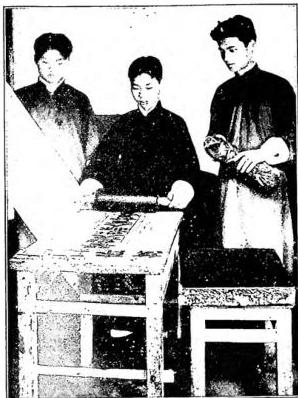
(fot. Fides)
CINA - Chinese students at work.
Ichang, printing press of the Catholic Mission.
The new times have accelerated but not created the educational movement for Catholics; it suffices to recall the College of St. Ignatius in Zikawei, near Shanghai, founded as early as 1850. It is certain, however, that during the 20th century, male and female schools of every level have multiplied wonderfully. Higher education was provided to lay students, Catholic and non-Catholic, in three universities: the Aurora University, founded in Shanghai in 1903 and directed by French Jesuits; the Catholic University of Peking, founded in 1925 by American Benedictines but transferred as early as 1933 to the Society of the Divine Word; and the University of Tientsin, directed by French Jesuits, which became a university in 1947 but whose origins as an institute of higher studies date back to 1922. In 1946-1947, approximately 4,500 students attended these three universities, including about fifty priests and over 400 female students from the women’s section of Aurora, directed by the Religious of the Society of the Sacred Heart. Furthermore, in 1947-1948, C. had 189 colleges of higher or secondary studies with a Catholic student body of 7,350 and a non-Catholic one of 39,698. Two thousand primary schools were attended by approximately 60,000 Catholics and 136,000 pagans. Counting all other schools, there was a school population of about 320,000 children attending nearly 4,450 different schools.
Ecclesiastically, C. has been divided into dioceses and archdioceses since 1946, the former now numbering 108 and the latter 20. Of these, 21 are in the hands of the Chinese secular clergy, who are entrusted with the major cities: Peking, Nanking, Mukden, Shanghai, and soon, without doubt, Canton as well. Additionally, two dioceses are entrusted to Chinese Lazarists and one to indigenous Franciscans. Moreover, one diocese entrusted to French Jesuits has a Chinese Jesuit bishop; one entrusted to Dutch Lazarists has a Chinese Lazarist bishop; and two dioceses entrusted to German Divine Word missionaries have so far had two Chinese Divine Word bishops. Thus, there are a total of 33 Ordinaries of Chinese nationality, of whom 28 hold episcopal rank.
The French protectorate of the missions, which was established between 1860 and 1880, over time became rather harmful to the Church and resented by other powers. Therefore, under the pressure especially of Germany and Italy, it has long since fallen into disuse. Today, the Church acknowledges that each nation has the right to protect its own nationals wherever they may be, but not the subjects of other nations, which nullifies any protectorate as it was understood at the end of the 19th century. This protectorate of France had already several times, in 1881, 1886, and 1918, prevented C. from having normal diplomatic relations with the Holy See. But in 1922, Pius XI, without asking anything of France, established the apostolic delegation and appointed the first delegate, who in 1924 convened the first plenary council in Shanghai. Its acts, approved by Rome in 1928, were published in 1929 (I. Antoniutti, Il primo sinodo cinese, in Il pensiero missionario, 1 [1929], pp. 182-94). In May 1942, Japan sent its representative to the Holy See. C., then at war with Japan, could not fail to do the same. Thus, as early as February 1943, C. sent its plenipotentiary minister, to whom the Vatican responded in 1946 by sending an internuncio. France, this time, remained silent.
The Church in C. already bears the divine seal. It is the mother thus far of 62 blessed, all martyrs. Of these, 19 were beatified by Leo XIII in 1889, 1893, and 1900; 14 by Pius X in 1929; and 29 by Pius XII in 1946. Among these blessed are six European bishops and thirteen European priests, four Chinese priests, one European layman, seven European nuns, seven seminarians, eight catechists, nine Christians, two virgins, and two widows, all Chinese. They were martyred between 1648 and 1900.
Francisco Fernández de Capillas (d. 1648) b. 2 May 1909, protomartyr of C.; Peter Martyr Sanz, bishop (d. 1747) b. 14 May 1893; Francis Serrano (d. 1748) b. 14 May 1893; Joachim Royo (d. 1748) b. 14 May 1893; John Alcober (d. 1748) b. 14 May 1893; Francis Diaz (d. 1748) b. 14 May 1893; Peter Wu, Chinese catechist (d. 1814) b. 27 May 1900; Joseph Tchang-Ta-Pong, Chinese catechist (d. 1815) b. 2 May 1900; Gabriel Taurin Dufresse, bishop (d. 1815) b. 27 May 1900; Augustine Tchao-Soung, Chinese priest (d. 1815) b. 27 May 1900; John Lantrua of Triora (d. 1816) b. 27 May 1900; Joseph Yuen-Tsai-Te, Chinese priest (d. 1817) b. 27 May 1900; Paul Lieou-Han-Tso, Chinese priest (d. 1818) b. 27 May 1900; Francis Regis Clet, Lazarist (d. 1820) b. 27 May 1900; Thaddeus Lieou, Chinese priest (d. 1823) b. 27 May 1900; Peter Lieou-Ouen-Yuen, Chinese catechist (d. 1834) b. 27 May 1900; Joachim Ho-Kai-Tche, Chinese layman (d. 1839) b. 27 May 1900; John Gabriel Perboyre, Lazarist (d. 1840) b. 10 Nov. 1889; Lawrence Pe-Man, Chinese layman (d. 1856) b. 27 May 1900; Auguste Chapdelaine, of the Paris Foreign Missions (d. 1856) b. 27 May 1900; Agnes Tsao-Koue, Chinese widow (d. 1856) b. 27 May 1900; Jerome Lou-Tin-Mey, Chinese catechist (d. 1858) b. 2 May 1900; Lawrence Ouang-Ping, Chinese catechist (d. 1858) b. 2 May 1900; Agatha Lin-Tchao, virgin (d. 1858) b. 2 May 1900; Joseph Tchang-Yo-Yang, seminarian (d. 1861) b. 2 May 1900; Paul Tchen-Tchang-Ping, seminarian (d. 1861) b. 2 May 1900; John Baptist Lo, Chinese layman (d. 1861) b. 2 May 1900; Mary Ouang, Chinese widow (d. 1861) b. 2 May 1900; John Peter Néel, of the Paris Foreign Missions (d. 1862) b. 2 May 1900; Martin Ou-Sue-Chang, catechist (d. 1862) b. 2 May 1900; John Tchang, Chinese layman (d. 1862) b. 2 May 1900; John Tchen, Chinese layman (d. 1862) b. 2 May 1900; Lucy Yi, Chinese virgin (d. 1862) b. 2 May 1900. To these must be added the 29 martyrs, victims of the Boxer persecution, who died on 4, 7, and 9 July 1900 and were beatified by Pius XII on 24 Nov. 1946: John M. Grassi, bishop; Francis Fogolla, bishop; Anthony Fantosati, bishop; Elias Facchini; Theodoric Balat; Joseph M. Gambaro; Cesidius Giacomantonio; Andrew Bauer; Mary Hermina of Jesus (Tema Grivot); Mary of Peace (Marianna Giuliani); Mary Clare (Clelia Nanetti); Mary of St. Natalia (Jeanne Marie Kerguin); Mary of St. Justus (Anne Françoise Moreau); Mary Adolphine (Anne Catherine Dierkx); Mary Amandine (Pauline Jeuris); five seminarians and nine servants.
In addition to these, many others gave their lives for the faith and await the glory of the altars.
In particular: T. M. Gentili, Memorie di un missionario domenicano della C., 3 vols., Rome 1887-88; H. Havret, La Stèle chrétienne de Si-ngan-fou, 3 vols., Shanghai 1895-1902; J. Tobar, Inscriptions juives de K'ai-fong-fou, ibid. 1912; J. de la Servière, Histoire de la mission du Kiangnan, 2 vols., ibid. 1914; A. Jann, Die katholischen Missionen in Indien, China und Japan. Ihre Organisation und das portugistische Patronat vom 15. bis ins 18. Jahrhundert, Paderborn 1915; B. Martínez, Historia de las misiones Augustinianas en China, Madrid 1918; J. Brucker, La Compagnie de Jésus. Esquisse de son Institut et de son histoire, Paris 1919; J. M. Planchet, Documents sur les martyrs de Pékin pendant la persécution des Boxers, 2 vols., Peking 1922-23; id., Le cimetière et les oeuvres catholiques de Chala, 1610-27, ibid. 1928; O. Maas, Die Wiedereröffnung der Franziskanermission in China in der Neuzeit, Münster in W. 1926; B. M. Biermann, Die Anfänge der neueren Dominikanermission in China, ibid. 1927; P. M. D'Elia, Catholic Native Episcopacy in China. Being an Online of the Formation and Growth of the Chinese Catholic clergy (1300-1926), Shanghai 1927; id., The Catholic Missions in China. A short sketch of the History of the Catholic Church in China from the earliest records to our own days, ibid. 1934; id., Fonti Ricciane. Documenti originali concernenti Matteo Ricci e la storia delle prime relazioni tra l'Europa e la C. (1570-1615), 3 vols., Rome 1942-49; id., Contributo dei missionari cattolici alla scambievole conoscenza della C. e dell'Europa, in Le missioni cattoliche e la cultura dell'Oriente, ibid. 1943, pp. 27-109; id., L'istituzione della gerarchia episcopale e dell'internunziatura in C., in Studia Missionaria, 2 (1946), pp. 1-31; id., La nuova C., in L'Universale, 1 (1946), pp. 1-17; id., Galileo in C. Relazioni attraverso il collegio Romano tra Galileo e i Gesuiti scienziati missionari in C. (1610-40), Rome 1947; K. S. Latourette, A History of the Christian Missions in China, London 1929 (with extensive bibliography); A. Van den Wyngert, Sinica Franciscana, 4 vols., Quaracchi: I, 1929; II, III, IV, 1942; A. C. Moule, Christians in China before the year 1550, London 1930; L. Thier, Notices biographiques et bibliographiques sur les Jésuites de l'ancienne mission de Chine (1525-1775), 2 vols., Shanghai 1932-34; A. Väth, Johann Adam Schall von Bell S. I., Cologne 1933; H. Bernard, Aux portes de la Chine, Tientsin 1933; id., Le p. Mathieu Ricci et la société chinoise de son temps, 2 vols., ibid. 1937; N. Gubbles, Trois siècles d'apostolat. Histoire du catholicisme au Hu-hwang depuis les origines 1587 jusqu'à 1870, Paris 1934; A. B. Duvigneau, S. Thomas a-t-il porté l'Evangile jusqu'en Chine?, Peking 1936; P. Y. Saeki, The Nestorian Documents and Relics in China, Tokyo 1937; G. Messina, Cristianesimo, buddhismo, manicheismo nell'Asia antica, Rome 1947. For recent statistics: Annuaire de l'Eglise catholique en Chine, 1948; Zi-ka-wei, Shanghai 1948. Pasquale M. D'Elia
CINA
The Chinese state (Ta Chung Hwa Min Kuo, i.e., "Great Republic of China") is a vast territory in eastern Asia, bounded to the north by the Mongolian People's Republic and the Soviet Union, to the east by Korea and the Yellow Sea, to the south by French Indochina, Burma, and India, and to the west by India, Tibet, and the Soviet Union. Its surface area is approximately 9,736,000 square kilometers, with a population of around 450 million inhabitants (1948 estimate). The capital is Nanking, though during the war against Japan (1937-1945) it was temporarily moved to Chungking. The official language is Mandarin Chinese, though numerous dialects are spoken across the country. The predominant religion is Buddhism, followed by Taoism, Confucianism, and Islam; Christianity, both Catholic and Protestant, has a significant presence, particularly in urban centers.
The history of China is one of the oldest and most continuous in the world, with written records dating back over 3,500 years. The country has seen the rise and fall of numerous dynasties, the most notable being the Xia, Shang, Zhou, Qin, Han, Tang, Song, Yuan, Ming, and Qing. The last imperial dynasty, the Qing, was overthrown in 1911, leading to the establishment of the Republic of China in 1912. The political landscape of China in the mid-20th century was marked by internal conflicts, including the Chinese Civil War between the Nationalists (Kuomintang) and the Communists, as well as the war against Japanese aggression.
Catholicism in China has a long and complex history, dating back to the arrival of Nestorian Christians in the 7th century. However, the modern Catholic presence began with the arrival of Jesuit missionaries in the late 16th century, most notably Matteo Ricci, who sought to adapt Christianity to Chinese culture. The Catholic Church in China faced numerous challenges, including periods of persecution, particularly during the Boxer Rebellion (1899-1901) and the subsequent decades of political instability. Despite these difficulties, the Church continued to grow, with a significant number of Chinese clergy and laity playing active roles in its development. The establishment of the Chinese Catholic hierarchy in 1946, with the creation of 20 ecclesiastical provinces, marked a significant milestone in the Church's history in China.
IV. ART
The origins of Chinese artistic civilization can be traced back to prehistoric times.In the period extending up to the 7th century A.D., known as that of the Six Dynasties, the most significant event was the introduction of Buddhism into China (1st century A.D.), which entered art around the early 5th century. It particularly influenced sculpture, both in elaborately decorated votive steles and in the effigies of sanctuaries—now largely lost—where figures were conceived with an original stylization. During this era, the first types of indigenous painting also appeared, known only through later copies. From 648 to 906, in the T'ang period, Chinese art reached its highest peak and achieved its widest diffusion beyond national borders. Sculptures, primarily depicting deities (Bodhisattva, Buddha, Kouan-yin, etc.), broke free from conventionalism and assumed a new expressiveness, revealing an intimate sentiment. Fine examples of this period in Italy include the recently restored stone sculptures, formerly in the Gualino collection and now in that of the Banca d'Italia in Rome.
Painting gained great importance precisely during the T'ang dynasty. Nurtured by great masters such as Wu Tao Tzu and Wang Wei—true founders of sacred and landscape painting—inspired in content by the great Indian religious cycles, it was essentially based on line and drawing, entirely ignoring the problems of color and chiaroscuro that were alive in Western Chinese art. However, the most splendid production of Chinese painting occurred during the three subsequent eras—the Five Dynasties, the Sung, and the Yan—which are grouped together due to the identity of style and technique. Execution on paper or silk benefited from exceptional skill, and the extensive use of glazes, particularly in the so-called Southern School, contributed to that refinement. Flowers, birds, fantastical animals, and imaginary architectures were recurring subjects. Among the most celebrated artists are Chu Hsi, Kuo Hsi, who favored black and white, Emperor Hui Tsung, and the delicate landscapists Ma Yuan and Hsia Kuei. Parallel to painting, ceramics reached their zenith in this period, thanks to the perfection of glazes, the variety of decorative solutions, and the preciousness of colors (blue, purple, ivory, pearl gray), whose harmony is exemplary.
With the conclusion of this lofty experience, an era of decline began to take shape in Chinese art. During the long Ming dynasty period, the pure forms of the T'ang period froze into an increasingly invasive mannerism, dominated by the demand for external grace and pleasantness. For this reason, the Ming period produced the greatest number of objects in the so-called minor arts, from lacquer to inlays, ivories, textiles, and enamels, often imitating forms already widespread in Japan. The use of kaolin, known alongside feldspar in the Sung period, expanded considerably, marking the historical origin of famous Chinese porcelain, whose first and greatest center of diffusion was Ching-te chen. Tributary to earlier ceramics in forms and decorations, it also drew motifs from painting and textile art, and was more exuberant in its always dazzling and vivid colors. The dating of Ming objects is facilitated by imperial marks often applied, and cataloging generally follows the names of the emperors who fostered this craft. Porcelain continued to maintain a high standard throughout the entire Ts'ing dynasty (from 1644 to 1912), while painting and sculpture were reduced to tired repetitions of ancient forms. The infiltration of a Western language into Chinese art forms is recent, but its fruits have not been significant.
Chinese architecture holds a unique place, having preserved its simple constructive module unchanged throughout the course of its civilization, varied only by vague and subtle ornamental solutions. The extensive use of wood, the notable importance given to the roof—an essential element in the stylistic economy of every building—the gracefulness of decorations, and above all the integration of structures into the landscape, form the original characteristics of Chinese architecture. Religious architecture also adhered to the same canons, with greater simplification of motifs, except for some singular buildings such as the Temple of Heaven in Peking and the rare surviving temples near the imperial tombs.
Giovanni Carandente
V. CHRISTIAN ART
1. Origins. - The Jesuit Giovanni Da Rocha (1565-1623), a missionary in China, had composed a book on the Rosary and wished to popularize it with suitable illustrations. At that time, some copies of the famous book of illustrated Gospels, compiled by Father Gerolamo Nadal and rich in 150 fine plates largely by the Roman painter B. Passeri and engraved in Antwerp, had reached China.Father Da Rocha gave the book to a skilled Chinese painter, who translated the engravings into Chinese. The translation did not succeed in concealing the European character of the compositions.
In some way connected to that iconographic cycle are six silk paintings discovered by M. B. Laufer in Sain (Shensi). Similar efforts were also made by the Jesuit Giulio Aleni in 1633 in his Chinese work Explanation of the Gospel through Images, and by the Jesuit Giovanni Adamo Schall von Bell in 1640 in his Chinese work Prints Offered to the Emperor. It is highly probable that from the movement created by the Jesuits derive two images of the Blessed Virgin from the 17th-18th centuries; the first is preserved at the Field Museum in Chicago and reveals its derivation from a copy of the Madonna of Santa Maria Maggiore; the second, with more Chinese features, is preserved at the British Museum in London. It is also worth mentioning the artistic activity carried out by the Jesuits at the court of Beijing and mentioning the brothers G. Castiglione (1688-1766), Attiret (1702-68), and Father Sichelbarth (1708-80). They adopted the Chinese style, and their paintings were highly esteemed and sought after. However, until now, no sacred works by them were known. C. Costantini had searched for them in vain in the museum of the imperial palace in Beijing. A few years ago, in a country house outside Beijing, two unsigned paintings were discovered, which, due to their stylistic characteristics, are certainly by Castiglione: they depict St. Michael the Archangel and the Guardian Angel. But the Jesuits' initiative did not have a following. In the countryside, where local craftsmen had to be used, there were only a few examples of churches in the Chinese style. However, the major centers believed they should give
2. New Movement in Favor of Chinese Christian Art. - C. Costantini, who arrived in C. as apostolic delegate in 1922, had the impression that the ancient Chinese world had collapsed with the empire, but that, through profound upheaval and the excesses of an exacerbated nationalism, a new C. was being prepared.
In this crisis of reform and growth, he thought that in a country possessing the decorum of a great and ancient art, Christian art too should associate itself with new directions by utilizing local forces, and this also for a reason of missionary methodology. Undoubtedly, Chinese art, due to its spiritual character, was admirably suited to interpreting Catholic thought and satisfying the demands of liturgy. On the other hand, this demonstrated that the Catholic religion was not a foreign religion. However, it was necessary to revitalize theory with practice. In 1925, the Benedictine architect D. Alberto Gresnigt came to C. He mastered the spirit of Chinese art and provided the plans and directed the construction of the beautiful Catholic University of Peking, the regional seminaries of Hongkong and Kaifeng, the church of the Disciples of the Lord in Suanhawa, and attended to
other minor works, using in his buildings the elements of traditional Chinese art but imprinting upon them a new Christian soul.
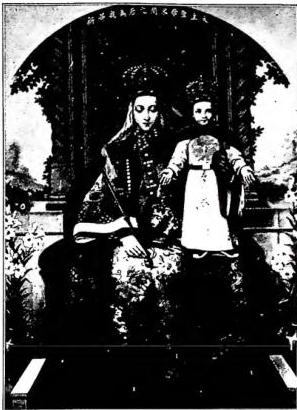
What has been done in the field of painting is also very interesting. In 1929, the painter Chen Suan-tu, who possessed expert skill in drawing according to the good Chinese tradition and the ability to render things with a vivid sense of spirituality and poetry, after reading the Gospels and having viewed some works by good Christian artists at the apostolic delegation, where he had been invited, painted and brought to the delegation itself a silk panel depicting the Virgin adoring the Child.
This delightful Chinese image constitutes the starting point of the new Chinese Christian painting. Having become a Christian and baptized with the name of Luke, he was appointed professor of art at the Catholic University of Peking and created around himself a family of Christian painters, in whom shines the purity of the primitives. Chinese art offered the sacred subject a form full of delicate spirituality, and the sacred subject offered Chinese artists a new, elevated, luminous, powerful theme, capable of creating a true renewal of ancient Chinese art. The painting school of the University of Peking immediately became a center of new ideas and activities. Exhibitions were held in Shanghai and Peking, which achieved flattering successes. Alongside the name of Luke Chen, that of two well-known painters, the French prince Pu Chin and Chang-wan-tzu, who also treated sacred subjects, must be remembered. Among the pupils of Luke Chen, Wangsuta, Lu Hung-Nien, Ming-yuan, and Hsu Chi-hua can be noted; the latter died in the prime of his years in 1937. Nor should it surprise if Chinese Christian painting appears suddenly mature: Chinese artists were masters of a pictorial language already refined by the poetic sense of things and by the habit of interpreting religious subjects; their painting was in some way already ready for Christian baptism. Traditional Chinese art, stirred by contact with naturalistic currents from the West, easily rediscovers itself in the sacred subject and joyfully takes refuge in the iconographic forms of ancient religious art.
We are still at the first experiments of a most auspicious rebirth, but these first flowers are sufficient to make us look with confident hope toward a spring of Christian art rising in the distant horizons of the Far East. - Vedi Tavv. CVII-CVIII.