
ROSARY. - This is the Marian prayer composed of 15 decades of Hail Marys intercalated with the Pater and the Gloria. Vocal prayer is joined to mental prayer, with meditation on 15 Mysteries concerning the joys, sorrows, and glories of Jesus and Mary. litanies (v.) are customarily added to the recitation of the R.
The R. belongs to that luxuriant flowering, in new manifestations, of devotion to the Virgin in its more popular and naïve aspects, which was already characteristic toward the end of the 12th century; the Cistercians contributed greatly to it, followed, from the beginning of the next century, by the great mendicant Orders in their strenuous struggles against heresies. Pious accounts of the period reliably inform us that in the 13th century it was customary to repeat frequently a sequence of 50 or 150 Hail Marys, also accompanied by genuflections and often intercalated with the Pater noster. Indeed, the recitation of the Pater and the Creed had repeatedly been imposed on the faithful in earlier ages; subsequently, that of the Angelic Salutation was also disseminated in its shorter form (v. AVE MARIA); thus, alongside the recitation of the Davidic Psalter proper to monks, friars, and devout persons of the more cultured classes, the people of the simple bourgeoisie had the Psalter of the Blessed Virgin, which, together with the Laudi spirituali, was recited in Societies and Confraternities. For easier and more diligent recitation, the crown (v.) was adopted, as it was already in use for similar devotions. Before long, remembrance of the Mysteries of the life of Mary and Jesus was introduced into this recitation; in this way its monotony was tempered and the fundamental points of supernatural belief were brought to mind. This remembrance was inserted almost in the form of a short prayer as an addition to the Hail Mary, suitably altering it; or it was made the object of a very brief consideration at the end of each decade, and the series of fifteen Mysteries, divided into joyful, sorrowful, and glorious, came into being. It is therefore a devotion originally belonging to the people, though constantly regulated by the spirit of the Church, and it acquired its definitive form gradually, within a period that was certainly not long. S. Domenico and his friars, popular preachers by virtue of their mission, could not remain uninvolved in this movement, but it is not easy to determine in precisely what form they initially practiced and disseminated II. A sanction that may be called official came when s. Pio V made the formula of the Hail Mary fixed and uniform. The Confraternities of the S. R., already widespread throughout Christendom, maintained under the assistance of the Dominicans and enriched with indulgences, played a major role in keeping love for the R. alive. The Dominican Fr. Alano de Rupe (v.) had contributed greatly to their dissemination beyond the Alps.
In recent times, the recitation of the R. has assumed new forms, such as the « perpetual R. », the « living R. », the « R. of children », and the « R. of the sick ». Among the popes who have promoted devotion to the R. with Encyclicals or letters are: Leone XIII (1883, 1891, 1895, 1896), Pio X (27 June 1908), Pio XI (1937), and Pio XII, who on 15 September 1951 sent the encyclical Ingruentium malorum to Christendom, imploring from the Virgin an end to the many evils afflicting humanity.
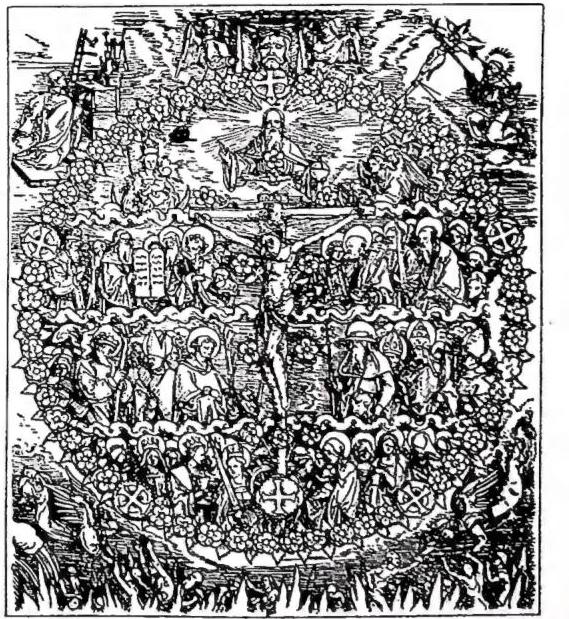
(courtesy of Dr. B. Degenhart)
ROSARIO — The R. German woodcut of 1515.
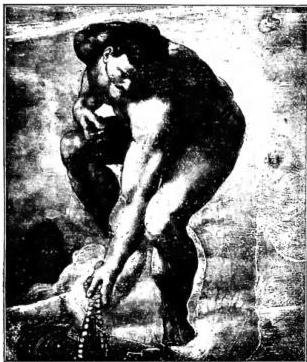
FESTA DEL R. - Sacratissimi Rosarii B. Mariae V., double of the second class, 7 October.
The liturgical feast of the R. derives its origin from the great victory of the Christian fleet over the Turks near Lepanto (7 October 1571), an event that made an enormous impression on all Christendom at the time (v. Pastor, VIII, p. 605 ff). S. Pio V attributed the victory to the intervention of Our Lady, invoked not only in Rome but throughout the Christian world, above all through the R. Thus, the following year, on 17 March 1572, he instituted in perpetuity the liturgical feast of the Commemoratio B. Mariae V. de Victoria, with a simple rite and the common formulary of the feasts of the Virgin Mary, without any reference to the R. The piety of the faithful then became accustomed to adding to the Litany of Loreto the invocation Auxilium Christianorum (Pastor, loc. cit.). With the bull Monet Apostolus (1 April 1573), Gregorio XIII instituted a proper liturgical feast of the R., to be celebrated on the first Sunday of October with a double rite; this feast was granted to the entire Dominican Order and to all churches and oratories where the Confraternity of the S. R. had been erected and which possessed a proper altar sub invocazione B. Mariae V. ROSARIO. He also promoted the solemn processions of the S. R. on the evening of the first Sunday of October (that of the church of S. Maria sopra Minerva in Rome was famous, and the popes often took part in it until around 1870), which were subsequently celebrated throughout the Catholic world.
On the first centenary of the victory of Lepanto, Queen Maria of Spain obtained from Clemente X, for all the countries of the Spanish Crown, the feast of the R. without the limitation imposed by Gregorio XIII (26 September 1671). The S. Congr. of Rites subsequently continued to grant this feast, without the aforesaid limitations, to many other dioceses. Finally, following the great victories over the Turks that succeeded one another from 1683 (the siege of Vienna) until the battle of Pietrovaradino (5 August 1716) and the abandonment of the siege of Cyprus (22 August 1716, the octave of the Assumption), Carlo VI obtained from Clemente XI (13 October of the same year) the extension of the feast of the R. to the entire Church, under the greater double rite. Benedetto XIII added to it (10 and 19 March 1725) the proper historical lessons for the second Nocturn. The intense revival of devotion to the R. in the time of Leone XIII also had its effects on the liturgy. The invocation Regina sacratissimi Rosarii was added to the Litany of Loreto (24 December 1883), the feast was raised to the double rite of the second class (11 September 1887), and in 1888 (5 August) the Office and proper Mass of the Dominicans, granted to them as early as 1834, were extended to the entire Church, while retaining the historical lessons of 1725.
In the general reorganization under the b. Pio X (decree of 23 October 1913), the movable feast of the R. was fixed on the historical date of 7 October.
The primitive feast of S. Maria de Victoria, on the other hand, survived in various proper calendars and in many places; that celebrated in the church of the same name in Rome was famous. There, on 8 November 1620, the ven. p. Domenico di Gesù e Maria, a Discalced Carmelite, deposited the image of Our Lady that he had carried with him into the battle of the White Mountain near Prague, in which the Catholic League achieved a decisive victory over the Calvinist and Protestant forces. The servant of God Bartolo Longo, founder of the shrine of Pompey, propagated devotion to the S. R., especially under the title of Our Lady «delle Vittorie», precisely in memory of so many glorious events involving Christian arms.
The Italian art of the late fifteenth century and the dawn of the sixteenth left few complete representations of the Madonna of the Rosary. From the late fifteenth century, one may recall the Madonna enthroned with the Child Jesus by Antonello da Messina, in the Museo civico of Messina, where a rosary is seen placed at the Virgin’s feet. Then, in 1539, Lorenzo Lotto produced a splendid depic-
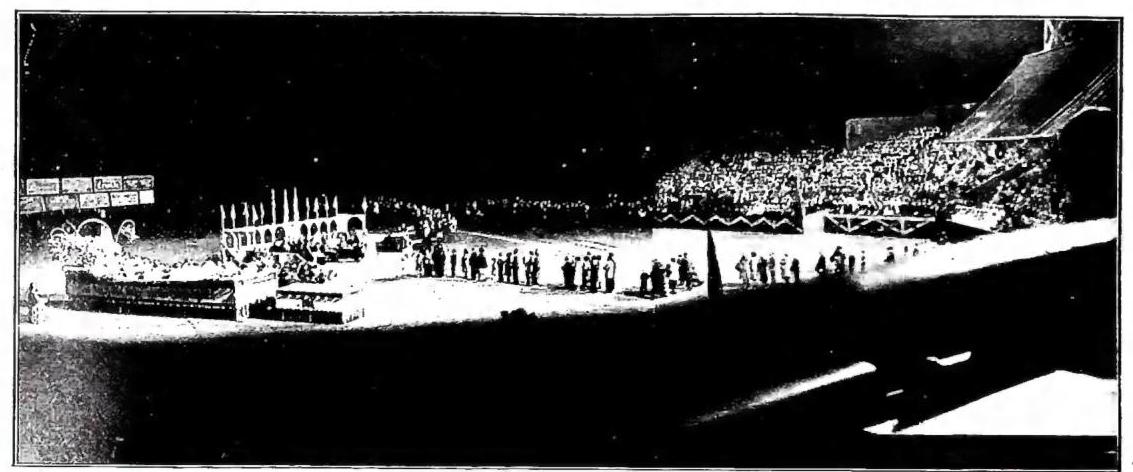
ROSARIO - The Crusade for the R. in the family - Victoria, British Columbia (Canada).
In the second half of the sixteenth century, altarpieces depicting the Madonna with the Child Jesus in her arms, giving the rosary to s. Domenico, became increasingly numerous; he is often accompanied by other Dominican saints and sometimes surrounded by humble faithful devoted to the rosary. Examples from this period include the altarpiece by Giorgio Vasari in S. Maria Novella in Florence; one by a follower of Tintoretto, now preserved in the Pinacoteca of Ferrara; and one painted at the time for the Confraternity of the R. in S. Pietro Martire at Murano, a work of the workshop of Paolo Veronese, now in the Accademia of Venice. Imbued with exquisite pathos is the Madonna del R., painted between 1588 and 1591 by Barocci for the church of S. Rocco at Senigallia; in it, s. Domenico alone on earth is seen kneeling in ecstasy before the Madonna giving the rosary, who, surrounded by angelic hierarchies, appears to him in heaven with the Child Jesus.
In the seventeenth century, several masterpieces took the Madonna del R. as their subject. Among them is the large painting by Caravaggio, painted in Naples in 1608 and now preserved in the Gallery of Vienna. In it, the Madonna appears to the family of devotees of the rosary, to whom s. Domenico, in the presence of s. Pietro Martire, is distributing crowns. A second masterpiece is the altarpiece of the oratory of the R. in Palermo, painted by Antonio van Dyck in Genoa in 1627. Dating from 1640 is the Madonna del R. in the church of S. Sabina in Rome, a most graceful work by Sassoferrato, in which, at the sides of the Virgin’s throne, ss. Domenico and Caterina da Siena are seen receiving the rosary from the Madonna and the Child Jesus. It should be noted that the venerated Madonna of Pompei comes very close to this iconographic conception of Sassoferrato.
In a splendid fresco decoration on the ceiling of the Jesuit church in Venice, G. B. Tiepolo left a grandiose eighteenth-century composition in which the Madonna with the Child Jesus is seen in heaven, s. Domenico below, and groups of faithful devoted to the rosary.
There have also occasionally been depictions of the Madonna with the Child Jesus in her arms, offering a rosary, without any other figure appearing in the painting. This simple model of the Madonna del R. implies that the crown is offered to all those gathered in prayer before the sacred image; an example of this simple model is provided by the modern painting by Niccolò Barabino in the church of the Immacolata in Genoa. - Vedi tav. LXXXIII.