
RITUALE ROMANO. – Liturgical book of the Latin Church for priests, containing the ceremonies for the administration of the Sacraments, for assisting the sick, and the formulas for the numerous blessings (v. LIBRI LITURGICI).
I. HISTORICAL FRAMEWORK
It is only from the sixth or seventh century that the existence of specific booklets for ritual, sacramentary, and sacramental purposes can be ascertained. The Fourth Council of Toledo (633) ordered in canon 26 (Mansi, X, 627) that the bishop provide every priest whom he sent to the(courtesy of Fr. Monarchino, S. J., archivist of the Pontifical Gregorian University)
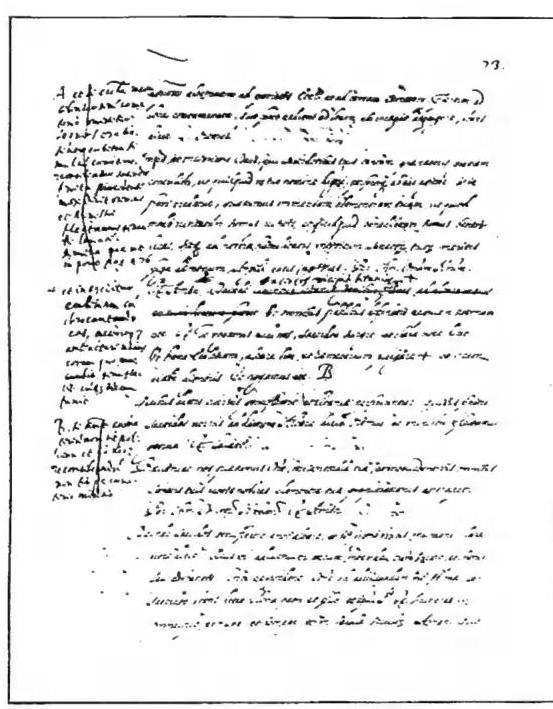
ROMAN RITUAL - Outline of the R. Romanum published by order of Paul V, Supreme Pontiff, with autograph annotations by s. Roberto Bellarmino. The chapter reproduced here contains the «Ritus reconciliandi ecclesiam violatam, si nondum erat ab episcopo conscrata» - Rome, Archive of the Pontifical Gregorian University, cod. 800, f. 73f.
The oldest R. preserved, so far as is known, is the one written for the use of the Canons Regular of S. Agostino, in the monastery of Sankt Florian (Upper Austria), and still existing there (CFI, XI, 467), a parchment booklet that begins with the blessing of candles on the feast of the Purification. From the 12th century, reliable information has been preserved concerning R. books in use among various churches. The Dominican Anselmo di Ermland, first bishop of Varmia (1250-77), brought a Dominican R. into the diocese, adapting it for the secular clergy: this was the first official diocesan R. From this period onward, diocesan and provincial synods also began to concern themselves with the R., especially in order to secure a certain uniformity within the diocese or ecclesiastical province and to prevent the insertion of superstitious and suspect texts and formulas. At the provincial Council of Salzburg (14 April 1465), under Archbishop Sigismondo di Volkerndorf, all the suffragans pressed for the compilation of a common R.
Among the first printed books, R. books are frequently found, and from then on the editions were supervised by the diocesan authorities. Of considerable importance was the Sacerdotale seu Liber sacerdotalis collectus (Rome 1523), published by the Dominican A. Castellani, whose compilation had interested Leone X; Pio IV, later, after the author’s death, had the work examined and corrected. It went through numerous editions, including, for example, that of 1506 with the title: Sacerdotale ad consuetudinem S. R. Ecclesiae aliarumque Ecclesiarum. Following the practice of such books, Castellani had introduced into it, in addition to strictly liturgical-ritual texts, many pastoral treatises based on the writings of the Fathers, scholastics, and canonists; in later editions, the canons of the Council of Trent were also introduced. Thus a true ritual-pastoral compendium had been formed.
The Council of Trent, in treating the Sacraments in general in session VII, condemned all personal arbitrariness regarding the rites; however, in session XXIV (De reformatione matrimonii, cap. 1), it also defended particular rites and ceremonies that were reasonable. This provision was subsequently incorporated into, and still remains in, the R. r. (ed. 1952, tit. VIII [olim VII], cap. 2, 6). After the Council of Trent, the Lateran canon Franc. Samarino prepared and published a new Sacerdotale sive sacerdotum thesaurus ad consuetudinem S. R. E. aliarumque Ecclesiarum collectus iuxta Tridentini Concilii sanctiones. Venice 1579, of which A. Rocca (v.) prepared the three editions of 1583, 1587, and 1597. Meanwhile, Cardinal A. Santoro, encouraged by Gregorio XIII and Gregorio XIV, had begun work on a new R.; the work was already in print when the author died in 1602, and publication was interrupted. Twenty-six copies exist with an added title page (v. B. Löwenberg, Das R. des Kard. Jul. Ant. Sanctorius. Ein Beitrage zur Entstehungsgeschichte des R. R., Monaco 1937). The printed work comprises 712 pages and is a veritable mine of rites and treatises, collected from a remarkably large number of Italian and foreign sources. Indeed, Santori had certain rites tested for several years in order to verify their pastoral efficacy. Meanwhile, various excerpts from his Sacerdotale were printed, and these enjoyed enormous
| 20 Rituale Wesprimiens. | |||
|---|---|---|---|
| SACERDOS. N. Credin in Spirium Sanam Ecclesiam Catholicam: San- ctorum Communionem, re- millionem peccatorum, car- nis refurrectionem, vitam x- ternam? Patrius. Credo. | SACERDOS. N. Hifz-e Szent Leleben, ha- bengere hierf- teny Anyaszem egyhaszem, jzva- rebach egyef- get, bünnbach batzamatyat, tefbach fektu- nadasat, avob ekret? Patrius. Hifzch. | SACERDOS. N. Glasheft du in dem Heiligen Geist, die alge- meine Christli- che Kirchen, Ge- münchalt der Heiligen, Verge- bung der Sünden Auferstehung des Fleisches, und eine wiges Leben? Patrium. Ich glaube. | SACERDOS. N. Wersfati m Dacha Sunt- ho, Swatu Cyr- heuwerscheenu, Swatych Obor- dni, Hrechum ndmitfeni, te- la wahrefeni, y Zivot weczny? Patrius. Wersm. |
| Subinde exprezzo nomine baptizandi, Sacerdos dicit: | |||
| SACERDOS. N. Vis Bapt- zari? Refp. Patrin. Volo. | SACERDOS. N. Ahrafz-e he- refzelteteni? Refp. Patrin. Aharoh. | SACERDOS. N. Willt du ge- tauffet werden? Refp. Patrin. Ja, ich will. | SACERDOS. N. Chesfati fe hefti? Refp. Patrin. Cheem. |
| Tunc Patrino, vel Marina, vel usroque (fi ambo admit- tantur) infantem tenente, Sacerdos vaculo, feu urceolo acci- pit squam Baptismalem, & de ex ter fundis super capus infan- tis in modum Crucis, & fiumi verba proferens, femel sanam, dithiafe, & salente dicit: N. Ego te baptizo in Nomine Patris †, fundat primo; & Filli ‡, fundat fecundo; & Spiritus ‡ Sancti, fundat terzo. Si |
(Int. Enc. Cstl.)
RITUALE ROMANO - R. Wesprimiens seu formula agendarum in administratione Sacramentorum, ac cæteris Ecclesiae Publicis Functionibus, Iussu et authoritate, Josephi Bajrath de Pézzah, episcopi Wesprimiensis, Wesprimii, typis Michaelis Semmer, 1801, p. 20; part of the rite of Baptism in Latin, Hungarian, German, and Croatian - Vatican City, copy in the Archives of the S. Congregation of Rites.
diffusion, such as, for example, the Ordo baptizandi iuxta ritum S. R. Eccl., 1575, with numerous editions up to 1623.
II. THE « R. r. ». - Paul V (1605–21) planned to complete the collection of the official Roman liturgical books with the edition of the R.; for this purpose, in 1612, he established a commission of cardinals of the S. Congregation of Rites, which took as its basis the work of Cardinal Santori, distributed to the members of the Commission itself (v. B. Löwenberg, Die Erstausgabe des R. R. von 1614, in Zeitschr. f. hath. Theol., 66 [1942], 141–47; a valuable study, which also indicates, on the basis of a ms. from the Barberini collection of the Vatican Library [Barb. lat. 1022, ff. 56–68], the sources used for the definitive compilation of the R. R. The Commission’s concern to seek the most ancient and genuinely Roman rites can be ascertained; cf. also G. Mercati, Ancora sul R. del card. Santori, in Rass. gregoriana, 5 [1906], 443–46). Finally, with a bull dated 17 June 1614, the first official edition of the R. r. appeared; but, unlike the other official Roman liturgical books, it was not prescribed, but merely recommended. With the first editions (v. BIBLICA), the R. r., as was to be expected, spread rapidly throughout the Catholic world. But precisely because its use had merely been recommended, particular ritual books continued to circulate everywhere, sometimes adapted in various ways to the R. r.; and even when the Ordinaries introduced the R. r. into their dioceses, the particular R. often continued to be used, at least in part. Benedict XIV also had a new and revised edition of the R. r. prepared, with additions, which he approved with the brief Quam ardeuti studio of 25 March 1752. Finally, Leo XIII published its first « typical » edition in 1884. Another appeared under Bl. Pius X, approved by the S. Congr. of Rites on 11 June 1913 (v. L. Barin, Le mutazioni al R. r. secondo l'edizione tipica, Rome–Rovigo 1915).
The publication of the CIC in 1917 made a complete revision of the R. r. necessary; this appeared with the approval of the S. Congr. of Rites on 10 June (v. also AAS, 17 [1925], p. 326), but not as a « typical » edition (v. anon., Il nuovo R., in Il Monitore ecclesiastico, 37 [1925], p. 293 ff; Fr. Schubert, Das neue R. r., in Liturgische Zeitschr., 2 [1930], pp. 161–74; and above all Fr. Battistini, De novo R. R. ed. Vaticana, in Eph. lit., 38 [1925], pp. 221, 246, 287, 308, 341, 387 ff). Finally, in 1952, with the approval of the S. Congr. of Rites (25 January), the new typical edition appeared, with its arrangement completely reworked, some rubrical modifications, and the necessary additions (cf. M. Brandys - I. Pizzoni, in Ephemerides lit., 66 [1952], pp. 220–24; H. Schmidt, Editio typica 1952 Ritualis Romani, in Periodica de re morali, canonica, liturgica, 41 [1952], pp. 157–82; the author makes interesting observations there).
III. THE CURRENT « R. r. »: OBLIGATION. - The R. r., as appears from the papal document of Paul V that remains at its head, was merely recommended for use by all those to whom it pertains; but later the S. Congr. of Rites declared it obligatory for all parish functions (Decr. auth., 1642, ad 7); moreover, the Ordinary may oblige all parish priests and all other priests ad Ritualis Romani praescripta omnia servanda, notwithstanding any contrary custom, even immemorial (Decr. auth., 3276, ad 6); on the other hand, the S. Congregation established that licet ubique adhiberi et in quibuscumque functionibus the R. r., even when an approved diocesan R. exists that differs from it (Decr. auth., 3792 dub. IX). By now, however, all the dioceses have adopted the R. r., and, insofar as they still preserve their own rites and functions, they submit them to the approval of the S. Congregation of Rites. Practically, therefore, one may say that the R. r. in its substance is in force throughout the Roman Catholic world, and that the S. Congregation of Rites continues to approve the particular rites existing in ancient dioceses, faithful to the desire of the Council of Trent that those rites and ceremonies worthy of preservation should indeed be retained.
IV. « R. », PARTICULAR NON-ROMAN ONES AND THE QUESTION OF LANGUAGE. - No systematic study exists concerning the ancient particular R., whether manuscript or printed. Zaccaria (v. BIBLICA) published a list of printed works for his
From the earliest printed R. onward, examples are found of the use of the vernacular, to a greater or lesser extent, up to a complete or almost complete translation of II. The R. r., faithful to the tradition and spirit of the Church of Rome, contains very few references to the vernacular; thus, in the general instruction preceding the administration of the Sacraments (tit. I, no. 10), and then repeatedly in the particular instructions, the priest is admonished to explain beforehand what he is about to do, so that the faithful may follow it attentively. When the form of Baptism is discussed (tit. II, chap. 1, no. 9), it is explicitly prescribed: Latinus presbyter latina forma semper utatur; the apostolic delegation, however, by which a priest may confer Holy Confirmation, is to be read lingua vernacula, alta et intelligibili voce; the appropriate admonition to those being confirmed and to their sponsors is likewise to be given in the vernacular. In the Sacrament of Matrimony, the questions addressed to the spouses are, by explicit command of the rubric, to be put vulgari sermone. In 1575, therefore, even before the R. r., the Libellus agendorum of the Archdiocese of Salzburg appeared, containing a considerable number of texts in the vernacular (the questions in Baptism, prayers for the care of the sick, Matrimony, etc., blessings) and an appendix of popular songs in German. The Sacerdotale Basileense of 1595, for the Diocese of Basel, contains the relevant texts in German and French; in the Agenda Colonensis Ecclesiae (Cologne 1614), besides the diocese’s proper calendar and, in the ritual section, the questions and prayers in the vernacular, there is also a complete short catechism in German.
As soon as the R. r. was published, translations into the vernacular languages also began: in Rome itself in 1621; into Albanian in 1640, into Croatian, and into French (Lyons); in 1646 another appeared in Paris; an Italian version was published at Lucca in 1724. Much more widespread were the abridged editions, that is, extracts from the R. r. for various circumstances: Baptismale, Poenitentiale, Exsequiale, Processionale, etc., often also in vernacular versions, for example, Le petit Rituel romain (Avignon, undated, seventeenth century) and many similar editions.
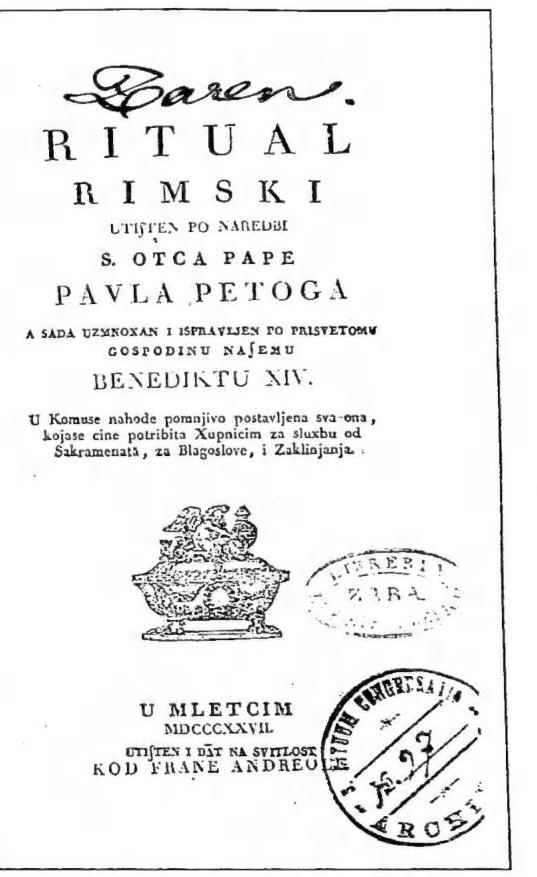
The R. of Alet achieved great renown: Rituel romain... à l'usage du diocèse d'Alot, in Languedoc, produced by the Jansenist bishop N. Pavillon (1597–1677), in Latin but with many texts in the vernacular; erroneous Jansenist infiltrations are found in the rubrics and explanations, to such an extent that Clement IX placed it on the Index (1668; V. Pastor, XIV, I, pp. 462 ff., p. 483); a similar fate befell in 1725 the R. r. published with additions by P. Lucatelli at Bergamo. Meanwhile, the diocesan editions of proper Rites, more or less dependent on the R. r., and employing the vernacular to varying degrees, continued to appear without hindrance, such as the R. sacramentorum ac aliarum Ecclesiae caerimoniarum (Braunsberg, 1733) for the Diocese of Warmia, with Polish and German texts; the already mentioned one of Basel, now bearing the title Rituale Basiliense iuxta R. R. (1700, 1739, 1788); and those of the Josephine dioceses, that is, those erected by Joseph II in Austria, R. R. usibus dioecesis S. Hippolyti accomodatum (St. Pölten 1787), with Latin and vernacular text, and many others of the same kind. Particularly noteworthy and instructive with regard to the question and the difficulties in regions of mixed languages is the R. Romanum Zagabriense (Zagreb 1796), which often presents the texts in five columns: Latin, Croatian, Slovenian, Hungarian, and German; to this must be added the Ritual Rimski (Venice 1827). Of the same type is the R. Westprimiense (Hungary 1801), with text in four columns: Latin, Hungarian, German, and Slovak, and that of Strigonia (1859), with the same title and the same arrangement.
In 1875 a Rituel romain-lyonnais appeared with parallel Latin and vernacular texts; at Bahia, Brazil, in 1869, an R. in Latin and Portuguese; while polyglot Rites continued to be published throughout Austria, Hungary, Poland, and Alsace. In 1906 an R. in Danish appeared for Denmark and Iceland. An R. published in Barcelona (1912) contains, in vol. II (1914), several texts in Spanish. With the explicit approval of the S. Congr. of Rites, an R. R... Ecclesiae Poloniae adaptatum (Katowice) appeared in 1927, with texts in Latin, Polish, German, French, Lithuanian, and Russian. An edition entirely in Croatian received the approval of the S. Congr. of Rites in 1930, for the use of the Catholics of Yugoslavia. In 1932 the same S. Congregation permitted the Agenda provinciae ecclesiasticae Moraviae (Olomouc), in which there is also a special decree concerning usum linguae vulgaris in liturgia in territorio ditionis Caecocleucacae, dated 21 May 1920. Again, in 1936, an R. omnium latini ritus dioecesium Slovacchiae, ad instar Appendicis R. R. was published at Scepusio (Slovakia), with texts in Latin, Slovak, German, and Hungarian. In 1950 an R. R... cum Appendice Toletana in lingua spagnola appeared at Toledo. Above all, however, the S. Congr. of Propaganda has been very generous in granting the use of the vernacular in ritual books for mission regions; thus India, Indochina, Japan, New Guinea, and Africa have their own R. in the vernacular for liturgical use.
Important is the R. parvum ad usum dioecesium Gallicae linguae (Tours 1948), approved by the S. Congr. of Rites on 28 November 1947 and making extensive use of the French language, for whose use general norms are also provided. The very recent Collectio rituum ad instar appendicis Ritualis Romani pro omnibus Germaniae dioecesibus (Regensburg 1950) is well known; it was approved by the S. Congr. of Rites on 21 March 1950 and is a truly excellent work, prepared over many years under the direction of the German episcopate, taking into account the particular usages still in force and making extensive use of the vernacular. - See pl. LV.
mente tutti gli autori che si occupano della materia. Fra i moderni, lo studioso più addentro nella materia è A. Franz, il quale, nell'introd. all'ed. del R. di St. Florian (Friburgo 1904), premette la più completa storia del R., mentre nel grandioso studio Die kirchl. Benediktionen im Mittelalt. (s. voll., Friburgo 1909), presenta nell'introd. (pp. xxiv-xxix), un elenco di R. manoser, e (pp. xxx-xxxiv) uno di R. stampati, che servono di base all'opera. Sono gli elenchi più completi, che esistano finora. Tra gli altri autori, quelli che apportano qualche cosa di proprio sono: H. Baruffaldo, Ad R. R. Commentaria, 1ª ed., Venezia 1731; in a voll., Firenze 1847; J. Catalani, R. R. Benedicti Papae XIV iuxta editum et auctum perpetuis comment. exornatum, 1ª ed., Roma 1757; 2ª ed., Padova 1760 (commentario più autorevole e scientifico); A. Ebner, Quellen u. Forschungen zur Gesch. u. Kunstgesch. des Missale R. im Mittelalter, Tubinga 1896; J. Braun, Sobramente, u. Sobramentalien, Ratisbona 1925 (una specie di commento alla parte sacramentaria); P. Parsch, Das Buch des Lebens; Laienrituale (vers. completa commentata del R. R. per i laici); L. Eisenhofer, Handbuch der kath. Liturgik, I, Friburgo 1932, pp. 100-103; Ph. Oppenheim, Tract. de iure liturg. parte 3ª, De libris liturg., Torino 1940, pp. 66-69, 114-15 e passim; id., Introd. histor. in literat. liturg., 2ª ed., Torino 1945; M. Righetti, Man. di stor. liturg., I, 2ª ed., Milano 1950, pp. 287-89; L. Eisenhofer - J. Lechner, Grundriss der Liturgik des rom. Ritus, 5ª ed., Friburgo 1950, pp. 23-24; E. Vykoukal, s. V. in LThK, VIII, pp. 911-13; Moroni, s. v., LVIII, coll. 56-57; A. Fortescue, Ritual, in Cath. Enc., XIII, 88-90; A. Bertholst, Die Ritualbücher, in Die Religion in Gesch. u. Gegenw. IV, tratta dei libri rituali antichi non cristiani. Giuseppe Low