
ZACCARIA, FRANCESCO ANTONIO. - Originally, according to some, Zaccheria, a distinguished scholar and historian, born in Venice on March 27, 1714, died in Rome on Oct. 10, 1795.
His father Tancredi, an esteemed jurist originally from Poppi in Casentino, and his mother, Teresa Ferretti, refined and more Venetian, gave this their only son an educa-
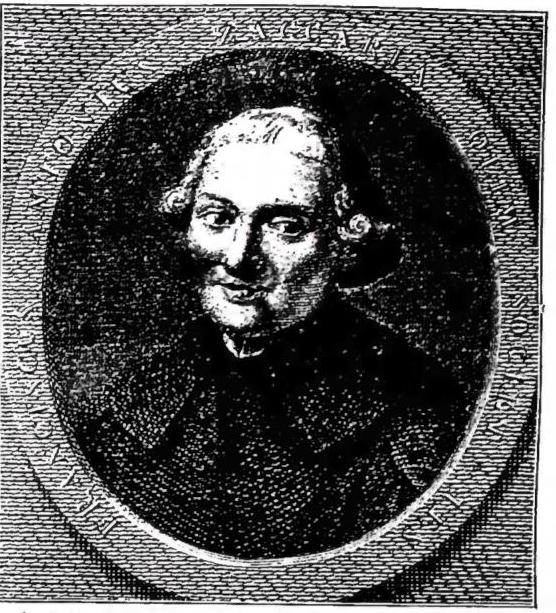
Having completed in Florence in 1742 the so-called third probation, or final trial of the Jesuits, he was appointed prefect of the Library of the Roman College, which was joined to the famous Casanatense and Angelica. However, he did not begin to exercise the office, having been replaced by his confrère Pietro Lazzari, who held it for thirty years. Since his rare oratorical qualities were well known, he was assigned to preaching. This displeased Card. Querini not a little, who considered him lost to the high historical studies for which he judged him born; nevertheless Z. reassured him, telling him that the new assignment offered him the opportunity to visit libraries and archives, and thus illustrate their many unexplored treasures.
In 1742 in the diocese of Fermo he began preaching and continued it for three decades, until 1773, in northern and central Italy. His eloquence may be called Segnerian for the robustness of its persuasion, but it is inferior to it in the elegance of language and overall delivery.
In the first six lustra after his priesthood, the most fruitful of his life, having been transferred in 1751 from the Austrian province of his Order to that of Rome, Francesco III, Duke of Modena, called him in 1754 to succeed Muratori,
(photo Musco di Roma)
Among the works written in the thirty-year period from 1742 to 1773, the following should be remembered: Bibliotheca Pistoriensis descripta (Turin 1742), followed by the illustration of the manuscripts of the same Library (Milan 1749); the Excursus litterarii per Italiam ab a. 1742 ad a. 1752 (Venice 1754), the Iter litterarium per Italiam ab a. 1753 ad a. 1757 (ibid. 1762); the Collectio anecdotorum medii aevi (1755). In addition to the Bibliotheca Pistoriensis and the Collectio of anecdotes, the Acta Sanctorum Bollandiana ... vindicata were published in Antwerp in 1755, which were preceded by a novelty for Italians, namely the 14 volumes of the Storia letteraria d'Italia (ibid. 1750-59). In these volumes Z. undertook to review books published in Italy from Sept. 1748 to 1749, also reporting on what was happening in the field of letters in his day. He then continued the work with the Annali letterari dal 1762 al 1764, providing a fine example of the manner to be maintained in reviews, abstaining from insults and abuse—such as the Florentine Giovanni Lami used against him—although Z. also did not shy away at times from treating his adversaries with a touch of polite humor.
To the same period also belong the Istituzioni di antiquaria-lapidaria e numismatica, the Thesaurus theologicus (1762-63), the Antifebronia, namely the polemical apology for the primacy of the Pope, an unanswerable refutation of Johann Nikolaus von Hontheim, a work published in Pesaro in 1767, and then, with the Antifebronius vindicatus, in Cesena in 1771-72.
A fatal blow struck Z. on July 21, 1773, with the suppression of the Society of Jesus; but it did not succeed in extinguishing his prodigious activity.
Indeed, dating from the following two decades are the Storia polemica del celibato sacro (Rome 1774), the Bibliotheca selecta historiae ecclesiasticae (ibid. 1776), the Storia polemica della proibizione dei libri (ibid. 1777), the Bibliotheca ritualis (ibid. 1776-81). To these must be added the De rebus ad historiam atque antiquitates Ecclesiae pertinentibus (Foligno 1781) and a whole host of minor writings, or dissertations, in Latin and in the vernacular that shed light on obscure points in the history of the Church and inexorably unmasked Jansenists and Regalists. He was supported in his extreme labors by Pius VI who, like Benedict XIV, always held him in the highest esteem and defended him amidst the contradictions and calumnies of the envious. Indeed, Pius VI in 1775 freed him from the prohibition against leaving Rome, appointed him professor of eloquence at the Sapienza, and director of sacred history studies at the Academy of Noble Ecclesiastics; he assigned him a large pension that gave him the means to live without hardship and to alleviate the poverty of his former confrères.
Pietro Tacchi-Venturi