
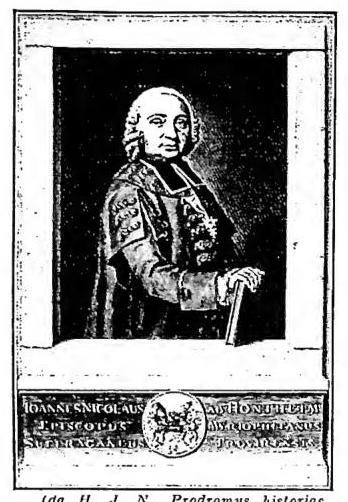
HONTHEIM, JOHANN NIKOLAUS von. — Bishop and canonist, better known under the pseudonym of Febronius; he was the initiator of the movement that took from him the name of Febronianism. Born at Trier on 22 January 1701, he died at Montquintin (Luxembourg) on 2 September 1790. He studied theology and canon law at Trier, Louvain (where the canonist Van Espen was his teacher), and Leiden. After holding various offices, in 1748 he was appointed coadjutor to the archbishop and vicar general of Trier.
Professor and later pro-chancellor of the University, he devoted himself to diligent historical research: in 1750 he published the monumental Historia Trevirensis diplomatica et pragmatica, completed seven years later by a supplement (Prodromus). These studies prepared him for his major work, on which he labored for 20 years and which was published in Frankfurt in 1763 under the cloak of anonymity: Iustini Febronii iurisconsulti de statu ecclesiae deque legitima potestate Romani pontificis liber singularis ad reuniendos dissidentes in religione constitutus. The purpose of the book, proclaimed in its title, is to promote the return of separated Christians to the unity of the Church; in reality, however, its content is anything but irenic, revealing the intention of transforming the constitution of the Church by emptying the authority of the Roman pontiff as its head. Its character is already disclosed in the preface. It is, in fact, an appeal to the pope himself, and then to princes, bishops, theologians, and canonists, so that limits might be placed on papal power in the Church, altered by the “system of ecclesiastical monarchy.” For this purpose, in the book’s nine lengthy chapters, H. outlines a genuine treatise on public ecclesiastical law, entirely directed against the papacy. The institution of the primacy is not denied, but it is interpreted in such a way as to demonstrate that Christ gave the primacy not to St. Peter, but to all the Apostles and therefore to the Church. The pope, consequently, possesses true authority in the Church—not merely a primacy of honor, but neither a primacy of jurisdiction (an expression strongly contested by H.): he is the “center of the unity of the Church,” ensures the observance of ecclesiastical legislation (“he speaks of the canons”), and exercises limited powers as judge and teacher of the Church. These, according to H., would be the “essential rights of the primacy,” and such, he held, was the constitution of the Church until the ninth century, that is, until the false decretals of Isidore (magnus ille peccator), which supposedly profoundly altered its nature by granting the pope new rights in usurpation of the rights of the bishops. Among these he places the so-called major causes (which concern bishops), ecclesiastical laws, and the supreme authority of ecumenical councils. The “ecclesiastical sys-
The book immediately enjoyed great success, especially in the German countries (German, French, Italian, and Portuguese translations were produced), because it corresponded to the spirit of the age, encouraging the struggle against papal authority conducted by most Catholic sovereigns in order to establish the supremacy of the State over the Church (v. REGALISMO; SEPARATISMO); moreover, it seemed to correspond to the contemporary works of political writers, who sought to regulate and transform the constitution of civil society. Brilliant in exposition and rich in historical erudition, the book contains inconsistencies and serious errors, nor is it original, since it depends on the Gallicans and above all on Van Espen. Beneath the appearance of historical-juridical research, it reveals its character as a great anti-papal pamphlet, no different in this respect from other works of the anti-papal polemic of the eighteenth century (for example, the writings of Giannone). The work was immediately placed on the Index (1764) and received many Catholic refutations; the most important was that of Fr. A. M. Zaccaria (Antifebronia, 2 vols., Pesaro 1776). St. Alfonso de’ Liguori also wrote a polemical pamphlet in 1768 (Vindiciae pro suprema Romani pontificis potestate adversus I. Febronium).
H. maintained his errors in the new editions of the book that appeared from 1765 to 1777; later he submitted to the Holy See and also wrote (1781) a refutation of his work. However, even his retractations are not fully orthodox, and his sincerity is doubted. His doctrine continued to exert influence, even in the first half of the nineteenth century (in Italy his ideas are represented by Pietro Tamburini, in the work Vera idea della S. Sede). The First Vatican Council, by solemnly defining the primacy of jurisdiction of the Roman pontiff (Denz-U, 1826–31), put an end to all these errors.