
PESARO, DIOCESI di. — Capital of the province of the same name and a suffragan diocese of Urbino.
It extends over 287 sq. km., with a population of 77,700, of whom 77,500 are Catholics. It has 44 parishes served by 80 diocesan priests and 37 religious priests, 1 seminary, 7 male and 15 female religious communities (Ann. Pont., 1952, p. 311).
The earliest Christian records of P. date from the 4th century: a Christian inscription belongs to this period (CIL, XI, II, 6473-75); in all probability the episcopal see also dates from the same period, although only an uncontrolled tradition has assigned to the city a 4th-century bishop named Heraclianus, whose see is unknown. The first bishop whose existence is certain, Germanus, belongs to the 5th century (Jaffé-Wattenbach, 739). The account of St. Terentius (BHL, 8007), who settled in P. from Pannonia, where he is said to have suffered martyrdom on 24 September 247 under Decius and to have been buried in the Cathedral, which was supposedly dedicated to him immediately afterward, is entirely legendary. The martyr Terentius, confused in the three figures of the martyrs of Luni (24 September), P. (24 September), and Todi (27 September), who constitute one and the same person, though whose history nevertheless remains unknown, became much later the titular saint of the cathedral of P. and was regarded as the city’s bishop (9th century). Some indications would suggest that the primitive cathedral stood outside the walls, on the Flaminia, at the site where the monastery of S. Decenzio was later built; it belonged to the Classensian monks in the 12th century, and today the suburban church of the same name (of the cemetery) stands there. A passio of the martyrs Decentius and Germanus (BHL, 2115) seems to have been embroidered around the historical figure of Bishop Germanus, who was certainly venerated in that monastic church from 1256 and had been buried there—as bishops, according to ancient custom, were buried near their respective cathedral churches—from antiquity. In any event, the document has no value for what it relates concerning the two figures presented as martyrs at P. during the persecution of Galerius (306-11). In the later succession of bishops are found: Felix, to whom Pope Gregory the Great addressed a letter (596; Epist. 6, 44, in MGH, Epist., ed. P. Ewald and L. M. Hart-
P. was a city of the Pentapolis and formed part of the Papal States at the time of their initial establishment (754-56). As a result of the continual struggles between the emperors of the West and the East and the popes, P. first broke away under the rule of a count and later under a communal government (11th-12th centuries). It was subjected to the lordship of the Malatesta, who held it as vicars of the Holy See. The Sforza then came to power: Alessandro received its investiture from Nicholas V and was lord of the city for a long period (1447-73). His nephew Giovanni married Lucrezia Borgia, who made her solemn entry into P. on 8 June 1494. The city was occupied by Duke Valentino (28 October 1500), who established the lordship of the Borgias there (1500-1503); it then passed to Fr. M. Della Rovere, who was invested with it by Julius II through a bull of 20 February 1513. Amid wars and devastation, the lordship of the Medici under Leo X (1513-21) followed, and then again that of the Della Rovere, with Fr. Maria, who received the investiture through a bull dated 25 March 1523.
When Fr. Maria II died on 28 April 1631, the city and principality returned to the Holy See.
Monasteries. — The most important was S. Tommaso in Foglia (iuxta Aposellam), Benedictine, known because Pope Clement II died there on 9 October 1047. Very little remains of the Abbey of S. Tommaso, today Apsella (Montelabate): the building, reduced to a farm colony, preserves only a few monumental elements of the Romanesque structure, some perhaps dating from the 9th century (A. degli Abati-Olivieri, Memorie della Badia di S. Tommaso in Foglia, Pesaro 1778).
Monuments. — Cathedral: dedicated to S. Maria (privilege of Celestine III, 12 May 1197, in the Chapter Archives), it was under the protection of the Holy See. A complete restoration was carried out in 1865 by Bishop Clemente Fares: the apse was enlarged, the roof renewed, the dome constructed, and the new chapel of S. Terenzio built (architect Carducci); the church was reconsecrated by C. Bonaiuti in 1903.
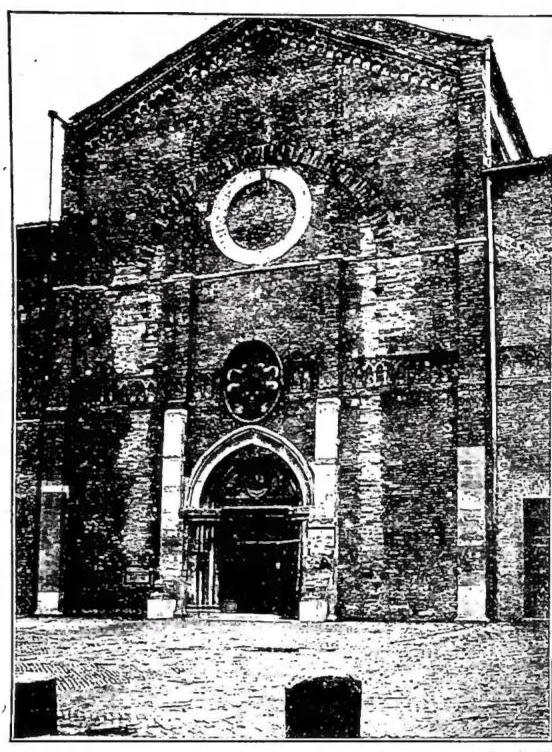
S. Decenzio: the hypothesis of an early Christian basilica does not have sufficient conclusive evidence in its favor. The building is Romanesque but has undergone radical restorations; the work, executed with a certain classical dignity, may be assigned to the 9th century. Of the other churches, of which P. had many, the most important are: S. Francesco (now dei Servi), built at the expense of Pandolfo Malatesta; S. Giovanni, a structure of grandiose lines, the work of the architects Gerolamo and Bartolomeo Genga, begun in 1543 at the wish of Duke Guidobaldo II; S. Ubaldo, built in fulfillment of a vow by Duke Fr. Maria II della Rovere for the birth of his son Federico Ubaldo (16 May 1605). Other churches belong to the Baroque period: Nome di Dio, S. Maria Maddalena, originally from the 13th century and renewed according to a design by Vanvitelli (1700-73), S. Rocco, S. Lucia, etc.
The Cathedral Treasury contains an ivory pyx with figures carved around it: the resurrection of Jairus’s daughter and the healing of the blind man; it is assigned to the 6th century. The bishop’s palace preserves the so-called Christian nymphaeum, from Ginestreto, dating from the 7th century. The Civic Museum, housed in the Government Palace (the 15th-century Ducal Palace), contains a rich collection of panels (a group of early masters, etc.), an altarpiece, Incoronazione di Maria by G. Bellini (1467), various works by painters from Pesaro: Simone Cantarini (1612-48), G. A. Lazzarini (1710-1801), and a considerable collection of ceramics, including examples of local production. The small Mosca Museum, in the building of the same name, should also be mentioned; it was donated to the Municipality in 1882 by Marchioness Vittoria Toschi-Mosca. The Library, founded by Annibale degli Abati Olivieri (1708-89), possesses a notable quantity of manuscript records and compilations that partly make up for the loss of the archival material; it has an annexed museum. The archival material of the Curia has perished; the Chapter Archives preserve several parchments from the 11th-12th centuries.