
MONTEFELTRO, DIOCESE of. — Suffragan of Urbino; since 1563 the episcopal residence has been in Pennabilli, province of Pesaro.
The diocese covers 800 sq. km., with a population of 70,000 inhabitants, all Catholics, distributed among 123 parishes served by 125 diocesan priests and 32 religious priests; it has one seminary, 10 male and 20 female religious communities (1949).
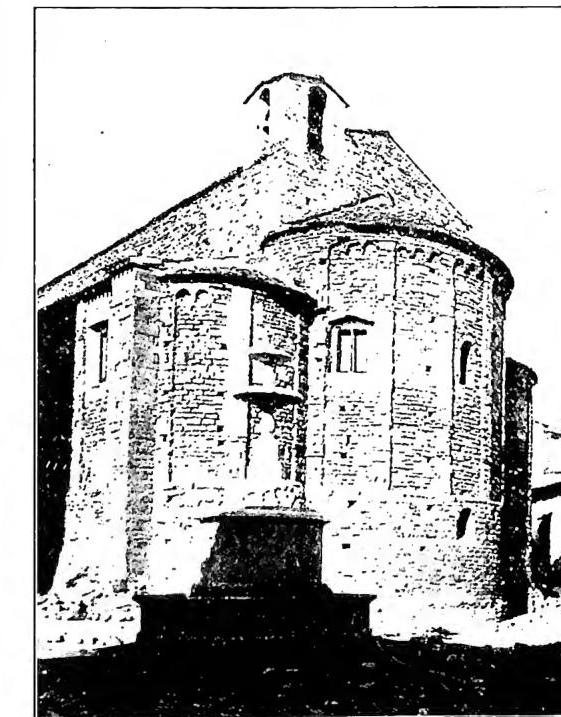
(from Corrado Ricci, II M., Bologna 1884, pl. II)
part of the Marches, Romagna, and the Republic of S. Marino; more accurately, it corresponds to the territory of the present diocese, properly called Feretrana.
According to the legendary life of ss. Leo and Marino, the former is said to have founded a church and monastery in M., and the latter on Monte Titano. Although it is not easy to date the origin of these two monastery-shrines to the 4th century, the foundation on Monte Titano (S. Marino) certainly dates from the 5th century (Eugippius, Vita Severini, 1, MGH, Auct. antip., I, 1), whereas the earliest records of the monastery of s. Leo date from the 9th century. The latter was made to appear a bishop in the Vita of s. Mercuriale (BHL, 5932), a late document of the 11th century: in truth, the first certain bishops of M. are no earlier than the 9th century. Made suffragans of Ravenna by Pope Gregory V in 997 (Jaffé-Wattenbach, 3878), they resided at S. Leo, where they had the Cathedral dedicated to the same saint erected. Later the residence was transferred to other centers, as is shown by various episcopal charters: Valle S. Anastasio (S. Anastasius de Valle) and Talamello; here they remained for more than a century, and Bishop Giovanni Sclani (1413–44) built a residence and an artistic oratory, frescoed by Antonio da Ferrara (15th century) and still preserved (O. F. Tencaioli, La cella dipinta da A. da Ferrara a Talamello nel M., in Urbinum, 2 [1928], pp. 171–84). During the episcopate of G. F. Sormani (1565–1601), Gregory XIII, by the bull Aequum reputamus of 23 May 1572, transferred the see to Pennabilli, raising the collegiate church of S. Bartolomeo to cathedral status and uniting it in perpetuity with the ancient Cathedral of S. Leo. Sormani deserves mention for the great activity he undertook in obedience to the decrees of the Council of Trent, for the diocesan synods celebrated at Pennabilli, S. Marino, Macerata Feltria, and in the abbey of Valle S. Anastasio, and for founding the Seminary. A Franciscan from this region, Matteo da Bascio (1495–1537), gave the first impulse to the religious reform of the Capuchins.
At the first establishment of the Papal States, the castellum S. Marini belonged to it (756); in the 11th century the emperors recognized M. as belonging to the Roman Church. The subsequent political history of the region is closely connected with that of the distinguished family that took its name from it: the Montefeltro. Descended from a branch of the more ancient Carpegna family, the counts of M., already independent in the 12th century, occupied S. Leo and Urbino in the 13th century. In the struggles between the Guelphs and Ghibellines, they sided with the Ghibellines (cf. Dante, Purgatorio, V, 85–129). Having made peace with the Church, they were recognized as lords in the reorganization of the Papal States carried out by Albornoz (1355), and the region of M. retained a parliament and administrative autonomy. In the 15th century the lordship acquired great splendor through the work of Federico, who became duke of Urbino (1474), but M. followed the troubled fortunes of war and political change characteristic of that period: the 15th and 16th centuries. When the dynasty of M. died out with the death of F. Maria della Rovere (1508), M. followed the fortunes of the Duchy of Urbino, which definitively returned to the Holy See in 1631. During this latter period S. Leo became famous for its state prison, where, among others, Count Giuseppe Balsamo (Cagliostro, d. 1796) was detained and died.
MONASTERIES: the ancient one of S. Trinità; S. Agata del Monte Ercole, founded in 997 and transferred to the Camaldolese in 1153; S. Anastasio de Valle, transferred in commendam in the 15th century to the bishops of M., who assumed its title; S. Salvatore (9th century); S. Severino, annexed to the episcopal mensa in the 12th century.
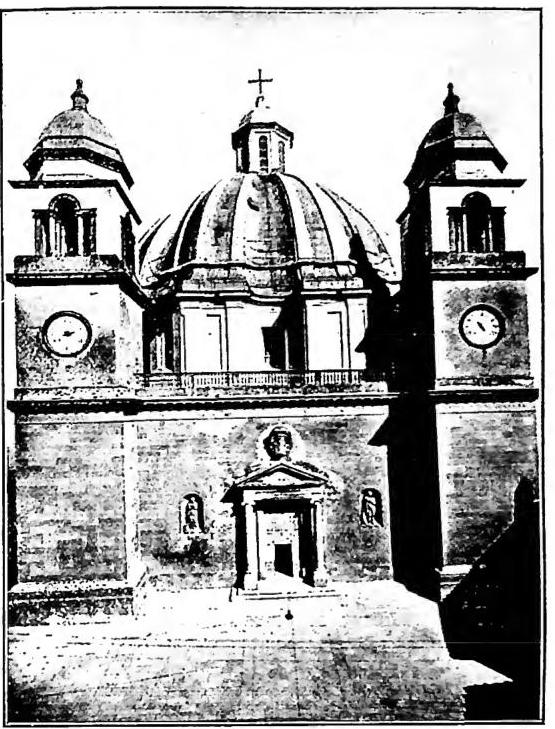
The present Cathedral, according to an inscription, should be assigned to 1173; but since the epigraph appears to be later and the building’s Gothic character is clear (transverse arches in the interior), it may be assigned to the 13th century. Its characteristic features are the absence of a façade, prevented by its position on the edge of a cliff, and the crypt with Roman elements said to have come from a temple dedicated to Jupiter Feretrius. The influence of French art, the fusion of Romanesque and Gothic, and the singularity and austerity of the building place it among the most significant medieval monuments of the Marches. Franciscan memories in several localities (A. Tani, S. Francesco nel M., Città di Castello 1926) are connected with the Saint of Assisi’s visit to S. Leo in 1213 (Fioretti, 55): among the foundations, S. Igne (c. 13th century) is noteworthy; its artistic church and, in altered circumstances, the adjoining convent remain.
In Pennabilli, the Cathedral was erected by Bishop G. Fr. Sormani in 1599, and he conducted there the recognition of the body of S. Marino; it underwent various subsequent restorations.
Within the diocesan territory: the parish church of S. Giovanni Batt. of Carpegna (12th century); the artistic church with its triple apse and the bell tower of the 14th century remain (G. Soriani, Notizie storico-artistiche della pieve di Carpegna, Macerata Feltria 1921); the parish church of S. Cassiano of Macerata Feltria, united with the Cathedral under Bishop Ennio Filonardo in 1544: it was an episcopal residence and the site of synodal assemblies.