
BENEDETTINI CAMALDOLESI. —
I. CONGREGATION OF THE HERMIT MONKS
The Camaldolese Congregation arose as a branch of the Benedictine Order in 1012 and is eminently contemplative in character and purpose. It was founded by s. Romualdo, who, while remaining united to the Benedictine trunk, gave his monasteries and hermitages an entirely distinctive character. The Rule is Benedictine, with particular statutes compiled in 1080 by Rodolfo, the fourth prior of Camaldoli, on the basis of the teachings of s. Romualdo. These concern especially the relations between cenobium and hermitage, united according to the model of Eastern monasticism, and the predominantly eremitical purpose of the institute. Juridically, the Order was first constituted around two centers: Camaldoli and Fonte Avellana. Monasteries and hermitages, including those not founded by s. Romualdo but arising spontaneously or through the work of Popes and bishops, accepted the Rule and the supremacy of the general priors; the latter, however, left the individual houses their autonomy. Relations between the two centers remained until the 16th century those of simple fraternal charity.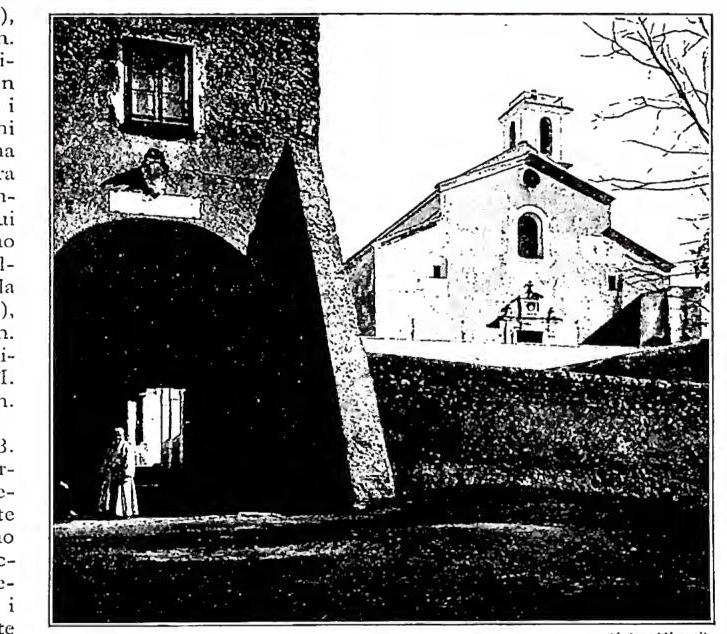
In the second half of the 15th century, in opposition to commendatory administration, smaller groupings began to be formed, which unfortunately caused deeper divisions. Thus in 1521, through the work of the b. Paolo Giustiniani, the Congregation of the Hermits of Monte Corona was established with full independence; it is still flourishing today. A century later, the branch of the Cenobites withdrew from the hermitage, forming an autonomous Congregation; finally, in the 16th century, the Piedmontese Congregation came into being, which in turn gave rise to the French one. Although these subdivisions benefited the propagation of the institute, they weakened its organism. The Piedmontese and Gallican Congregations disappeared in the Napoleonic upheaval, while the Cenobites, by the constitution Inter religiosus of 9 July 1935, were reunited with Camaldoli, restoring the characteristic union of the Romualdine institution: monastery and hermitage. Over ten centuries, the merits of the Camaldolese Order were many and great, both in the field of holiness and in those of science and art. To these must also be added its achievements in agriculture and, in particular, forestry; the great forests of Camaldoli were the work of many generations of monks. Thus the archives and libraries of Camaldoli, Fonte Avellana, S. Michele di Murano, and S. Apollinare in Classe gathered immense treasures of documents and codices. S. Maria degli Angeli in Florence was a gathering place for artists and scholars, and Camaldoli had the first Neoplatonic academies, bringing together in conference, in the second half of the 15th century, the great Florentine humanists: Ficino, Alberti, Rucellai, etc. Other academies later arose at Avellana and S. Apollinare in Classe. From the beginning, almost every Camaldolese monastery had a hospital for the poor under its direction; in Pisa, through their efforts, the first hospice for foundlings was established.
There were many saints and blesseds, among them s. Pier Damiani, one Pope, Gregorio XVI, and many cardinals and bishops; writers such as Ambrogio Traversari, Niccolò Malermi, Mittarelli, etc.; Lorenzo monaco and Bartolomeo della Gata, painters; F. Mauro, cosmographer; Grandi, Soldani, Piccolomini, etc., scientists; without counting the two outstanding figures Guido d'Arezzo and Graziano.
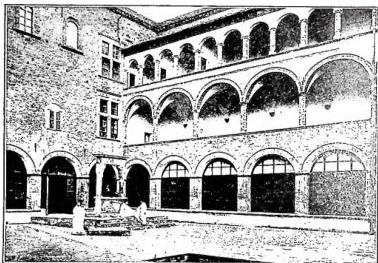
BENEDETTINI OLIVETANI – The great cloister (14th–15th centuries). Abbey of Monte Oliveto Maggiore.
II. CONGREGATION OF THE CAMALDOLESE HERMITS OF MONTE CORONA
They are a branch of the Camaldolese family that separated from it in1523, through the work of Blessed Paolo Giustiniani (d. in 1528), in order to observe the Rule and the customs of the Order more strictly. At first the Congregation was called the Company of the Hermits of s. Romualdo; it later took its name from the hermitage of Monte Corona (Perugia), where, in 1730, it established its headquarters. It reached its greatest development in the eighteenth century, with 23 hermitages in Italy, 7 in Poland, and 5 in Austria-Hungary. The religious policies of Joseph II and, subsequently, the Napoleonic government caused almost all the hermitages to disappear. Monte Corona itself was suppressed under the Italian government's dissolving laws.
Today there are only 9 hermitages: 6 in Italy, 2 in Poland, and 1 in Spain, with approximately 200 monks.