
BENEDETTINA, ARTE. - In the strict sense, the term designates—and for this reason is used by a large part of modern criticism—a movement in art that had its center in southern and central Italy between the ninth and twelfth centuries. On the other hand, the enormous religious, political, and social importance that the Benedictine Order possessed, especially in the Middle Ages, was reflected in so many and such varied artistic manifestations, imprinting upon them a particular character of its own and giving its own accent to different figurative languages, that it is necessary to mention it from this point of view as well.
From its very origins, through the moral and intellectual caliber of its founder and the eminent personalities who soon joined its ranks, the Order appears as the most effective custodian of the still-living Roman cultural tradition, which, in the field of the figurative arts, by then amounted to Early Christian art. The elevation of s. Gregorio Magno to the papacy, by tightening the bonds between the Order and the Roman See, strengthened it and broadened, through its missionary activity, its function, which was not only religious but also cultural. The illuminated «Evangelario» preserved at Cambridge, sent to England by Pope Gregorio through the Benedictine monk Agostino, who would become bishop of Canterbury, is a clear example of this perpetuation of Early Christian spirit and forms.
These first Roman-Benedictine missions introduced—without denying limited contributions of Eastern culture from Syrian or Thebaid monasticism—a vein of Early Christian tradition into a soil rich in other ancient traditions—the Celtic culture; and they called forth and awakened other abundant sources, which flowed together into the great stream of Anglo-Saxon and Irish art. It is now again being debated which of the two had precedence (Masa), but both were powerfully original, and both had, in their rich and splendid miniature production and in the related but more modest production of carved crosses, an origin and character that were predominantly, not to say exclusively, monastic, and more precisely Benedictine.
The «scriptoria» too were for the most part monastic, during the Carolingian period and later also during the Ottonian; and it was therefore from the Benedictine monasteries of Metz, Tours, S. Gallo, etc., that the most distinguished illuminated codices emerged.
In southern Italy, around the mother abbey of Montecassino and the smaller abbeys that flourished around it, the work of the book workshops was carried on vigorously, while churches arose and were adorned with the decoration of vast pictorial cycles, employing in this way genuine teams of painters and illuminators dependent upon the Order.
In the church of the mountain cenobium of S. Vincenzo al Volturno, a series of Gospel frescoes, datable to the ninth century, possess a frank and popular vigor that always leads them back to the same late Roman source.
But it is above all to the time of the great abbot Desiderio (1058–86), and to his works of renovation and embellishment of the monastery and church of Montecassino, that the movement definable as «a. b. «stricto sensu»» may be traced.
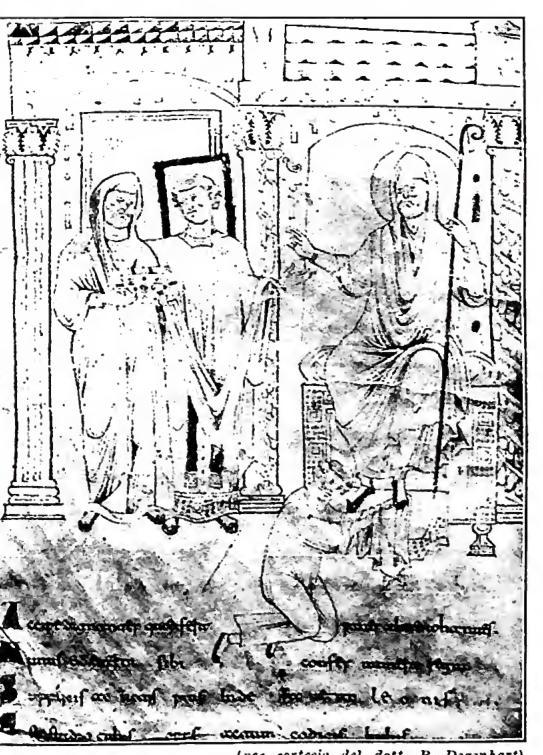
The mosaics of Montecassino having been destroyed, substantial evidence remains on the one hand in the series of illuminated codices and on the other in that of the frescoes. Among these, those of S. Angelo in Formis are of the greatest importance, including a Vita s. Benedicti in the Vatican, a Regestum of S. Angelo in Formis (the library of Montecassino), Exultet (v.) etc.
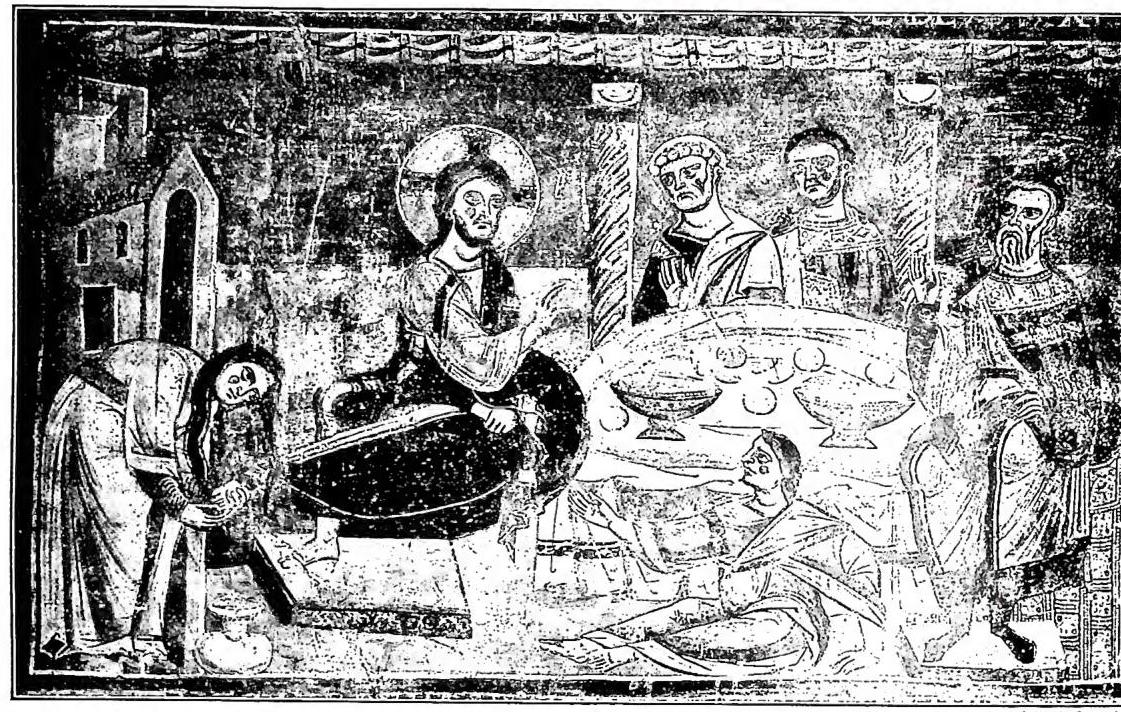
That Abbot Desiderio commissioned goldsmith’s and carving work in Constantinople, and had masters of mosaic and inlay brought from there, is apparent from the well-known passages in the Chronicle of Leone Ostiense. But everything suggests that the intervention of foreign elements was operative much more in the technical than in the stylistic field. The acquisition of rare and precious objects, and the work and instruction of masters specialized in difficult and complex operations whose tradition had been lost, rather than the contribution of creative artists. And even if some artist took part—an «imaginarius» as well as a «musearius»—his activity was limited; his influence slight and very short-lived; so that his local pupils immediately assumed an autonomous position. The imposing decoration of S. Angelo in Formis provides proof of this. For in it, which clearly reflects the fortunes of the Cassinese school at the time of the arrival of these Greeks, only a few sections—on the exterior of the façade beneath the portico, and especially the Angel and the Madonna above the door—possess a pure and exquisite Byzantine accent, in their refined decorativeness, heraldic rigidity, and abstract solemnity of aspect. Whereas, through successive developments of taste and style, with various changes in emotional tone revealing the succession of an equal number of different masters, from the Stories of hermits, still on the exterior, from the enormous Last Judgment on the interior of the façade,
BENEDETTINA, ARTE - Jesus and the Sinful Woman. Fresco in the central nave of the church of S. Angelo in Formis (11th century).
Through the extraordinarily numerous biblical and evangelical scenes along the walls of the naves, one arrives at attitudes of a robust, almost violent expressionism in the Redeemer in the apse, which reveals links with Ottonian art. But between these two extremes extends the most substantial body of these paintings, and in particular the series of the «biblical and evangelical scenes», which possesses a character of its own, of great representational and expressive efficacy in the compositions, in the vivacity of the attitudes, in the simple and lucid dramatic quality of the gestures; a fresh and abundant inspiration, a manly and candid feeling; a popular manner, but by no means plebeian, a swift manner of painting in patches of colour on the white plaster, with a preference for cool tones (sky-blue, violet, amaranth red, brown), within vigorous outlines and compact syntheses. The iconography, moreover, departs from that of the East; for example, Christ himself appears in the scene of the Judgment, in place of the empty throne of the Etimasia. This artist, together with his collaborators, was without doubt one of the greatest of the Middle Ages. These same qualities, though transposed into the format of the «reduced scene», are revealed by the finest Cassinese codices, especially the Vita s. Benedicti. And by some of the Evultet; even though certain of these (that of Salerno, for example, in the refinement of its execution; that of Bari in certain Greek inscriptions) display a somewhat stronger accentuation of Byzantine elements.
The inferior quality of some of them should not be surprising when one considers that not all originated in genuine scriptoria and miniature workshops, but are copies, made for ordinary use, from more precious exemplars, evidently in order to spare the latter. They therefore cannot be judged by the standards of works of art, but rather as manual productions by occasional draughtsmen, amateurs lacking technical training; and thus Bertaux’s judgment concerning the «barbarism» of the second exemplar of Gaeta appears too severe: it is a literal but crude copy, made by a calligrapher inexperienced in drawing, of the other exemplar, which instead is the work of an artist endowed with considerable personality and characteristic of this tendency.
That these highly varied and numerous manifestations of a. b., with which southern Italy is so richly endowed, possessed a particular and differentiated character is also evident for historical reasons, since there is no doubt that Western Benedictine monasticism tended, if not to oppose itself to Eastern monasticism, at least to distinguish itself from it, although the latter was widespread especially in Puglia and Calabria through the so-called Basilian monks.
They are, moreover, closely related—and this too is obvious for historical reasons—to the painting that developed in Rome between the 9th and 12th centuries. Such are the earliest Ascension (datable between 847 and 855), and then the marvelous Stories of s. Clement and s. Alessio in the lower church of S. Clemente, prior to 1084, in which the distinctive character of the language of medieval Roman painting, based predominantly on the decorative value of a thin, vibrant line, is manifested in exquisitely elegant forms and in a tone of courtly refinement, such as are also found, though to a lesser degree, in other fresco cycles, especially in S. Elia at Nepi, the work of Stefano, Giovanni, and Niccolò (as well as Farfa and Tuscania).
While still belonging to this current, but with a vein of more rugged feeling and in attitudes that are almost dialectal, other fresco cycles in Latium with scenes from Genesis may be included (S. Maria in Vescovo, S. Giovanni a porta Latina in Rome), parallel to the illustrations of certain Atlantic Bibles (Tocesa).
Roman and Benedictine at once are the frescoes of the Benedictine church of S. Maria in Pallara on the Palatine, and the large and extremely rare panel with the Last Judgment, recently entered into the Vatican collections, signed by Giovanni and Nicolò and datable, as Redig de Campos rightly maintains, to the end of the 11th century rather than to the 13th, as Paeseler would have II.
If, as a. b., this painting of central and southern Italy may properly be designated, then a large part of all artistic production in general during the period between the 9th century (and even earlier) and the 13th, before the emergence of the new mendicant Orders, may be traced back to the multifaceted activity of the Benedictine Order, which covered with its powerful and flourishing abbeys the whole of civilized Europe and of Europe in the process of civilization, from Ripoll to Fulda, from Durehm to Nonantola, from Durrow to Einsiedeln.
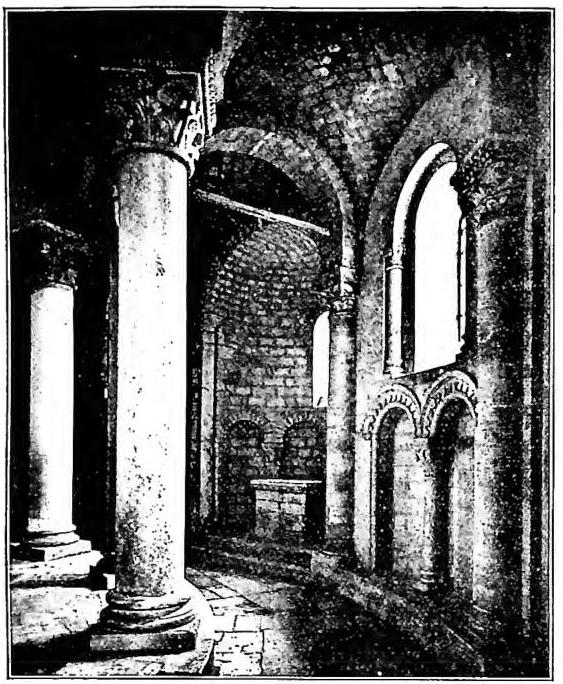
And it was above all Cluny that, through the prestige of its religious spirit and the wisdom and firmness of its institutions, became an exceptionally vibrant and active centre for the assimilation, elaboration, and propagation of artistic currents, and especially of architectural types, during the periods corresponding to the three abbots: Bernone (910–27), Maiolo (954–94), and Ugone (1049–1109), and to the respective constructions of the abbey church—relatively modest in Bernone’s time (the so-called Cluny I), larger under Maiolo (II), and of exceptional sumptuousness and grandeur under Ugone (III). In the latter, architectural motifs that had already appeared timidly elsewhere were asserted with renewed vigor and clarified: especially the archiepiscopal cross-shaped plan with a double transept and double choir (in order to accommodate the large number of monks), and the ambulatory around the high altar, crowned by a series of small chapels or apsidal niches; while here the pointed arch made one of its earliest, if not perhaps its first, appearances in the load-bearing walls along the naves. These motifs spread widely and also, though more rarely, in Italy, where the most notable examples of an ambulatory with apsidal niches of the Cluniac type are the cathedral of Aversa, founded by the Norman dukes, and the abbey church of S. Antimo near Siena.
But it must be borne in mind that Cluny’s ties with Rome and therefore also with Montecassino always remained firm and enduring; we see the Pontiffs frequently visiting the abbey, Urban II consecrating the altars of the choir there in 1095, and Innocent II, in 1130, consecrating the entire new church founded by Ugone and continued by Ponzio (Pons) of Mergueil (1109–22) and completed by Pietro il Venerabile (1122–56).
Parallel to the growth of the central Cluniac abbey and of others nearby in Burgundy and Languedoc, and always stimulated by the central house at Cluny, other abbeys arose that were exceedingly rich in art and renowned, such as the Daurade at Toulouse and, above all, through the work of the abbots Duvand (1048–72) and Ansquetil (1085–1115), that of Moissac.
It should also be borne in mind that among the foremost of these Benedictine promoters and builders was Guglielmo da Volpiano, a native of Lago d’Orta, founder of an abbey in Piemonte (Fruttaria), a monk at Cluny under Abbot Maiolo, and founder of the church of S. Benigno at Dijon; he was subsequently summoned by the Norman king Riccardo II to found the abbey of Fécamp. Guglielmo da Volpiano certainly introduced into Norman and Burgundian architecture the results of experience, matters of taste, and constructive and decorative elements of Lombard origin. Likewise, it is probable that the abbot Lanfranco, appointed archbishop of Canterbury, brought Lombard customs and practices to England.
The series of splendid capitals formerly in the ambulatory (now in the Octav museum) of Cluny, whose dating is disputed (Kingsley Porter 1095, Michel 1130–40, Aubert 1109–13 and 1113–18), finds an equivalent, in its already Gothicizing taste and the delicacy of its workmanship, in examples from the cathedral of Modena: not so much in Wiligelmo’s «biblical scenes» on the façade as in the capitals with drô-
more particularly the pediment with the Last Judgment at Conques (ca. 1130–35), on the one hand, and the Evangelical Stories at Moissac, on the other, seem to be related to the art of Wiligelmo. And at Moissac the sublime pediment of the Last Judgment, like the other famous pediment at Souillac, evokes strange, ill-defined yet unmistakable echoes of the art of the distant East, with stylistic attitudes and iconographic details that recall India and China.
The genuinely Cluniac painting, of which—since the decoration of the church at Cluny has been destroyed and is known only from old descriptions—we can observe a direct derivation at Berzé-la-Ville in Burgundy, would, according to Mercier and Focillon, be closer to Byzantine than to the Romanesque manner of St-Savin and others, owing to a greater technical refinement in the delicacy and continuity of the modeling, and in the fullness and richness of the color. Yet these frescoes at Berzé-la-Ville also have surprising affinities with certain frescoes in the crypt of Anagni (figures of Hippocrates and Galen, etc.).
A new wave of diffusion of the a. b. lato sensu occurred with the Cistercian reform, which was highly effective, at the beginning of the thirteenth century, in spreading forms of a Gothic style austere to the point of nudity, but no less expressive and evocative for that reason. Its fundamental motifs,
BENEDICTINE ART — Illuminated page from the Homilliarium copied by the monk Leone in 1072: the abbot Desiderio, Leone, and Giovanni, archpriest of the Marsican Church — Montecassino, ms. 99.
BENEDETTINA ARTE – BENEDETTINE DI N. S. DEL CALVARIO
(photograph by Alinari)
BENEDETTINA, ARTE - Ambulatory of the church of the abbey of S. Antimo (12th century) - Castelnuovo dell’Abate near Moltalcino (Siena).
in their constructive simplicity, would later be adopted, though with substantial modifications and adaptations that alter their meaning, by the two great mendicant Orders of the Franciscans and the Dominicans.
According to the most widespread opinion, recently contradicted by Serafini, a long series of abbeys, each a filial foundation of the preceding one, would mark in Italy the spread both of the Cistercian Rule and of architectures modelled on those of Cîteaux and Clairvoux: Fossanova, Casamari, S. Maria di Arbona, S. Galgano da Siena, and, successively, many others, among which the numerous Chiaravalli in honour of s. Bernardo. This influence may also have been exercised in secular churches, as when we find monks of S. Galgano at the head of the construction of Siena cathedral. With regard to the latter, the supposed original existence of a Cluniac-type ambulatory, derived from the example of S. Antimo, proposed by Lusini and accepted by Salmi, is contradicted by more recent criticism (Carli).
Typical of the examples of Italian Cistercian churches closest to the original model is the plan with three naves, a broad transept, and square terminal chapels opening onto the transept.
The rapid flourishing of the mendicant Orders marks the decline of the Cistercians; yet, as has been said, the new Orders partly adopted their architectural style.
Recently, an attempt has been made to give life to a new Benedictine artistic Beuron (v.), whose painter and decorator monks also worked extensively at Montecassino (Crypt) at the beginning of the century. But this style seems rather a programmatic compromise between a deliberately archaizing culture and a somewhat uncertain taste, such as prevailed at that time between the “floral” style and the Pre-Raphaelite style.