
NONANTOLA, ABBEY nullius. — Founded in 751–52 in honor of the holy Apostles, to whose names that of St. Silvester was added in 756, by St. Anselmo, formerly a Lombard duke (v. ANSELMO di N). The abbey soon became, and for many centuries remained, a flourishing center of monastic culture. From 1411 it passed into commendam, often to the Este family; in 1514 it was given to the Cistercians, and in 1768 Clement XIII suppressed II. It was reestablished by Pius VII on 23 January 1821 and given in commendam to the archbishop pro tempore of Modena; it was secularized in 1866. In 1926 it was united in perpetuity with the archbishopric of Modena. It has its own Chapter (since 1928), minor seminary, and Curia, with 31 parishes and 57,646 inhabitants.
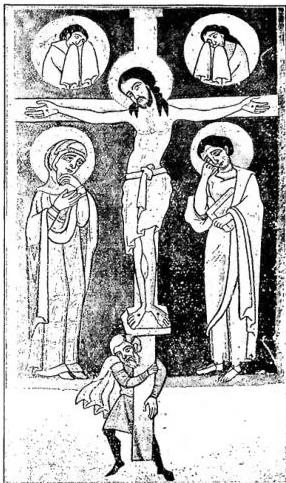
After various vicissitudes in the 12th century, the abbey church was rebuilt in imitation of the forms of the cathedral of Modena, designed by Lanfranco, while in the portal (ca. 1121) the influence of Wiligelmo’s manner is evident. The church, disfigured by restorations and alterations, especially during the Baroque period, was restored in the second decade of the present century. It now appears as a three-aisled basilica with a spacious crypt supported by 92 columns. In the presbytery is the mausoleum of St. Silvester (1380), decorated with sculptures depicting episodes from the Saint’s life. The altars contain works by M. Lambertini, F. Bianchi Ferrari, and the Carracci. In the adjoining seminary are a library and an extremely important archive. Among other things, two very interesting codices bound in silver and ivory are preserved there. They are a Gradual and a Gospel Book; the latter, from the 12th century, is known as the Countess Matilde’s and is decorated with precious miniatures of Byzantine taste. A considerable number of codices from N., displaying a characteristic type of pre-Carolingian Italian script specific to that scriptorium, are now in the National Library of Rome, in the Sessorian collection. What remains of the ancient and once exceptionally rich abbey treasury is in the inner chapel of S. Carlo Borromeo, formerly commendatory abbot of N. — Vedi tav. CXXII.
(phot. Orlandini)
NONANTOLA – Gospel book known as “of Countess Matilda” (12th century) – Seminary, Library.