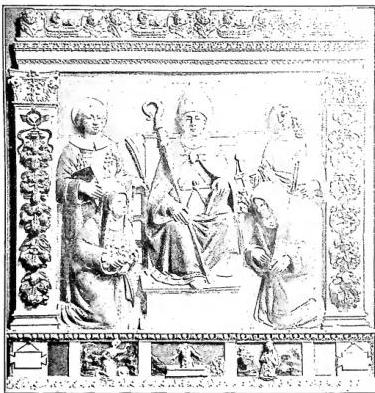
ANSELMO di NONANTOLA, saint. — Former duke of Friuli, brother of Giseltruda, wife of the Lombard king Astolfo. Having embraced the monastic life, he received present-day Fanano as a donation from Astolfo in 749, where he founded a monastery and hospice, and, in 751–52, Nonantola (v.), on which he built the celebrated monastery of that name and the church dedicated to all the holy Apostles, consecrated on 9 June 753 by the archbishop Sergio of Ravenna. The author of the Life mentions three other foundations of monasteries and hospices at S. Ambrogio, in the Vicentino, and in the place called Susonia.
A., while with his brother-in-law Astolfo at the siege of Rome in 756, removed part of the body of s. Silvestro pope from the cemetery basilica of Priscilla and placed it in the church of the monastery of Nonantola, where he had an oratory and an altar dedicated in honour of the aforementioned Pontiff on 20 November of the same year by the bishops Romano of Bologna and Apollinare of Reggio; from that moment the monastery, in addition to its original title of the holy Apostles, was also called by the name of s. Silvestro. The historicity of this translation, attested by genuine ancient sources but subsequently distorted by later sources, cannot be doubted, even though the Liber Pontificalis of Rome (cf. Duchesne’s edition, I, p. 464) says that Paolo I transported the body of s. Silvestro into the city in 761. Bortolotti, whom De Rossi supports (letter to Bortolotti), reconciles the two traditions through the truly reasonable hypothesis that A. brought not the whole body but only part of it to Nonantola, so that Paolo I was able to transport the remainder into the city in 761. In both cases the sources speak of the body, but evidently this means a part for the whole.
A. was confined to Montecassino for seven years by King Desiderio, probably because he was a supporter of Rachi; released, as is believed, around 764, he returned to Nonantola with a rich collection of codices and resumed the direction of the abbey, which he governed until his death on 3 March 803.
The Life of A., entitled: Actus vel transitus beati Anselmi Abbatis, was most probably written in the first half of the 11th century. It is a composition abounding in commonplaces and lacking in historical information, sometimes also interpolated, despite the genuine sources used by its author.