
DE ROSSI, GIOVANNI BATTISTA. — Archaeologist, founder of the science of Christian archaeology, b. in Rome on 22 Feb. 1822, d. in the papal palace at Castelgandolfo on 20 Sept. 1894. Having completed his humanistic and philosophical studies at the Roman College, he proceeded to the faculty of law at the University of Rome, where, in 1843, he obtained the degree ad honorem in utroque iure; but he was irresistibly drawn to archaeological studies, to the point of declaring himself: “Bosio’s Roma sotterranea was always more pleasing to me than the Decretum of Gratian or the Corpus Iustinianum” (P. M. Baumgarten, 2nd ed., Rome 1892, p. 10). As early as the preceding year, on 20 July 1842, Fr. G. MARCIA (v.) had come upon him intent on transcribing Christian inscriptions in the crypt of S. Prassede, and Cardinal A. MAGI (v.) had found him in the Lapidary Gallery in the Vatican, transcribing Greek inscriptions. Through these two scholars, the doors of the Roman catacombs and of the Vatican Library were opened to the young Roman: he became the former’s collaborator and devoted friend, and from the latter received his appointment as a writer in the Vatican Library.
The first archaeological explorations which he diligently pursued were those of the cemetery to the left of the Via Appia, then known as that of S. Sisto, which he later recognized as the cemetery of Praetextatus, between 1847 and 1850.
Here he had the opportunity to make his first fruitful observations concerning the chronological connections among the finds: “A clear light flashed into my mind here, and here I matured the plan of the new Roma sotterranea” (as he himself states in Le cripte storiche del cimitero di Pretestato, in Bull. d’arch. crist., 2nd series, 3 [1872], pp. 63–64).
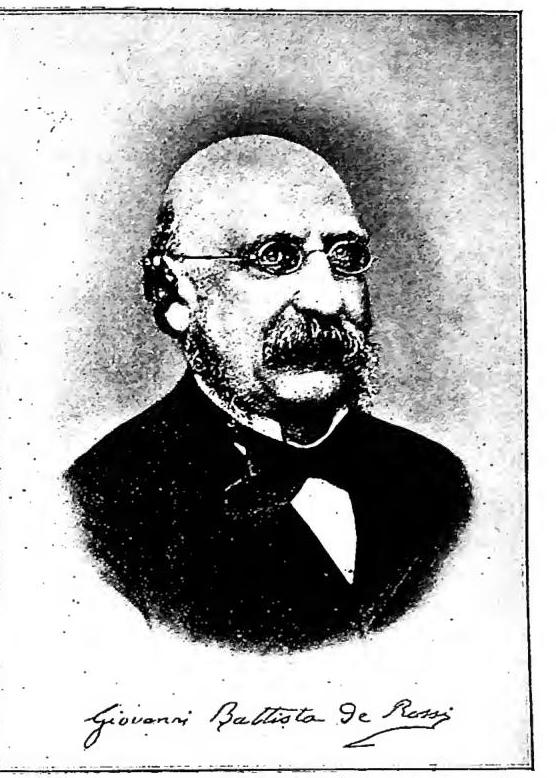
DE ROSSI, GIOVANNI BATTISTA — Portrait with autograph signature.
This enabled him to identify the exact location of the actual cemetery of Callistus, a name which until then had been extended not only to all the underground galleries from the “Quo vadis?” to S. Sebastiano and the Via Ardeatina, but above all had been applied to the cemetery in catacumbas, where throughout the Middle Ages all the Christian memories of the Via Appia had been gathered. In 1854 there followed the discovery of the crypt of the third-century popes and of the tomb of S. Cecilia; in 1856 that of S. Eusebius; in 1863 that of Pretextatus; in 1864 he discovered the hypogeum which he considered to belong to the Flavians in Domitilla; in 1873 the basilica of SS. Nereus, Achilleus, and Petronilla; in 1882 the crypt of S. Hippolytus; in 1883 that of S. Felicitas; in 1888 the hypogeum of the Acilii; and in 1890 the basilica of S. Silvester in Priscilla.
In 1863 he began publishing his Bullettino di archeologia cristiana, which for thirty years he continued to edit alone, until his death (1894), in order to illustrate discoveries made not only in the Christian cemeteries of Rome, Italy, and abroad, but also in Christian basilicas and in the epigraphic, hagiographic, and artistic fields of the first centuries of Christianity. His Bullettino was translated into French, first by Martigny and then by Duchesne, until 1883. In 1864 the first volume of his Roma sotterranea, published by order of Pius IX, appeared. In it he retraced the history of Christian antiquities from their origins to his own time, followed by an analysis of the ancient topographical documents and a description of the first part of the cemetery of Callistus; this was continued in the second volume, published in 1867, and in the third (1877), in which he completed the exposition of the cemetery of Callistus and, in addition, Generosa (v.), and summarized the history of the origin, development, and administration of the ancient Christian cemeteries of Rome, their dependence on the urban titular churches, up to the period when the relics of the martyrs were transferred inside the city. The three volumes of D. R.’s Roma sotterranea aroused such admiration among scholars that summaries were soon compiled for purposes of popularization. The first were J. Spencer Northcote and W. R. Brouwlow, The Roman Catacombs (London 1872); P. Allard, Rome souterraine. Résumé des découvertes de M. de Rossi dans les catacombes romaines et en particulier dans le cimetière de Colliste par J. Spencer Northcote et W. Brouwlow (Paris 1872, 2nd ed. there 1874); F. X. Kraus, Roma sotterranea, Die römischen Katahamben. Eine Darstellung der älteren und neusten Forschungen mit Zugrundelegung des Werkes von J. Spencer Northcote und W. R. Brouwlow (Freiburg im Breisgau 1874).
The importance of D. R.’s studies and discoveries in the field of cemetery topography is no less than that of his work in the sphere of Roman topography and classical and Christian epigraphy.
In Roman topography, D. R.’s first study dates from 1858: Le stazioni delle sette coorti dei Vigili (in Annali dell'Istituto di corrispondenza archeologica, 1858); in the same year he added the site where G. Henzen later discovered so many remains of the “Acts of the Arval Brethren.” His most notable work in this field is that on Piante iconografiche e prospettiche di Roma anteriori al secolo decimosesto (Rome 1879). It is a monumental history of the city from its origins to the age of Augustus and Aurelian, followed by a study of urban plans, from the one painted in the portico of Polla in the Campus Martius to the Severan “forma Urbis”; from schematic medieval plans to the fifteenth-century perspective of Mantua. In 1882, in Studi e documenti di storia e diritto, he offered Note di topografia romana raccolte dalla bocca di Pomponio Leto e il testo pomponiano della Notitia regionum Urbis Romae; in 1884, Note di ruderi e monumenti antichi per la pianta di G. B. Nolli conservata nell'Archivio Vaticano (ibid.). He subsequently illustrated the plan of Rome painted by Cimabue in Assisi (Bull. dell'Istituto, 1887). A drawing of the Roman Forum among the collections of the Escorial (ibid., 1888). The circular panorama of Rome delineated in 1534 by Martino Hensheere, a Dutch painter (Bullett. della commise. archeol. comm. di Roma, 1891); from 1886 to 1890 he published, together with G. Gatti in the same periodical, a Miscellanea di notizie bibliografiche e critiche per la topografia e la storia dei monumenti di Roma.
Theodor Mommsen, in the preface to volume III of the Corpus inscriptionum latinarum (Berlin 1873, p. vi), states that without the assistance of D. R., “Italiae Iumen,” the collection of Latin inscriptions would have had to disregard the manuscripts, just as he himself had been compelled to limit himself in the case of the inscriptions of the Kingdom of Naples, whereas D. R. had opened the way to knowledge of the manuscripts not only of the Vatican Library and the other libraries of the city of Rome, but also of the libraries of Italy and of all other nations. By a letter in Latin dated 22 January 1854, the Academy of Berlin had officially invited him to collaborate on the Corpus inscriptionum latinarum and solemnly declared that it reserved for D. R. himself the task of publishing the Christian inscriptions of Rome. From 1854 to 1858, the Monatsberichte der K. Akademie der Wissenschaften zu Berlin indeed contained periodic reports of the investigations conducted by D. R. in all the libraries, concerning epigraphic manuscripts. In classical epigraphy, G. B. D. R. made his debut with the “Honorary Inscription of Nicomachus Flavianus” (in Annali dell'Istituto di corrisp. archeol., 1849, pp. 283–303).
The Académie des Inscriptions et Belles Lettres, together with others, entrusted him with the task of overseeing the publication of the works of B. Borghesi (Oeuvres complètes de Bartolomeo Borghesi par les ordres et aux frais de S. M. l'Empereur Napoléon III, later sous les auspices de M. le Ministre de l'instruction publique, Paris 1862–97).
From his youth D. R. began collecting ancient Christian inscriptions. He presented an initial study at the Pontifical Roman Academy of Archaeology on 3 April 1851, with his dissertation on the collection of the Christian inscriptions of Rome from the first six centuries, published posthumously under the editorship of G. Gatti (v.) in the final issue of the Bull. d'arch. crist. (1894, pp. 151–73). He insisted especially on the usefulness of the geographical method. In 1855, in the Spicilegium Solesmense (III, Paris 1855, pp. 544–77), he dealt with “de christianis monumentis 1280v exhibentibus,” and in volume IV of the same Spicilegium he wrote “de christianis titulis Carthaginensibus” (Paris 1858, pp. 505–38). In 1861 the first volume of his Inscriptiones christianae urbis Romae septimea saeculo antiquiores appeared: the work opens with a history of epigraphic studies from the Middle Ages to his own day. This is followed by a treatise on chronological notes, the laws and formulas of consular dates, the consular fasti, and the various solar and lunar cycles.
Of the second volume of his Inscriptiones Christianae, D. R. published the first part in 1888; the preface contains the first history ever traced of Christian metrical and rhythmic epigraphy and includes an edition of the ancient epigraphic sylloges up to the Carolingian anthologies. Pope Pius IX entrusted Father Marchi and D. R. with the task of arranging the Pontifical Lateran Museum; the former brought together there the most important Christian sarcophagi scattered throughout various parts of the city, while D. R. admirably classified the ancient Christian inscriptions, dividing them into two principal classes, sacred and funerary. D. R. explained the principle he had followed in this classification in the Triplice omaggio a Pio IX and in a special article in his Bull. d'arch. crist. (1877).
The work accomplished by D. R. as a writer for the Vatican Library is attested by the five volumes describing and classifying manuscripts, and by the arrangement of the catalogue cards of Gaetano Marini and Cardinal Angelo Mai. Prefixed to the first volume of the catalogue of the Palatine manuscripts (1886) is his treatise: De origine, historia, indicibus scrisii et bibliothecae Sedis Apostolicae.
In the Vatican Library’s jubilee tribute to His Holiness Leo XIII (1888), he discussed The Bible offered by Ceolfrid the Abbot to the tomb of St Peter, an extremely ancient manuscript among those surviving from the libraries of the Apostolic See. His writings on the Bibbia pauperum and its very ancient origins (Bull. arch. crist. 1887, pp. 56–59), and on the Bibbia pauperum of the Lyceum of Constance (ibid.), also belong to this field of study. D. R. also concerned himself with the Middle Ages, in studies on Stefano Porcari, on the statutes of Anticoli, and on the collection of Roman inscriptions relating to artists and their works in the Middle Ages, compiled at the end of the sixteenth century (Bull. di arch. crist., 3rd series, 1 [1890], pp. 79–100). Another work by D. R. is that on the Christian mosaics and specimens of church pavements in Rome dating from before the fifteenth century (Rome 1872–96, completed by E. Stevenson), with parallel Italian and French texts. In collaboration with L. Duchesne he published the Martyrologium Hieronymianum ad fidem codicum, adiectis prolegemnis aegli Acta SS. Novembris, II, 1, Brussels 1894. G. B. D. R. also contributed to the most authoritative Italian and foreign periodicals. A list of all his writings was compiled by G. Gatti in the Album presented to him in 1892 and brought up to date in the final issue of the Bull. d’arch. crist. for 1894. His substantial catalogue-card collection occupies 31 volumes (codd. Vat. lat. 10512–43, described by M. Vattasso and E. Carusi, Rome 1920). From 1884 G. B. D. R. was president of the Society of Students of Christian Archaeology; president of the Pontifical Roman Academy of Archaeology; secretary of the Pontifical Commission for Sacred Archaeology; «magister» of the «Collegium cultorum martyrum»; and prefect of the Sacred Museum of the Vatican Library.
A man of irreproachable life and profound piety, averse to politics, he was greatly beloved by the pontiffs Pius IX and Leo XIII, who called him «Urbis decor». Scholars and scientific institutions of every nation honored him, especially on the occasions of his sixtieth and seventieth birthdays. Pope Pius XI solemnly commemorated the centenary of his birth. His greatest desire—«I dream of a Christian world illuminated by the monuments of the first six or seven centuries» (Roma sotterranea, I, p. 82)—was entrusted by Pope Pius XI as the ideal goal of his Pontifical Institute of Christian Archaeology.