
ASSISI, DIOCESE OF. — In Umbria, in the province of Perugia, it covers an area of 352.17 sq. km., with a population of 34,653 inhabitants, all Catholics, distributed among 36 parishes with 54 secular and 102 regular priests, 11 religious houses for men and 24 for women, a diocesan seminary and the Umbrian regional seminary (1948).
A., halfway between Perugia and Foligno, was built on the limestone spur of Mt. Subasio, which dominates the plain crossed by the Topino and the Chiascio. Birthplace of the Latin poet Propertius, A. was during the imperial period a flourishing Roman municipality (Asisium), of which monumental remains still survive. At the time of the barbarian invasions it barely escaped complete destruction, but its life became increasingly impoverished. With the Lombard occupation it formed part of the Duchy of Spoleto until the 12th century: this caused it considerable damage, since it had to wage many wars with nearby Perugia, which for centuries fiercely contested it with the Popes and other lords. In the 13th century, adherence to the Guelph party brought it a period of truce with Perugia and the benevolence of the Popes, who in 1287 recognized its communal liberties. New struggles between Guelphs and Ghibellines again afflicted it, until in 1367, in order to free itself from the yoke of the Perugians, it voluntarily gave itself to Cardinal Egidio Albornoz. It still had to endure various lordships, until Paul III (1534–49) definitively brought the city under papal rule, which lasted until the occupation by the Italian government in the second half of the last century (1860).
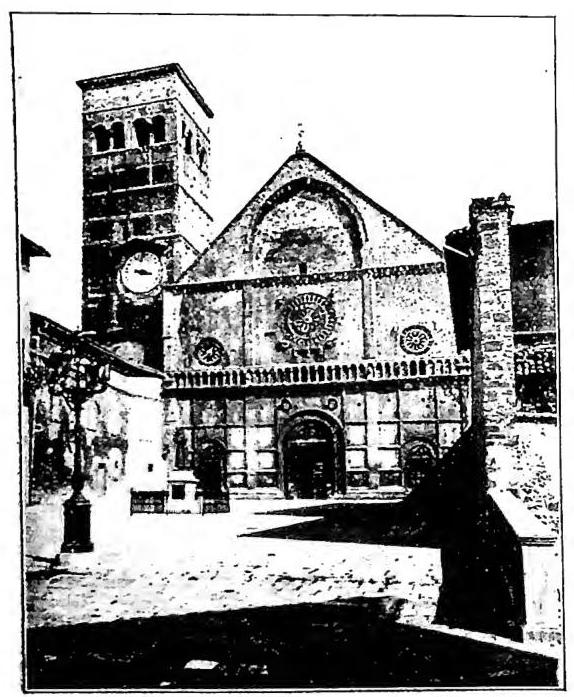
A. Harnack, basing himself on the argument of the martyrs, believed that he could establish the existence of the diocese of A. before 325. Nevertheless, we must note that the existence and status of the bishops and martyrs of the period of the persecutions attributed to Vittorino, Savino, and Rufino himself, patron and protector of A., rest on documents that are of little or no reliability and do not predate the 11th century. The first bishop of A. known to us, whose historicity cannot be doubted, is Avenzio (547), who was an envoy of the Ostrogoths to the emperor Justinian. After him, until the end of the 9th century, there are many gaps, and only around the year 1000 did A. begin to flourish again and live a new life. A small church dedicated to the Virgin served as the cathedral until Bishop Ugo (1036–52) rebuilt the primitive little church of S. Rufino which, reconstructed by Giovanni da Gubbio, is the present Cathedral. Among the bishops, besides Ugo, special mention should be made of Guido II (1204–28), friend and protector of s. Francesco, and Marcello Crescenzi (1591–1630), to whom the present seminary building is due.
A. should be remembered above all for its illustrious citizens Francesco di Bernardone (v. saint), Chiara (v. saint), respectively founder of the Friars Minor (v.) Poor Clares (v.), and s. Gabriele dell'Addolorata (v.).
Among the several monasteries or abbeys that existed in the diocese of A., particular mention should be made of the abbey of S. Benedetto al Subasio, generally dated to the year 536 (but the first certain notice dates from 1041), and the abbey of S. Pietro, whose first secure record likewise dates from the 11th century, namely 1029. The sons of s. Benedetto are still at S. Pietro today, but of both ancient monasteries only the remains of the church and the underlying crypt survive (12th century?).
Greater prominence belongs to the Franciscan sanctuaries, which have impressed upon A. a character of mysticism and, at the same time, of grandeur. S. Maria degli Angeli, which began with the Porziuncola donated to s. Francesco by the monks of Subasio, became the cradle of the Minorite Order. Its name is linked to the famous Indulgence of the Pardon, obtained by the Saint on 2 Aug. 1216, to the Chapter of Mats, and to numerous characteristic episodes of early Franciscan history. In a cell near the Porziuncola (the Chapel of the Transit), s. Francesco passed, singing, from earth to heaven on 3 Oct. 1226. The great basilica enclosing the two precious relics was declared by Pius X (11 April 1909) a Patriarchal and Papal Basilica, and the Cardinal Protector of the Friars Minor is its papal Legate.
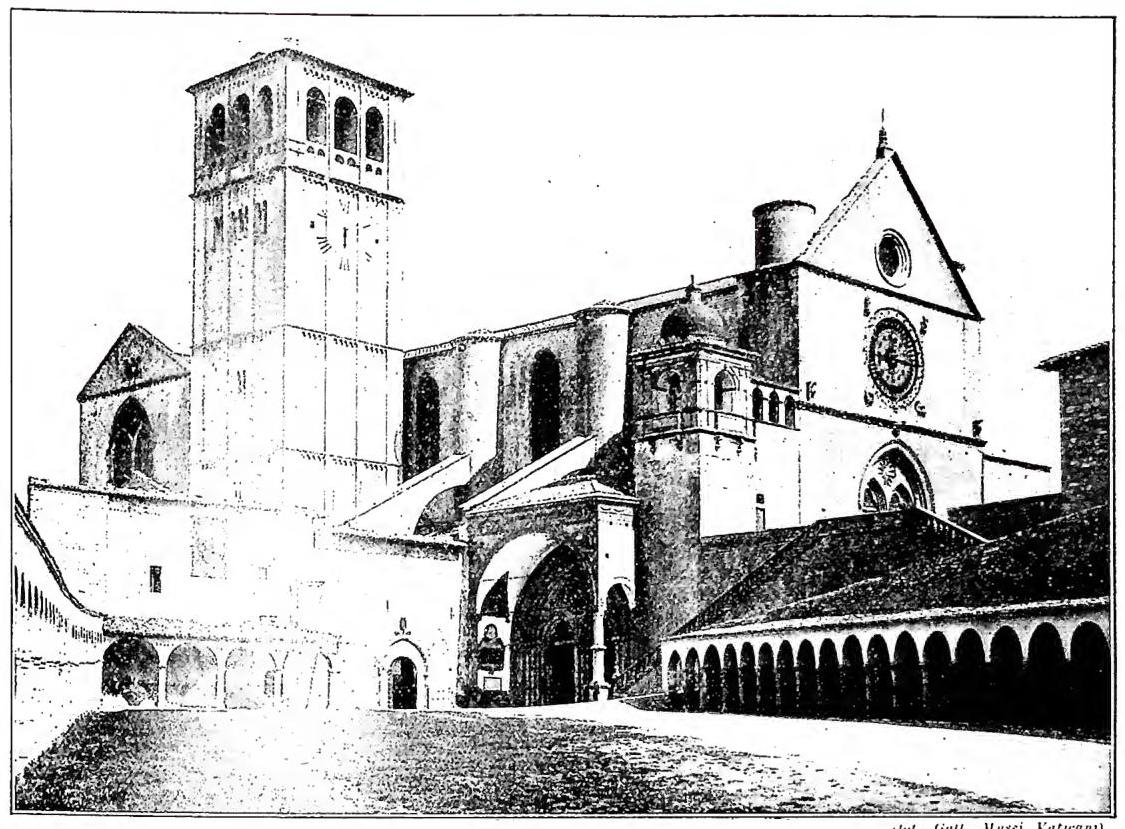
S. Francesco is the imposing monumental complex that arose on the Hill of Hell, which from then on was called the Hill of Paradise, to house the venerated remains of s. Francesco. The transfer of the venerated body took place on 25 May 1230, but the church was consecrated by Innocent IV on 20 May 1253.
In 1818 the body of s. Francesco was discovered; it had remained concealed for almost six centuries beneath the altar of the lower church. The Greek-cross crypt, communicating with the lower church by means of two stairways, was then excavated, and the sacred relic was placed there. The present architectural arrangement is due to the architect U. Tarchi. The distinguished monument is jealously cared for by the Conventual Friars Minor.
San Damiano is the sanctuary associated with the memory of s. Chiara and her first companions, who took up residence there in 1212 and left it in 1257 so as not to be separated from the virginal remains of their Mother. Since then, the Friars Minor have been there, carefully preserving a true relic of seraphic life.
S. Chiara is the basilica that preserves the venerated remains of the Saint. The body of s. Chiara was transferred there on 3 Oct. 1260, but the church was consecrated by Clement IV in 1265. In 1850 the venerated remains were discovered and the crypt where they now rest was excavated. The Basilica preserves the celebrated crucifix of S. Damiano (a 12th-century panel), which is said to have spoken to s. Francesco. The Cardinal Protector of the Friars Minor, as at S. Maria degli Angeli, is its papal Legate.
A striking place in the surroundings of A. is the hermitage of Le Carceri, on the slopes of Subasio, where s. Francesco withdrew to pray. The present small Franciscan convent was built there by s. Bernardino da Siena in the 15th century.
Precious documents of local history are preserved in the Municipal Library of A., established in 1866 from the libraries of the suppressed convents, particularly from the Library and Historical and Musical Archive of the S. Convento. Of lesser importance, but not negligible, are those preserved in the Capitular Archive of S. Rufino, at the Accademia Properziana, at the International Society for Franciscan Studies, founded by Paul Sabatier, and at the Chiesa Nuova.
of S. Damiano in A., Assisi 1927; id., La chiesa nuova di S. Francesco converso, casa paterna del Santo in A., Todi 1943; G. Abate, La casa paterna di s. Chiara e falsificazioni storiche del sec. XVI e XVII intorno alla medesima Santa e a s. Francesco di A., Assisi 1946.
ART. — To the profound significance that A. possesses in the life of the spirit, the rich artistic production preserved there adds a by no means negligible note; at least for the two centuries of its greatest flourishing, the thirteenth and fourteenth centuries, this production may be said to have been almost exclusively linked to the glorification of the Franciscan epic.
Of the Roman period, A. offers very notable remains (the Temple of Minerva, today the church of S. Maria sopra Minerva, which dates from the early imperial period and is one of the best-preserved monuments of classical times; the remains of the Forum; the vestiges of a theatre, an amphitheatre, and the city walls). Yet nothing remains there—after the city was destroyed by Totila in 545—of the early Christian period and the early Middle Ages: only a few remains in the crypt of S. Rufino can be assigned to the eighth century. This crypt, as an architectural structure, and through its ornamental sculptures and scant surviving traces of frescoes, now documents for us the reconstruction of the church carried out in 1028 by Bishop Ugone, who raised it to the dignity of a cathedral. The eleventh century must also be assigned the abbey of S. Benedetto on Monte Subasio, of which interesting remains survive; the small suburban church of S. Masseo belongs to the end of the same century. The second circuit of walls, which considerably enlarged the Roman one, dates from the twelfth century, while a third expansion took place with the third circuit in the fourteenth century.
Beginning in 1144, the cathedral of S. Rufino was radically transformed by Giovanni da Gubbio, becoming one of the most significant monuments of Romanesque art. Preserved on the exterior, it has unfortunately undergone a radical transformation in the interior, begun in 1571 by Galeazzo Alessi. The church of S. Maria Maggiore, which bears an indication of the year 1162, also seems to be the work of the same Giovanni da Gubbio; this architect probably also worked on the apse of the church of S. Pietro, which was begun in the eleventh century and today presents features deriving above all from works carried out in the second half of the thirteenth century.
The suburban church of S. Damiano owes much of the appearance it still preserves to the restoration carried out there by s. Francesco in 1207; the oldest parts of the Eremo delle Carceri on the slopes of the Subasio also date from the Saint’s time.
In 1228, less than two years after the Saint’s death, Gregory IX laid the first stone of the double basilica of S. Francesco. The Lower Church was built rapidly, and a few decades later the Upper Church was completed: while the former still displays a dominance of Romanesque proportions, in the latter Gothic forms triumph, simplified as required by Italian taste. The adjoining sacred convent arose at the same time as the Basilica, although it subsequently underwent radical transformations. In all probability, friar Elia, the companion and friend of s. Francesco, was the first conceiver and first architect of the marvelous monumental complex, which soon became a model for Franciscan churches in Italy: in A. we find an imitation of it in the church of S. Chiara, begun in 1257. Yet it should not be thought that the triumph of Gothic architecture took place in A. without opposition during the course of the thirteenth century.
For the fourteenth century, the works in the basilica of S. Francesco and in the sacred convent, carried out by the great architect from Gubbio Matteo Gattaponi, must be remembered. In the sacred convent, substantial works of consolidation, enlargement, and transformation were also executed later, especially in the fifteenth century. Modest medieval buildings survive in some of the city’s streets, giving them an original and evocative appearance.
Little sculpture remains in A.: in the Basilica there are several funerary monuments from the thirteenth and fourteenth centuries; the two principal altars of the Lower and Upper Churches were executed by Roman marble-workers in the mid-thirteenth century.
The painted cross from which s. Francesco received the first impulse toward his vocation in S. Damiano is now preserved in the monastery of S. Chiara, and is a work of the end of the twelfth century. From 1236 until well into the following century, numerous painters, nearly all among the greatest working in various parts of Italy, came together in A. to decorate the basilica of S. Francesco. The first was Giunta Pisano (nothing of his remains in the basilica of S. Francesco, but one of his painted Crosses is preserved in the museum of S. Maria degli Angeli). Of a great follower of his, perhaps Umbrian, the “Master of S. Francesco,” a series of mutilated frescoes in the nave of the Lower Church is of particular interest. Another notable follower of Giunta (whose work may be recognized in A., in the church of S. Chiara) is the “Master of S. Chiara.” Later, perhaps between 1277 and 1281, Cimabue came and worked in the Lower and Upper Churches, accompanied or followed within a few years by numerous Roman masters (among whom Jacopo Torriti and Filippo Rusuti seem likely to be recognized) who painted in the Upper Church.
Giotto also came from Rome, where he had encountered the works of Pietro Cavallini, in the final years of the thirteenth century, and executed the cycle of the Storie di s. Francesco on the lower zone of the walls of the nave of the Upper Church, truly succeeding in saying something new. In certain frescoes in the upper zone of the same walls, an activity of Giotto preceding the Franciscan cycle seems perhaps to be recognizable. In the Basilica, and in other churches of A., numerous followers of Giotto worked, of whom Maso reveals himself as the best; the frescoes in the vault compartments above the altar of the Lower Church should be attributed to one of these painters, and not to the master. From Siena, accompanied by assistants, came Simone Martini shortly after 1320 and Pietro Lorenzetti around 1339, leaving frescoes of remarkable beauty in the Lower Church, where in 1368 Andrea da Bologna was at work, completing the pictorial decoration of the sacred building.
The thirteenth- and fourteenth-century stained-glass windows in the Basilica also deserve particular attention. Along with many other valuable works of art, the Treasury of the adjoining sacred convent preserves goldsmiths’ work from the thirteenth and fourteenth centuries, tapestries, and rare textiles.
In the succeeding centuries, artistic production remained significant, corresponding to the high level maintained by religious and civic life. Remaining within the basilica of S. Francesco, we may recall the choir of the Lower Church, completed in
1471 and bearing the signature of Apollonio da Ripatransone, while the beautiful one in the Upper Church is signed by Domenico Antonio Indivini da San Severino and bears the date 1501. Paintings by Matteo da Gualdo, Pier Antonio Mezzastris, and Nicolò Alunno provide good evidence of pictorial activity in the fifteenth century, while at the end of that century and the beginning of the next we find two painters native to the place at work, Andrea da Assisi and Tiberio da Assisi, who, although the work of the former has not yet been securely identified, reveal themselves to have worked in accordance with the examples of Perugino and Pituricchio. Paintings by Giovanni Spagna, Dono Doni (also born in this city), and Cesare Sermei are preserved in A.; with the activity of the latter we reach the seventeenth century.
The basilica of S. Maria degli Angeli preserves a statue of s. Francesco and an altarpiece attributed, on sound grounds, to Andrea della Robbia; there, in the dome, one can especially appreciate the features of Galeazzo Alessi’s architecture. Small but characteristic sixteenth-century monuments in A. also include the Marcella fountain and the Oliviera fountain. In the seventeenth century, an architect native to A., Giacomo Giorgetti, left several fine palaces and also worked as a painter. Another seventeenth-century painter worthy of remembrance is Girolamo Martelli.
Interesting ancient remains are preserved in the Museum housed within the crypt of S. Niccolò adjoining the Forum; paintings and various objects from the Middle Ages and the Renaissance are found (in addition to those already mentioned in the Treasury of the Sacred Convent of S. Francesco and the Museum of S. Maria degli Angeli: both collections contain sacred vestments of the greatest interest) also in the Municipal Picture Gallery and in the Franciscan Museum of the Capuchin Fathers.
In more recent times, the foremost concern, as regards the religious and civic monumental architecture of A., has consistently been to preserve the city’s appearance untainted. In determining this appearance, even the humbler buildings may be said to play a part, since almost all of them too were constructed in that limestone of Subasio, with its twofold white and rosy hue, which the work of time has rendered precious. - Vedi Tav. XVIII.
Achille Bertini Calosso