
PINTURICCHIO, BERNARDINO BETTI (DI BETTO) detto il. – Painter, born in Perugia in 1454, died in Siena in 1513.
Formed in the Umbrian milieu, perhaps under the guidance of Caporali, he was subsequently influenced above all by Perugino, with whom he collaborated in the execution of the Storie di s. Bernardino (recently denied to Perugino), and then in Rome on the paintings of the Sistine Chapel: Circoncisione dei figli di Mosè e Battesimo di Gesù. But already in these early works the personality of the collaborator, more than pupil, is distinct from that of the master, and the separation appears even greater in the decoration of the Bufalini Chapel in S. Maria d'Aracoeli (after 1490). Here his pleasant narrative vein prevails, accompanied by that exquisite and refined decorative sense which, in the profusion of gold, colours, minute details, and the richness of the landscape, always maintains balance and elegance. He is more restrained in the frescoes of the side chapels in S. Maria del Popolo, executed in collaboration with other Umbrian artists, where a gentle Nativita is framed by his customary landscape, rich in vegetation and rocks. After a brief
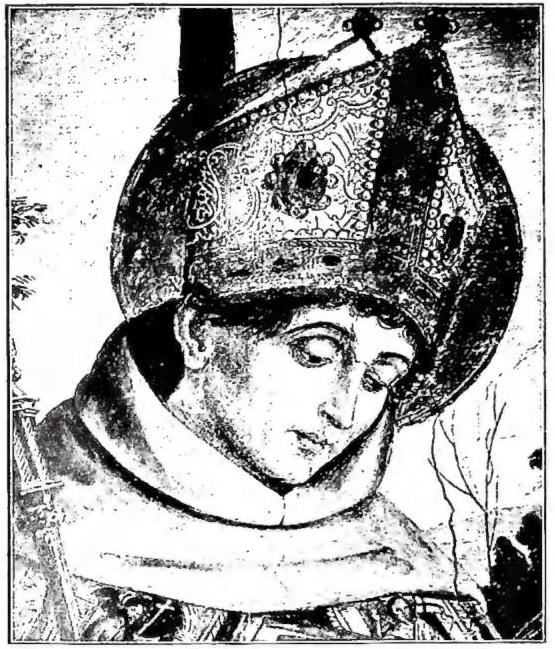
(Int. Anderson)
For the decoration of these rooms as well, where he illustrates the Mistori della Fede, Storie di Santi, the Arti liberali, the Sibille, Profeti and Apostoli, he resorted to the collaboration of other artists; but his imprint dominates everywhere. The manner of narration is always calm and somewhat detached, while the expressive means become richer and more sumptuous in the decoration, where the use of gilded pastiglia is very extensive, and the colours are vivid and vividly juxtaposed. With regard to these works, he has been accused of a lack of depth of feeling and structural solidity. The accusation is unjust, since none of this is necessary to his art, as it does not answer to one of its requirements; proof of this is the force he succeeds in imparting to the frescoes of the Baglioni Chapel in S. Maria Maggiore at Spello (1500–1501), using his habitual language precisely because it corresponds to his true personality. He appears less convincing in the Piccolomini Library in the cathedral of Siena (1505–1508), in his narration of the Fatti della vita di Pio II, with the usual richness, but in a distracted and rather superficial manner, attributable only in part to the presence of collaborators; whereas his finest qualities are evident in the earlier (1504) execution of the Chapel of S. Giovanni Evangelista, also in the Duomo.
He experienced another felicitous moment in 1508, when he frescoed the vaults of the presbytery of S. Maria del Popolo with balanced and effortless elegance. In addition to these works, he executed various paintings preserved in galleries in Perugia, Valencia, Dresden, London, Florence, the Vatican, etc., as well as in churches; there is also evidence of a miniature-painting activity of his, an example of which may be the illuminated missal page with a Crocifissione in the Vatican Library, attributed instead to Perugino by some scholars. – Vedi tav. Cl.