BAGLIONI. – A Perugian family that rose to power at the end of the 14th century, particularly after Malatesta restored Perugia to papal rule following the death of Braccio Fortebracci. It was Braccio B. who consolidated the family’s greatness in the second half of the 15th century. Upon his death in 1479, his brother Guido forcibly expelled the rival Oddi family from Perugia in 1488; Innocent VIII’s efforts to quell these factional strife proved futile. In the massacre of 15 July 1500, in which Guido was killed along with his son Astorre and other family members by conspirators Grifonetto B. and Carlo Barciglia B., allied with the opposing faction, Guido’s nephew Gian Paolo, son of Rodolfo, survived. After defeating the Oddi and other exiles in May 1501, Gian Paolo entered the service of Alexander VI and his son Cesare Borgia. Skillfully navigating the turbulent politics of the early 16th century, he managed to maintain his family’s covert lordship for several years. However, accused before Leo X of grave crimes and suspected of involvement in the cardinals’ conspiracy, he was summoned to Rome on 16 March 1520, imprisoned in Castel Sant’Angelo, and executed on 2 June.
Gian Paolo’s son, Malatesta, re-entered Perugia in January 1522. On 15 January 1530, he was appointed captain-general of the Florentines in their struggle against Clement VII. When resistance to imperial forces proved futile, he negotiated terms in August that, accepted by Florence and Clement VII, saved the city from ruin. Malatesta, who had secured his own interests, retired to Bettona, where he died on 24 December 1531.

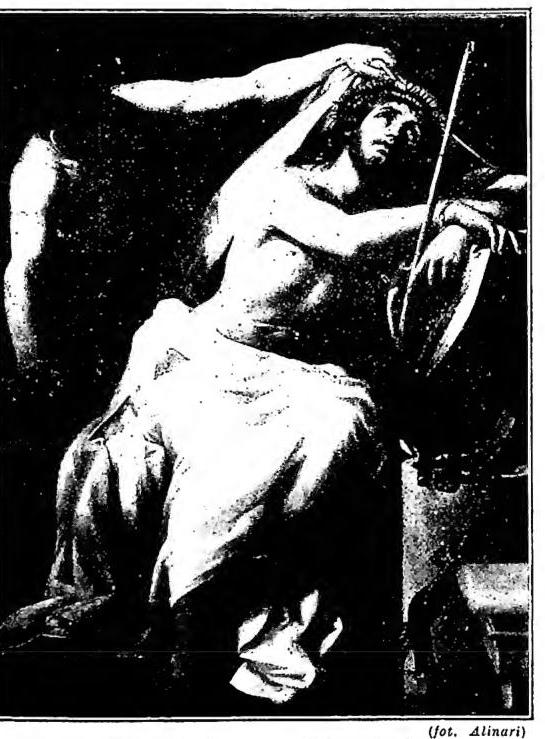
Baglione, Giovanni – *Christ Mocked*.
Sacred work in the Museo Federico (Berlin), the *St Sebastian* from S. Maria dell’Orto, the *Death of St Francis with an Angel* (formerly in the Borghese collection), and *Christ Mocked* (Borghese Gallery).
As an art writer, he is chiefly remembered for his *Lives of Painters, Sculptors, and Architects*, covering the period from the pontificate of Gregory XIII in 1572 to that of Urban VIII in 1642 (Rome, 1642). A manuscript copy, annotated by Bellori, is preserved in the Vatican Library and was recently (1936) published in facsimile. The work is divided into five sections, each corresponding to the pontificates of Gregory XIII, Sixtus V, Clement VIII, Paul V, and Urban VIII. Its episodic structure contrasts with the author’s stated intention of continuing Vasari’s *Lives*, whose underlying historical framework he seems to have overlooked. The exposition is concise, almost austere, devoid of rhetoric: brief biographical details and occasional stylistic observations, sometimes penetrating. Caravaggio (v.), he alludes to the debate between naturalists and mannerists and, in addition to Caravaggio’s already extensive biography, includes those of his followers Saraceni and Valentin. He also provides a substantial biography of his principal rival, Cavalier d’Arpino. This work is of primary importance as a source for art history, offering rare, sometimes unpublished, and generally precise information, occasionally extending to foreigners (e.g., Rubens, for whom he provides the earliest biography). Baglioni also authored a small volume, *The Nine Churches of Rome* (1639), which examines the churches most revered in Roman devotion.

Frontispiece of *Lives of Painters*, etc., Rome 1642.
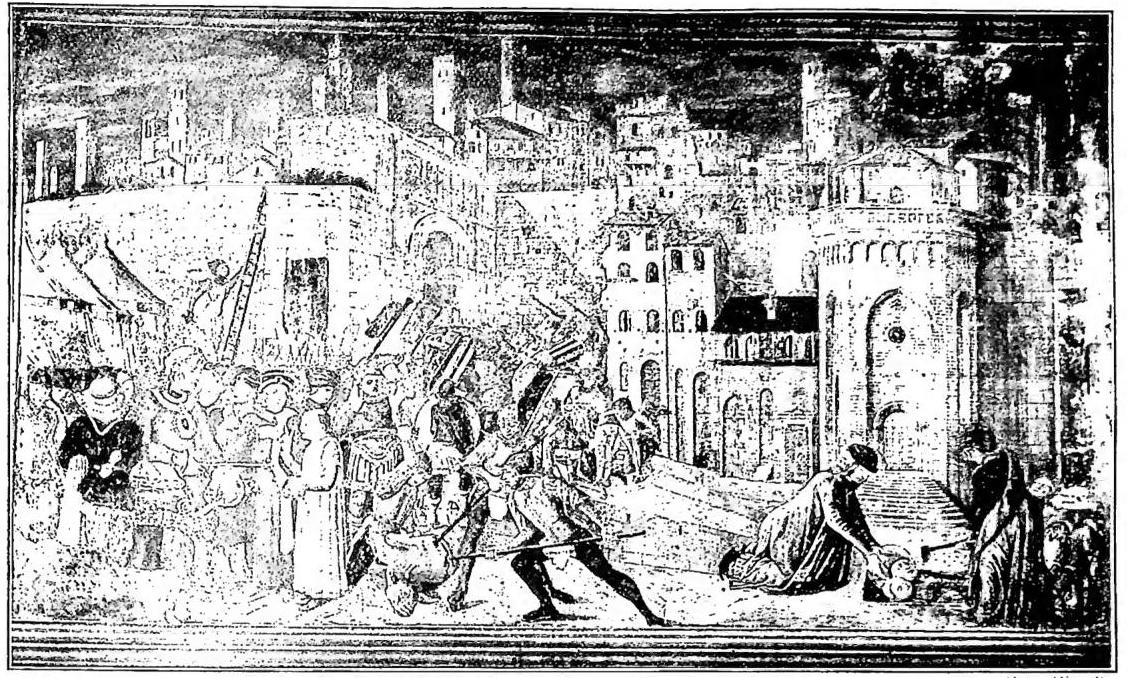
BAGLIONI – The houses of the B. appear on the second level of the fresco by B. Bonfigli in the Palazzo dei Priori (15th century), depicting the Siege of Perugia and the Discovery of the Body of St Herculanus – Perugia.