
BAGLIONE, GIOVANNI. – Painter and writer, b. in Rome ca. 1573 and d. there in 1644. He painted one of the great altars in St Peter’s (ca. 1606); the Pauline Chapel in St Mary Major (1611–12); and, again in St Peter’s, the Gregorian Chapel (1628). He also worked for Mantua and other Italian cities (Savona, Spoleto, Perugia, Naples), and sent works abroad (France, Holland, Spain). He was engaged in a lively conflict with Caravaggio, with whom he had a lawsuit. Nevertheless, he underwent influences from him that strengthened and enlivened his style. Among other works, he is credited with Amore
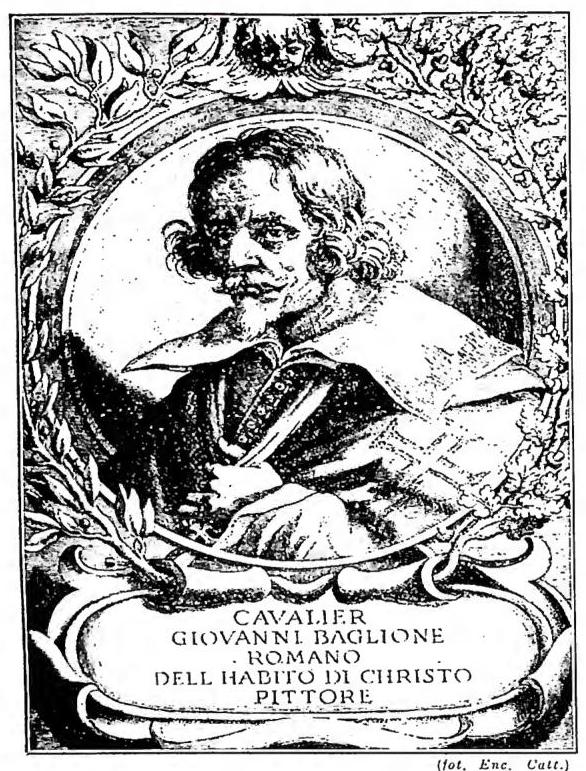
As an art writer, he chiefly entrusted his name to the Vite dei pittori, scultori ed architetti, dal pontificato di Gregorio XIII nel 1572 fino a' tempi di papa Urbano VIII nel 1642 (Rome 1642). A manuscript of this work, with annotations by Bellori, is held in the Vatican Library and was recently (1936) published in facsimile. The actual treatment is divided into five days, in which the artists’ biographies are arranged according to the pontificates of Gregorio XIII, Sisto V, Clemente VIII, Paolo V, and Urbano VIII. The occasional organization of the material is antithetical to the author’s intention of continuing Vasari’s Vite, whose underlying historical structure seems to have eluded him. The exposition is rapid, almost austere, devoid of rhetoric: a few biographical facts and some stylistic assessments, at times penetrating. With regard to Caravaggio (v.), he alludes to the controversy between naturalists and Mannerists and, in addition to his already extensive biography, adds those of his followers Saraceni and Valentin. The biography of his chief adversary, the Cavaliere d'Arpino, is also extensive. This work is of primary importance as a source for artistic history, all the more so because the information it provides is often rare, at times unpublished, almost always precise, and occasionally extended to a foreigner (for example, Rubens, of whom it gives the earliest biography). B. is also responsible for a booklet entitled Le Nove chiese di Roma (1639), in which the churches most dear to the devotion
of pilgrims are considered: among them, S. Pietro, S. Paolo fuori le mura, S. Giovanni in Laterano, and S. Maria Maggiore.