
URBANO VIII, POPE. - Maffeo Vincenzo Barberini, born in Firenze, where he was baptized, on 5 Apr. 1568, died on 29 July 1644. The family, of Marchigian origin, enriched through trade, moved from Ancona first to Val d'Elsa, where it changed the three wasps of its coat of arms into three bees and the original name Tafani into Barberini, from the castle of that name; then, in the 14th cent., it moved to Firenze.
The fifth of the six children of Antonio Barberini and Camilla Barbadori, orphaned of his father at the age of three, he studied with the Jesuits in Firenze, then in Rome with his uncle Francesco Barberini, apostolic protonotary, and subsequently devoted two years to the study of law at Pisa. Referendary of the Segnatura di Giustizia and, under Gregorio XIV, of Grazia, he accompanied (1598) Clemente VII to Ferrara; he was charged with settling a dispute with Venezia over the waters of the Po (1599); then became governor of Fano. In Oct. 1601 he brought the swaddling bands blessed by the Pope for the newborn Dauphin Luigi, son of Enrico IV. Appointed archbishop of Nazareth (Oct. 1604), he was sent as nuncio to Parigi and on 11 Sept. 1606 was created cardinal at the age of 38. In 1607 he held the protectorate of Scotland; then the bishopric of Spoleto, whose cathedral he restored; he was legate of Bologna from Aug. 1611 to 1614. Having returned to Rome, he was appointed prefect of the Segnatura di Giustizia and, when Gregorio XV died on 8 July 1623, after a long Conclave, on 6 Aug. 1623 he was elected pope at the age of 56 through the efforts of card. Maurizio di Savoia, who in the Conclave won over for him the cardinals Borghese and Ludovisi. He was consecrated on 29 Sept.
Prudent by temperament and through experience in affairs, he always distrusted cardinals whom he knew to be attached to sovereigns, and wished to give a personal impetus to the government of the Church. He was extraordinarily lavish toward his relatives in dignities and revenues: his brother Carlo was appointed governor of Borgo and general of the Church; one of Carlo's sons, Francesco, was made cardinal at 26, another son, Antonio, at barely 20; his brother Taddeo, destined to perpetuate the family, received the prefecture of Rome. Yet, being exceedingly jealous of his authority, he gave them no share whatever in the government of the Church. Amid the tangle of conflicting interests of the Catholic powers, U. adopted an impartial and peaceful attitude, and gave proof of it when, after the young son of the aged duke Francesco Maria della Rovere had suddenly died as a result of his excesses, eight days before the death of Gregorio XV, he succeeded in having the rights of the Holy See over the Duchy of Urbino recognized and sent Berlinghiero Gessi as governor.
In the more complex question of the Valtellina, whose fortresses Gregorio XV had received in custody on behalf of France and Spain, U. had Chiavenna added to them, and in two Treaties concluded in Rome on 24 Feb. 1624 obtained protection for the Valtellinese Catholics and, for the Spaniards, passage from Italy to Germany through the valley and Bormio. France, supported by the Protestant Grisons, its allies, demanded that the Valtellina be ceded to II. U. resisted, and when a French army, advancing from the Engadine, occupied Poschiavo and Brusio and compelled the papal troops to evacuate the whole Valtellina, U. demanded the punishment of the marquis of Coeuvres and the restoration of the fortresses, supporting the demand with arms. Yet, in order not to drive matters to extremes, disagreeing with the Spaniards, he sent card. Francesco Barberini in an attempt to mediate between Spain and France, first to Parigi and then to Madrid. The Treaty of Monzon (5 March 1526), concluded between Filippo IV and Luigi XIII when the papal envoy had barely reached Barcellona on the road to Madrid, nevertheless satisfied the Pope, because it restored the fortresses to him, to be destroyed; admitted only Catholic worship in the Valtellina; and freed Italy from the threat of war.
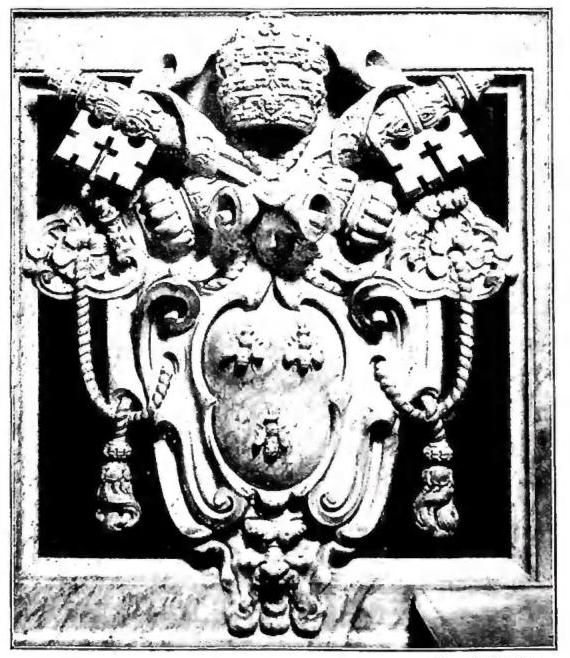
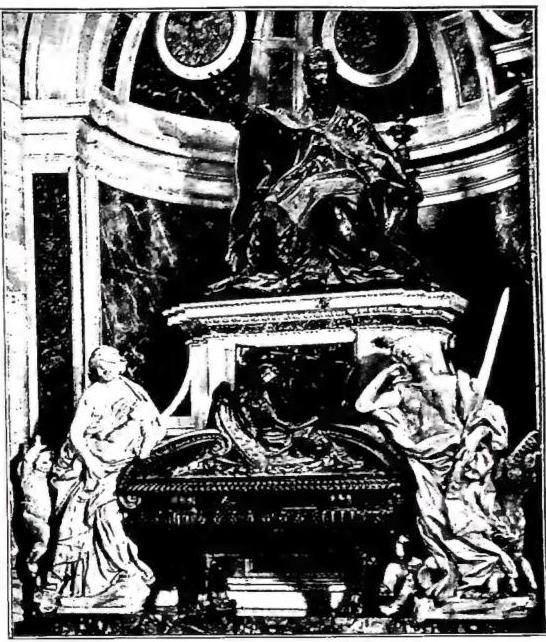
(photo by Alinari) URBANO VIII, PAPA - Monument to U. VIII. Work by Bernini. Basilica of St Peter.
(Photo Camponi)
He worked assiduously for the defense of the Catholic faith, making use of the Congregation of the Inquisition. Among those condemned were some who had plotted against U., and others for sorcery and necromancy. CAMPANELLO (v.) GALILEA (v.), whom U. nevertheless esteemed as a scientist.
U. established (1623) a special Congregation of Cardinals so that the jurisdictions and ecclesiastical immunities regulated by Gregory XV might be respected. It had much work to do, especially in Savoy, where the new nuncio had to draw attention to the heretics of Pinerolo and recover what had been lost; in Lucca, which rebelled against respect for ecclesiastical jurisdiction, Rome imposed an interdict (2 April 1640), from which the city was freed only three years later; and with Venice, where another reason for conflict was added to the others: the claim of precedence between the Venetian ambassador in Rome, Giovanni Pesaro, and the prefect of Rome. With Spain, although a rupture never occurred, being inadvisable for political and religious reasons, there were frequent suspicions, owing to the Catholic King’s caesaropapist pretensions and to the resentment of the Spanish Court over the refusal of the cardinal’s hat to Abbot Francesco Peretti, who was supported by the court; over the insolence of the Spanish nuncio, who, when U. was ill (10 May 1637), was already speaking of a conclave, while the Barberini were hiring three hundred Corsicans to prevent surprises; and also owing to the attempt to paralyze the nuncio’s tribunal and bend U., through flattery and threats, to place the ecclesiastical nunciature under state control. Only after the uprising in Catalonia (July 1640), supported by France and U., and Portugal’s separation from Spain, whose new sovereign, the Duke of Braganza (John IV), declared himself devoted to the Holy See, did Spain reach an agreement (27 April 1641) that preserved the independence of the nunciature and prevented its being placed under state control. In Sicily, the tribunal of the «Sicilian monarchy» (v.) threatened to annihilate every legal jurisdiction and, through the «letters of safeguard», every independence of the bishops. Philip IV removed the Archbishop of Palermo, Cardinal Giovanni Doria, from his post as lieutenant because he had opposed the tribunal of the monarchy and appealed to the Council of Trent.
A. U. is owed the Collegio Urbano of Propaganda fide, with an attached residence for twelve young Easterners, the polyglot printing press, and the new premises. To him are due the establishment of numerous colleges and the dispatch of Franciscan, Dominican, Jesuit, and Augustinian missionaries to India, Siam, the Moluccas, the Philippines, and Japan, as well as that of the Jesuit Antonio D’Andrade to Tibet. Nor did he neglect to strengthen the State militarily; for this purpose he carried out works at Castel S. Angelo, completed the fortifications of Loreto, Ancona, Sinigallia, Pesaro, Rimini, Castello di Orvieto, and Civisevecchia, whose port he restored and enlarged, equipping it with an arsenal. He expanded the arms factory at Tivoli and improved the armament against the Barbary corsairs. Other measures were intended to improve agriculture, especially in the Roman countryside, and to regulate the grain supply. A poet and man of letters of refined sensibility, he wrote poetry, with religious aims (the reform of the Breviary hymns [v.]) and civic aims, in Italian, Latin, and Greek. He was highly deserving of gratitude for the Vatican Library, which he enriched with rare books and manuscripts. In his household he collected whatever rarest and most beautiful objects could be found in statues, paintings, frescoes, cameos, archaeological remains, manuscripts, and incunabula. He also deserves credit for establishing the canonical procedure for beatifications and canonizations (v. CANONIZZAZIONE).
U.’s pontificate coincided with the most flourishing period of the Roman baroque and of the work of Lorenzo Bernini, whom U. knew well. Famous are: the baldachin of S. Pietro, the church of S. Andrea della Valle, U.’s funerary monument, beside whom the statues of Justice and Charity tower; the Trevi Fountain and that of Piazza Barberini; much of Piazza Navona; and finally Palazzo Barberini, in which his genius shone forth. U. worthily continued the patronage of Sisto V, Clemente VIII, and Paolo V. Great artists worked at his invitation and under his favour: besides Bernini, Pietro da Cortona, Andrea Sacchi, Maderno, Domenico Castelli, Vincenzo della Greca, Bartolomeo Braccioli.