
URBANO VII, PAPA. - Giambattista Castagna, born in Rome on Aug. 4, 1521, from a noble Genoese family, related on his mother's side to the Roman families of the Riccis and Jacobazzis.
He studied in Perugia, then in Padua, and obtained his doctorate in Bologna. Card. Girolamo Varallo, his uncle, welcomed him
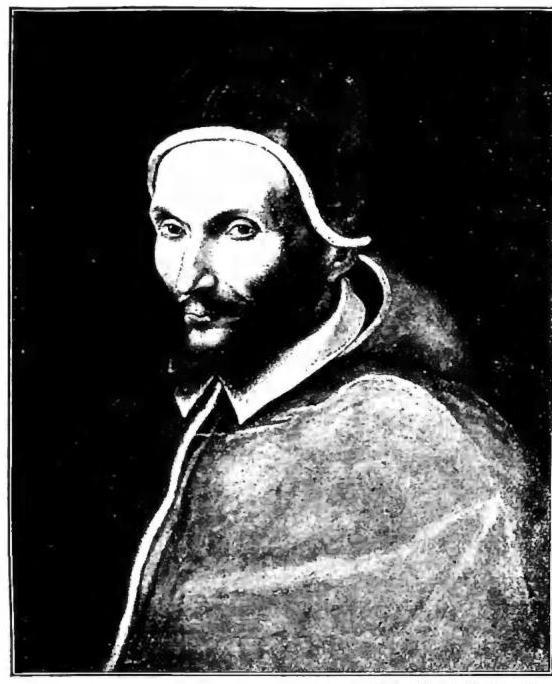
After a brief stay in Rossano, in 1564 he accompanied Card. Boncompagni, papal legate to Spain; Pius V sent him as nuncio to Madrid, where he remained until 1572 and negotiated that Holy League against the Turks which led to the victory of Lepanto. As nuncio to Venice (1573), he prepared the war against the Turks; then he went as governor to Bologna. He subsequently represented the Holy See at the Congress of Cologne for peace with the Netherlands (1578). Having returned to Rome in early 1580, he was appointed consultant to the Inquisition and to the Congregation for the Affairs of the Papal State, until Gregory XIII created him cardinal (Dec. 12, 1583) with the title of S. Marcello al Corso; later he was legate to Bologna, where he remained until the death of that Pope.
Elected pope on Sept. 15, 1590, with the support of the Spaniards, the Florentines, Card. Sforza, and the Genoese cardinals of Sixtus V, with his first measures he soon won over everyone's goodwill. He modeled his government on wise economy, arranged for the wealth of the churches to be directed toward supplying Rome with good and inexpensive bread, and arranged for the oppressive taxes introduced by Sixtus V to be abolished. He commissioned four cardinals to reform the Dataria. He declared that his numerous relatives should be treated after the poor and the servants of the pope. As soon as he was elected, he issued measures to have the dome of St. Peter's completed.
Struck by a bout of malaria on the first night after his election, bled and weakened, he died on Sept. 27, 1590, at 69 years of age, after barely 12 days of papacy. His entire paternal estate (30,000 scudi) was bequeathed to the Confraternity of the Annunziata in S. Maria sopra Minerva, to provide dowries for needy girls. His mortal remains were transferred on Sept. 21, 1606, to the church of S. Maria sopra Minerva, where a fine statue by Ambrogio Bonvicino commemorates him.