PAUL IV, POPE. – The election to the papacy of Cardinal Marcello Cervini (Marcellus II), which took place on 10 April 1555, was like an opening made in favour of the Catholic Reformation. The fact, moreover, that after his death he was succeeded on 23 May 1555, through the intervention of Cardinal Alessandro Farnese, not by Ippolito d’Este, but by the dean cardinal Giampietro Carafa, demonstrated that the idea of Catholic reform could no longer be restrained.
Carafa, born at Capriglio on 28 June 1476 from the Neapolitan branch of the Carafa barons, rapidly ascended the ladder of ecclesiastical dignities as the nephew of Cardinal Oliviero Carafa; in 1505 he obtained the bishopric of Chieti, where he zealously promoted reform; in 1513 he was sent as nuncio to England; in 1515 to Spain; and in 1518 he was elected archbishop of Brindisi. Already at this period of his life he combined a severely ascetic manner of life with a humanistic formation, which was also acknowledged by Erasmus. His sojourn in Spain acquainted him with the efforts being made there for reform, but it also intensified in him the aversion, rooted in family tradition, against Spanish domination in Italy.
After his return to Rome, Carafa joined the Oratory of Divine Love, devoted himself to works of charity and to the reform of his two dioceses of Brindisi and Chieti. Chosen by Adrian VI as a collaborator in the projected universal reform of the Church, after the Pope’s death he decided to resign his bishoprics and, together with St Cajetan of Thiene, founded the Order of Theatines, of which he became the first superior. In this Order the fundamental principles of Catholic reform were put into practice: to set a living example for others in priestly conduct and apostolic activity. Driven from the city by the Sack of Rome, Carafa spent most of the following years in Venice, from where in 1532 he sent to Pope Clement VII a memorandum on the reform of the Church and the struggle against the penetration of heresy into Italy (the best edition in Concilium Tridentinum, XII, pp. 67-77).
Created cardinal by Paul III on 22 December 1536, Carafa was a member of the commission which in 1537 produced the famous *Consilium de emendanda Ecclesia* and, as commissioner together with Cardinal Contarini (1539-40), worked for the reform of the Penitentiary. From the beginning he was a member of the Roman Inquisition and over the years became its true guiding spirit. Assigned the archbishopric of Naples on 29 February 1549, he was long unable to take possession of it because of opposition from Charles V. From 1553 he was dean of the Sacred College.
Carafa, although at the time of his election he was already 79 years old, still burned with zeal for reform, of which his earlier life seemed a foretaste. But the intense expectations of the friends of reform soon turned to disillusionment, for the Pope, in his deep aversion to the Spanish, allowed himself to be ensnared by his unworthy and scheming nephew, Carlo Carafa, in a disastrous war against Spanish preponderance, concluding an alliance with France for this purpose. However, the irruption of the Duke of Alba into the Papal States forced him to the Peace of Cave (12 September 1557), and thus the attempt to overturn Spanish predominance in Italy came to nothing.
From that moment the Pope concentrated his efforts on the reform of the Church. Even before the outbreak of the Spanish war, in 1556, he had established a special Congregation which was to serve as a substitute for the Council of Trent, not yet concluded but only suspended, and intended to expand it into a Roman Council by summoning foreign prelates. But this plan was not carried out; and after the Peace of Cave the Pope, with even greater urgency because of the delay, devoted himself to the Roman Inquisition, whose competences he greatly enlarged and at whose head he placed Michele Ghisleri, the future Pope Pius V. In his zeal for maintaining orthodoxy he went so far as to imprison in Castel Sant’Angelo, on mere suspicion of heresy, Cardinal Morone, and to remove from the office of papal legate in England Cardinal Pole. The *Index librorum prohibitorum*, which he published at the beginning of 1559 (cf. H. Reusch, *Die Indices librorum prohibitorum des XVI. Jahrhunderts*, Tübingen 1886, pp. 176 ff.), proved impossible to enforce, since, for example, it prohibited all editions of the Bible and of the Fathers published by Protestant printers, so much so that St Peter Canisius admitted that “qui maxime catholici videbantur, severum iudicium improbare audent.” Even the draconian severity used against apostate or wandering monks outside their convents (3 August 1558) failed of its purpose. The attempt to force the Society of Jesus to introduce changes into its Constitutions, and especially into the recitation of the Office in choir, came to nothing only because of the Pope’s death.
The pontificate of Paul IV did not bring to the Church the universally expected reform; nevertheless it created the essential precondition: the energy of Pope Carafa completely transformed the appearance of the city of Rome and of the Roman Curia. He showed great conscientiousness in the selection of new cardinals, among whom shone strong figures of ecclesiastics such as Ghisleri, Scotti, Reumanus, and Alfonso Carafa. When the Pope learned from the Theatine Girolamo the truth about the unworthy life and corruption of his nephew, Cardinal Carlo Carafa, and of the Duke of Paliano, he banished both from Rome in January 1559. He renounced the proceeds of the Dataria, though this caused a notable loss to his income; he forbade cardinals to procure reversions to benefices, because by this indirect route the canonical laws on the “cumulatio beneficiorum” were violated. With a decree of 6 March 1559 he obliged all bishops present in Rome who held no curial office to return to their dioceses and reside there. At his instigation Cardinals Scotti, the Theatine Girolamo Seripando, and Sirleto began the reform of the Roman Missal and Breviary. Through numerous other decrees he restored to Rome the dignity of worship and public morality. The erection of 14 new bishoprics in the Netherlands on 12 May 1559 gave firmer consistency to Catholicism, seriously threatened in those regions.
The later Tridentine reform cannot be conceived without the severe and energetic spirit of Pope Carafa. But precisely this severity and the contrasting conduct of his nephews were the cause that, after his death on 18 August 1559, disturbances broke out in Rome, the Palace of the Inquisition was stormed, the statue of the Pope erected on the Capitol was damaged, and then thrown into the Tiber.
No pope of the 16th century has left so vivid a description of his character as that which Paul IV received from the Venetian ambassador, Bernardo Navagero, in 1558 after his return to Venice (cf. E. Alberi, *Relazioni degli ambasciatori veneti*, 2nd series, III, Florence 1848, pp. 379 ff.). His volcanic temperament and his inability to maintain the proper measure not only often deprived his ecclesiastical measures of efficacy but also led to a dangerous political isolation of the papacy. This remains

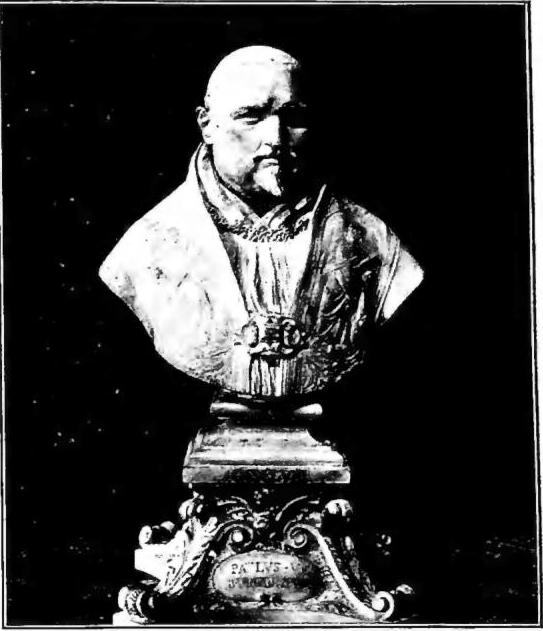
PAUL V, POPE – Bust of Paul V, work by Gian Lorenzo Bernini – Rome, Galleria Borghese.
Born in Siena, a graduate in jurisprudence, he held important offices in the Roman Curia, became a cardinal in 1596, vicar of Rome in 1603, and was elected pope on 16 May 1605 through an agreement among the factions. Noted for his piety, honesty, gentleness, generosity, love of justice, and tireless activity, he was not without a measure of “petty nepotism”: to his nephew Scipione Caffarelli Borghese he gave his surname, the purple (1605), numerous offices and benefices, and appointed him Secretary of State while reserving to himself the handling of important affairs; to other relatives he distributed positions and wealth. Deeply concerned with the interests of the State, he confirmed (30 Dec. 1605) the prohibition against the dismemberment of the papal dominions; extended the powers of a Commission for good government; ensured public tranquility; reformed the judiciary (10 Mar. 1612), improving the administration of justice and providing especially for the poor and prisoners; attended to the supply of provisions, roads, sanitation, and building in Rome; promoted agriculture and commerce, for which he built a port at Fano. He did not, however, succeed—or perhaps did not wish—to prevent the gradual elimination of laymen from the bureaucracy, nor did he undertake a thorough reform of the financial administration, instead relying too heavily on borrowing.
He devoted every effort to preserving peace in Europe and especially in Italy. He maintained neutrality between France and Spain, seeking to bring them closer together even through marital alliances; he opposed the expansionist designs of Henry IV of France and Charles Emmanuel of Savoy; he championed peace between Venice and Austria in the Uskok War; and he refused to take sides in the Valtellina War, despite its ostensibly religious pretext.
He avoided pronouncing on theological questions, such as those concerning the Molinist doctrine of grace and the Immaculate Conception of Mary, and imposed silence and respect for opposing opinions on the disputants. Under his pontificate, the Copernican system was condemned in 1616 (v. GALLIA, 1617), and in 1622 Cremonini’s De coelo was placed on the Index.
Of those rights which he considered inalienable to the Catholic faith and the Church, Paul V declared himself ready to defend them even to the shedding of blood. The conflict with Venice remains memorable, arising from two restrictive laws on ecclesiastical property enacted by the Republic before Paul V’s accession, and from the violation of the privilege of the ecclesiastical forum by the arrest and citation before the Council of Ten of two members of the clergy. The Pope condemned these measures and threatened censures (10 Dec. 1605). The Signoria intensified its opposition to the privileges of the Church, and on 17 Apr. 1606, in a consistory, Paul V decreed excommunication against the Senate and interdict over the entire territory. This was followed by a violent protest from the Doge and a bitter struggle against what Venice regarded as unwarranted pretensions of the Church and affronts to the rights of the State. The conflict was waged both with the pen—skillfully wielded by jurists and theologians, especially the Servite theologian to the Republic, ARPI (v.)—who fiercely assailed what he deemed abuses of papal power—and with police measures: orders not to recognize the excommunication or respect the interdict, banishment or severe penalties for disobedience. The submission of much of the clergy and people to the will of the Signoria was a bitter disappointment to Paul V. The danger seemed near that Venice might unite with the Protestants; the entanglement of political interests in the religious dispute raised fears of a European conflagration. Through the mediation of France, supported by Spain, an agreement was reached, and the Pope granted absolution from the censures (21 Apr. 1607); some satisfaction was given by the release of the two ecclesiastics, the suspension of the laws, and the revocation of measures against those who obeyed the interdict, but the jurisdictional question remained unresolved, and the Jesuits were excluded from Venice for another fifty years. While Venice did not obtain the hoped-for support from the powers against the Papacy, neither did the authority of the Papacy gain any advantage from the affair.
In the rest of Europe, too, the Pope sought to preserve for the Church the positions it held and to recover those it had lost; but, averse to armed conflict, he generally proceeded with a prudence that some deemed excessive at the time and which did not always yield happy results. In the dispute over the succession to the Duchy of Jülich-Cleves, though he strove to prevent it from falling into Protestant hands, he wished to avoid war. In the Empire, he sought to secure the succession for the House of Austria and especially for the fervently Catholic Ferdinand II, and to prevent dangerous concessions to the Protestants; yet he tolerated the maintenance of the Religious Peace of Augsburg of 1555, and only when war became inevitable did he proclaim a jubilee to implore God’s aid against the enemies of the true faith (1620), grant tithes and subsidies to the Emperor and the Catholic League, and work toward the formation of a league of Catholic powers. In France, he opposed the advances of the Huguenots; and he could regard as a victory for the Papacy the removal from the rectorship of the Sorbonne of Edmond Richer, an opponent of papal authority, the withdrawal of a decree by the Parliament of Paris denying the Pope the right to excommunicate and depose a king who had become a heretic, and the suppression in the cahiers of the States-General of 1614 of a proposal by the Parisian delegation of the Third Estate that it be declared by law that the king held his crown from God and was entirely independent of any foreign spiritual or temporal power; yet he had to be content with the decrees of Trent being published only by the clergy, not by the civil authority. In England, his prohibition to Catholics against rising against James I did not prevent the king from using the participation of some of them in the famous Gunpowder Plot (5 Nov. 1605) as a pretext to implicate their coreligionists and the Pope himself and to impose on Catholics an oath of allegiance, which Paul V condemned in a brief (22 Sept. 1606) as contrary to faith and the salvation of souls; despite the Pope’s efforts, the position of Catholicism in the British Isles, as in nearby Holland, remained very difficult. In Russia, the hopes Paul V placed in the adventurer Demetrius for adhesion to the Church of Rome proved illusory and provoked even fiercer hostility toward the Latins. Nor did his concession to the Ruthenians allowing them to retain their rite succeed in overcoming the violent opposition of the schismatics to union with Rome.
But P.’s industry in the religious sphere manifested itself above all in promoting the implementation of the Catholic Reformation. He set before the clergy and the faithful the examples of canonized figures such as Charles Borromeo and Francesca Romana; he proclaimed beatified, among others, Thomas of Villanova, Paschal Baylon, Ignatius of Loyola, Francis Xavier, Philip Neri, and Teresa of Jesus. He renewed (19 Oct 1605) the obligation of episcopal residence, admitting no exceptions. He reformed religious orders; he raised the Fatebenefratelli of John of God and the Camillians to the rank of orders, and the Capuchins and the Scolopi to that of autonomous congregations; he granted new approval to the statutes of the Society of Jesus and gave it extensive support. He imparted regularity and majesty to sacred rites by publishing and imposing the Roman Ritual (20 June 1614); he ensured better preservation of the documents of the Holy See by gathering them into a Secret Archive; at his instigation Bellarmine composed the catechism for the young. The effect of his work was considerable, even if not entirely in accord with his wishes. He reformed religious life in Rome and in many Catholic countries: in France, of particular importance were the foundation (1618) of the new Benedictine Congregation of St Maur, to which belonged those Maurists who left such a deep mark also in the field of scholarship, the spread of the Ursulines, and the foundation of the Order of the Visitation.
P. gave the broadest support to missionary activity: evidence of his broad-mindedness in this field is the concession he made to the Chinese to use their own language in the breviary, in the liturgy, and in the administration of the sacraments. For the missions of the Discalced Carmelites, P. founded in Rome a seminary and a higher school. During his pontificate the Catholic hierarchy in America was reorganized and the first Jesuit reductions arose in Paraguay.
P.’s vast patronage was directed especially towards the field of art. While what remained of the ancient basilica of St Peter, threatened with collapse, was being demolished and most of its precious monuments and relics were being gathered in the Grottoes, the structure designed by Maderno transformed Michelangelo’s Greek-cross plan into the present, much larger, Latin-cross basilica; the vaulting of the naves was completed, the dome decorated, and the Confession opened; the atrium and façade were erected, on which the name of Paul V Borghese stands out. At S. Maria Maggiore P. had built and adorned with frescoes by Reni and other celebrated painters the chapel that bears the name of his family and contains his tomb; before the basilica he erected the column taken from the basilica of Maxentius, surmounted by a statue of the Virgin. In the Vatican were erected the Pauline Chapel and that of the Most Holy Annunciation, the Library was enlarged and embellished, fountains opened, and the bronze door installed; in the Quirinal Palace, the Pope’s summer residence, among other works the Chapel and the main door were executed. The Trajan aqueduct, restored and renamed “Acqua Paola,” supplied water to the monumental fountain on the Janiculum, to the other one near Ponte Sisto, and to Maderno’s fountain in St Peter’s Square. In the Campus Martius P. acquired and enlarged a palace, while another palace, now the Rospigliosi, near St Peter’s, and the Villa Borghese were built through the agency of his cardinal-nephew.
Not marked by sensational events, the pontificate of Paul V nonetheless left deep traces in the life of the Church and in the creation of papal Rome.