Also known as:
Italian: Ferdinando I d'Aragona, Ferrante d'Aragona
FERDINAND (Ferrante) I of Aragon, King of Naples. - Born in Catalonia in 1431, died in Naples on 25 Jan. 1494. Illegitimate son of Alfonso the Magnanimous, he was designated by the latter as heir to the throne in 1443. As duke of Calabria he took part in the war against Florence in 1452. In 1458 he succeeded his father, and was recognized the following year by Pius II. He immediately had to face the pretender John of Anjou, supported by rebellious barons. Defeated at Sarno in 1460, he managed to win the decisive victory of Troia in 1462.
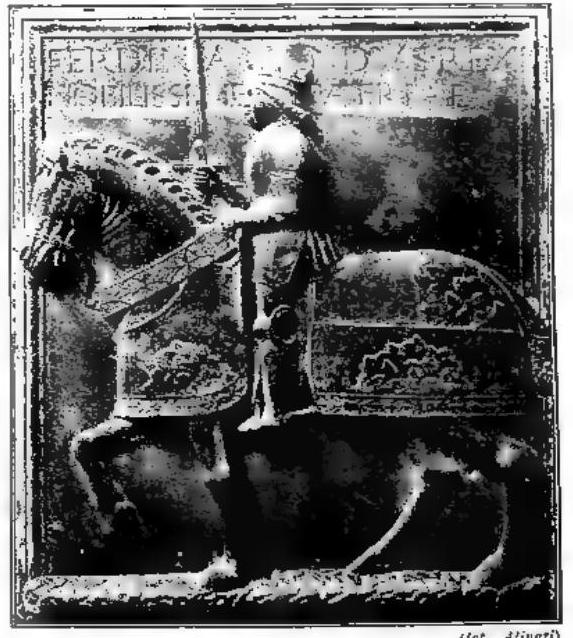
FERDINANDO (Ferrante) I of Aragon, king of NAPLES - Bas-relief in the Museum of S. Martino - Naples.
An ally of Sixtus IV in the war against Florence that followed the Pazzi conspiracy, the visit of Lorenzo de' Medici induced him, against the will of the Pope, to make peace. In the war of Ferrara he took the field against Venice, alongside the Holy See. In 1485 the barons, aided by Innocent VIII, rebelled once again. With the help of Florence and Milan, F. succeeded in defeating the papal army, and the Pope had to sign the peace. The barons surrendered, and after the surrender many of them were executed or imprisoned for life. Against the accusation of having violated his faith F. defended himself by maintaining that they had continued to conspire. F. had a reputation for cruelty, but it must be considered that the overbearing power of the baronage was the greatest obstacle not only to the consolidation of the monarchy, but also to the civil and economic progress of the Kingdom. F. protected men of letters and artists, and unlike his father he wished to be, in every respect, an Italian prince.
Bibliography3 worksRegis Ferdinandi I Instructionum liber, with historical and biographical notes edited by L. Volpicella, Naples 1916; E. Pontieri, Per la sto
BIBL.: Regis Ferdinandi I Instructionum liber, with historical and biographical notes edited by L. Volpicella, Naples 1916; E. Pontieri, Per la storia del Regno di Ferrante I d'Aragona re di Napoli, ibid. 1947; C. de Frede, Un memoriale di Ferrante I d'Aragona a Luigi XI (1748), in Rivista storica italiana, 60 (1048), pp. 403-410.
Palmarocchi, Roberto. “Ferdinando (Ferrante) I di Aragona, re di napoli.” In Enciclopedia Cattolica, vol. V, coll. 1166–1167. Città del Vaticano: Ente per l’Enciclopedia Cattolica e per il Libro Cattolico, 1950. https://azioneromana.com/article/ferdinando-ferrante-i-di-aragona-re-di-napoli.
MLA
Palmarocchi, Roberto. “Ferdinando (Ferrante) I di Aragona, re di napoli.” Enciclopedia Cattolica, vol. V, Ente per l’Enciclopedia Cattolica e per il Libro Cattolico, 1950, coll. 1166–1167. Azione Romana, https://azioneromana.com/article/ferdinando-ferrante-i-di-aragona-re-di-napoli.
BibTeX
@incollection{ec5_ferdinando_ferrante_i_di_arago,
  author    = {Palmarocchi, Roberto},
  title     = {Ferdinando (Ferrante) I di Aragona, re di napoli},
  booktitle = {Enciclopedia Cattolica},
  volume    = {V},
  pages     = {1166--1167},
  note      = {Cited by column},
  publisher = {Ente per l’Enciclopedia Cattolica e per il Libro Cattolico},
  address   = {Città del Vaticano},
  year      = {1950},
  url       = {https://azioneromana.com/article/ferdinando-ferrante-i-di-aragona-re-di-napoli}
}
One of some 20,000 entries brought back from the twelve printed volumes (1948–54). Spotted something? Help us improve it.
Click or scroll to zoom · drag to pan · Esc to close