
TROIA, diocese of. — City and diocese in the province of Foggia. It has a population of 31,004 inhabitants, almost all Catholic, distributed among 10 parishes served by 41 diocesan priests and 9 religious priests; it has a seminary, 2 male and 6 female religious communities (Ann. Pont. 1953, p. 433). It is immediately subject to the Holy See.
The city of T. originated from a group of refugees from ancient Ecana who escaped the destruction of 662 (under Constans II, emperor of the East). The Byzantines enlarged and fortified the settlement in 1019, making it a bulwark on the border of Apulia against the aggressive Lombard Duchy of Benevento. The emperor St. II (v.) in his anti-Byzantine campaign accepted its surrender after several months of siege (1022), and among the terms of the capitulation imposed the city’s transition from the Greek to the Latin rite, thereby removing it from the influence of the East. At the same time, the Pope erected it as a diocese immediately subject to the Holy See (1031; bulls of confirmation by Paschal II in 1100 and Adrian IV in 1156). The ineffectiveness of Byzantine rule meant that the political direction of the city was in fact in the hands of the bishop, assisted by the «noviliores homines», in that characteristic form of organization widespread in Apulia during the early Middle Ages (F. Carabellese [V. BIBLICA.]); it was the only viable organization of those populations during the chaotic Byzantine period and that of the Norman penetration. T., under the energetic leadership of its bishops, tenaciously resisted the ferocity of these new conquerors (the bishop Angelo died on 4 May 1041 while fighting them on the Ofanto) until they made peace with the Pope, from whom Robert Guiscard obtained the investiture of the Duchy of Apulia in 1054. T. then accepted their lordship and became a Norman center in northern Apulia, entering a period of great prosperity and splendor. In 1093 Urban II held a council there, and in the same year construction of the new Cathedral was begun. In 1105, in an undertaking that seems to have imitated the Bari episode of the abduction of the relics of St. Nicholas, the relics of Saints Eleutherius, Pontianus, and Anastasius were transferred from Tivoli to T. Paschal II held other councils in T. (in 1114 and 1116), as did Callistus II (in 1120); at the latter, the Norman barons swore the Truce of God (document in the Chapter Archive, bundle 4, letter A).
When the line of descent from Robert Guiscard died out in 1127, T. opposed Roger of Sicily’s designs on the mainland, reaffirming its freedom under the leadership of Bishop Guglielmo II (inscription on the smaller bronze door of the Cathedral) and engaging in an epic struggle that ended only in 1139. Once peace had been made with the new Kingdom of Sicily, the bishopric of T. increased its political importance still further, eventually seeing its bishop Gualtiero II first become a trusted adviser to King William II and then grand chancellor to Henry VI and Frederick II during the latter’s minority. During his episcopate, Clement III granted the see of T. the privilege of the pallium (1189). At the time of the uprising of the Apulian cities against Frederick II, T., already wounded in its pride by the exclusion of its bishops from the Swabian court, attempted to restore its ancient freedom even against him; but Frederick conquered it (1229) and razed it to the ground. The city recovered only after the definitive collapse of the Swabians (1266–68), without ever regaining its former importance. The personal property of Joanna I of Anjou, and later the comital fief of Pietro of Ivrea and Muzio Attendolo Sforza, it was granted by Charles V the title and privileges of a city, together with financial concessions that gave it considerable splendor during the Spanish domination. The diocese declined toward the middle of the 1600s because of famines and epidemics; it revived at the end of that century through the work of distinguished bishops. In 1854 Pius IX, in view of the growing importance of the city of Foggia, detached it from the diocese of T. and erected it as a diocese sui iuris. Since 1925 the two dioceses, while retaining their distinct jurisdiction, have been united ad personam.
Most probably the cathedral of T. incorporated into its structure a pre-existing «ecclesia S. Mariae» (around 1080), identifiable with the present apsidal arm (except for the lions’ window), an imposing example of a singular, austere, and powerful art. Clear and harmonious in the rhythm of the blind arches that articulate its first level (1093 and c. 1105–20), it breaks forth with a superbly original note in the upper part of the façade, where the customary rose window passes from a simple decorative function to an essential and predominant architectural one. Apulian sculpture marked every stage of its development in the cathedral of T., from the archaic capitals of the apse and the tentative cornices of the right side wall
TROIA, DIOCESE of — Apsidal arm of the Cathedral (11th century). Troia.
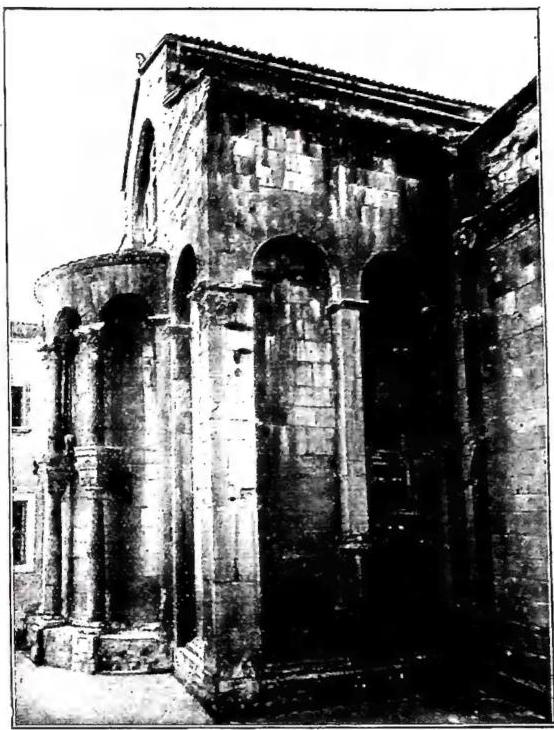
Superstructures that had been badly accumulated over the centuries were removed in a general restoration by the architect Travaglini (undertaken by Bishop T. Passero, in 1856–58); but, according to the standards of the time, the interior was decorated with stucco and paintings, giving it a smooth and embellished appearance in contrast with the original rugged elegance. A rational restoration began with the reinstatement of the visible trussed roofs (1949). Of the two bronze doors (the work of Oderisio da Benevento, dating respectively from 1119 and 1127), the larger is notable for its imposing character, and the second because, work (v.) and inscription, it recalls the culminating episode of Troia’s freedom.
Numerous parchments and several manuscript codices preserve important documents concerning the history of the diocese and of Apulia in the Chapter Archive. Particularly worthy of interest in the Treasury are the three Exultet (v. ROTOLO LITURGICO), richly illuminated (beginning and end of the 11th century, mid-12th century); ivory caskets from the same period; chalices (12th, 13th centuries and later); ancient vessels; enamels; precious vestments (16th century and later); and silver busts and furnishings (Neapolitan school, 17th–18th centuries).
TROFIMO, proto-bishop of ARLES, saint — Facade of the church of St. T. (12th century) — Arles.
(from G. Cromart, L'architecture romane, I, Paris 1988, pl. 1)
The church of S. Basilio (first half of the 11th century) should also be recalled in T., sober and noble in its simplicity; the church of S. Francesco (airy eighteenth-century architecture); the church of S. Giovanni, with a very fine Renaissance altar; the Bishop’s Palace (late 18th century, decorations of 1905); the City Hall (formerly the Marchional Palace, with a beautiful portal and a small collection of stone inscriptions from ancient Ecana). Noteworthy in the diocese of T. are the remains of the ancient abbey of Calatrava at Orsara di Puglie, and the Norman Towers of Castelluccio Val Maggiore and Biccari. - Vedi tav. LVII.