
ARLES. — City of southeastern France, in the department of Bouches-du-Rhône, with a population of approximately 29,000, A. was an archiepiscopal see, suppressed by the Napoleonic Concordat of 1801. Although its origins remain obscure, the existence of a Christian community there is attested as early as the 3rd century. Local tradition, credited since the 4th century, holds that the founder of the see of Arelate was St. Trophimus, presented in the letters of Pope Zosimus as the first bishop of A. and the first apostle of Gaul. Historically attested is Marcian, whose deposition St. Cyprian requested (454), because he was a supporter of the Novatian schism. A favorite residence of Constantine, A. became in 314 the site of a council convened to settle the controversies between Caecilian of Carthage and the Donatists. Under the emperor Constantius, one of the leaders of the Arian party who condemned St. Hilary of Poitiers at the Synod of A. (353) was Saturninus, who a decade later, during the orthodox reaction, was deposed from the episcopate.
Although the importance of the city as a commercial center was considerable, throughout the 4th century A. nevertheless remained a secondary city in the administrative and political sphere. It was only toward the end of the century (about 392), when the prefect of Gaul took refuge there and established the seat of government, that it acquired a political renown it had never previously enjoyed. This perhaps provided the local bishop with the opportunity to claim, in imitation of the civil authorities, prerogatives over the other bishops of the region, against the metropolitan of Vienne. Indeed, at the Council of Turin (401), the question of which of the two sees—Vienne or A.—was to enjoy the rights of an ecclesiastical metropolis was debated, though not resolved.
1. METROPOLIS AND ECCLESIASTICAL PROVINCE
In 417, with the intention of binding the episcopate of Gaul more closely to the Roman See, Pope Zosimus allowed himself to be persuaded by Patroclus, who had succeeded Heros in 412, to raise A. to the status of a metropolitan see, not only of the province of Viennensis, to which the see belonged, but also of Narbonensis I and II. Going further, the Pope made Patroclus a kind of intermediary between the episcopate of Gaul and the Holy See. From then on, no bishop could be admitted before the Pope without testimonial letters from the bishop of A., and all ecclesiastical affairs of Gaul had to be referred to him. This accumulation of privileges made him, in addition to being a metropolitan, a papal vicar.The primacy declined shortly afterward, because Zosimus’s successor, St. Boniface, took a different course, followed by his successors. In 445, St. Leo the Great, insisting on the personal character of the privileges granted to Patroclus, judged them by then to be an abuse and stripped Bishop St. Hilary of all jurisdiction not only over the neighboring provinces but also over Viennensis itself. Shortly afterward (450), when Ravennius was bishop, the Pope received an address signed by 19 bishops of Gaul in favor of the metropolitan privileges of A. as they had been defined by Pope Zosimus. St. Leo replied by setting forth the complaints of the bishop of Vienne and deciding that the whole of Viennensis should be divided into two metropolitan sees: Vienne and A. To the former were assigned as suffragans Valence, Geneva, Grenoble, and Tarentaise. To the latter: Marseille, Toulon, Orange, Saint-Paul-Trois-Châteaux, Avignon, Aix, Vaison, Cavaillon, and Carpentras. The primacy of A. ceased to attract attention when the Visigothic invasions compelled the great Roman administrations to transfer to Italy. They returned there after the fall of the Visigothic kingdom (507). Pope Symmachus once again sought to restore the fortunes of the primacy by appointing St. Caesarius (v.) his representative in Gaul and Spain (514). At the death of Caesarius (542), Gaul, except for Septimania, was entirely Frankish, and A. recognized the authority of King Childebert. Every link was practically
severed between it and Spain, including Narbonensis I, and the successors of St. Caesarius—Ausanius, Aurelian, and Sapaudus—although recognized by Rome as vicars, no longer possessed any effective power. Under Frankish rule, the archbishops of A. appeared in the national councils as ordinary metropolitans, and by the end of the 6th century the vicariate was no longer at issue. With the rise of the Merovingians, the primacy passed to Lyon. The metropolitan jurisdiction, however, continued to be the subject of discussion, and at the Council of Frankfurt (794) the decision of 450 was confirmed, assigning 9 suffragan sees to A. and 4 to Vienne. In 828, with the elevation of Aix to metropolitan status, A. was left with 8 suffragan sees; this situation remained unchanged until 1475, when Avignon was made a metropolitan see, with Vaison, Cavaillon, and Carpentras as suffragans.
2. ARCHBISHOPRIC
The successor of Patroclus, who was killed in 426, was St. Honoratus (d. 429), founder of the celebrated abbey of Lérins, where some of his successors in the episcopate were formed: St. Hilary (429–49), St. Caesarius (502–42), and St. Aurelian (546–51); the last two were zealous promoters of the religious life introduced by St. Honoratus and founders of monasteries with a stable rule. Lérins played a notable role during the 5th and 6th centuries in the development of parish life in the territory of Arles; this was later hindered by the political events that, under Frankish rule, led to the dismemberment of the metropolitan territory, and even more by the disturbances caused in Provence by the Saracen invasions.In the 10th century, the establishment of a new comital dynasty coincided with a local religious revival and the restoration of ecclesiastical discipline, but this was the work of monasticism: especially of Lérins, Saint-Victor of Marseille, and above all the abbey of Montmajour, founded in 974 and destined for great prosperity. As for the bishops, who had become powerful feudal lords, they were victims of the system against which the Gregorian movement would later rise. Their temporal power, asserted during the anarchy of the 9th and 10th centuries, was recognized by the kings of Burgundy through the granting of the rights of regalia, and was consolidated under the emperors of the Salian House. In 1164 Frederick Barbarossa called A. «caput provinciae et principalis sedes imperii», and in 1178 received there the crown of king of Burgundy from Archbishop Raymond. In the first half of the 13th century, A. suffered the effects of the politically and religiously charged disturbances caused by the Albigensian heresy, until in 1251 it fell under the rule of Charles of Anjou, with whom French influence triumphed.
The residence of the Popes in Avignon was not without interventions in the see of Arles. Several of its holders belonged to the papal court, which also intervened in the neighboring bishoprics. After the Western Schism, the activity displayed by the archbishops of A. at the Councils of Constance and Basel was noteworthy; there Cardinal L. ALEMAGNA (v.) supported the election of the antipope Felix V against Eugene IV. Under the influence of the Pragmatic Sanction, the chapter of A. sought to reclaim its right to elect the archbishop; but with the Concordat of 1516 this right passed into the hands of the king of France. The last archbishop was G. M. du Lau, killed during the Revolution (1792) and beatified by Pius XI on 17 October 1926. Under the Concordat of 1801 the see was suppressed, and the archbishop of Aix added those of A. and Embrun to his title.
3. ARCHAEOLOGY
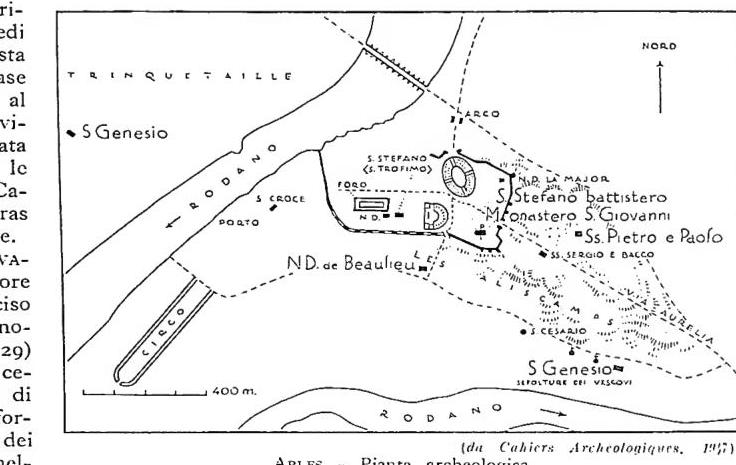
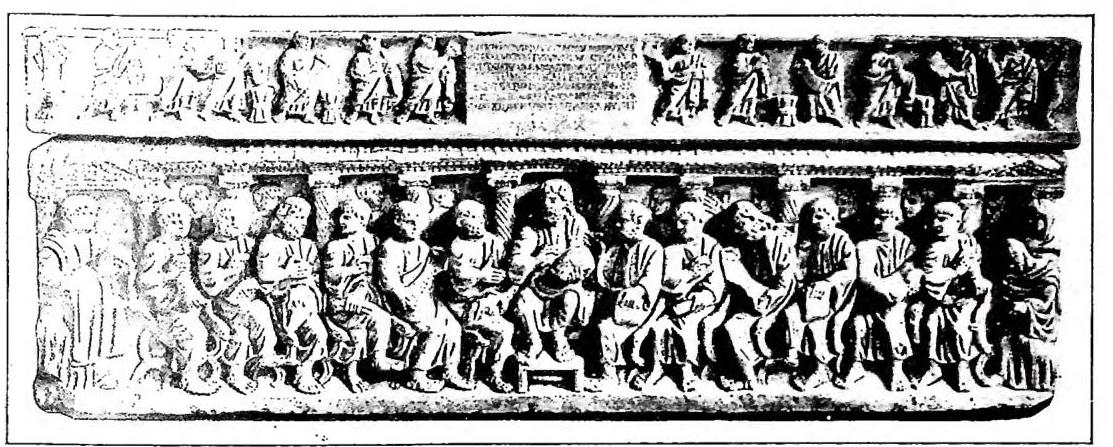
The ancient basilicas of A. — basilica Constantia, beati ac primi martyris Stephani, beati Genesii, etc. — present the archaeologist with difficult problems, on account of their later reconstructions. But the memory of primitive Christianity is more eloquently preserved in the inscriptions and sarcophagi originating from the Christian necropolises and now assembled in a precious collection in the museum of Christian art. Of the two necropolises, that of the Aliscamps and that of Trinquetaille, the former is still a highly evocative site, with its rows of stone sarcophagi and its medieval monuments, among which the church of S. Onorato predominates, built on the remains of the ancient basilica of S. Genesio (existing in the 5th century) and rebuilt several times (6th-7th and 12th-13th centuries).Two other monuments, intra muros, arouse the keenest interest: the church of Notre-Dame-la Majeure, where the Council of 451 was held, but which was rebuilt in the 12th century, and the primatial church of S. Trofimo. This church, originally dedicated to s. Stefano, was built over the remains of a Roman building that is difficult to identify, and was likewise reconstructed between 1152 and 1180. The choir is an addition of the 15th century. Its portal (c. 1175) and its cloister, half Romanesque and half Gothic, are two jewels of medieval art.
Luciano De Bruyne
4. THE COUNCILS OF A
A. is of great importance in the history of the first centuries of the Church, especially on account of the numerous councils held there. The most famous is that of 314. Constantine summoned the bishops of his empire to the Council of A. in Gaul, for 1 August 314. The case of Cecilianus, the new bishop of Carthage, whose election the Donatists contested, had to be dealt with. Various bishops from the provinces of the West were present, and the proceedings opened on the day appointed by the emperor. The number of six hundred bishops said to have been present is exaggerated and must be reduced by several hundred. In the synodal letter sent to Pope Sylvester, thirty-three bishops are mentioned; nevertheless, it may be said that the greater part of Western Christendom was represented there. In the East the Donatist controversy was almost entirely unknown.In the aforementioned letter to Pope Sylvester, the Fathers of the council declared that their joy would have been complete if the Pope had come in person to preside over the sessions. In fact, the Pope was represented by legates, who signed after the bishops. Unfortunately, we do not possess the complete acts of the Synod; we know, however, that the case of Cecilianus was carefully examined there. The Donatists renewed their accusations, but without producing evidence; they were therefore condemned or dismissed.
After the judgment concerning Cecilianus, the Fathers formulated various canons, which they sent to the Pope for confirmation. They concerned the Paschal controversy, the question of the rebaptism of heretics, and certain disciplinary matters.
The best edition of the synod’s twenty-two canons is still that of the Maurists, published in 1789. The first canon establishes that the feast of Easter should be celebrated everywhere on the same day, and that the Pope should, as usual, inform the bishops on this matter. According to Hefele-Leclercq, the primary aim was to ensure uniformity through the sending of letters from Rome, without directly proposing the abolition of the Alexandrian computation. The second canon imposes upon clerics the obligation to remain united to the church for which they were ordained.
In the third canon, excommunication is imposed upon those who lay down their arms in time of peace. How is this canon to be explained? It was intended to make the faithful aware of the obligation of military service: the Church censured deserters. The following two canons considered unworthy of communion with the faithful those who made a profession of entertaining the people with the various spectacles at the circus, in the arenas, at the theatre, and in the stadium.
It may be inferred from the seventh canon that the council was reluctant to admit magistrates in office to the use of the Sacraments. In the new political atmosphere, the Christian magistrate was no longer obliged, as in the past, to abstain from attending church; but the bishop was to extend his pastoral solicitude over him, so that he might not commit injustices.
The eighth canon deals with the rebaptism of heretics. It must be said that the Council of A. places the matter on its proper footing when it declares valid Baptism conferred according to the form prescribed by the Gospel and practised by the Church. No account is taken of the minister’s orthodoxy or morality. The heretics were to be questioned concerning the Creed: had they been baptised according to the Trinitarian formula or not? If not, they were rebaptised; if so, hands were simply laid upon them « ut accipiant Spiritum Sanctum ». This imposition was made ad poenitentiam, or ad confirmationem. The thirteenth canon orders that those who had handed over the Sacred Scriptures or the sacred vessels, or the names of the brethren, be removed from the clergy; nevertheless, ordination performed by the « traitor » bishop remains valid. It is known that, with the edict of 303, Diocletian had decreed the prohibition of Christian assemblies and the destruction of churches, sacred books, and liturgical furnishings.
The fifteenth canon declares abusive the right arrogated by certain deacons to offer the divine sacrifice on the pretext that they had parishes to govern.
Such were the principal canons of the first Council of A. « the most illustrious that had until then been seen in the Church ».
The second Council of A. was held in 443 and is ordinarily designated « Arelatense II », because that of 353 is not counted, being tainted with Arianism.
In 455, Ravennius, bishop of A., presided over an assembly to settle the dispute between the bishop of Fréjus and the abbot of Lérins.
Some years earlier, in 451, a gathering of bishops in A. solemnly approved the Dogmatic Epistle of St. Leo, which was read at the Council of Chalcedon.
The occasion for the Council of 475 was provided by a priest, Lucidus, who maintained certain errors concerning predestination and grace. In agreement with the Fathers, Faustus of Riez undertook to lead the heretic back to the truth and, for this purpose, wrote two works which were themselves infected with semi-Pelagianism.
In 524, under the presidency of St. Caesarius, an important council was celebrated, called « Arelatense III » in some collections. It was convened on the occasion of the consecration of the Basilica of S. Mary and issued four disciplinary canons reflecting ancient ordinances that had been reinstated.
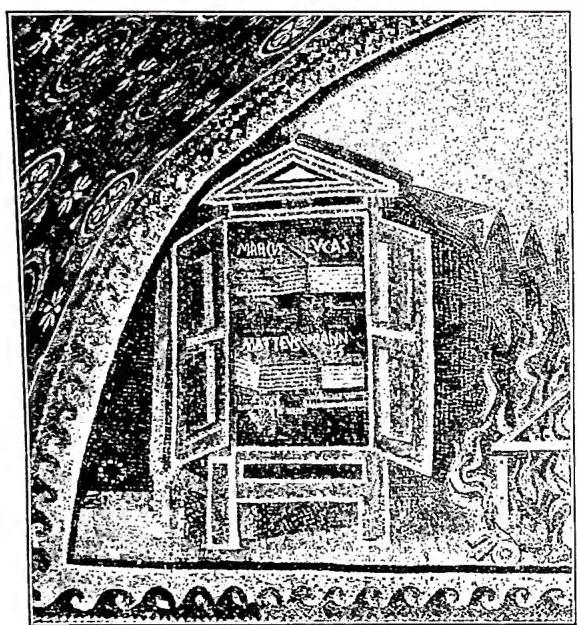
(phot. Anderson) CABINET — A. containing the four Gospels. Detail of the mosaic in the mausoleum of Galla Placidia (5th century) — Ravenna.
In 1211, a synod again met at A. against Raimondo, count of Toulouse, who persisted in ravaging southern France and supporting the heretics. He was ordered to lay down his arms and recall the auxiliary troops. Raimondo would not listen to reason, but the legates declared him an enemy of the Church and promised his possessions to whoever conquered them. Innocent III confirmed the sentence.
The three Synods of 1234, 1236, and 1246 promulgated disciplinary regulations. Among the 24 canons promulgated in 1234 is one obliging Jews to wear distinctive signs on their clothing. The fifteenth prescribes that at every synod and on all Sundays and feast days the usurers, notorious adulterers, fortune-tellers, and those who consult them be excommunicated.
The Synod of 1275, held in the church of S. Trofimo, should be remembered; twenty-two capitula renewing ancient ordinances were published there.
At the Synod of 1303, the Fathers GIOACHINO, SANTO (v.) da Fiore, a Cistercian abbot. To the condemnation of Gioacchino and his followers, the Synod added sixteen canons. - Vedi Tav. CXXXIV.