Machine translation of the 1948–1954 Italian original. The original text is authoritative.
FAUSTO di RIEZ. — Ecclesiastical writer, born in Brittany at the beginning of the 5th century, died after 485. He entered the monastery of Lérins as a young man, and was elected its abbot in 433; he defended its rights against Teodoro, bishop of Fréjus. Before 462 he succeeded Massimo, who had already been his predecessor as abbot of Lérins, in the episcopal see of Riez (Reji, Regium) in Provence, continuing his austere way of life and devoting himself energetically to pastoral care. He was a celebrated preacher even outside his diocese. He was a member of a commission of bishops commissioned by the emperor Nepote to negotiate with Enrico, king of the Visigoths. When the latter seized Narbonese Gaul in 477, F. was condemned to exile, which he spent in a monastery; it seems that he returned after the death of Enrico, which occurred in 485.
His literary activity, about which Gennadio provides fairly abundant information (De viris ill., 85), is connected with the theological controversies of his time—Trinitarian and Christological, and especially the controversy concerning Grace. A book of his, De Spiritu Sancto, transmitted under the name of the Roman deacon Pascasio, demonstrates, beginning from the relevant article of the Creed, the divinity of the Holy Spirit, consubstantial and coeternal with the Father and the Son.
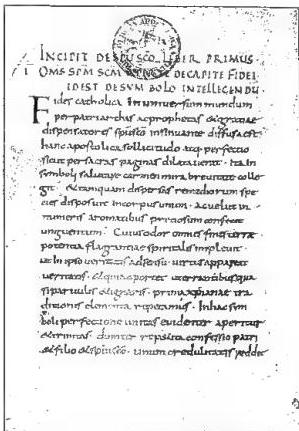
(photograph: Vatican Library) FAUSTO DI RIEZ - Incipit of the treatise De Spiritu Sancto, Vatican Library, cod. Pal. lat. no. 241, f. 2° (10th century).He wrote a brief book, Adversus Arianus et Macedonianus, on the unity of essence of the three divine Persons, probably lost, since the identifications attempted with works that have come down to us have not won the consensus of scholars. In the De gratia, in two books, written at the behest of the Synods of Aries (473) and Lyons (474), he proposes to follow the middle way between the adversaries of Grace and the deniers of free will. In fact, against the Pelagians, he maintains the insufficiency of free will, the immortality conferred upon Adam, and the transmissibility of original sin; but he combats predestination at greater length, saying that it denies the justice of God and renders prayer, penance, and good works useless. He affirms the possibility of faith even without Grace, which is above all external. Thus he decisively takes his stand against s. Agostino, without naming him, accepting the semipelagian theses. The work provoked a strong reaction among Catholics and was refuted by s. Fulgenzio. Ten letters of F. remain: the first and the second are connected with the De Gratia; the third, addressed to an unnamed bishop, seeks to demonstrate that all creatures, including the soul and the angels, are corporeal; the fourth, addressed to Paolino di Bordeaux, responds to various questions of a psychological and soteriological nature; the sixth gives ascetic advice to the young Felice; the seventh, addressed to the deacon Greco, combats Nestorian doctrines; the others, addressed to Ruricio, concern ascetic matters and recommendations. Of the sermons that have come down under the name of F. and have been attributed to him by scholars, it cannot be said how many are authentic. F. writes in an emphatic and prolix style and willingly repeats the same expressions.
BIBL.: Editions: PL 58 (De Gratia, letters, sermons); ibid., 62, 9-40 (De Spiritu Sancto, among the works of Pascavio); CSEL 21; MGH, Anet. Ant., VIII, p. 265 (letters of F. and Ruricio). Studies: A. Engelbrecht, prologues to the CSEL edition; A. Koch, Der hl. Faustus, Bischof von Riez, eine dogmengericht, Monographit, Stocarda 1895; Fr. Werter, Zur Dogmengericht. des Semipela-
cianismus (Kirchengeschichte, Studien, 5, 1), Münster in West, 1890, pp. 45-103; Schanz, IV, pp. 241-47; Bardenhauser, IV, pp. 582-89; Moricea, III, 1, pp. 916-41; P. Godet, s. V. in DThC, V, cols. 2101-2105; J. Tixerant, Hist. des dogmes, III, 8th ed., Parigi 1928, pp. 292-300. Michele Pellegrino
Cite this article
“FAUSTO DI RIEZ.” Enciclopedia Cattolica, vol. V (1950), p. 648. Azione Romana digital edition, https://azioneromana.com/article/fausto-di-riez.